

A school or district buying in this category is not a retail buyer with a different logo, and the difference shows up before any specification is discussed. A retail buyer asks what the product does and what it costs. A school buyer asks what the product does, who is responsible when something goes wrong, what happens to the information a connected device handles, and whether the device can be operated inside a lesson without becoming a distraction — and they ask all four in a procurement process where the answer has to be written down before a contract exists. Our catalogue publishes the product rows for three products in this family and nothing else, so a school buyer's file is assembled almost entirely from documents they obtain, and the purpose of this page is to say which documents, in which order, and which of the questions are the school's own to answer.
Kids smart glasses school requirements: what a district buyer is really buying
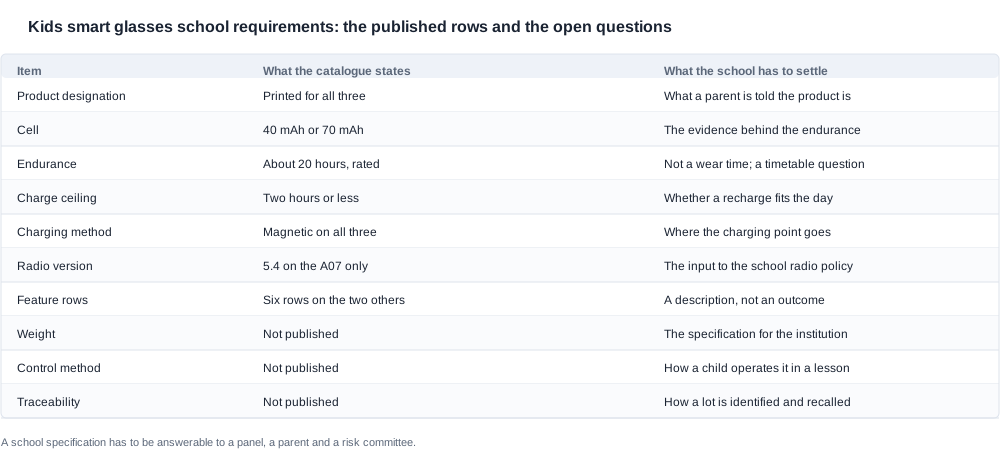
The catalogue position for this family is the same one a retail buyer starts from, and it is worth restating because the school context changes what each row is used for. Two of the three are published as 儿童智能防护眼镜, both carrying a 40 mAh cell, a rating of around twenty hours, charging capped at two hours, a magnetic charging method, no radio-version line, and an identical set of six feature rows. The third is published as a 儿童智能音频眼镜, where a 70 mAh cell is paired with the same endurance rating and the same charging cap, magnetic charging is used, Bluetooth version 5.4 is printed, and no feature rows appear at all. Across the family, no weight, lens material, control method, pairing procedure, ingress marking or per-model conformity record is printed for any of them.
What a school buyer does with those rows is different from what a retail buyer does. A retail buyer uses them to write a listing. A school buyer uses them to write a specification, and a specification has to be answerable to a procurement panel, a parent, an information officer and a risk committee, and it has to survive being handed to each of them in turn without changing. The practical consequence is that the school buyer's evidence requirements are stricter rather than looser, and the first requirement is the one our catalogue cannot meet: there is no product description in our material detailed enough to put in front of a parent without a supplier document behind it.
That is worth saying plainly to a school buyer at the start, because the alternative expectation — that a catalogue page can be the specification — is the most common cause of a stalled institutional procurement in this category. The catalogue row tells a buyer what is fitted and what the electrical envelope is. It does not tell them what the product does in a classroom, what it does with information, or who stands behind it. Each of those has to be documented, and each of them has to be documented per market and per age band, because that is the basis on which a school is being asked to approve the product at all.
The third requirement is the one that is specific to an institution rather than to a category, and it is the consent process. A school cannot simply decide to issue these products; a product that is issued to a child in a classroom has a consent dimension that a retail purchase does not, and the consent process has a document dependency that most suppliers do not think about. Which is why the section below puts the consent process after the data question rather than before it — the consent text cannot be written until the document behind it exists.

Classroom policy, radio devices and the question the catalogue cannot answer
A school that allows wireless devices in a classroom has already made a decision about radio policy, and that decision sits with the school's own information officer or its governing body rather than with a supplier. A buyer therefore cannot answer the policy question for the school, and can only supply the facts the school needs in order to answer it. The facts available from our catalogue are narrow: the A07 publishes a radio version of 5.4, and the A05 and the A06 publish no radio version.
That last point has to be handled carefully, and it is the same point that appears elsewhere in this family's material. Publishing no radio version is not the same as publishing a product with no radio. Our catalogue states that the two protection models carry no radio-version row; it does not state that they make no radio transmission, and a school buyer who is given a file saying "no wireless" without a document behind it is carrying an unsupported statement into a policy decision. The correct sequence is the one a school buyer will already know: the question goes to the supplier, the answer comes back in writing, and the school's policy is written against the answer.
There is a fourth question that a school buyer should ask a supplier before a pilot rather than after one, and it is the question of what happens to a device that is not working. A school is running a programme with a finite number of units and a large number of children, so the operational question is not whether a unit will fail but what the failure path is: whether there is a swap procedure, whether a spare stock is expected, who authorises a replacement, and whether a fault unit is returned to the factory for diagnosis. A supplier that has a documented fault-handling route can support a pilot; a supplier that does not will generate a school-to-supplier conversation every time a unit is faulty, and that conversation is the most expensive thing an institutional programme can accumulate.
The second school-specific question is about interruption, and it is a practical one that a catalogue row cannot address at all. A device that is present in a classroom can be audible, can be visible, can require attention, and can interrupt a lesson. For the audio product the question is about sound and about whether the device can be used in a way that is inaudible to the room; for the two protection products it is about the presence of indicators, and about whether an indicator that a child can act on becomes a distraction rather than a support. What the catalogue publishes on the two protection models is six published feature rows covering the fitted elements and the listed indicators, and it publishes nothing about how loud, how visible, how often or how intrusive any of them are.
The third question is the one a school will ask and a supplier rarely volunteers, which is what happens when the device is switched off, when it is removed, when it is not in a child's hands for a lesson, and whether it can be left on a desk without being worn. A buyer should be able to describe the answer, because a school that cannot describe it cannot write a policy for it. It is also a question that a school may need answered differently for a shared classroom device than for one issued to an individual child, and that difference should be settled before a pilot rather than after one.
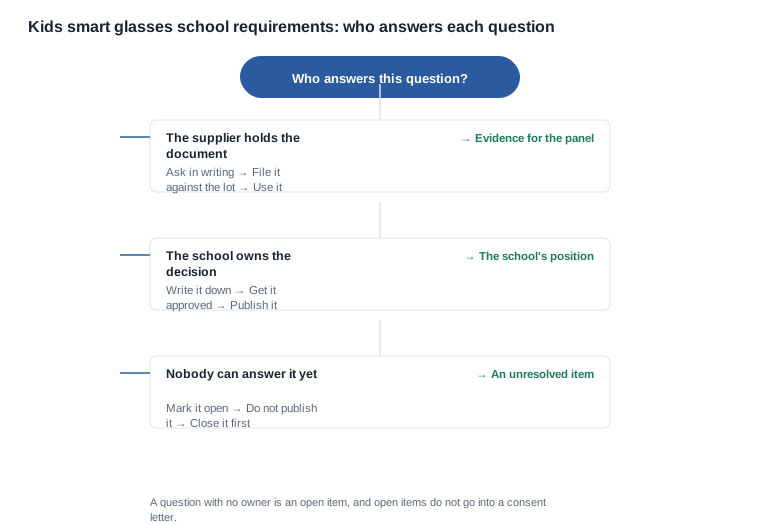
The routing structure above is the practical tool for a school buyer's first meeting with a supplier. The left band is the supplier's, the middle band is the school's, and the right band is the document that settles a question once it is routed. What the structure makes visible is how much of the school-side work is genuinely the school's and cannot be delegated, which is a relief to a school buyer who has been told that a catalogue can answer it.

Wearing duration is a timetable question, not a battery question
The published endurance of around twenty hours is the figure a school buyer is most likely to seize on, and it is the figure most likely to be misunderstood. It is a manufacturer rating for a cell of 40 mAh or 70 mAh, published without a workload definition, a start state or an end criterion, and it says nothing about how long a child would wear the product in a lesson, how long a device would last in a school day, or how a teacher would schedule a session.
The actual wearing-duration question is a timetable question, and it belongs to the school. A school knows the length of a lesson, the length of a break, the length of a day, whether the device is issued for a morning session or a full day, and whether it is shared or personal. Those are inputs the school holds and the supplier does not, and they are the inputs that determine whether a twenty-hour rating is a comfortable margin or a tight one. A buyer who presents the endurance figure as a wear-time figure has answered a question nobody asked and left the one that matters unanswered.
There is a second order to the same question, and it is about the charging cycle inside a school day. Every product here uses a magnetic charging method, and the published charging ceiling is two hours or less — a ceiling, not a duration, with no published start state and no published end criterion. A school that is considering a mid-day recharge needs a charging point, an allocation of time, and a safe way to store the devices in between, and none of those is a product specification. The published rows tell the school what the product's charging method is; they do not tell the school whether a recharge fits inside the timetable, and the second question is the one that decides whether the product is usable in that setting at all.

The sequence above is deliberately ordered so that the school supplies the inputs before the product figures are consulted, because a rating that is read before the timetable is known tends to be read as a promise. Once the session length and the issue pattern are written down, the published endurance and charging rows become what they are — evidence about the product — and the assessment becomes the school's, which is where it belongs and where the school's own governance expects it to be.
It is also worth stating what a buyer should evaluate when comparing two suppliers in this context, because the criteria are not the usual ones. The first is whether the supplier will answer the radio-policy question in writing rather than in a conversation, since the answer has to reach a school governance body. The second is whether the supplier's documentation is written for a generalist reader, because the file that arrives has to be readable by a procurement panel without a technical translator. The third is whether the supplier will commit to a change process, so that a modification to the box or the accessory set does not silently invalidate the file. Those three criteria tell a buyer more about an institutional programme than any feature comparison would, and they are all answerable before an order.
The design implication for a buyer is worth stating. If a school is likely to run a full day with a shared pool of devices, the charging point and the storage between sessions become part of the product, and a programme that has not planned for them is a programme that will fail in the first week. That is a commercial point as much as an operational one, and it is the kind of thing that a school buyer can ask a supplier about directly.

The parent consent process, and the document it depends on
Consent is the part of an institutional deployment that has no analogue in a retail sale, and it is the part that most often arrives at the end of a programme rather than the beginning. The structure of a consent flow is fairly standard, but the content is entirely dependent on documents a buyer has to obtain, and the dependency is what makes the ordering matter.
The flow has five steps. The first is a description of the product that a parent can read, and the only description our catalogue supports for these three products is a set of rows: the product designation, the cell, the published endurance, the charging method, the published radio version where one exists, and the feature rows for the two protection models. The second is a statement of what information the product handles and whether any of it leaves the device, and that statement is a supplier document. The third is the position on the age band and the classification the product has been assessed for. The fourth is the opt-out, the withdrawal and what happens to a device that is returned. The fifth is the point of contact for a parent who has a question, and it has to be a real one.
The order of the second step is the constraint. A consent text that describes information handling cannot be written before the information-handling document exists, and an institution that has already circulated a consent letter has a problem, because consent that is issued on incomplete information has to be withdrawn and re-issued. For the A07, where a radio version is published, the information-handling document is the gating item and the enquiry should start there. For the two protection models, where no radio version is published, the gating item is the supplier's written statement about whether the device transmits anything at all, and until that statement exists the consent text for those two is also incomplete.
There is one more institutional point that belongs here, and it is about the boundaries of the school's role. A school approving a device for a classroom is not a statement that the device improves anything, and the consent letter should not become a performance claim by accident. Our catalogue publishes no outcome for any of the three products, and a consent document that implies an outcome — about the child's eyesight, about attention, about any clinical or developmental question — has left the published data behind. The safe formulation is a description of what is fitted and what the device does with information, and nothing more.
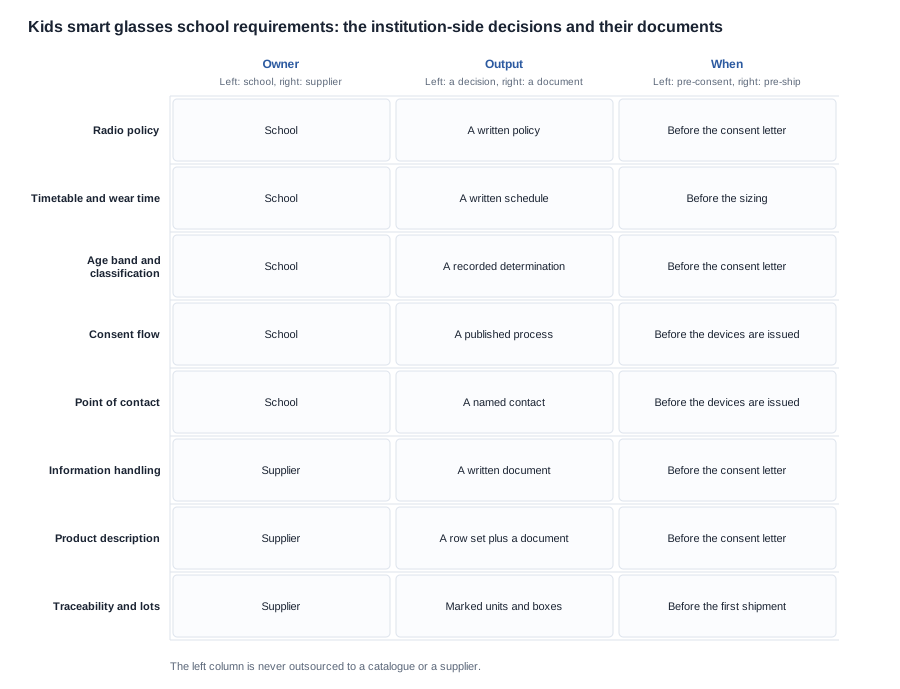
The matrix above separates the two things an institution has to get right and the two things it has to obtain. What the school owns, it owns permanently: the policy, the timetable, the consent flow and the age band. What it obtains, it obtains from a supplier or a document, and the file it ends up with is only as good as the provenance of each item. A buyer who separates the two at the outset can tell a procurement panel exactly which parts of the file are the school's own decisions and which are evidence the school is relying on, and that distinction is usually the thing a panel asks about.
How a school procurement panel reads a product file
A school procurement panel is not a category specialist, and the file it reads has to be readable by a generalist. The questions it asks are consistent enough to be worth preparing against in advance, and the criteria for judging the answers are simple enough to write down.
- What the product is, in terms a parent can read and a panel can check against a document.
- What it does during a lesson, and whether it interrupts the room.
- What information it handles, and whether any of it leaves the device.
- What happens when it fails, and how a unit is replaced or returned.
- Who is responsible, and which document says so.
The evaluation criteria that go with those five questions are worth stating separately, because they are what a buyer can use when comparing two suppliers. The first is provenance: does the document name the configuration and the market it covers, and can the buyer tell which of the two protection models or the audio model it belongs to. The second is completeness: does it answer the question that was asked, or a neighbouring one. The third is consistency, which is the one that is hardest to check and matters most, because a file where the product description, the information-handling document and the warning text disagree with each other is a file that a panel will find, and a school that discovers the inconsistency itself has a much better position than one that has it discovered for it.
A school procurement panel is not a category specialist, and the file it reads has to be readable by a generalist. That imposes a structure on what a supplier provides, and a supplier who has never supplied an institution is often surprised by it: the panel wants to know what the product is, what it does, what it handles, what happens if it fails, who is responsible, and what evidence supports each of those answers. Six questions, and a document for each.
The packaging and information side of an institutional programme carries one extra item that a retail programme does not, and it is the traceability data. A school buying several hundred units needs to be able to identify a lot, and a lot that cannot be identified cannot be recalled, cannot be quarantined, and cannot be reported on. That means the batch marking has to be on the product and the box, it has to be legible, and it has to survive the supply chain. It is a small requirement that is cheap to satisfy and expensive to retrofit.
The compliance framework underneath all of this is determined by the buyer's own compliance function, once the destination market and the age band are fixed. For the European Union, the general product safety framework is (EU) 2023/988; the applicable children's product requirements — such as EN 71 in Europe or ASTM F963 in the United States — are determined by the buyer's compliance function after classifying the product for its intended use and age band in the destination market, and the determination is recorded rather than assumed. A school buyer who can produce that determination, with the file behind it, can answer a panel; a school buyer who cannot, cannot.
Four neighbouring pages carry the parts of this subject that do not fit here: the structural and electrical safety file is in the safety file for this family; what a household asks is on the parent concerns page; the age-band questions sit in kids smart glasses age suitability; and the decision about which of the two product types suits a classroom is worked through in the comparison of those two product types.
A practical point for the buyer doing the work, and it is the difference between an institutional programme and a retail one. An institutional programme has a decision cycle that is longer than the shelf life of most of the answers, so the file that is assembled at the enquiry stage will be out of date by the time the framework is agreed. The sensible discipline is to fix the market, the age band and the product first, because those three determine everything else, and to treat the product description and the information-handling document as the two items that have to be re-confirmed at each review rather than as items that can be filed once. A buyer who has a framework agreement based on a file assembled three years ago has a documentation risk, and in this category the documentation is most of what the school is relying on.
The trade-off is worth naming, because it is the one that makes institutions slower than channels. A channel can launch on a thin file because the worst outcome is a return; a school cannot, because the worst outcome is a question from a parent or a panel about a product the institution approved. The correct response is not to supply a thinner file to the school but to build a thicker one, and the difference in effort between the two programmes is usually smaller than it looks at the start.
Three things belong in the contract rather than in a conversation, and a buyer who writes them there is protected when the programme is reviewed. The first is the document set, named by revision, together with a written change process so that a modification to the box, the accessory set or the artwork is notified before it is built. The second is an acceptance threshold for the incoming shipment, expressed as the checks the buyer will actually run and the disposition for each failure, so that a shipment is judged against a standard rather than against a conversation. The third is a written confirmation of the radio and data position for the configuration being supplied, since that is the question a parent is most likely to ask and the one a school is least able to answer from a catalogue.
The criteria a buyer should apply when comparing two suppliers on this work are straightforward, and they are the criteria a shortlist should be built on: whether the document set is per model and per market rather than per range, whether the change process is in writing, whether the acceptance threshold is expressed in a form the supplier has already agreed to, and whether the consent route can be documented without adding a step the school cannot staff. Those four criteria decide more about an institutional programme than any comparison of the published product rows, because they determine whether the programme can be run at all. A buyer who evaluates suppliers on this basis should also ask what to ask when the answers are unclear, and should treat an unanswered question as an open item rather than as a soft yes, which is the practice that keeps a framework agreement defensible when it is reviewed.
Bring us the institution's timetable, the age band and the markets, and we will tell you which parts of the product description our published rows can support, which parts need a supplier document before a consent letter can be written, and which parts of the institutional decision are the school's own and should not be outsourced to a catalogue.


