
Age suitability for a children's wearable is not a figure on a datasheet. For kids smart glasses age suitability, the workable position is that it is a conclusion a buyer has to reach, from a physical sample and from documents our catalogue does not contain, and that conclusion has to be written down before the packaging, the warnings and the listing copy exist. What follows sets out the seven checks that produce it, the order they have to happen in, and for each check what the catalogue already answers and what has to be closed with a supplier, a laboratory or a test body.
The catalogue covers three children's models. The A05 and the A06 publish a 40 mAh cell, a rated endurance of about twenty hours, a charge time of two hours or less and magnetic charging. The A07 publishes a 70 mAh cell, the same rated endurance, the same charge time, magnetic charging and Bluetooth V5.4. None of the three publishes a frame dimension, a frame weight, an adjustment range, a recommended age band, an ingress rating or a per-model conformity file. There is no lookup available here. There is only a method, and the method is what a sourcing team is being paid for.
We will not assign an age band to any of the three models in this article, and we make no vision, health or eyesight claim for any of them. A unit that senses a posture or a distance and reminds is not a clinical device, and nothing in a listing may imply that it is. That boundary is settled before anything else, because it decides what the rest of the programme is for.
Kids smart glasses age suitability is a set of questions, not a published figure
An age band on a children's product is not a merchandising label. It is a set of commitments: the warnings printed on the carton, the label content required in each destination market, which product-safety requirements attach to the unit, the instructions a parent is handed, and the scope of the file a retailer asks for before it will take delivery. Each of those commitments is downstream of one number, and the number is not in our documentation. The question is therefore not how to describe an age band. It is how to earn one, and how to record the evidence that earned it.
The published position across the three children's models is short enough to set out in full, which is useful, because it defines the boundary of what a buyer has to gather elsewhere.
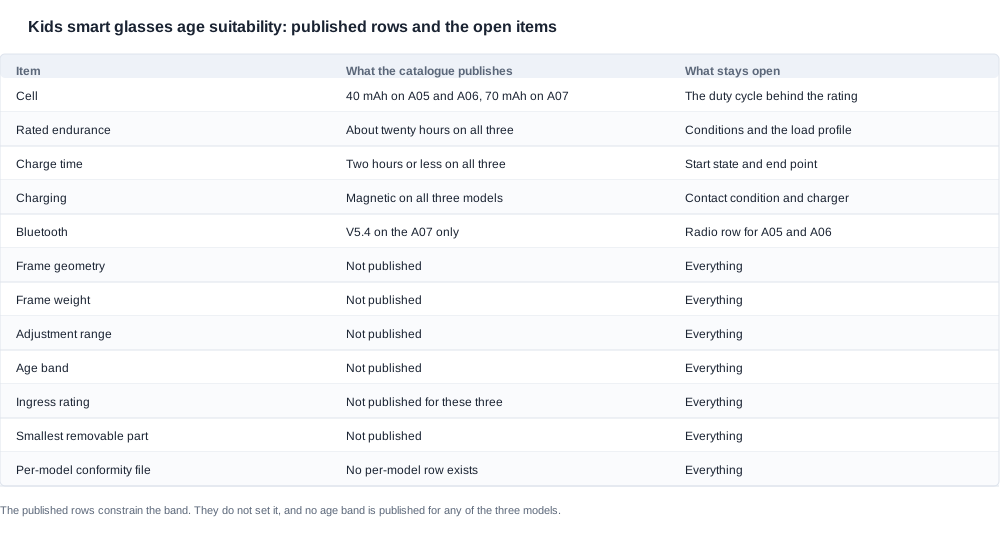
Three things follow from that table, and each of them changes what a procurement team does next.
The identical rows on the A05 and the A06 mean the age question is asked twice. The two models publish the same cell, the same rated endurance, the same charge time, the same charging method and the same feature rows, and we document no specification difference between them. A buyer ordering both is managing two per-model documentation tracks for what may be one platform, and the only way to know is to ask, in writing, what each designation refers to at platform level, and whether one conformity document is enough for the pair.
The twenty-hour figure is a rating, not a schedule. It is a rated endurance published under conditions the catalogue does not describe, so a channel building a support policy on twenty hours of continuous use is planning against a number that was never published, and the gap shows up as a returns queue.
An absent ingress rating is an absence, and not a permission. No ingress marking appears against the A05, the A06 or the A07 anywhere in our documentation, so a channel whose proposition involves a school bag, a sports hall or a walk in the rain has to resolve that with the supplier, because nothing in our documentation supports a water, sweat or rain claim for these three models.
The published rows, in the order they constrain the band
- Cell, endurance and charging. The A05 and the A06 publish a 40 mAh cell; the A07 publishes a 70 mAh cell. All three publish an endurance of about twenty hours, a charge time of two hours or less, and magnetic charging. These rows set the power envelope of any band you might write.
- The feature rows on the A05 and the A06. The catalogue lists lens-based electronics, a fogging unit, prompts for correct posture and distance and for incorrect posture and distance, lens clarity, and lens fogging. These are catalogue rows describing what the unit senses and reminds about. They are not a medical effect statement, and they are not a statement about eyesight.
- The radio row on the A07. Bluetooth V5.4 is published for the A07. The A05 and the A06 publish no Bluetooth version, so nothing about their radio can be asserted on the basis of the A07's row.
What the catalogue does not publish, gathered in one place
- Frame geometry, in lens width, bridge and temple length — Not published
- Frame weight — Not published
- Any adjustment mechanism and its range — Not published
- A recommended age band for any of the three — Not published
- An ingress rating — Not published for these three models
- The smallest removable part and its dimensions — Not published
- A cell safety report and any transport test reference for the fitted cell — Not published
- A per-model conformity file, with numbers, issuing bodies and validity dates — Not published
- The detection thresholds, delays, false-positive rate, alert format and disable path behind the A05 and A06 feature rows — Not published
A procurement file that treats any of the above as known is a file that has confused a catalogue row with a specification. That confusion is the reason so many children's programmes stall in the second month, when the first retailer asks for the document behind the number on the carton.

What the catalogue can close on paper and what has to be measured on a sample
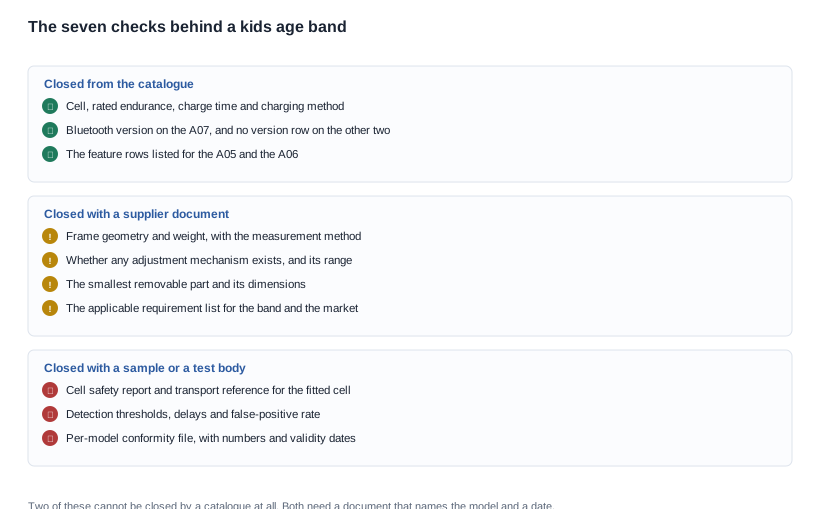
Every item in an age decision belongs to one of three evidence classes, and the class tells you what a usable answer looks like before you ask the question.
Class one, already published. A row in the catalogue. Nobody has to agree with you about it, there is no version to chase, and it cannot change under you without a new catalogue. Cell, rated endurance, charge time, charging method, the Bluetooth version on the A07, and the feature rows on the A05 and the A06 are all class one.
Class two, a supplier document. Something in writing, dated, that names the model designation it covers. This class is cheap to request and expensive to accept badly, because a supplier document without a model designation, an issuing party and a date cannot be attached to your file later, and the retailer will ask for it again at every renewal.
Class three, a measurement or a test report. Something produced on a sample by a defined method. Geometry, weight, adjustment travel, the smallest removable part, and every behavioural parameter behind a detection function sit in this class, and a class-two answer to a class-three question is the single most common way a children's programme ends up with an unenforceable number on its packaging.
The seven checks below name the class for each one, because the commonest failure in this category is a buyer accepting a general statement for a specific measurement.
- Frame geometry and weight — class three. Ask for lens width, bridge, temple length and the weight, and ask for the method: which sample, and with or without the cell fitted. A usable answer carries a unit and a method. A number without a method is not a number you can defend, because the same frame weighs differently with and without a cell, and it is the tolerance, not the nominal figure, that turns one size into a sellable size range.
- Adjustment — class one for the answer, class three for the evidence. No adjustment mechanism is published for any of the three models, so a fixed geometry is the working assumption until the supplier says otherwise. A fixed geometry narrows any band, because a band spanning a head-growth range needs either an adjustment travel or a tolerance wide enough to cover it. The question to put in writing: does any adjustment exist, what is its range in millimetres, and is it set by the customer or by the factory.
- The smallest removable part — class two. It sets a floor under the band whatever the other measurements say, and it is the first question a reviewer asks. A usable answer gives the part, its dimensions and the method used. On these three models the removable items are the charging accessories and any detachable frame element; the catalogue lists a fogging unit as a feature row for the A05 and the A06, and whether that unit detaches, how it is handled and how small it is has to come from the supplier.
- The cell and its safety documentation — class two. The cell is 40 mAh on the A05 and the A06, 70 mAh on the A07, and charging is magnetic on all three. Request the cell specification, the safety report for the cell as fitted, and the transport documentation reference. The magnetic contact is worth a specific question on a children's product, because a magnetic charging interface is handled by a child: the contact condition, the charger geometry and the behaviour when the contact is only partly made are all unanswered in our documentation.
- The behaviour behind the feature rows — class three on the A05 and the A06. The catalogue publishes what the unit senses and reminds about. It does not publish the threshold, the delay, the behaviour on a repeated trigger, the false-positive rate, the alert format, or whether a parent can switch the function off. A threshold written as a number with a unit can be measured on a sample and turned into an acceptance criterion. A threshold written as a quality cannot be measured at all. That difference is the difference between a feature and a specification, and in a children's product it is the difference between a unit that keeps being used and a unit that is switched off in the second week.
- The requirements that attach to the band — class two, from your own compliance party. This is the item most often deferred until the artwork is finished, and it is the one with the longest elapsed time, because the elapsed time is set by the test body rather than by your order. Which frameworks reach a given unit is a classification your compliance party makes against the finished product, separately for each destination market and for the band you intend to sell into, and the toy standard and the consumer product safety rules are the two most frequently raised in the two large markets. It is not a statement this catalogue can make, and no document in our documentation set asserts it.
- The warning text and the label set — class two, and a commercial deliverable rather than a technical one. The warnings that must appear, their language, their format and their placement follow from the band and from the requirements determined in check six. Ask for them as a supplied artwork item with a version and a release date, not as a paragraph written by the channel, because a warning written by the channel is a warning no insurer or reviewer will accept as a supplier obligation.
The order the checks happen in

Two of the seven gate the others. Check one gates the band itself, because a band cannot be wider than the geometry supports. Check six gates the scope of checks three, five and seven, because the requirements decided for the band decide what the small-parts assessment has to cover, which behavioural parameters matter, and what the warnings have to say. If either is skipped, the remaining five produce a number that will not survive a retailer review or a market surveillance enquiry.
The practical sequencing question is what to send for while the long-lead items are running. Class-one material and the class-two document requests cost nothing but a week, and they can go out on day one. The class-three measurements need production samples, so the sample order is the critical path item, and it is the one thing a buyer should never defer to a second order.
A shortlist built from a catalogue sheet, and the checklist to replace it
A shortlist in this category is usually built from a catalogue sheet, and a catalogue sheet is the wrong instrument for a children's line. The checklist below is worth sending as one document before you order, in this order, because each answer narrows the next question.
- Which measurement criteria do you apply to the frame, and on which sample? A usable answer names the dimensions, the mass, whether the cell is fitted, and the tolerance.
- Can a single file cover both the A05 and the A06, and if so under which designation? This one answer changes the total cost of the documentation scope more than any other question on the list.
- What are the red flags in the sample measurements? A supplier who names the measurement where a child product most often fails has done the work; one who says everything is fine has not measured.
- How should we evaluate the behavioural parameters behind the feature rows? Ask for the threshold with its unit, the delay, the false-positive rate and the disable path, and ask how the sample was set up.
- What trade-offs does a fixed geometry create for the band, and what would an adjustment have changed? This is the question that connects the size decision to the commercial decision.
- Which items would you assess as blocking before you order, and which as follow-up? A supplier who separates the two is managing risk; one who marks everything as blocking is managing the conversation.
- What does your due diligence record need to contain for the retailer? Ask for the format the retailer's technical team will accept, then check every item against it.
- Which of the eight open items can you close this month, and which need a laboratory? The split tells you where the critical path actually is.
Read the answers against the seven checks above, and treat any check that is still open after this exchange as an open item with a name and a date against it. That is the whole method, and it is why a kids age band is something a buyer establishes rather than something a catalogue hands over.

Four age tiers and the checks that differ between them
Because no band is published, the buyer sets one. The defensible way to set one is to work from the size range the channel actually has to serve, then attach the requirement classification to that range, rather than choosing an age first and hunting for a product afterwards. Four bands cover most of what a children's line in this category has to handle, and the four below are bands of evidence, not ages this catalogue assigns to anything.
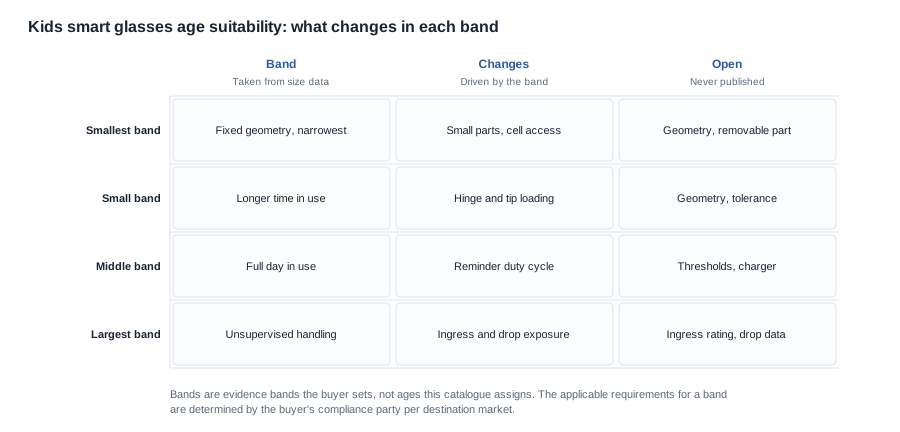
The smallest band. The tightest geometry requirement and the narrowest tolerance expectation, and the band where the small-parts assessment and the accessibility of the cell do most of the work. A unit in this band is handled by the youngest children in the range, so the removable-item question is not a formality. The unresolved items are the geometry itself, the weight, and the dimensions of the smallest removable part, because none of the three is published for any model.
The small band. Still a narrow tolerance expectation, but the time the unit is in use per day begins to extend past a single activity, and hinge and temple loading start to matter as a repeated rather than an occasional event. The unresolved items remain the geometry and the tolerance, because a band that is one size wider is a band with a wider tolerance question, and that question is answered by a measurement rather than by a catalogue row.
The middle band. This is the band where the published endurance row stops being comfortable and the duty cycle becomes the real subject. A unit in use across a full day at a fixed reminder setting is a different measurement from a unit in use for one session, and the twenty-hour rating is a rated figure whose conditions are not published. The unresolved items here are the detection thresholds behind the feature rows, the charger, and the charge discipline the household can actually keep.
The largest band. The oldest children in the range handle the charging interface without supervision, the unit is exposed to the full range of school and activity environments, and drop and ingress questions move to the front. Here the unresolved items are the most consequential for the category: the catalogue publishes no ingress rating for the A05, the A06 or the A07, and no drop or impact data for any of them, so a channel making a claim in this area is making a claim with nothing behind it.
Why a size band is not the same thing as an age band
Size is a physical fact, and a physical fact is measured. An age band is a classification that a market, a retailer or a liability regime attaches to that size, and it is the trigger for the requirement determination in check six. The same measured size can fall into different bands in different destination markets, and the same band can cover different sizes in different channels. That is why the record has to hold the size data and the band as two separate entries, with the party who determined the band named on it and the date attached.
The open items that do not close with the band
Whatever band a buyer lands on, a set of items stays open, because publishing a band would not make them true: the geometry and the weight, the adjustment question, the smallest removable part, the cell report and its transport reference, the thresholds behind the feature rows, the per-model conformity file, and the warning set. Treat them as a standing open-item list with an owner and a date against each entry, rather than as a document chase that restarts every time a new market is added.

Where the A05 and the A06 ask a different question from the A07
The A05 and the A06 publish the same six feature rows. The A07 publishes none. Everything that follows from that difference is about the evidence a buyer has to collect, not about the merit of either product.
The A07's age question is short. Geometry, the smallest removable part, the cell and its safety documentation, the charging interface, and the requirement determination. There is no sensing row whose threshold has to be measured, no reminder whose false-positive rate has to be quantified, and no parent-facing behaviour to specify. For a channel whose proposition is audio, that is a materially shorter file, and it is worth knowing before the programme is scoped rather than after.
The A05 and the A06 add a behavioural half to the same physical half. The physical work is identical to the A07's. On top of it sit the threshold, the delay, the repeated-trigger behaviour, the false-positive rate, the alert format and the disable path, none of which are published. A file for these two models therefore has two sections, and the second one is the one that decides whether the unit is used after the first fortnight.
The identical rows force a second question that has nothing to do with the features. Which platform each designation refers to, whether the two share a conformity file, and whether the six feature rows are configured identically or merely listed identically. This is the question to put in writing before a quotation that prices the two models as separate lines is accepted, because the answer determines whether the documentation cost is one file or two.
How to describe the feature rows without turning them into a claim
The rows describe detection and reminder, so a listing may say that the unit detects posture and viewing distance and reminds. It may not extend that into a statement about eyesight, and it may not turn the word protection into a performance adjective, including inside a category name or a channel description. A catalogue row that names a fogging unit alongside separate entries for lens clarity and lens fogging is still only a list of functions; it is not evidence of a clinical outcome, and the marketing copy has to be narrower than the specification it describes, not wider.
We make no vision, health or eyesight claim for the A05, the A06 or the A07, in any market, and we do not describe any of the three as a medical device. If a channel's proposition depends on such a claim, this is the wrong category, and it is better to establish that before the artwork is approved than after it is printed.
The written record that carries a kids age band onto a listing
An age band becomes commercially real the moment it is written into a dated record that somebody has signed. A band in a catalogue, a band in a conversation and a band in a purchase order are three different objects with three different consequences, and only the third one binds anybody.
Four criteria that establish an age band, and the documents behind them
- The size data, with the measurement method, and the identification of the sample it was measured on.
- The band, the destination markets it applies to, and the party who determined it.
- The requirement list for that band and each market, with the standard names and the edition dates.
- The documents received, each with its number, its issuing body, its validity dates and the model designations it covers.
- The open items, each with an owner and a date.
- The claim position, in writing, confirming that no vision, health or eyesight claim is made and that the feature rows are described as detection and reminder.
- The warning and label artwork version, with the date it was released.
Where a children's age programme goes wrong
A band reaches the carton before the file exists. The band is set in artwork, the artwork is approved, and the file arrives afterwards saying the band was a commercial estimate. Nothing detects this until a retailer or a market surveillance authority asks which requirement set the band was based on, and at that moment the answer is a recollection rather than a document. The prevention is structural: the band is a field in the record and the artwork is released from the record.
A general statement is accepted in place of a measurement. A supplier confirms a frame size for a family of models, the buyer records it against two designations, and the sample that eventually arrives measures differently. The prevention is to accept only a number that names a model designation, and to re-measure one unit from the first shipment against the record.
One documentation track is assumed for two designations. The A05 and the A06 publish identical rows, so a buyer treats them as one file, and then a retailer asks for a document naming the other designation. The prevention is to establish the platform behind each designation before the file scope is priced, and to price two files if the answer is that they are separate.
The requirement determination is left to the last market added. The first destination market is simple, the second one is not, and the programme is built on the assumption that the first determination carries over. The prevention is to run the determination for every market at the same time, because the elapsed time belongs to the slowest one, not to the first.
The commercial terms that follow from the record
The first list is genuinely open for negotiation: how many models and how many bands the programme covers, because each band and each model carries its own test scope; the artwork round count, since each round is a week; the number of sample units sent for measurement; the number of destinations; the order in which the per-model files are produced; and the sequence in which models appear in the first shipment, so that a designation without a completed file is not shipped first. Notice also that the notice period owed before any change to a safety-relevant component belongs in the same conversation, because a component change can invalidate a document that was expensive to obtain.
The second list is not a commercial variable at all. The elapsed time set by a laboratory or a test body is what it is. The safety-relevant design decisions — the accessibility of the cell, the geometry of small parts, the contact design of a magnetic charger that a child will handle — are engineering decisions that a commercial negotiation cannot reopen. And once the band is documented, it becomes an input to the file rather than something to be adjusted to fit a programme. A band that is renegotiated after the file is built costs a re-test, and the re-test is not on the supplier's side of the table.
The clauses to write into the purchase order are these: the model designations covered by each document, attached to the order; the acceptance criteria from the sample measurements, with the method attached; a requirement to give notice before any change of firmware, detection threshold default, frame material, or the supplier of a safety-relevant component; an obligation to update the documentation pack when a standard's edition changes; and a statement of who bears the cost when a lot fails the acceptance criteria.
A worked sequence, not a client story
The sequence below is an illustration rather than an account of a real customer, and it is included to show the order in which the decisions fall.
Assume a distributor that already runs an adult audio line is asked to add a children's line under its own label, for three markets. The constraint is not the unit price. It is that the retailer's technical team has already suspended one of the distributor's listings in another category over a documentation gap, and it now asks for the file before it will accept delivery.
The distributor's first question to the supplier is whether the listing may say anything about eyesight. The answer is that it may not, that the feature rows describe detection and reminder, and that the confirmation comes in writing. That single answer costs nothing and removes the largest commercial risk in the programme.
The second step is the requirement determination, run for all three markets at once, with the intended band stated as a size range rather than an age. It comes back with a requirement list per market, and the distributor now knows the size of the file, which is the number its retailer's technical team actually asked for.
The third step is the sample order, with the measurement protocol attached: which dimensions, which mass, with and without the cell, how many units, and what the pass condition is. The measurements close the geometry and the weight, and they produce the tolerance the band depends on.
The fourth step is the documentation request, per model and per market, with numbers, issuing bodies, validity dates and the exact model designations. One designation comes back with a file that does not name it, and that designation is held back from the first shipment rather than carried as a risk.
The fifth step is the behavioural measurement on the A05 and the A06, at the reminder setting the channel intends to ship, with the false-positive rate and the alert format recorded. The sixth step is the record, the artwork release and the claim position.
The outcome is a narrower launch than the distributor first asked for, and a file that survives the retailer's review. The decisive decisions were the boundary, the requirement determination and the documentation scope. None of them was about the electronics.
What our own documentation can and cannot answer for this decision
We publish the electrical rows for these three models: the cell, the rated endurance, the charge time, the charging method, the Bluetooth version on the A07, and the feature rows listed for the A05 and the A06. We do not publish the geometry, the weight, the adjustment range, the removable parts, the cell report, the thresholds, the age band, the ingress marking or any per-model conformity file, and we will not estimate them, because an estimate that reaches a carton becomes a claim the seller made.
The same boundary applies to everything else we publish about these three: no eyesight, health or vision claim is made for them, and none of the three is offered as a medical product. What we can do is tell you which of the seven checks our documentation answers today, which need a supplier document, and which need a sample measurement. Send us the intended size range, the three markets and the customer profile, and we will say which applies to each — and where a kids age band has to be earned rather than looked up.
The range itself is at kids smart glasses. The product decision behind the age band is in the kids buying guide, the requirement side is in kids smart glasses safety requirements, and what a parent will ask about the same decision is covered in kids smart glasses parent concerns.


