

A buyer who searches for ky06 smart glasses certification status is usually doing one of three things. They are trying to clear a sample shipment for a destination market. They are trying to write a compliance clause into a purchase order or a private label contract. Or they are trying to avoid the failure mode where goods arrive, sit in a warehouse, and cannot be listed on a marketplace or shipped to a customer because a document set was never assembled.
The honest answer is that the catalogue does not publish a certification status for the KY06. There is no line in the published material that says the KY06 holds FCC, CE, RoHS, or RED approval, and there is no line that says it does not. What there is, for this model and for the rest of the camera glasses group, is a set of specifications — battery cell, runtime, charge time, charging method — and a separate export page that carries certificate imagery rather than a per-model compliance table.
That distinction matters more than it sounds. A product page that lists a battery capacity tells you what the product does. A compliance record tells you what you can legally do with the product after you buy it, in the market you are shipping it to. Buyers routinely conflate the two, because on a catalogue page the two sit side by side and both look like "facts about the device". They are not the same kind of fact, and only one of them is on this page.
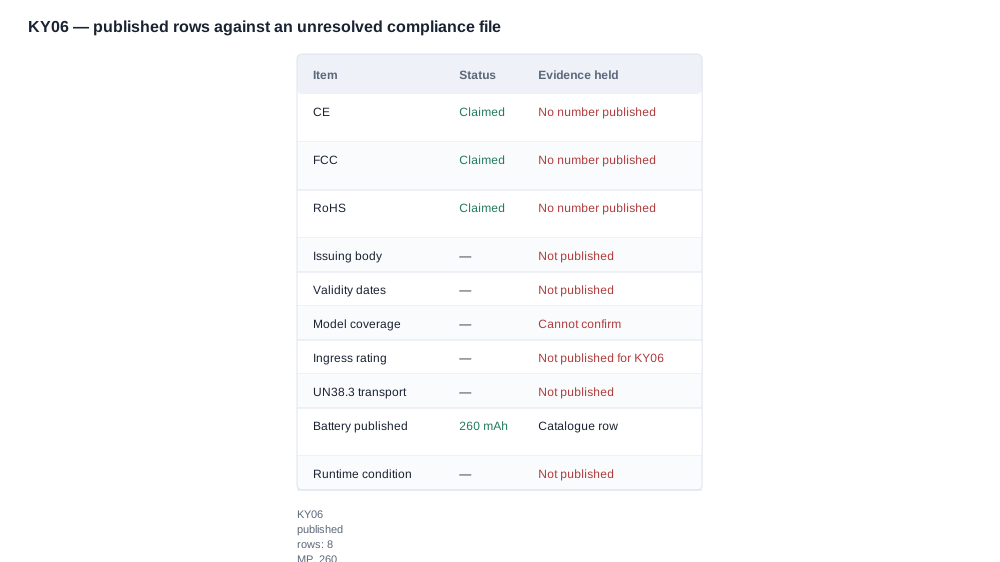
The position is simple and we will state it early. We will not restate a certification we cannot point to, so a buyer who needs the KY06 cleared for a destination market should ask for the model's own documents and record what each one covers. We do not treat the absence of a published claim as evidence of non-compliance, and we do not treat an image of a certificate on an export page as evidence that a specific model is covered. Neither inference is safe, and the second one is the more expensive mistake.
KY06 certification status: what the catalogue does and does not say
Start with what is actually published about the KY06, because the published set is small and clean.
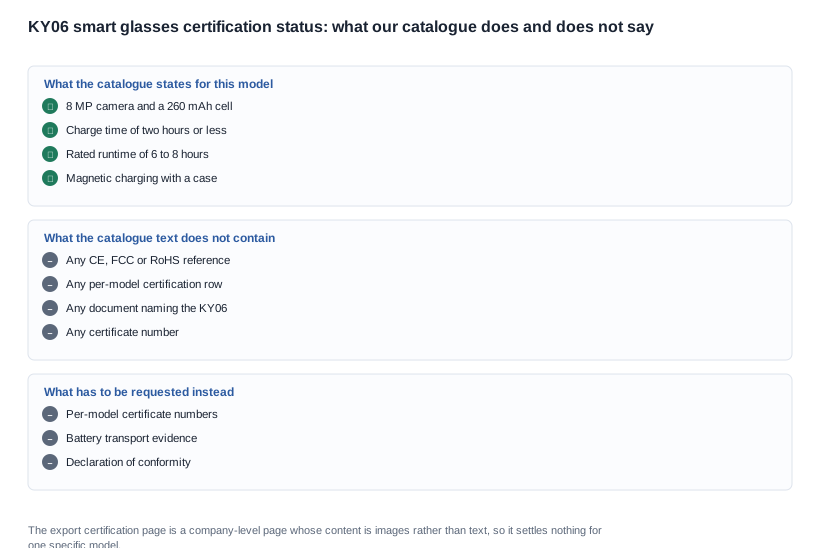
The KY06 is listed as the KY06 AI sport camera glasses. It is part of the camera glasses group, which in the published catalogue consists of eleven models and is documented in more depth on the AI camera glasses overview than any other line. The KY06 carries a 260 mAh battery cell, a published runtime of roughly six to eight hours, a charge time of no more than two hours, and a magnetic charging method that works with a charging case. The charging method is published as magnetic plus charging case. The case itself is present for the KY06, but the case capacity is not published.
That is the complete published specification set for the KY06. There is no published Bluetooth version. The catalogue's Bluetooth column for the KY06 is empty, and the reason is structural rather than an omission: the KY06 sits in the camera group, and no Bluetooth version has been published for any camera glasses entry in the published rows. Buyers who arrive expecting a "KY06 Bluetooth 5.3" style line item will not find one, and any such figure in a quotation or a listing is unsourced.
There is also no published weight for the KY06. The only weight published anywhere in the range is for a different model entirely. And there is no published IP rating for the KY06, because the only two models in the catalogue with a published ingress protection rating are the V06 and the S7, both of which carry IP54. The ingress protection reference sets out how these ratings are defined and what a published rating would commit a supplier to. The KY06 carries no published IP rating, which is a distinct statement from "the KY06 is not IP54" and from "the KY06 is IP rated but the number is missing".
So the catalogue tells you what the device does. It does not tell you what you are permitted to do with the device. Concretely, none of the following appear anywhere in the published material for the KY06, for any model in the range, or for the export page:
- No FCC certification claim, and no FCC test report number
- No CE marking claim, and no notified body reference
- No RoHS declaration, and no material compliance statement
- No RED radio equipment directive claim, and no radio test report
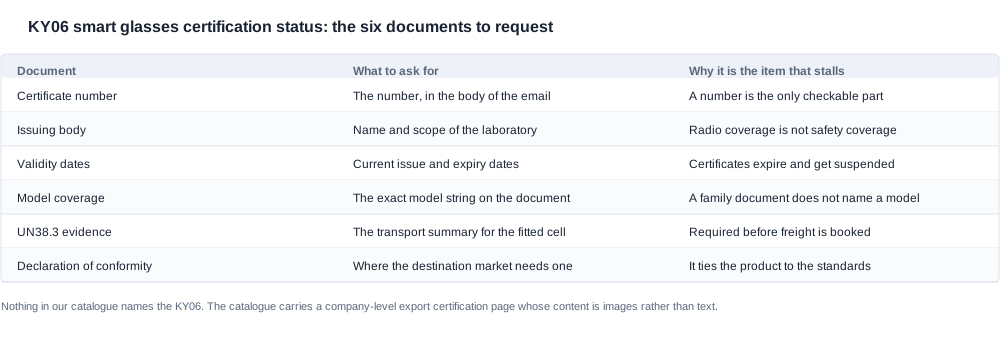
- No test report number, laboratory name, report date, or certificate serial
- No battery transport compliance reference tied to the 260 mAh cell
- No UN 38.3 or equivalent lithium battery shipping document for the KY06
- No packaging, labelling, or importer-of-record responsibility matrix
This is not a criticism of the catalogue. It is a description of the catalogue. A product catalogue built for buyer research and product selection is doing a different job from a compliance file, and the failure mode is to read one as the other. The risk lands on the buyer's side of the table: a procurement lead who treats a specification table as a compliance file will discover the gap when the goods are already in transit.
What a buyer should take from this is not a negative finding about the KY06. It is a scoping instruction. The KY06 is a real catalogue model with a real, coherent spec profile — a 260 mAh cell, a six-to-eight-hour runtime, magnetic charging with a case. If the compliance status of that model matters to your programme, the information is not in the catalogue, and it has to be requested.

The export page as an image page rather than a per-model table
The export section of the catalogue deserves its own specific description, because how a page is built tells you what it can and cannot support.
The export page is an image page. It carries certificate imagery — ten images in total, made up of eight appearance design entries and two utility model entries. These are intellectual property instruments, not market-access approvals. An appearance design patent or a utility model covers what something looks like or a specific mechanical arrangement, and it has a jurisdiction and a term. It is not the same class of document as a radio equipment compliance test report, and holding ten of them does not put a product on a market's approved list for any regulatory scheme.
The more important structural point is what the page does not contain. There is no per-model certification row. Nothing on the export page maps a certificate image to a specific model in the catalogue. So the page cannot be read as an evidence trail for the KY06, and it should not be used as one in a buyer's file. If a supplier points you at the export page as proof that the KY06 is FCC or CE or RoHS compliant, the correct response is not to argue about whether the models are covered; it is to ask which certificate number covers the KY06, which lab issued it, what the report date is, and what product configuration the report names.
We do not read that page as a compliance file, and we advise buyers not to file it as one either. For the purposes of a purchase order, it is best treated as background evidence of some kind of documented activity around the product line, and nothing more specific than that.
The same logic applies to the battery. The published battery page is a reference for battery and transport considerations rather than a per-model compliance dossier, and the battery transport reference is the right background reading before you raise the question with a supplier. A 260 mAh cell inside a wearable that will cross a border generates a different question set from a finished radio product: how is the cell shipped, what does the carrier require, what does the packaging need to declare. A general battery reference page helps you frame those questions. It does not answer them for a specific model, at a specific configuration, under a specific carrier requirement.
The distinction worth holding onto is this. Compliance evidence is always model-specific and configuration-specific. A radio test report names a model number and a firmware or radio configuration. A battery shipping document names a cell, a pack, and its watt-hour rating. A declaration of conformity names the product and the directive. A generic certificate gallery names none of those things. When you are doing due diligence, ask for the document that carries the model number, not the page that carries the pictures.

Turning the open certification items into a document request
The practical move is to convert the open items into a specific request. The good news is that "please send certificates" is a weak request. "Please send the following ten documents, each identified by number, date, and the model or cell they cover" is a request that can be closed.
Here is the request list we would put in front of a supplier, framed as the questions to ask before you order rather than as an accusation. It is a condensed version of the procurement certification checklist, trimmed to the items that matter for a camera glasses model with no published compliance file.
Identity of the exact product. Confirm the model designation, the marketing name, and the product configuration the documents will cover. A test report written against an internal engineering designation does not automatically cover the KY06 as it ships under your private label, and if you are buying a private label version, the question becomes sharper: which documents are the manufacturer's, and which are the label owner's responsibility? Many compliance obligations attach to the entity placing the product on the market, not only to the entity that designed it. That answer changes with the destination market and cannot be assumed.
Radio compliance. Ask for the test report covering the radio module actually fitted in the KY06, the applicable regime for each target market, the test report number, the issuing laboratory, the report date, and the standard version referenced. If Bluetooth is a requirement for your programme, note that the KY06's Bluetooth version is not published, and ask what is fitted. If the answer is that a particular radio is fitted and certified at module level, ask for the module's certification documents and for written confirmation of the end-product configuration that the module approval is valid in.
Chemical and material. Ask for the RoHS declaration for the KY06 as configured, the material or substance declarations that a retailer or marketplace will require, and the declaration of conformity that accompanies the product in the destination market. If the buyer needs the CE route specifically, ask which conformity assessment route is used, who is the responsible party named on the declaration, and what the technical file contains.
Battery and transport. Ask for the cell and pack documentation for the 260 mAh cell: the UN 38.3 test summary, the watt-hour rating, the battery transport compliance data, and the packaging configuration used for shipping. The battery page in the catalogue is a useful reference for framing this; the model-specific document is what closes it. If goods will ship by air or ocean under a freight forwarder, ask what the forwarder's current requirement set is, because carriers update their requirements independently of the manufacturer.
Factory, quality, and audit. Ask where the KY06 is manufactured, whether the production site is the same site that holds the design and test history, and what quality control steps run on the line. Then ask whether a factory audit is possible, whether a third-party inspection before shipment is acceptable, and what the pre-shipment sampling plan looks like. A buyer's due diligence on a model with an unpublished compliance file leans heavily on the supplier's own controls, which makes the site and the process more important, not less.
Commercial and contractual. Ask for the terms that would eventually appear in the contract: minimum order quantity, unit pricing at volume, tooling or mould costs and who owns them, sample order cost and lead time, bulk order lead time, warranty terms and what the remedy is, payment terms and deposit structure, incoterms, and what happens to the compliance obligations if the documentation turns out to be incomplete on arrival. When you negotiate these terms, treat the documentation scope as a line item, not a footnote.
Traceability. Ask how a unit shipped under your label can be traced back to the model configuration and the production batch that the documents describe. This is the point where documentation stops being paperwork and becomes evidence. Ask what the supplier's process is for recording a configuration change, and who is notified if one occurs.
For a buyer who wants a ready-made version of the above, the camera and imaging reference is where to align on the technical vocabulary the model uses, so that the wording in the request matches the wording in the documents you receive back.
That last group is where most of the real risk sits, and it is worth being explicit about why. A missing certificate is an obstacle that can be cleared before you order. A missing change-notification process is a risk that materialises after you have committed inventory, tooling, and shelf space. The questions to ask before you order are not only about documents; they are about the process that keeps the documents true over the life of the programme.

What a certification file has to contain before it enters the buyer's folder
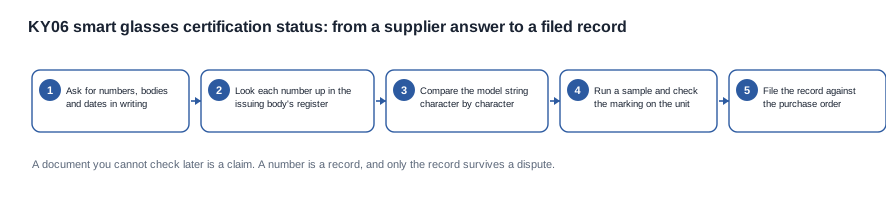
Every buyer needs a consistent acceptance rule, otherwise the folder becomes a pile of PDFs with no way to tell which ones matter. The criteria should be written down before the first request goes out, and the check should be repeatable by someone who did not attend the call.
For each document in the KY06 file, five things have to be answered.
Who issued it. A laboratory name, a notified body, a certification mark owner, or a compliance route. If a document cannot name its issuer, it is a marketing asset, not evidence.
What it covers. The model number, the model family, the radio configuration, the cell and pack, the accessory set. "Smart glasses" is not a product identity. If the document says the product is "a Bluetooth eyewear device", it may or may not cover the KY06 in the configuration you are buying.
When it was issued. A report date tells you how current the evidence is. Regime requirements move, and a report written against an older standard may not satisfy a current requirement.
Which market it is for. The same device can need different evidence for different destinations. A document that satisfies one market is not automatically evidence for another.
What it does not cover. This is the one most teams skip, and it is the one that matters most. Limits of applicability, exclusions on accessories, restrictions on the end configuration, and any statement about the final labelling or packaging. A report that covers the engineering sample and excludes the retail configuration is still a useful document, but it is useful only if you know that is what you have.
Applied to the KY06 specifically, this rule set produces a clear and honest outcome. The KY06 cannot be cleared for any market on the basis of the catalogue alone, because the catalogue does not publish the documents needed to clear it. Equally, nothing in the catalogue indicates the KY06 is unfit for clearance. The correct state is simply open, and open is a normal and workable state in a procurement cycle. It means there is a defined document request and a defined acceptance rule.
The trade-off to be aware of is timing. A supplier who has a mature compliance file can usually answer a request quickly, and a supplier who does not may need a few weeks to assemble, or may need to commission, the missing evidence. Ask for the document list up front, before a sample order is booked, because the sample is not the cheapest moment to discover that the documentation work has not started. If the model is new for the supplier, or if your private label configuration differs from the catalogue configuration, the documentation work is larger, not smaller, and the lead time for that work is part of your lead time.
We would also note a caution about volume of paperwork versus value of paperwork. A buyer can easily spend more time collecting documents than the model justifies. The criteria are what keep this proportionate. Six documents that each answer the five questions above are worth more than thirty documents where you cannot tell which one covers the model in your box.
One more practical point, relevant to anyone building a private label programme on this model. The compliance obligations that attach to a private label version of the KY06 may be split. The design and the radio and the cell come from the supplier. The label, the packaging, the instructions, the importer declaration, and the local registration may sit with you. Ask which obligations are the supplier's, which are yours, and which are shared, and get the shared ones into the contract as named deliverables with a date attached to each. This is a checklist item, and it is also the item that most often gets missed until a listing is suspended or a shipment is held.
The value of this exercise for the KY06 is that it turns an ambiguous search into an executable one. You are not trying to find out whether the KY06 is compliant in the abstract. You are assembling a file where each document names an issuer, a scope, a date, a market, and a limitation, and where each gap is written down as a gap rather than as an assumption. That file is what makes the purchase order safe, what makes the due diligence defensible, and what makes the eventual shipment boring — which is the outcome you actually want.
Before you order, put the document request and the acceptance rule in front of the supplier together, and put both in front of your own review. If the answers come back with model numbers on them, you will have a real file for the KY06. If they come back with nothing, you will have learned that early, at a point when it is still cheap, and you will have a criteria-based reason to negotiate rather than a guess.


