
The L2 Utral is published with a 290 mAh battery, a charge time of up to two hours, and roughly seven hours of rated use. Those three numbers sit together in the catalogue and they look like a complete answer to the question of l2 utral smart glasses battery life. They are not. None of the three states the condition it was measured under, and on a camera product that omission matters more than it would on an audio frame, because the camera is the component that decides how much power is left at the end of the day.
The honest summary is this: seven hours is a ceiling measured under favourable conditions, not a working day. Everything below explains why, and what to ask for instead. It also separates the two decisions that get mixed together in most conversations about this model: what the cell can do, and what a case does to the shift. They are different decisions, they close in different ways, and they belong on different lines of a purchase order.
L2 Utral battery life: what the published configuration actually is
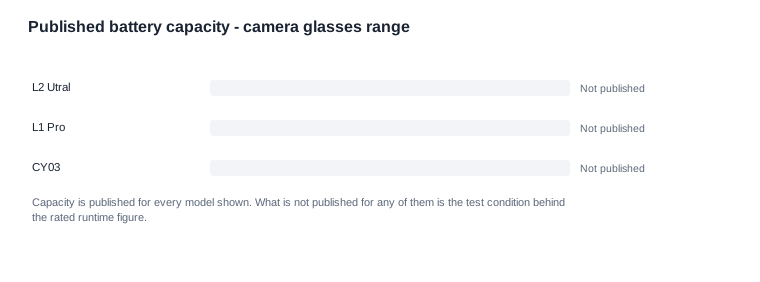
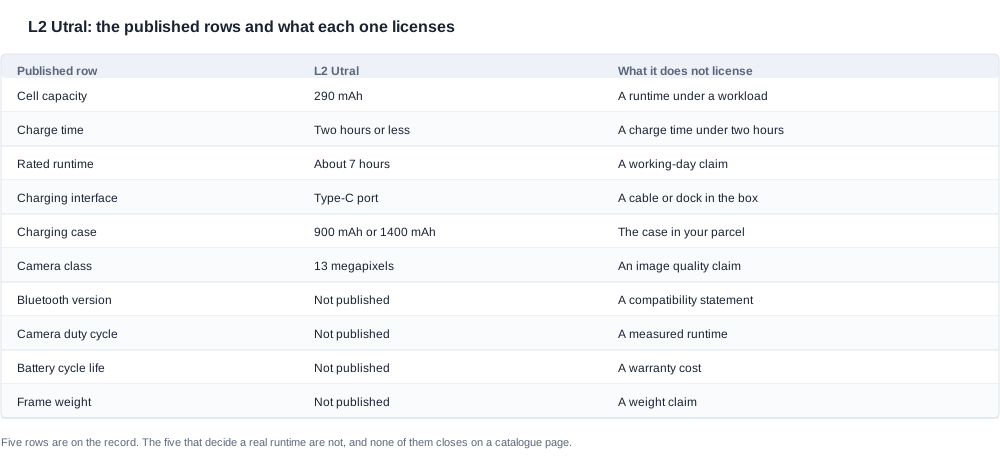
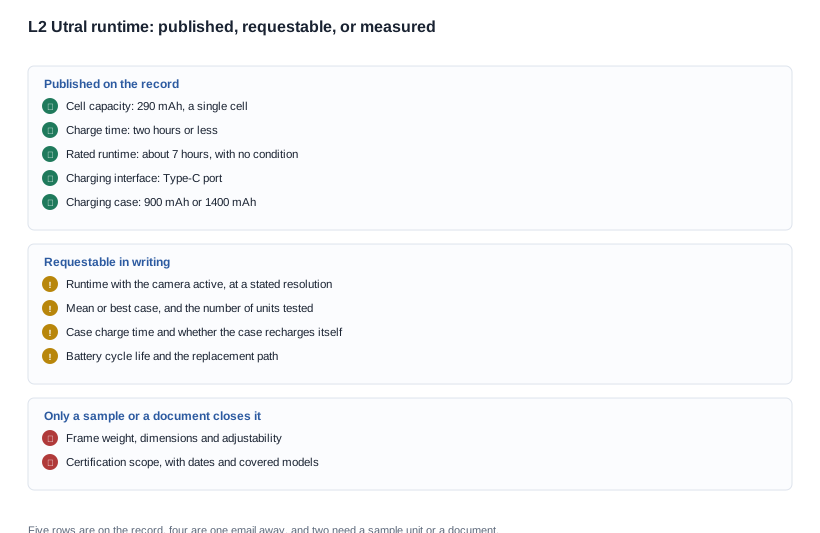
Five rows in the catalogue describe this model: a 13-megapixel camera, a 290 mAh cell, a charge time of two hours or less over a Type-C interface, a rated runtime of approximately seven hours, and a charging case available in two capacities — 900 mAh and 1400 mAh. That last row is the reason the case is a configuration choice rather than a fixed part of the box, and it is the one most often missed when the model is compared on paper.
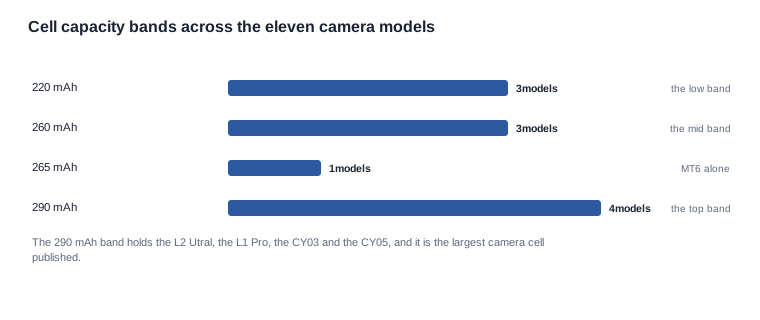
The 290 mAh figure puts the L2 Utral at the top of the camera cell sizes in this catalogue. The camera models fall into four published bands: 220 mAh for the V03 and the MT5, and the V03 Pro; 260 mAh for the S7 and the V06, and the KY06; 265 mAh for the MT6 alone; and 290 mAh for the L1 Pro and the CY03, and the L2 Utral and the CY05. No larger camera cell is published anywhere in the range, so if your requirement is capacity rather than camera resolution, there is nothing to move up to. The runtime conversation with this supplier is therefore about test conditions and duty cycle, not about a bigger number.
And the camera class does not follow the cell, which is worth knowing before you use either row as a proxy for the other. The 13-megapixel class is three models — the S7 and the L2 Utral, and the L1 Pro — and the S7 carries 260 mAh rather than 290. The 8-megapixel class is eight models, and two of them, the CY03 and the CY05, carry the same 290 mAh cell as this one. "13 megapixels" and "290 mAh" are therefore two independent published rows: the L2 Utral is one of four models at the top cell size and one of three on the higher camera class, and neither fact implies the other.
The cell row carries one caveat of its own. Some models in this catalogue publish a capacity with a cell count attached and some publish a bare capacity, and the camera models publish a bare capacity. That is why the 290 mAh figure is only comparable with the other camera cells, and why setting it against a two-cell figure from another category is a comparison of architectures rather than of numbers.
That is the whole of the published battery story. The radio version is not published for this model, because no camera model in this range publishes one. The charge time is a ceiling rather than a measurement. The runtime is a rating with no condition attached to it. And the case is the only other place where energy enters the system, so it deserves the same attention as the cell.
Why "about seven hours" is a ceiling, not a day
Runtime in a wearable is a function of what the device is doing, not a property of the cell. Four variables do almost all of the work, and on a camera product the first of them is large enough to decide the answer on its own.
Camera duty cycle. A camera that records continuously will exhaust a 290 mAh cell in a fraction of the audio-only figure. If the seven-hour rating was measured with the camera idle, your real-world number for continuous first-person capture is lower, and how much lower depends entirely on the video specification — which is not published for this model. This is the single largest unknown on the sheet, and it is the one that decides whether seven hours is a working day for your use or merely a number.
Audio volume and codec. Playback at a low volume with a power-efficient codec runs longer than playback at a high volume with a demanding one. This is normal variance, not a defect, but it is exactly the kind of thing a buyer needs stated.
Connectivity conditions. A phone at close range with a strong link consumes less than a phone in a pocket with the radio searching. In an open-air product the second condition is the realistic one.
The electronics behind the camera. A camera product draws from more than the sensor and the speaker, and the part of the consumption that nobody publishes is the part spent on the electronics rather than on the cell. The published row cannot be broken down into its components, so the only honest way to treat it is as a single figure measured under conditions the supplier has not stated.
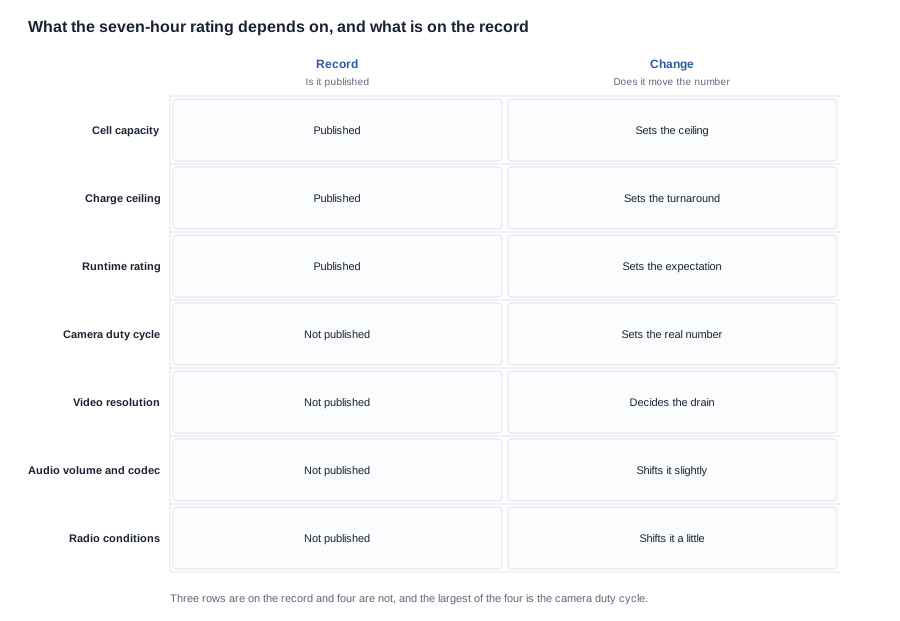
The specification you would want is not the one that exists. The number that would actually settle this is a published runtime measured with the camera active, at a stated resolution and frame rate, at a stated volume. Nobody publishes that, which is why this paragraph cannot be closed with a figure. We are not going to supply one.
And the practical consequence for a channel is a recharge cycle, not a runtime. If the figure is a rating, then the thing to design is how often a unit is away from a socket in a normal day, and how long it can be away before a customer notices. On a camera product that question is set by the recording duty cycle rather than by the audio use, which is why the first two questions in the quotation are the ones that decide whether the seven hours matter at all. A buyer who answers them gets a design; a buyer who does not gets a marketing line and a returns problem later.
Which is why the seven hours have to be written as what they are. On a listing, the figure belongs as a rated use, with the words that make it a rating rather than a promise. On a purchase order, the figure is a condition to be defined rather than a number to be repeated, because an acceptance criterion that repeats a rating without a condition cannot be failed and therefore cannot be enforced. The difference between those two sentences is the whole of this page.
The case question is a separate decision
The case is available in 900 mAh and 1400 mAh, and it is the only other place where energy enters this system. That is a bigger difference to a buyer than it first looks, because the case changes the shift length, the parcel and the retail proposition at the same time.
A 900 mAh case stores roughly three times the energy of the frame's own 290 mAh cell, and a 1400 mAh case close to five times. The usable fraction of that is not published: the conversion losses in a dock and the behaviour of a case under a partly depleted frame are both unpublished, so the honest way to hold the number is as stored energy rather than as additional runtime. Even on that conservative basis the gap between the two options is large, and it is large in the dimension that matters most for a camera product — the number of hours a unit can be away from a socket.

And it is a channel decision more than a hardware decision. Between them, the two capacities are the difference between a shopper who charges the frame nightly and a shopper who charges it when it is flat, and the second one changes what the listing has to promise. The 1400 mAh option also changes the shipping weight and the unboxing, and a retail proposition built around a larger dock is a different proposition from the one built around a small one. Both should be costed separately, because the case, its tooling and its packaging are separate line items and a case folded into a unit price hides all three.
Three things about the case are not published and should be: whether it charges the case itself, how long the case takes to charge, and whether the case is included at the quantity you are ordering. The first two are hardware questions with short answers, and the third is a commercial question that has to be settled before any artwork is printed, because the box contents decide the packaging.
And it is worth separating what to ask from what to measure before the sample arrives. The three questions above are all questions for the supplier, and all three can be answered in one message. The packaged weight is a measurement, and nobody can answer it until a unit exists. Keeping the two lists apart is what stops a programme from waiting on a sample for information a document could have closed in a day.
One more question belongs here, because it is the one a buyer forgets. Nobody publishes the weight of the frame with the case, and the case is a significant part of what ships. A wearable that a customer holds for a whole shift is a parcel decision as much as a battery decision, and the freight class follows the packaged weight rather than the cell capacity. A 290 mAh cell does not make a light parcel.

A model-naming issue you should resolve first
The catalogue lists this model as the L2 Utral, and separately references a designation reading "Utral Pro Max" without explaining what it denotes. "Utral" appears to be a rendering of "Ultra", and the second designation is not defined anywhere in the material we hold.
This is not a cosmetic point, and on this model it is not cosmetic twice over. A model designation that differs between a supplier's document and your own listing creates problems at customs, in warranty claims, and on a certificate. If you are preparing product literature, get the exact model string confirmed in writing first, and use that string consistently on the carton, the manual and the conformity documentation. It costs one email and saves a recall.
The reason it matters more here than on most models is the case. Two designations and two case capacities are on the record for this model, and a file that names one designation and one capacity may not cover the other pairing. The question to ask is therefore not only "what is this model called" but "which designations, and which case capacities, does the document cover". A file that covers the L2 Utral with the 900 mAh case and is silent on the 1400 mAh case is a file that has to be reissued the first time a customer orders the bigger one — and reissuing a conformity file is slower than asking the question now.
And the question is cheap, because the supplier almost certainly already has the answer. Both names appear in the material we hold, so the supplier knows which string is which and which of them is a variant. What is missing is the mapping, and a mapping is a documentation task rather than a development task. Put it in the same message as the runtime questions and ask for it in a form you can paste straight into your own specification: the exact model string, the case option it covers, and the market it is intended for. Where a model carries a variant name, the variant is the thing that has to be specified precisely, because it is the variant that ends up on the box.
The questions to put in the quotation
Seven questions, in the order that keeps the programme moving. The first two decide whether the published rating is usable at all, the next three decide what actually ships in the box, and the last two close the physical gaps that no document will close for you.
- What runtime does the supplier quote with the camera active, and at what video resolution and frame rate? If the answer is that this is not measured, say so in your own specification and design the programme around charging rather than around the seven hours.
- Is the seven-hour figure a mean or a best case, and how many units were tested? A single-unit best case is not a rating, and a mean over three units is still a mean over three units. Ask for the number of units and the spread, not just the average.
- Which case capacity is quoted by default at my quantity, and is the case a line item or included? A default that changes with quantity is not a default, and an included case is a packaging decision that has to be made before artwork.
- How long does the case take to charge, and does it recharge itself? Not published, and it is the number that decides whether the dock is a bedside object or a weekly errand.
- What is the battery's rated cycle life, and what is the replacement path? Not published. For a product sold as a wearable, cycle life is a warranty-cost question before it is a specification question, because the cost of a replacement path is a line in the aftersales budget.
- What does the frame weigh, and what does the packaged unit weigh? Not published for either, and the case is a large part of the parcel. The freight class follows the packaged weight.
- Which model designation and which case capacities does the conformity documentation cover? The regulatory frame for a file of this kind is the Radio Equipment Directive (EU) 2014/53/EU and the EMC Directive 2014/32/EU; what you need from the supplier is the document that covers your exact model string and your exact case option, with its dates on it.
How to evaluate the answers is as much a part of this as the questions are. An answer tied to the model designation and to the case option can be written onto a specification sheet; an answer that covers the family cannot, and it will look complete on first reading. A runtime figure with no stated workload is a number nobody can repeat on a delivery, so treat it as a request rather than as a figure. A charge time returned as an average rather than a commitment says nothing about the first week of a new batch, and a cycle-life answer with no replacement path defers a warranty conversation rather than settling it. The red flags are the same across all seven: an answer with no model string, a figure with no method, and a quantity assumption nobody disclosed. The criteria for accepting each answer are different in each case, which is why one blanket follow-up message does less than it appears to.
Two rules make the answers usable. Ask per model designation and per case option, because a combined answer tends to come back blended and to belong to neither. And ask for the method alongside every figure, because a number without a method cannot be repeated by your own quality team on a delivery you did not order.
And record each answer in the form it can be used in. A published rating goes on the listing, because that is what it is. A measured figure with a stated condition goes on the purchase order as an acceptance criterion. A number nobody has verified stays a request on the sheet with an owner and a date against it. Mixing those three is how a rating ends up quoted back to you as a specification.
What we can and cannot tell you about the runtime
We can give you the published configuration for the L2 Utral and we can tell you precisely which parts of the runtime story are missing from the documentation. We will not fill those gaps with figures from comparable products, because the whole reason a buyer asks about l2 utral smart glasses battery life is to find out whether this specific model will hold up in their channel.
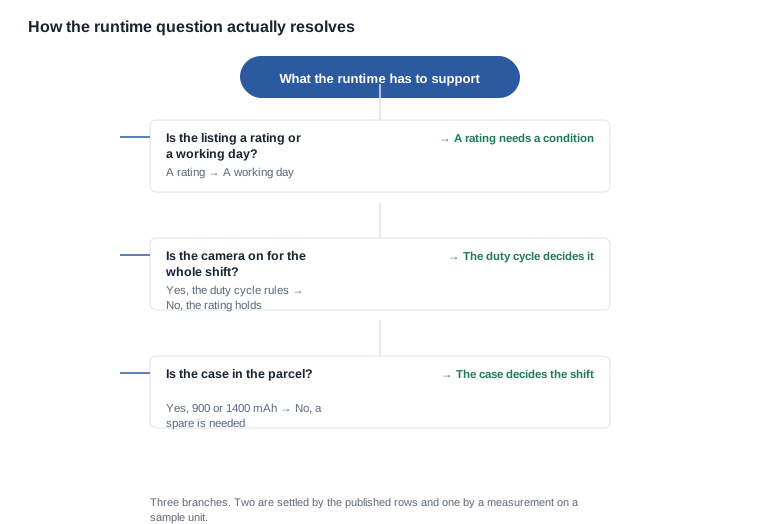
What the published rows support is a rating and a ceiling. Seven hours, two hours or less, 290 mAh, Type-C, and a case in one of two capacities. What they do not support is a working day, a charge time under two hours, a case in your parcel, or any statement about what the camera does to the drain. That is not a thin answer; it is the answer the documentation gives, and the difference between a rating and a working day is the difference between a listing and a commitment.
We will not convert a rating into a promise. The same seven hours appear here and on every other model in the range that publishes that figure, and the moment one of them is written on a page as a working day, the buyer who relied on it finds the difference on the first long day. We would rather publish the rating with its missing condition stated in the open than publish a condition we cannot evidence.
What we can do is close the gaps that can be closed. The runtime with the camera active, the mean-or-best-case question, the case charge time, the cycle life, the frame weight and the certification scope are all questions with answers behind them, and one written request plus one sample unit per model is usually enough to get them. The buyer checklist for this model is short, and the items on it are the ones that change what you can promise rather than the ones that change what you can describe.
If you tell us the duty cycle your product actually needs, we will tell you whether a 290 mAh cell with a case is sufficient, or whether you are looking at the wrong model for that use. Sometimes the useful answer is that a different model in the range fits better.
Related reading
- Published battery figures and how to read them — smart glasses battery life
- The same 290 mAh cell in the other camera model — L1 Pro versus L2 Utral battery and charging
- How this model is positioned — AI camera glasses
- What to check when the sample arrives — sample evaluation
Send us the duty cycle, the target retail price and the quantity, and we will tell you which configuration is realistic.


