

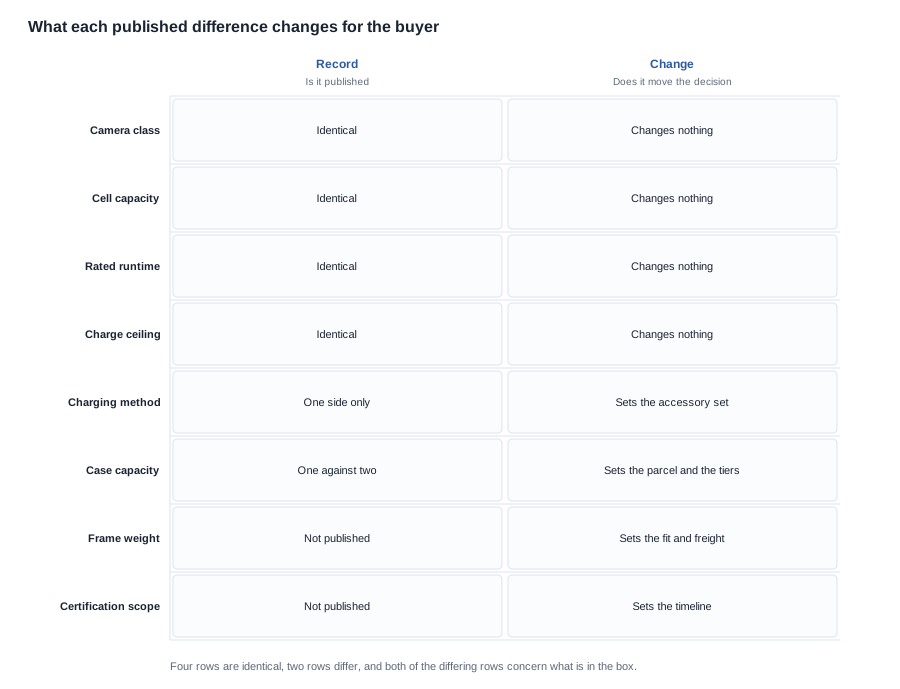
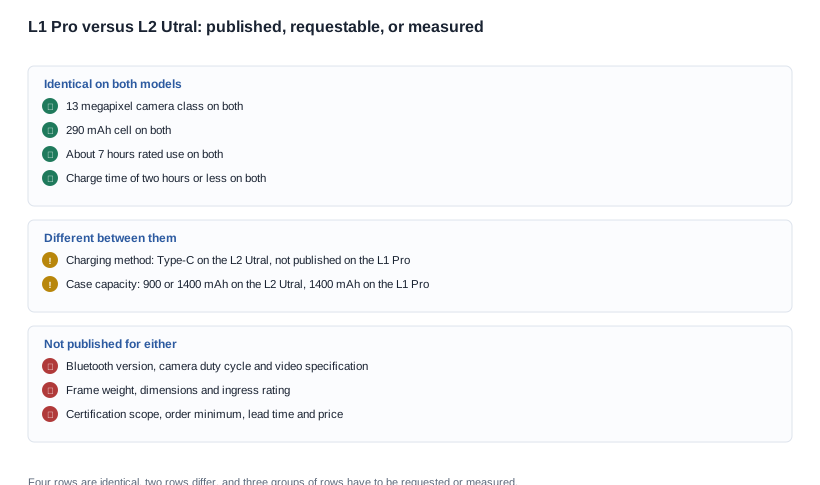
The L1 Pro and the L2 Utral share every published power figure: a 290 mAh frame cell, a charge time of two hours or less, and roughly seven hours of rated endurance, and they sit in the same 13-megapixel class. The comparison is therefore unusually narrow, and that narrowness is the finding rather than a limitation of the documentation. Only two published rows differ between them, and they differ in kind rather than in degree — one is a fact about how the frame is charged, and the other is an option on what the case holds. Everything else a buyer would want to compare is either identical across the pair or unpublished for both.
There is a third thing to say about this pair before any of it is useful, and it is the correction of the assumption most buyers arrive with. The catalogue publishes a charging method for the L2 Utral, and that method is Type-C. It publishes no charging method at all for the L1 Pro. The L1 Pro is one of four camera models in this range whose charging interface is simply not on the record, and the honest position is that it is neither magnetic nor Type-C — it is unpublished. That single row is the largest practical difference between these two models, and unlike the other differences it is a request rather than a comparison.
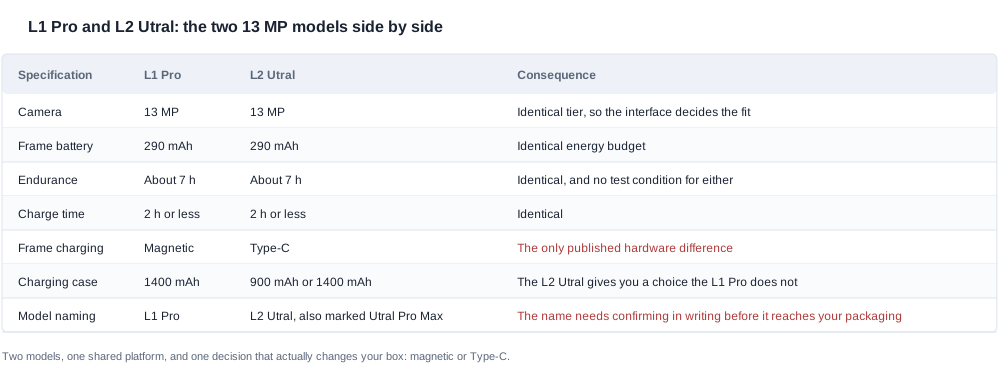
L1 Pro and L2 Utral: the shared platform
Both models sit on the same 290 mAh platform, and that cell size is shared with two other camera models: the CY03 and the CY05. The 290 mAh band is the largest cell published anywhere in the camera category, and the four models on it are the CY05, the L1 Pro and the CY03, and the L2 Utral. The camera class is a separate axis: 13 megapixels is a three-model tier, the L2 Utral and the L1 Pro, and the S7 and the S7 is the one on the tier that does not carry a 290 mAh cell.
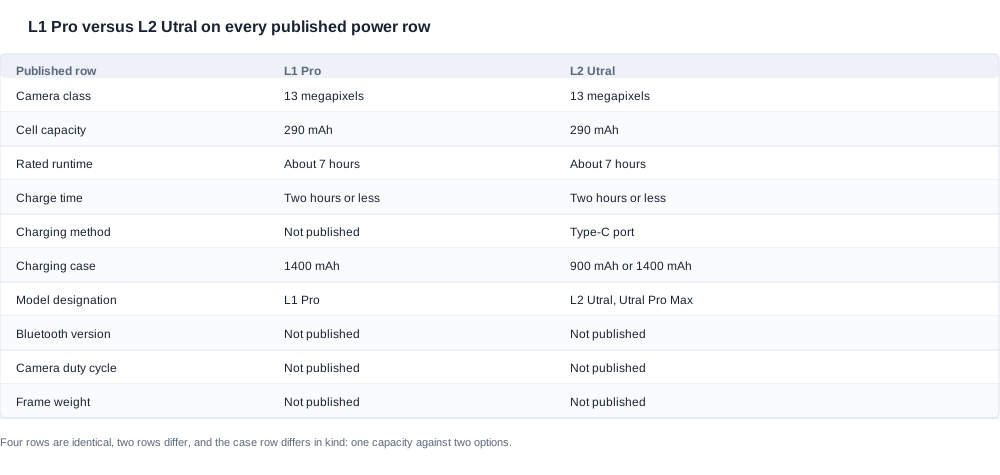
What that shared platform is worth is narrower than it first looks, and the difference is worth knowing before the artwork is drawn. One firmware branch and one app can plausibly serve models on the same platform, and that is a real saving on a software maintenance budget. One case is not published as shared. The catalogue publishes a 1400 mAh case for the CY03 and the CY05, and the L1 Pro, and both a 900 mAh and a 1400 mAh case for the L2 Utral, so a single capacity does sit across all four — but nothing in the catalogue says the cases are interchangeable, and interchangeability is a question for the supplier rather than an inference to make from a shared number.
| Published row | L1 Pro | L2 Utral | What it decides |
|---|---|---|---|
| Camera class | 13 megapixels | 13 megapixels | Nothing between the two |
| Cell capacity | 290 mAh | 290 mAh | Nothing between the two |
| Rated runtime | About 7 hours | About 7 hours | Nothing between the two |
| Charge time | Two hours or less | Two hours or less | The turnaround for both |
| Charging method | Not published | Type-C port | The accessory set |
| Charging case | 1400 mAh | 900 mAh or 1400 mAh | The parcel and the tiers |
| Model designation | L1 Pro | L2 Utral, Utral Pro Max | The file, the carton, customs |
| Bluetooth version | Not published | Not published | Any compatibility statement |
| Frame weight | Not published | Not published | The fit data and the freight class |
And the third model on the camera tier is worth naming. The 13-megapixel class is not a two-model comparison with a leftover: the S7 sits on the same camera class, and it carries a 260 mAh cell with magnetic charging, and the catalogue carries no charging case row for it at all. A programme that treats the L1 Pro and the L2 Utral as the whole of the 13-megapixel choice is working from a two-model view of a three-model tier, and the third model is the one whose power rows differ from both of these.
And the certification point is the one that turns a four-model programme into a four-file programme if nobody checks it. A document that names the L1 Pro does not automatically cover the L2 Utral, even where the electrical rows are identical, and a document that names one model covers one model. That is not a weakness in the models; it is how conformity files work. The certification coverage notes cover the mechanics, and the question to put to the supplier is simply which model strings a given file covers, per market.

The charging decision, which is the real decision
The L2 Utral charges over Type-C, and the L1 Pro's method is not published. The L2 Utral's frame takes a standard USB-C cable, which is the cable almost every customer already owns. The cost of the product drops by the value of a proprietary charging accessory, the box gets smaller, and the customer can charge from a laptop, a power bank or a car socket without asking the retailer for anything.
What the L1 Pro does is leave the accessory chain open, and open is a different state from known. Its catalogue page carries a case capacity but no charging method row, and it is one of four camera models in this range in that position — the L1 Pro, the CY03 and the CY05, and the MT6. All four publish a case capacity, and that is not a coincidence: the case is what the catalogue records when the interface is not. So the probable shape of the answer is a case-based charging route, but probable is not a published row, and a buyer who designs the accessory set for the L1 Pro on an assumption is designing a packaging programme on a guess.
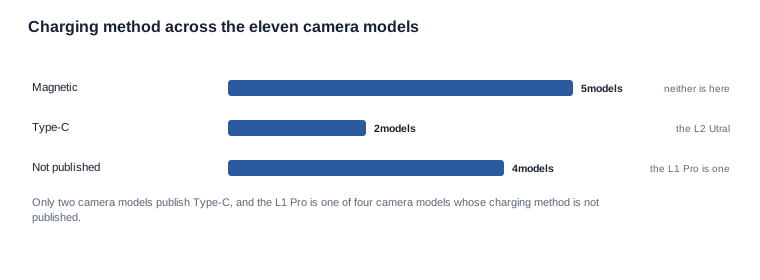
The count is what turns this into a commercial fact rather than a footnote. Across the eleven camera models in this catalogue, five publish magnetic charging, two publish Type-C, and four publish no method at all. The two Type-C camera models are the V03 Pro and the L2 Utral. So the L2 Utral is one of only two camera models in the range with a documented Type-C interface, and the L1 Pro is one of the four for which the question is still open. If your programme needs a documented charging route on the 13-megapixel class, one model has it today and the other does not.
And the request is cheap, which is the practical point. The supplier published the cell, the runtime, the charge ceiling, the camera class and a 1400 mAh case capacity for this model. What is missing is a single line on the interface, and a supplier who has recorded the case has almost certainly recorded the interface as well. That is one line in one message, and it is worth sending before the packaging artwork is drawn rather than after it is printed.
One more consequence follows from the same row, and it is about the parcel rather than the customer. A Type-C route means the frame itself needs no proprietary accessory, whatever else the box carries, and it means a customer who loses the cable can buy one anywhere rather than raising a support ticket. An unpublished route means neither of those is known yet, and an unknown accessory set is an unknown line in the carton, in the tooling budget and in the aftersales process.
How the case changes the commercial answer
A 1400 mAh case stores close to five times the energy of the 290 mAh frame cell, and that is what allows a customer to wear the product through a working day without thinking about it. It is why the case is a merchandising feature in this category rather than an accessory, and it is why two models with identical cells can still behave very differently in a customer's hand depending on which case is in the box.
And the L2 Utral is the only model in the range with a two-capacity case. The catalogue publishes a case capacity for five camera models: the CY03 and the L1 Pro, and the CY05 — each at 1400 mAh, the L2 Utral at 900 or 1400 mAh, and the MT6 at 1200 mAh in a folding case. Every one of those publishes a single figure except the L2 Utral, which publishes two. Two camera models publish a case with no capacity attached — the KY06 and the MT5 — the V03 Pro is recorded as having no case at all, and the S7 and the V06, and the V03 carry no case row whatsoever. So the case option is a structure nobody else in the range can copy, and it is a real option rather than a theoretical one: a lighter parcel at a lower freight class for a customer who does not need the full case, or a two-tier retail structure across one platform.

Three things about the case are not published for either model and should be: whether it recharges itself, how long the case takes to charge, and whether the case is included at the quantity you are ordering. The first two are hardware questions with short answers. The third is a commercial question that has to be settled before any artwork is printed, because the box contents decide the packaging, and the packaging is the one thing in this programme that cannot be changed after the first production run.
A second lithium cell in the parcel carries a cost that is easy to underestimate. A heavier carton means a different shipping class, a battery transport document, and more units in a warehouse for the same number of sellable products. For a reseller shipping in volume, the choice between a 900 mAh case and a 1400 mAh case is a choice about delivered cost per unit rather than about the product, and it should be costed as its own line rather than folded into a unit price where it disappears. Our charging case options analysis and the shipping weight breakdown cover the arithmetic.
What the endurance figure does not tell you
Both models publish about seven hours, and neither publishes the condition. The most important thing to say about that is narrow: because the two figures are identical, endurance cannot be a reason to choose between these two models. It is the one row that is certainly not going to decide your range, whatever the supplier's sales material implies.
On a camera product it is also the row that most needs a condition attached. The camera is the dominant load on the power budget, and the difference between a seven-hour rating with the camera recording and a seven-hour rating with the camera idle is the difference between a product that works and a product that returns. Three questions settle it, and they are worth asking for both models in the same message: was the camera recording during the measurement, was the radio link active, and was the figure taken on one unit or averaged across a batch. The L1 Pro battery life analysis covers the same ground for the L1 Pro on its own, and the L2 Utral battery life page does it for the other model.
And there is a comparison risk that only exists on a pair like this. Two ratings that look identical on paper are not necessarily measured the same way, and a seven-hour figure for one model may have come from a different duty cycle than the seven-hour figure for the other. If both models end up in the same range, that is not a problem as long as the rating travels with its condition; it becomes a problem the moment one of the two numbers is quoted to a customer and the other is quoted to a retailer. Ask the method for both, in one request, and write them into your specification as one line with two conditions rather than as two lines with one condition.
The charge ceiling is the one power row that is published for both, and it is worth being precise about it. Two hours or less is a ceiling rather than a measurement: it permits exactly two hours, and it does not license the tighter phrasing. That matters less for the comparison between these two models, which publish the same ceiling, and more for the line on your specification sheet, where "two hours or less" and "under two hours" are two different assertions and only the first of them is what the catalogue says. The same rule applies to the case charge time once you have it: a ceiling written as a ceiling can be tested, and a ceiling written as a tighter number cannot be met by a unit that was compliant all along.
How the figure is written decides how it can be used. On a listing it belongs as a rated use, with the words that make it a rating rather than a promise. On a purchase order it is a condition to be defined rather than a number to be repeated, because an acceptance criterion that repeats a rating without a condition cannot be failed and therefore cannot be enforced. Since both models carry the same figure, that single line of the specification does real work: it is the only endurance criterion you need, and it applies to both.
The naming point and the first-order list, which are not cosmetic
The catalogue writes this model as the L2 Utral and also carries the marking Utral Pro Max. Both readings look like a typographical rendering of Ultra, and neither is defined anywhere in the material we hold. Confirm the model designation in writing before it reaches your packaging, your listing, your certificate application or your customs paperwork, because a designation that differs between the supplier's document and yours creates real friction at customs and in the event of a quality claim.
On this model the naming point bites twice, because the case makes a third axis. There are two designations and two case capacities on the record, so the file you ask for has to cover the model string and the case option together. A file that covers the L2 Utral with the 900 mAh case and is silent on the 1400 mAh case is a file that has to be reissued the first time a customer orders the bigger one, and reissuing a conformity file is far slower than asking the question. The L1 Pro's own designation is a single string, which is simpler, and the same request resolves both models in one message.
Seven questions to ask for both models, in this order:
- What sensor, what field of view, what video format and frame rate? Neither model publishes a sensor model, a field of view or a frame rate, and the 13-megapixel class on its own does not describe an image.
- What was the seven-hour endurance measured under, with the camera active or idle, the radio connected or not, and across how many units?
- What is the frame weight for each model, and what does the packaged unit weigh with the case in it?
- What is the L1 Pro's charging method, stated per model designation, and is a magnetic route, a cable route or a dock route?
- Which case configuration is quoted by default at your quantity, and is the case a line item or included in the box?
- Does a 900 mAh option exist for the L1 Pro, and if it does not, which case does the L1 Pro ship with in each market?
- What is the correct model designation for each model and each case option, confirmed in writing?
How to evaluate the answers is as much a part of this as the questions are. An answer tied to a model designation and a case option can be written onto a specification sheet; an answer that covers the family cannot, and it will look complete on first reading. A runtime figure with no stated workload is a number nobody can repeat on a delivery, so treat it as a request rather than as a figure. The red flags are the same across all seven: an answer with no model string, a figure with no method, and a case capacity that comes back without the charging method attached to it. The criteria for accepting each answer differ, which is why one blanket follow-up message does less work than it appears to.
What the two published rows can and cannot settle
The L1 Pro and the L2 Utral are the same platform with two different packaging outcomes, not two different products, and the published rows make the charging method and the case structure the only real decision between them. We will not present endurance as a reason to choose between them, because the endurance rows are identical, and we will not quote a weight, an ingress rating or a certificate number that our documentation does not contain.
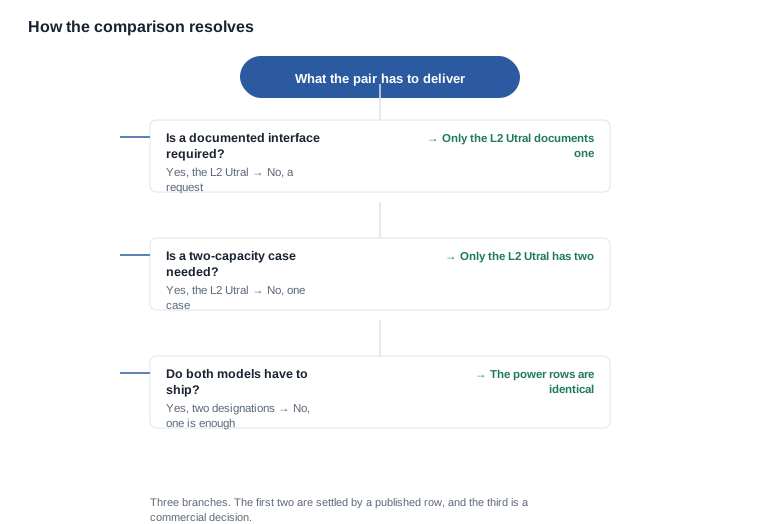
What the two differing rows settle is narrower than it looks, and it is worth stating precisely. The charging method settles the accessory set, the box contents and the support story. The case capacity settles the parcel, the freight class and the retail tier structure. Between them they decide what the customer holds and what you ship. They do not settle the image, because neither model publishes a sensor or a field of view; they do not settle the fit, because neither model publishes a weight; and they do not settle the paperwork, because there is no per-model certification row for either of them anywhere in the catalogue. What can be written down about compliance is the regulatory frame that a file would be built against — the Radio Equipment Directive (EU) 2014/53/EU and the EMC Directive 2014/32/EU — and not a certificate number.
And we will not fill the L1 Pro's blank by inference. It is tempting to conclude that a model with a published case capacity and no published interface charges magnetically, because that is the pattern across most of the range, and because a case has a charging surface to be built into. The pattern is real, but a pattern is not a row, and the difference matters exactly where it is expensive: the case design, the tooling, the packaging and the accessory list are all committed before anybody discovers the assumption was wrong. Write it as not published, ask the question, and let the answer close it.
What we can do is tell you which model the published rows make eligible for a given programme. A programme that requires a documented charging interface on the 13-megapixel class has one model that satisfies it today. A programme that wants two case tiers from one platform has one model that offers them. A programme that needs neither of those things, and only the camera class, has two models that are interchangeable on the power rows — and for that programme, one model is usually the better commercial answer than two, because the second model brings a second set of files, a second case option and a second packaging decision for no published difference in the product itself.
The published L1 Pro specification list and the L2 Utral specification list are the honest starting points for each model, and the AI camera glasses range page is where the rest of the eleven sit.
Related reading
- The published rows for the L2 Utral — L2 Utral smart glasses specifications and features
- Choosing across the whole camera range — AI camera glasses which model to pick
- The cost of the case in the parcel — AI camera glasses shipping weight
Tell us the channel, the volume and the markets, and we will tell you which charging approach and case configuration fit.


