

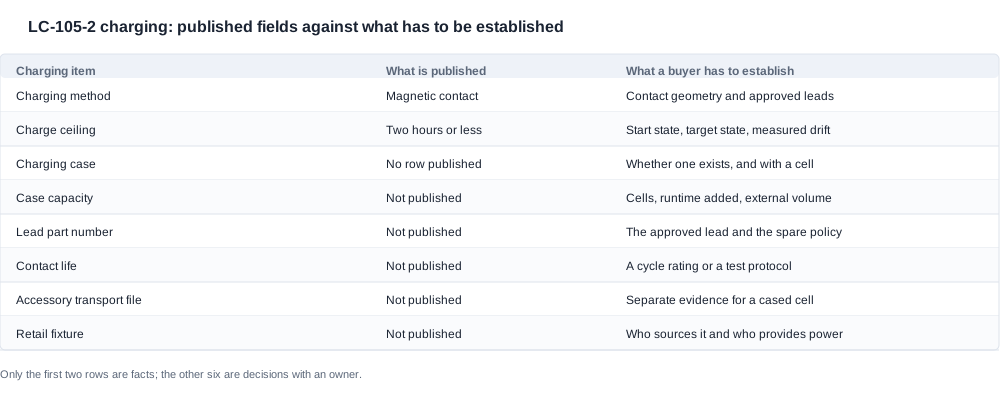
Charging is the one subject in this model that the catalogue answers plainly, and the answer changes how the product is operated rather than how it is specified. The published charging method is magnetic contact, and the published charge time is two hours or less. That single figure is a ceiling, not a duration, and it is the number a buyer should plan an interruption budget around.
Everything else about charging is a question rather than a published fact. Whether a charging case is supplied, what it holds, whether it is sold as part of the retail bundle or bought separately, how the contact points behave after a season in service, what a spare-lead policy looks like, and whether a second lithium item in the carton complicates the transport file — none of that appears in the published record for this model.
That is the subject of this article: the charging options that actually exist for a magnetic-contact product, what each one costs the buyer in stock, freight, compliance and after-sales terms, and the specific questions that settle the decision before an order is raised. The specification and feature page is the authoritative record of what is published; this article deals with what a buyer has to build around that record.
LC-105-2 charging options: what magnetic contact actually changes
Magnetic charging is usually described as a convenience feature, and in a consumer brochure that is exactly what it is. In a procurement file it is a supply-chain decision, because the method determines four things: what is in the box, what sits in the warehouse, what the field team has to carry, and what the after-sales process is built around.
The first of those is the packaging. A product that charges over a magnetic contact needs a lead, and that lead is a specific item with a specific part number, a minimum order quantity of its own and a colour or length variant if the buyer wants one. It is not a generic cable. That means it cannot be substituted at the receiving end when a customer has lost it, which pushes the loss-rate problem onto the importer rather than onto the customer. A buyer who has decided to stock a spare lead has to decide how many, and the answer to that question is a packaging and inventory decision, not a technical one.
The second is the charging act itself. Plugging a connector into a socket is a discrete event that a user either does or does not do. Placing a product onto a contact is a small physical routine that a user does half-heartedly, because a contact has to be aligned and a product has to be left in a place where somebody can find it again. This is not a claim about user behaviour in the abstract; it is a reason why the contact geometry, the magnetic strength and the position of the contact on the frame are worth asking about in writing, and why the packaging artwork matters more than it would for a port-equipped product. If the product has to be set down to charge, the retail carton and the retail counter both need somewhere for it to go.
The third is the service model. When a contact degrades, the symptom is not that the product stops working. It is that the charge takes longer, and then longer, and eventually the product will not reach a useful state within the window the buyer promised. That is a slow, ambiguous failure that arrives as a support conversation rather than a return, and it is one of the reasons contact quality belongs in the incoming inspection plan rather than in the sample phase.
The fourth is what the buyer has to say in the retail listing. A published charge time of two hours or less is a clean, checkable statement. It is also incomplete on its own, because a buyer who writes "charges in two hours or less" without stating the method is describing a ceiling for a process the reader cannot picture. The method belongs in the description, and it belongs in the instruction insert that the supplier has to provide.
The published charging rows for this model are short, and they are enough to plan with: the method is magnetic contact, and the charge ceiling is two hours. The table below sets those against the operating questions the published record leaves open.


The three ways this product gets charged in the field, and who supplies each
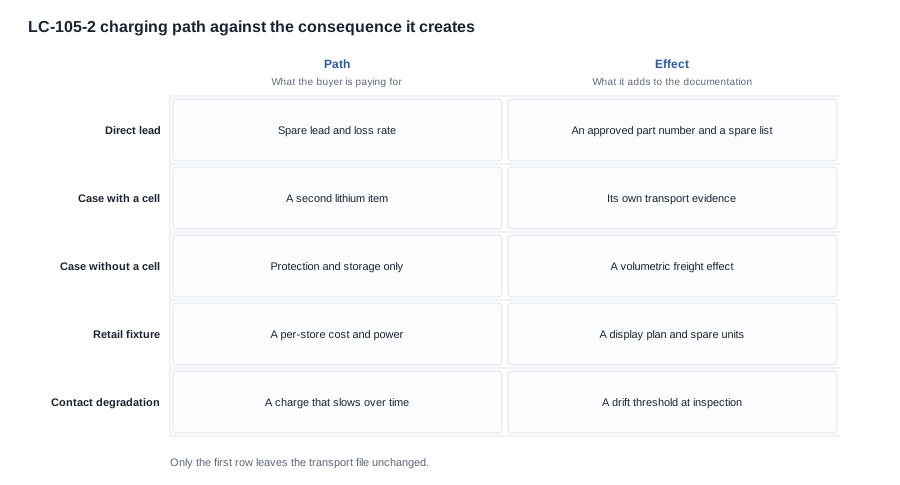
Every commercial decision about charging reduces to a question about which of three paths the buyer is actually paying for. A path is not just a physical method; it is a bundle of parts, paperwork and failure modes with an owner, and the owner is not always the same.
The direct lead. The product sits on a supplied cable that goes to a wall adapter or a power bank. The buyer owns the lead, the spare-lead policy and the loss rate; the supplier owns the contact geometry and the specification of which leads are approved. The transport file for the shipment is unaffected by this path, because the product travels with its own cells and the lead is an ordinary accessory. This is the path most quotations assume, and it is the cheapest to start with.
The charging case. A case that holds the product and carries its own cell, so that a product can be topped up away from a socket. Two things follow, and both belong in the buyer's file rather than in a later conversation with the forwarder. The first is that the case becomes a second product with its own capacity, its own cycle behaviour and its own failure modes, and the published record for this model contains no charging-case row at all. The second is that a case with a cell inside it is a second lithium item travelling in the same consignment, which brings its own transport documentation and its own presentation at the border. A buyer who adds a case has added a compliance surface, not a gift box.
The powered fixture. A retail counter fixture or a display dock that holds the product and charges it while it is on display. For a distributor this solves a specific problem, namely that a product sitting on a counter with a flat battery cannot be demonstrated. It also creates a cost that does not scale with unit volume, because the fixture is per store, and it adds a dependency on a power outlet at a point of sale that is not under the buyer's control. It is rarely in the supplier's standard quotation, so it is usually something the importer sources and owns, and it is a line that has to be present in the landed cost calculation before anyone compares two quotations.
Three paths, and in practice most programmes end up running two of them at once: a direct lead for the customer and the service bench, and a case or a fixture for the retail environment. The important part of the decision is not which combination is chosen but that the combination is fixed in the purchase specification, because every downstream document — the carton artwork, the instruction insert, the transport file, the spare-parts list, the retail fixture plan — inherits it.
The charging case question nobody answers in the specification
The case is the single most common open item in this product family, and it is worth handling carefully because a case is routinely treated as an accessory when it is in fact a product decision with four separate consequences.
The first consequence is the packaging and the freight. A case that holds the product is a box that has to survive a freight network alongside the product, and it adds a fixed volumetric quantity to every unit shipped. For a buyer moving volume on a long route, a case can add more to the freight bill than the product itself contributes, and that is a number the buyer can calculate before the order is placed provided somebody establishes the case's external volume early. Nothing about the case's dimensions appears in the published record.
The second is the compliance surface, and it is the one that is easiest to get wrong. A case with a cell inside it is a separate lithium item. That means it needs its own transport evidence, it may need to be declared separately on the shipping paperwork, and in some destinations it changes how the consignment is presented and inspected. A buyer who has treated the case as packaging discovers this at the point where the goods are already packed, which is the worst possible moment to discover it. The question to the supplier is therefore not "is a case available" but "is a case available with a cell, and what transport evidence accompanies the cell in the case".
The third is the aftersales behaviour, and it is where a case changes the economics of a warranty claim. A product that arrives with a flat battery because its case was left uncharged is a complaint, not a defect, and a buyer who has sold the product as a set needs a documented way to distinguish the two. A case also introduces a second failure mode into the set, and a service process that has to handle the case separately from the product is a service process the importer has to design rather than inherit.
The fourth is the retail proposition, and this is the one that has to be settled before the artwork is locked. A product sold with a case reads as a complete set; a product sold without one reads as the bare device, and the price and the shelf positioning that follow from those two positions are very different. This is a commercial decision that depends on the channel, the price tier and the destination market, and none of those three is fixed at the point where the technical file is requested.
There is one thing the buyer can be certain of, and it saves an afternoon of speculative research: the published record for this model contains no charging-case row. That is an absence of information, not a statement that no case exists. The distinction matters commercially, because a supplier who has not published a case row may still have a case in development, may have one for a sibling model, or may simply not have included it in the catalogue. Each of those three answers leads to a different plan, and all three are answerable with one question. The limitations page for this model sets out the full set of unpublished items in the same terms, so that the charging items can be read as part of the whole rather than as an isolated gap.

What magnetic charging does to the contact points over time
The contact is the part of this product that degrades, and it is the part with no published figure attached to it. There is no contact cycle rating, no contact resistance specification, no declared number of charge sessions before the interface is expected to reach the end of its useful life. That absence is normal for this class of product, and it should be treated as a verification task rather than as a defect.
The mechanism is straightforward enough to design a test around. A magnetic contact carries current across a metal-to-metal interface. The interface has a finite number of mating cycles, and every mating is an opportunity for the contact surfaces to be disturbed, for oxide or debris to build at the mating point, and for the contact resistance to rise. A rising contact resistance shows up as a longer charge time for the same starting state and the same target. It does not show up as a sudden failure, and it does not show up in a single-session sample test, which is why a buyer who tests only a fresh sample learns nothing about the field.
The verification that matters is a repeated-cycle test with a fixed protocol. The protocol has to fix the starting state of the cell, the target the charge is run to, the ambient temperature, and the number of charge sessions; and it has to record the elapsed time for each session rather than a single pass or fail. The output the buyer wants is a drift figure — the change in elapsed charge time over a stated number of sessions — and a threshold above which a unit is rejected at incoming inspection.
There are two things to get right in that protocol, and both are commonly got wrong. The first is that the starting state has to be defined, because a charge started from a different state takes a different time and a drift figure is meaningless without it. The second is that the test has to be run on a sample that came from the same production window as the goods, and it has to be repeated rather than performed once, because a drift figure from a single unit is an anecdote with a decimal point.
The commercial question that follows from the test is the spare-lead and spare-unit policy. If a contact degrades past the point where the charge ceiling can no longer be met, the unit is effectively out of specification, and the question is whether it is replaced, whether the product is sold with a fresh lead and a fresh contact, or whether the customer is told to expect a longer charge. That last option is the one that has to be decided deliberately rather than inherited, because it changes what the published ceiling means in practice. A buyer who has sold "two hours or less" and then discovers a service population charging in noticeably longer has a marketing problem and a returns problem at the same time.
A shortlist of questions that settle the charging decision
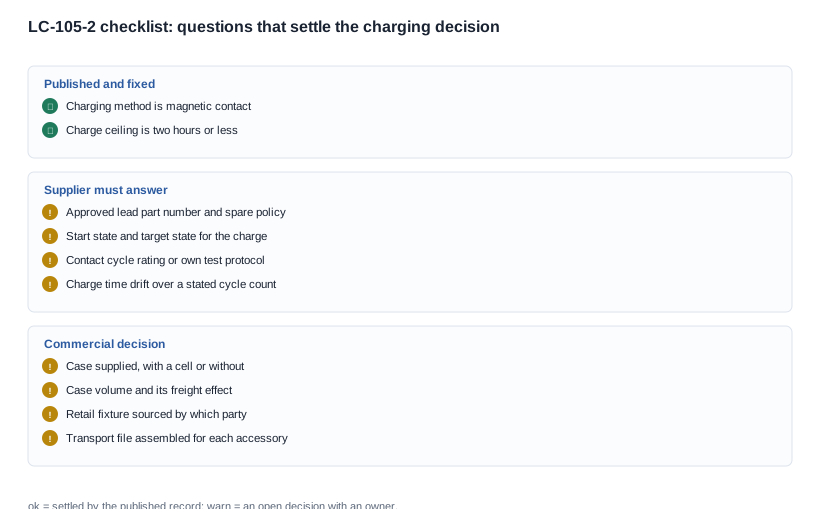
The questions below are ordered so that the ones with the longest lead time come first. The first group has to be answered before artwork is locked; the second before the transport file is assembled; the third before the first bulk order is released.
- Is a charging case offered for this model, and does it contain a cell. If it does, what capacity and what transport evidence travels with it.
- Which charging leads are approved, and what is their part number. A buyer needs a specific lead, not a compatible one.
- What is the spare-lead policy, and what is the expected loss rate per hundred units in service.
- Where is the charging contact positioned on the frame, and how is the product placed to charge. This determines whether the carton and the retail counter need somewhere for the product to sit.
- Is a powered retail fixture or dock available, and is it offered by the supplier or sourced by the importer.
- What is the charge time measured from, and to. A starting state and a target have to be defined before any charge-time figure means anything, including the published ceiling of two hours.
- Is there a contact cycle rating, and if not, what is the supplier's own test protocol for contact durability.
- What is the drift in charge time over a stated number of charge sessions, on a stated sample size.
- What is the case's external volume, and what is the change to the carton dimensions and the freight charge per unit.
- Which party carries the aftersales cost when a unit arrives with a flat battery because its case was left uncharged.
- Does the transport file for the product and the transport file for the case differ, and who assembles each.
- What does the supplier's instruction insert say about the charging procedure, and is it available in the languages the destination markets require.
The criteria that turn those questions into a decision are three, and they are worth writing into the purchase specification because they are the ones that get lost in a negotiation. First, the charging method and the charge ceiling have to be stated in the same terms as the published record, so that the retail listing, the carton and the specification agree. Second, the case decision has to be made explicitly, in writing, with the transport consequence attached, so that it cannot be inherited as an accident. Third, the contact durability has to be a measured number with a threshold, so that a slow degradation becomes a detected condition rather than a background complaint.
A buyer who applies those three criteria to two quotations will find that the visible difference between them is usually smaller than the difference between what each of them leaves open. That is the practical value of the checklist: it converts a comparison of totals into a comparison of how many questions each quotation still has to answer. The total cost of the gap rarely appears in either quote, and it is always more expensive to close it after the first production run than it is to close it in the quotation, which is the whole argument for putting the twelve questions on the table before a purchase order is raised.
The position we can take from the published record is narrow but firm. The charging method is magnetic contact and the charge ceiling is two hours or less, and those are the two charging facts that exist for this model. There is no published case row, no published contact rating, no published lead part number, no published case capacity, and no published transport document for either the product or any accessory that may accompany it. We will not present a typical contact life or a typical case capacity as though it described this product, because in a category where the whole charging proposition rests on a physical interface, a borrowed number is worse than an admitted gap.
If you are working out the charging plan for this model, tell us whether the product is sold bare, with a case, or with a retail fixture, and which destination markets the first shipment covers, and we will set out which of the twelve questions above the published record can already close for you, which have to go to the supplier, and which depend on decisions you have not taken yet.


