

The questions that come back about this model fall into three piles, and sorting them before you send anything to a supplier saves more time than any other hour you will spend on this product. The first pile is answered by the published record, and it should be answered in a sentence so that the conversation can move on. The second pile has no published answer but a supplier can produce one, and those are worth asking in writing. The third pile has no published answer and no obvious supplier, and those are questions a buyer has to answer for themselves before the product can be sold.
What follows is organised that way rather than by subject, because the subject grouping is what produces the unfocused question list that comes back as a long paragraph of marketing instead of answers. Each question below is written the way a buyer actually asks it, followed by what the record can and cannot settle, and followed by the action to take. The specification record for this model is the single place where the published fields are set out in full, and this article never repeats that listing.
LC-105-2 common questions, and how to tell which ones have a published answer
The test for sorting a question is not how important it is. It is where the answer lives. A question whose answer lives in the catalogue is closed by a citation. A question whose answer lives in the supplier's engineering file is closed by a document. A question whose answer lives in the buyer's own decision is closed by a decision, and asking the supplier about it produces a second-hand opinion rather than an answer.
That distinction is worth more than it sounds, because the most expensive questions in this product are the ones that get asked in the wrong pile. Asking a supplier for a decision they do not own produces an answer that sounds confident and commits nobody, and it has to be re-asked later. Asking a buyer to produce a catalogue fact produces a guess, and a guess that reaches a retail listing is a claim nobody owns.
Three working habits make the sorting reliable, and they are cheap. First, every question gets a status before it is sent: answered by the record, answered by the supplier, or answered by us. Second, the questions that need a document request the document by name and by date, because a document without a date and a version cannot be filed later. Third, the questions nobody can answer yet are written into the purchase specification as gaps rather than left as assumptions, so that both parties sign the same understanding of what is not yet known.
There is one more habit that pays for itself immediately, and it concerns how the questions are sent. A list of questions sent as prose comes back as prose. A numbered list comes back as a numbered list, and the gaps in the reply are then visible as gaps rather than buried in a paragraph. For a product where most of the interesting information does not exist yet, the shape of the reply matters more than its length.
The reason the shape matters is that partial answers are the normal case. A supplier who can answer six of twelve questions will normally answer all twelve in the same paragraph, and the six unanswered ones will not be marked. The criteria for a usable reply are simple enough to state in the covering note: every question is answered or explicitly declined, every answer that is a document carries a date and a version, and every answer that is a value carries the condition it was measured under. A supplier who declines a question is giving a usable answer, because a decline can be planned around. A supplier who answers loosely is not giving an answer, and the difference between a decline and a evasion is the difference between a project that can be scheduled and one that cannot.
The same logic applies to the questions the supplier answers with a range. A range is often the honest form of an answer, and it is frequently the right one, particularly for commercial terms where a volume tier exists. What makes a range unusable is when the range and its conditions are not attached to each other — a unit price band that does not say which quantity band it applies to is not a price, it is a shape. The red flags to watch for in a reply are consistent across the range of products in this category: a number with no condition, a document with no version, and a claim with no document behind it. Each of them looks like an answer on a quick read and turns out to be an assumption later, and each of them is easy to close at this stage and expensive to close after a production run.
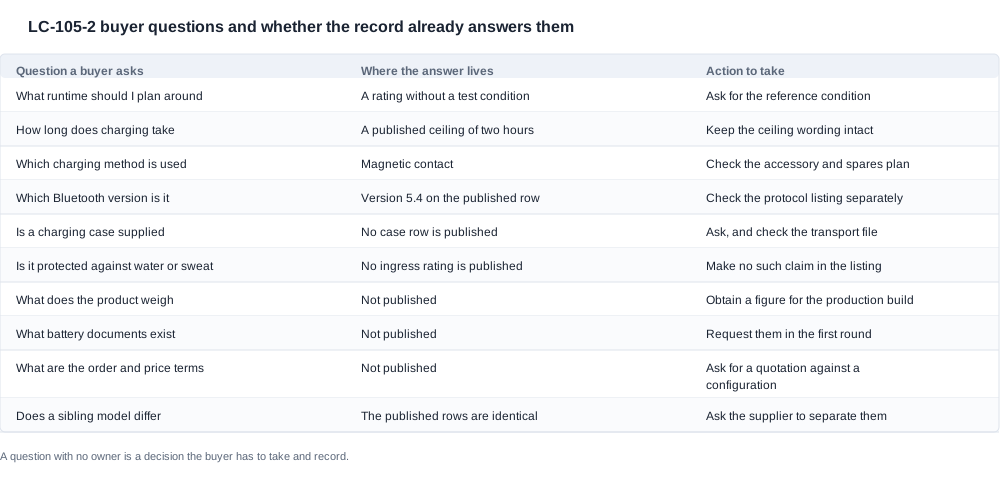
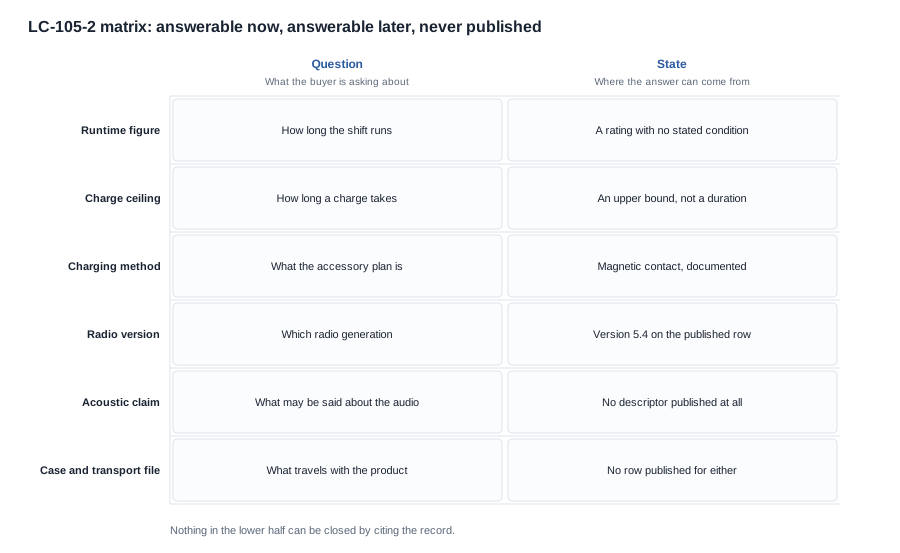
What runtime should I plan the deployment around? The published endurance is a rated figure of roughly eight hours, published without a stated test condition. That makes it a planning number and not a guaranteed duration, and the question worth asking is what the reference condition is. Until that comes back, plan the shift around the published figure and treat the gap as one your own duty cycle may or may not absorb.
How long does charging take? Two hours or less. This is a ceiling, and the ceiling has to survive translation into the retail listing, the carton and the purchase specification without being tightened into a stricter promise. If a distributor asks for a precise figure, the honest answer is that the published value is an upper bound and the supplier's own measured average, if it has one, is what belongs in the retail copy.
What is the charging method? Magnetic contact. It is a documented field, and it is the one that decides the spare-parts policy, the retail fixture question and the accessory file. Those three consequences are set out in the charging options note, which is worth reading before the first question round, because it is much easier to ask a supplier about a decision you have already thought through.
Which Bluetooth version is it? Version 5.4. That identifies the radio generation and takes one compatibility question off the table, and it is worth noting separately that the radio version and the protocol qualification are two different things — a version figure on a published row is not evidence of a member listing in the industry's own registry, which is a check the buyer performs rather than a document the supplier hands over.
Is there a charging case? No case row is published for this model. That is an absence of information rather than a statement that no case exists, and the distinction is worth a sentence in the question round because the answer determines the accessory transport file as well as the retail proposition.
Is it protected against water and sweat? No ingress rating is published for this model, and therefore no water, sweat or rain claim may appear in a listing. This one is worth confirming with your own compliance team rather than with the supplier, because the constraint is on what the buyer says rather than on what the product does.
What does it weigh? Not published. This is the single most common request from a distributor and it is also the one most often answered with a number that turns out to describe a different product in the range. The correct answer to a distributor who needs a figure is that the weight is not published and that a figure will be issued against the production configuration once the packaging is settled.
What is the battery transport documentation? Not published for this model. It is a supplier document, it has to exist before the first shipment, and it should be requested in the same round as the market-access documents rather than separately.
What is the minimum order quantity, the sample order quantity, the unit price and the lead time? None of these are published, and all four are commercial terms that belong in a quotation rather than in a specification. A buyer who asks for them as facts will get a range rather than a commitment, so the better approach is to ask for a quotation against a named configuration and a named quantity.
Does a sibling model differ from this one? A sibling in the range carries the same published row, and nothing in the catalogue separates the two. That is a question with a supplier answer rather than a catalogue answer, and it is the subject of the comparison against the models around it.


Questions about the product itself
Three product questions recur, and they are the three that determine whether the product can be listed in a way that survives a competitor comparison or a customer complaint.
What can the audio side actually do? The published record for this model carries the radio version and the charging rows, and it carries no acoustic descriptor at all — no surround-sound line, no microphone count, no noise-reduction claim. That absence matters commercially, because a distributor will ask whether this model matches the other audio models in the range, and the honest answer has to be that the published record does not let you say. A buyer who wants to make an audio claim needs a supplier document that supports it, and a claim that the supplier has not substantiated is a claim the buyer carries.
What is the difference between the two 55 mAh cells in it? The published row describes the cell configuration as two 55 mAh cells, and the catalogue does not publish a total, a distribution between the two, or an arrangement. For a buyer this is mostly a curiosity, but it becomes material in one place: a product that reports a flat state on one side and a charged state on the other is a product that a technician needs a procedure for, and a procedure is written from a supplier's description of the arrangement.
Does it pair with more than one device at once? Nothing in the published record says, in either direction. Multi-point behaviour is a common expectation in this category and it is not a default assumption a buyer should make, so it belongs in the question list with a request for a written answer, because the answer determines how the instruction insert describes the connection procedure and how a support agent answers the first call.
Two further product questions are worth raising with a supplier even though they sound trivial, because they are the questions that determine the retail proposition. The first is what colours the model is offered in, which drives the artwork and the listing, and the second is what the packaging contains, which drives the freight, the carton artwork and the after-sales spares. Neither is a technical matter, and both are needed before a first order is placed.

Questions about the paperwork and the shipment
These are the questions with the longest lead time, and they are the ones that are most often left until after the goods are packed.
What documents exist for this model? The catalogue carries no per-model conformity row, so the file has to be requested. A buyer should ask for the index of the technical file rather than for individual documents, because an index shows the full population of what the supplier holds and lets a buyer see immediately what is missing. How that request is ordered, and who ends up responsible for the product in each destination market, is covered on the export side of the compliance file.
Which parts of the product do the declarations cover? A declaration that covers the radio and the charger but not the cells, or not the acoustic components, is a partial file, and a buyer should know which parts are inside it and which are outside. The list of covered parts is a reasonable thing to request and a reasonable thing to record in the purchase specification.
What is the packaging configuration for transport? A two-cell product plus a lead plus a case plus the retail carton is a packing problem with a volumetric answer, and the volumetric answer determines the freight cost per unit. Nothing about the packing configuration is published, and it is worth establishing before the first quotation rather than after the first booking.
What is the state of the product when it ships? This is a question with a surprisingly large practical answer. A product shipped with a charged cell and a product shipped with a flat one are different products as far as the transport rules and the retail experience are concerned, and the buyer's preference here should be stated explicitly rather than left to the factory's packing habits.
What is the aftersales route? A warranty term, a claim procedure, a turnaround and a freight arrangement are all commercial terms that are not published. A buyer who expects to sell through a distributor needs the route in writing, because the distributor will ask for it and the answer has to be consistent across the channel.
The way to run this group is as a single request rather than five. Buyers who send a document request with a named scope, a named date and a named recipient get a coherent file back, and buyers who send five separate requests get five partial answers and an argument about which version governs.
It also helps to sequence the group deliberately, because the questions in it are not independent of each other. The transport question comes before the packaging question, because the case decision changes the packing. The packing question comes before the weight question, because the weight a distributor publishes is the weight of the packed retail unit rather than of the product alone. The model designation comes first of all, because every document in the group is issued against it and a document issued against the wrong name cannot be corrected without re-issuing everything that depends on it. A buyer who works the group in that order can answer the commercial questions with an estimate on the first pass and replace the estimate with a document on the second, instead of waiting for perfect information before starting.
The trade-off in all of this is between speed and completeness, and the usual mistake is to assume the two are the same axis. They are not. A buyer who asks twelve questions in one round and waits for all twelve gets a slow reply and a complete file. A buyer who asks the same twelve in three rounds gets three replies, three opportunities for the answers to drift out of step with each other, and a document set that has to be reconciled at the end. The first approach is slower and the second is faster, and the total cost of the second is usually higher than the time it saves, which is why the shortlist of documents to request, and the order of that list, is worth deciding once and writing down.
Questions that should stop an order until they are answered
A small number of questions in this product are not merely open; they are the ones where the buyer should not release a bulk order until the answer exists in writing, because an incorrect assumption about them is discovered in the field rather than in the office.
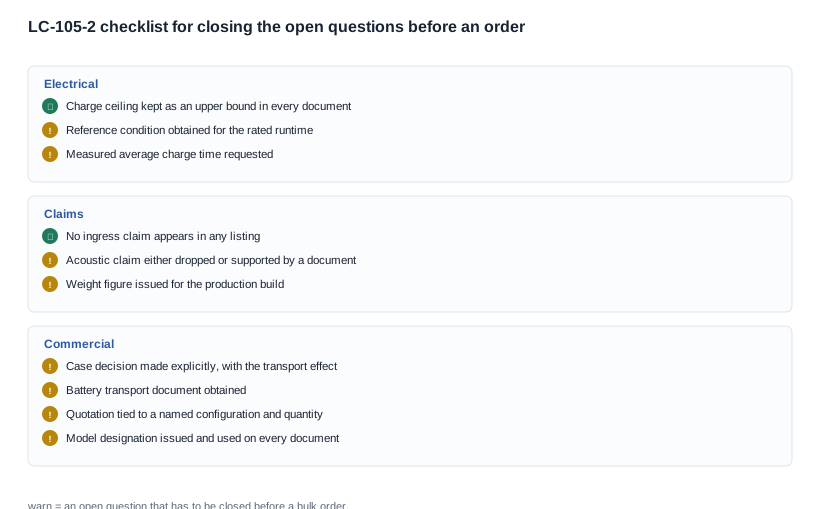
- The charging ceiling and the measured average. If the published ceiling of two hours is tightened anywhere in the retail copy, the gap between the promise and the product becomes a support cost.
- The reference condition behind the rated runtime. A rating without a condition is a planning figure, and a planning figure that turns out to have been measured under favourable conditions is a plan that fails on shift one.
- The acoustic claim. If the listing is going to say something about the audio, a document has to support it, and a competitor comparison will expose an unsupported claim faster than anything else.
- The ingress position. No rating means no claim, and a claim that appears in a distributor's listing is a claim the importer carries.
- The weight. The figure that a distributor publishes is the figure that customers hold the product to, and the figure is not published here.
- The charging case and its transport evidence. A case with a cell changes the shipment, not just the carton.
- The battery transport document. Without it, the first consignment does not move.
- The model designation and the file issued against it. A file issued against a name that does not appear on the unit and on the carton cannot be reconciled later.
The test for each of these is the same, and it is the test that turns a list of questions into a control: the answer has to exist as a document with a date and a version, or as a decision recorded in the purchase specification. An answer given in a conversation is not an answer, because the person who gave it will have moved on by the time the first shipment is held up at a border.
Our own position on the questions above is the one we take everywhere in this range. We publish what the catalogue publishes, and where the catalogue is silent we say so plainly rather than filling the space with a typical figure from the industry. For this model that means the electrical and radio rows are answerable today, and that the weight, the ingress position, the case, the transport documents, the commercial terms and the per-model conformity file are not. The limitations page collects the unpublished items in one place, and the value assessment note deals with what it means to judge a product whose price is not published either.
If you send us the list of questions your own customers and your own compliance team are asking, we will mark each one as answerable from the published record, dependent on a supplier document, or dependent on a decision you have not taken, and we will tell you which of them is worth raising in the first round and which can wait for the second.


