

Judging value on a product like this is awkward, because the two things a buyer would normally use to judge it are both missing. There is no published price, so there is no ratio to calculate; and there is no published weight, no material, no acoustic descriptor and no case arrangement, so the qualitative side of the value case is undocumented as well. A buyer who asks whether the product is worth the money is therefore asking a question that cannot be answered with figures, and the honest answer is that the question has to be rebuilt rather than answered.
Rebuilt, it becomes a better question. What a buyer can do without a price is decide which cost model the product belongs in, establish what would have to change for the product to be a good purchase, and then find out what the supplier's quotation actually contains once the configuration is fixed. That is a slower process than reading a spec sheet and a price, but it is the only one that produces a defensible answer, and it is the one that prevents a buyer from discovering, a season later, that the cheap product was the expensive one.
This article sets out that process: the dimensions that actually move the total cost, the customisation dimensions that determine whether a brand can be built on this product at all, a decision path for a first order, and a statement of the items we do not publish and therefore do not quote.
LC-105-2 value for money: judging a product whose price is not published
The reason there is no published price is worth understanding before treating it as a gap to be worked around. The catalogue is a product record rather than a commercial document: it carries the fields that describe what a product is, and it does not carry the fields that describe what it costs to buy. A price would also be a moving quantity — dependent on volume, on packaging, on the documentation scope and on the configuration — and a catalogue that published one number for it would be publishing a number that is only true in one particular case.
That does not make the absence harmless, and it does not mean a buyer should stop asking about price. It means the question has to be asked properly: not what does this model cost, but what is the total cost of a defined configuration at a defined volume, including the accessory chain, the documentation scope, the packaging, the freight terms and the service commitment.
Three sub-questions sit inside that, and they fail in different ways.
Is the product right for the deployment? This is a judgement about the published electrical rows — the cell class, the endurance rating, the charge ceiling and the charging method — set against a duty cycle the buyer controls. It is the only part of the value case that can be settled from the record, and it is the part most buyers settle last.
Is the configuration complete? A quotation for a bare product, a product with a case, a product with a per-market documentation package and a product with a service commitment are four different things, and they are not close to each other in cost. Comparing quotations without establishing the configuration is the most common way a value comparison goes wrong.
Is the total cost the one the business model can carry? Unit price is a small part of the total, and for a product with a proprietary charging accessory, a translated instruction set, a per-market conformity file and a distributor margin, the other parts are not small. A buyer who compares unit prices will reach the wrong answer with complete confidence.
The one thing a value judgement cannot be based on here is a comparison with a competing product on headline specification, because the headline specification of this product is a set of electrical and radio rows and the interesting differences are in the fields nobody publishes. That is the subject of the twin comparison, which is worth reading alongside this page whenever the question is whether this is the right platform rather than the right price.

The dimensions that actually move the total cost
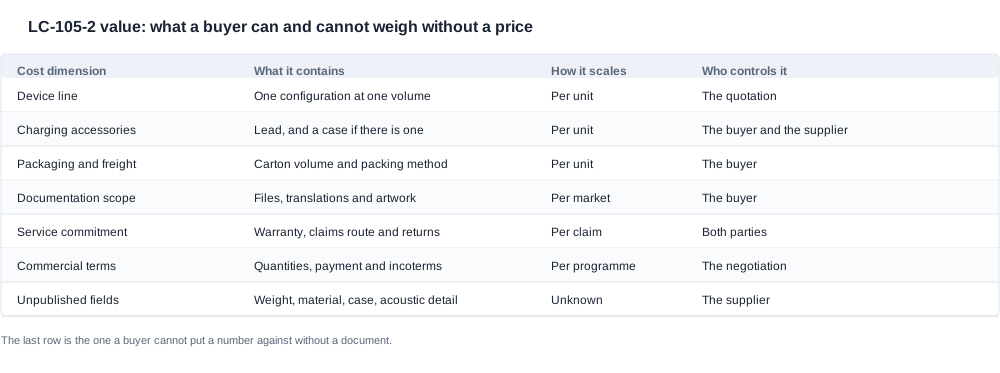
A total cost is easier to reason about when the components are sorted by how much control the buyer has over them, because a dimension the buyer controls is a negotiation and a dimension nobody controls is a fact to be priced.
The device itself. One line, one configuration, and the only part of the total that most buyers think about. Its variability comes from volume and from the configuration options, and both are settled in the quotation.
The charging accessory chain. Magnetic charging makes the lead a specific, proprietary, stocked item rather than a generic cable, and the case, if there is one, is a second product. Both are per-unit costs, both recur on every order, and both are invisible in a device price. This is usually the largest single correction a buyer makes to its own first estimate.
The packaging and the freight. The carton dimensions, the volumetric weight and the packing configuration determine the freight cost per unit, and the case decision changes all three. For a distributor moving volume on a long route this can outweigh the device line.
The documentation scope. A conformity file per model, a transport document for the cells, translated instruction sets per market, and the artwork work that follows each of them. This is largely a per-market cost with a per-model element, and it is the cost that gets left out of the estimate and then appears in the second year of selling.
The service commitment. A warranty term, a claims procedure, a response time and a freight arrangement for returns. It does not appear in a quotation unless somebody asks for it in writing, and it is a real cost with a real cycle time.
The commercial terms. The minimum order quantity, the sample quantity, the payment terms, the incoterms and the tooling where a custom part is involved. These do not change the unit price much; they change the cash position and the risk, and a buyer that ignores them can find that the price was right and the deal was not.
Against those six, the published electrical rows do something different: they tell the buyer whether the product belongs in the portfolio at all. They are a filter, not a price. Treating them as a value argument — which is what happens when the only numbers available are technical ones — is the single most common analytical error in this category, and it produces a conclusion that looks rigorous and is not about money at all.

The customisation dimensions that decide whether a brand can be built on it
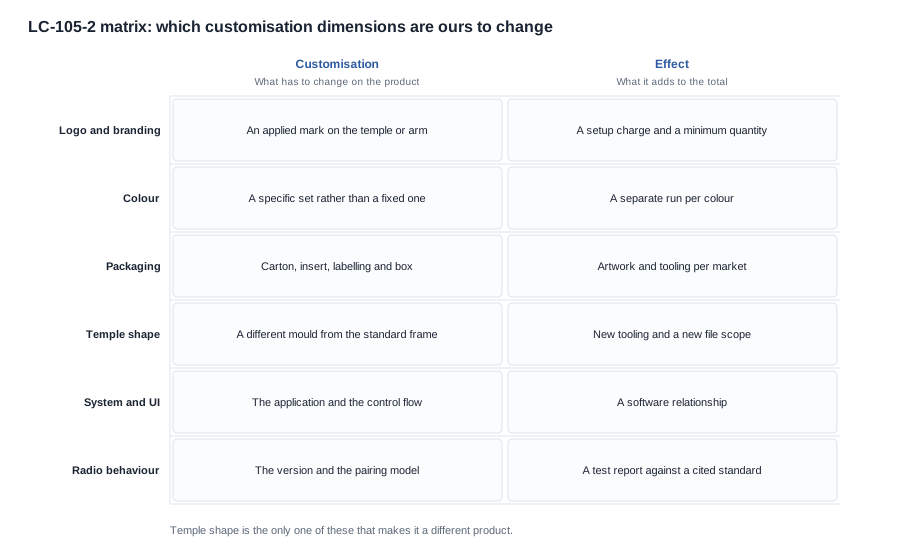
Value in a product of this class is often decided well before the price is discussed, because the question is not only whether the product is good enough but whether it can carry a brand. That is a question about customisation, and the dimensions that matter are structural rather than cosmetic.
The first dimension is logo and external branding: whether a mark can be applied to the temple or the arm, what process is used, what the minimum quantity for a custom run is, and whether the custom treatment changes the tooling. A buyer with an existing brand identity cannot use a product that carries somebody else's, and the cost of customisation is usually quoted separately precisely because it is a separate operation with its own setup.
The second is colour. A published catalogue carries product photographs and, for some entries, a short list of colour names. A brand usually needs a specific set, and a product offered in a fixed set that does not include the brand's colour is a product the brand cannot launch with, regardless of what it costs.
The third is packaging: the retail carton, the insert, the labelling and the accessory box, each of which is a separate artwork and tooling line. Packaging is also where the transit damage rate is decided, and it is the only part of the product a customer sees before opening it.
The fourth is temple shape and frame geometry. This is the dimension that determines whether the product reads as the brand's product rather than as a generic item with a logo on it, and it is the one that is hardest to obtain: it generally implies a different mould, and therefore different tooling, different certification scope and a different landed cost.
The fifth is system and UI: what the device connects to, what application drives it, what the pairing and control flow looks like, and what language and branding the interface carries. A brand that has an application already has a software relationship with the supplier, and that relationship is often where the real leverage lies.
The sixth is Bluetooth and the radio behaviour: which version, how the radio behaves in a multi-device environment, and what the radio means for the certification file. This model is published at version 5.4, which is a good starting point, and the rest of the radio question is a document request.
A seventh dimension is worth adding for buyers who sell through partners: what the distributor is allowed to do. Whether the brand's own specification survives into a partner's listing, whether a claim can be made at the distributor level, and whether a competitor's product can sit next to it on the same shelf with a different specification sheet. That is a channel decision with a technical consequence, and it is settled before the first order rather than during the first negotiation with a partner.


A decision path for a first order
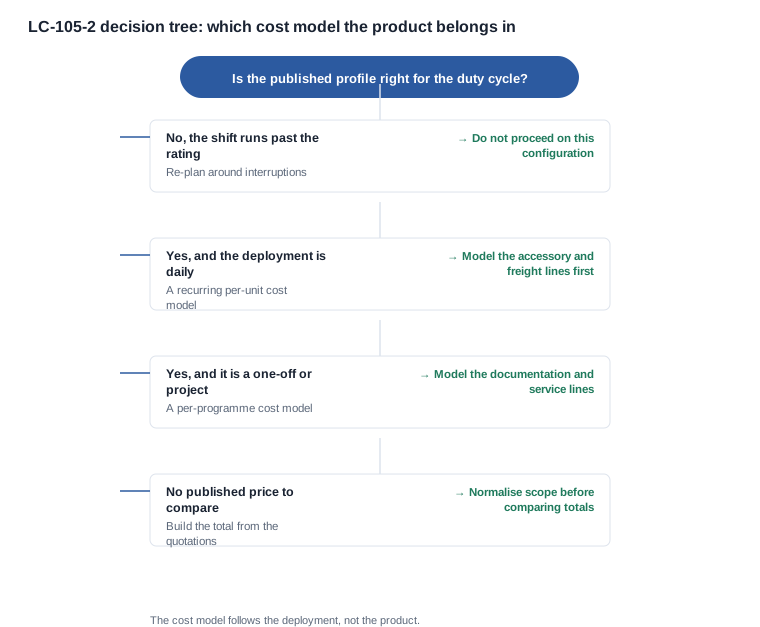
The path below is what a buyer does when there is no price to compare. It is deliberately ordered so that the decisions that change the configuration come before the quotation, because every one of them moves the number.
- Fix the duty cycle and test it against the published rows. If the deployment does not fit the rated endurance and the charge ceiling, no commercial discussion will change the outcome.
- Decide the configuration, including the case, the colour set, the packaging scope, the number of markets and the documentation scope per market. These are buyer decisions, and they are the ones that move the total.
- Decide the customisation scope, and separate the dimensions that need tooling from the ones that do not. A product that needs a different temple shape is a different product commercially, not a variant.
- Obtain the quotations against that single configuration, and require that each quotation states what it includes: the accessory set, the documentation, the packaging and the service commitment.
- Normalise the quotations onto the same scope, and record what had to be changed to normalise them. The differences that survive normalisation are real; the ones that do not were scope.
- Model the total cost per unit, adding the freight on the actual carton dimensions, the accessory cost at the actual volume, the amortised documentation cost per market and the service cost the aftersales route will actually generate.
- Re-test the value case against the model the business is choosing between, on the dimensions that are documented, and treat the undocumented ones as the residual risk in the decision rather than as differences in the product.
Step seven is the one that is most often skipped and the one that matters most, because the residual risk has to be priced somewhere. A buyer who has not closed a documentation gap has not saved the cost of closing it; the buyer has transferred it to their own balance sheet, and the value case is only complete when that transfer is visible.
Two of the steps are worth isolating because they are the ones that get skipped. The normalisation step is skipped because it is tedious and because nobody wants to tell a supplier that their quotation is missing a line. The step seven test is skipped because it asks a buyer to say which of two products they would rather have, before either has been sampled, which feels premature. Both are the wrong instincts. Normalisation is arithmetic and it changes the answer; the comparison in step seven is a test of which unknowns the business would rather carry, and it is exactly the question that a product with a thin published record forces a buyer to answer.
The steps also produce a negotiating position, which is worth more than a lower price. A buyer who can say that a quotation differs from another by a defined scope, that the scope is priced, and that the documentation obligation is the same in both, is negotiating on substance. A buyer comparing two numbers is negotiating on nothing.
What the unpublished items do to the value calculation
There is a set of fields that this product does not publish, and the honest position on them is that we do not quote a value for any of them, because a value we cannot substantiate is worse than an admitted gap.
That covers the unit price, the minimum order quantity, the sample quantity, the delivery schedule, the warranty terms, the weight, the frame and temple material, the ingress rating, the charging-case capacity, the microphone and noise-reduction arrangement, the battery transport documentation and the per-model conformity file. We are not going to print a typical figure for any of them, because a figure taken from another product in the range describes that product and not this one, and a figure taken from the industry describes nobody's product at all.
There is a practical consequence for the value question that is worth stating directly. Because the unpublished fields cannot be converted into a cost, they cannot be converted into a value either. A buyer who prices this product has to treat every one of those fields as an open line rather than as a zero, and the discipline that follows from that is to put a name against each open line and a date against each name — a supplier document, a buyer decision, or an accepted risk that somebody has signed for.
The product also has to be judged as it is, not as a hypothetical version of it. Its published profile describes a device built around two small cells, a rated endurance in the region of eight hours, an upper bound of two hours on a charge, and a magnetic charging method. That is a coherent design for a full working day with one or two interruptions, and it is a design that will suit a channel selling to people who want something unobtrusive for a working day. It will not suit a channel whose product promise is all-day battery or a top-up that never happens. Recognising which side of that line a business sits on is the first step, and it is a step that costs nothing.
There is a further reason the unpublished fields matter more to the value calculation than to the specification. A specification is a list, and a list can be incomplete and still be useful: a buyer can order against it, and the missing items surface as questions. A value calculation is a model, and a model with missing inputs does not produce a slightly wrong answer; it produces an answer whose error is invisible, because the number still comes out. A total cost built with a guessed weight and an assumed case capacity looks exactly like a total cost built with both, and the difference between them is the difference between a decision and a guess. Which is why the discipline in this article is to put a name against every open line rather than to put a plausible number against it, because a named gap can be closed, and a plausible number can only be discovered.
The same reasoning applies to the qualitative side of the value case. The product is presented on a light platform, and a light platform has real commercial appeal in channels where the buyer wants something unobtrusive for a working day. But the weight is not published and the material is not published, so that appeal is a design intention rather than a measurement. It is entirely legitimate to buy a product for that reason; it is not legitimate to quote the lightness to a customer as though it were a published figure, and the two positions have to be kept apart in the buyer's own paperwork.
Our own position on price is therefore a limitation of the published record rather than a refusal to discuss it. We will quote a price for a defined configuration at a defined volume as soon as one is asked for, we will set out what that price includes, and we will not print a number here that a buyer cannot check against a quotation. Where the question is whether this platform is the right one rather than what it will cost to run, the sibling model published on a matching row is the relevant comparison, and it is handled in the dedicated twin comparison. The per-unit accessory chain, which is usually the largest correction a buyer makes to its own first estimate, is set out in the charging analysis, and the decision path above is the right place to look if the question is what the product will cost to run.
If you want the value model built for your own business, send us the duty cycle you have to support, the markets you are selling into, the configuration you need including any case, and the volume you are planning, and we will return the cost lines that are knowable, the ones that are not, and the decision each of the open ones belongs to.


