

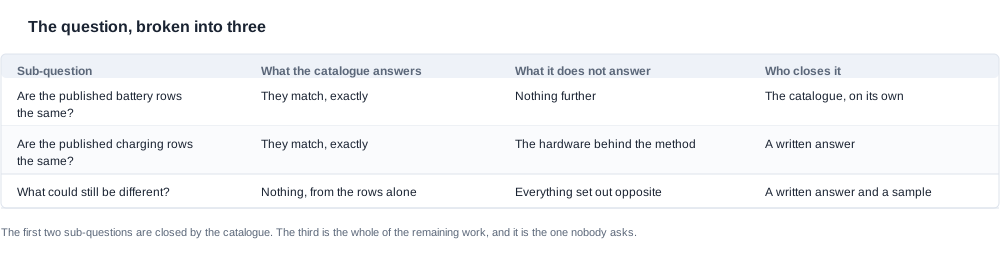
The question in the title has three parts inside it, and the published data answers the first two of them completely and the third one not at all. That is the whole of the difficulty, and it is worth separating the three parts before doing anything else, because a buyer who treats the question as a single question will read two identical rows, conclude that the two designations are the same, and order against a product they have not actually distinguished.
So: are the published battery rows the same for these two designations? Yes, and they are the same line for line. Are the published charging rows the same? Yes, in exactly the same way. And what could nevertheless be different between two designations whose published rows match? The catalogue does not say, because the catalogue does not publish the information that would answer it, and the only honest position is that this is an open question with a name and a date on it.
The two designations are not thereby the same product, and they are not thereby different products. The published record does not distinguish them, and a record that does not distinguish them cannot be used to choose between them. What it can do is tell a buyer exactly what has to be established, and the list is short.
LC-105-2 smart glasses vs LC-105-1 battery and charging: the question inside the question
Why the battery and charging rows match
There is nothing remarkable about two models publishing the same rows, and it happens across this range more often than a buyer expects. The catalogue publishes the same handful of lines for every model of a given kind: the cell, the rated endurance, the charge time, the charging method and, where one is printed, the radio version. Two models of the same kind with the same configuration will print the same lines, because the lines describe the configuration rather than the designation.
That is the key to reading them: the rows describe the product, and the designation names it. When two designations print identical rows, the reading is not that the two names refer to one product. It is that the published attributes of the two are the same, and the name is the only thing that differs on the page.
The two designations in this comparison are audio models, and the rows for both cover the same five lines. What a buyer can take from that is narrow but useful. There is no charging routine to teach twice, no accessory difference to manage, and no endurance difference to explain in a listing. The rows also mean that the endurance figure and the charge ceiling published for either of them apply equally to both, and that a measurement taken on one is a measurement taken on the other's specification.
Why identical specifications can still be two products
A catalogue prints a designation because the two things it names are, in some commercially meaningful sense, different. If they were not, one of the names would have been withdrawn. So the interesting question is not whether the two differ, which is close to certain, but where the difference sits, and the answer is nowhere in the rows.
The differences that matter to a channel divide into two families. The first is the difference in what the two are for: one may be built for a distributor channel and the other for a direct channel, or one may be the variant intended for a market with a particular label set, or one may exist because a customer asked for a name. None of that appears in a specification, because a specification is about the product while a designation is about the commercial arrangement around it.
The second family is the difference in what sits behind the rows: the hardware revision, the component source, the configuration set, the packing. These are closer to the product and further from the name, and they are the ones that matter when a buyer is comparing two designations against a single written specification and a single set of documents.
The discipline for a buyer is to keep the two families apart. Questions about what the designations are for go in the commercial request and are usually answered in a sentence. Questions about what sits behind the rows go in the technical request and need a sample. Mixing them produces long meetings and short answers, because a supplier answering a commercial question with a component list has not been asked the right question, and a supplier answering a component question with a channel policy has been asked it in the wrong meeting.
What the identical rows do not settle
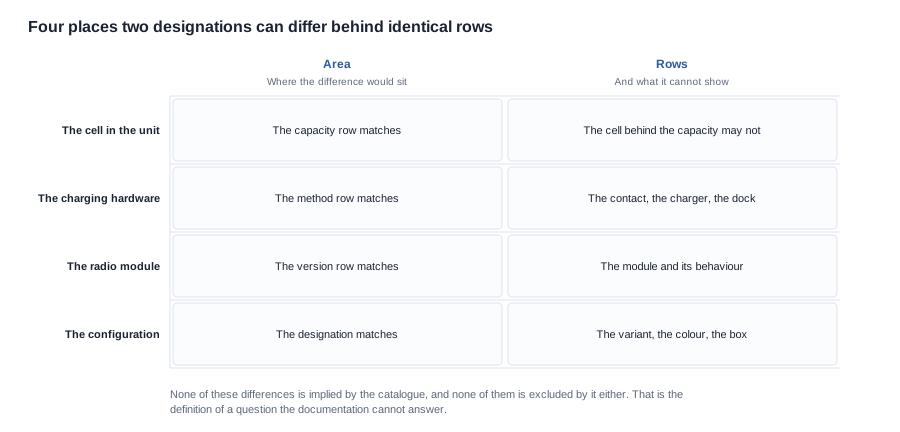
The four areas in the matrix above are the ones a buyer should be asking about, and the reasoning is the same in each case. The published row is a description of a configuration at a level of detail that does not reach the thing that matters. Two units that publish the same cell capacity may carry different cell revisions behind the number, and the row cannot show that. Two units that publish the same charging method may be supplied with different contact geometry or a different charger, and the row cannot show that either. Two units that publish the same radio version may contain different module revisions. And two units that share a designation may be supplied in different variants, colours or boxes, because the rows are silent on all of it.
None of these is a claim that the two designations do differ. That is exactly the point: the published record neither shows a difference nor rules one out, and a comparison that is going to be defended in a review has to be built on something other than the rows.
The cost of guessing
The consequence of ordering against two designations that the documentation does not distinguish is worth spelling out, because it is larger than it first appears.
A file is issued against a designation. If a channel orders both designations and receives a file that names one of them, the other has no file, and the request to add it is a second request with a second elapsed time. The same applies to a sample: a sample drawn against one designation approves one designation, and an acceptance sample taken from the wrong one proves nothing about the goods that will arrive.
A listing is written against a product. If the copy was written from the row and the two designations turn out to differ in something the listing describes, the copy is wrong for one of them, and the correction is a reprint rather than an edit.
And a return is judged against a specification. If a channel has one written description and two designations behind it, the desk has no way to tell which one a customer is holding.
None of these is a reason to avoid either designation. They are reasons to establish which one you are actually buying, before the paperwork is requested rather than after.

The written clarification, and the form a usable answer takes

The clarification is a single document, and the reason it is worth requesting in writing rather than settling in a conversation is that a conversation produces a summary while a written answer produces a record. A summary of the answer can be written into a listing by accident; a dated record has to be opened before it can be used.
The four questions the clarification has to answer
- What is each of the two designations for? The commercial question, and the one that is usually the real answer. Two designations in the same range often exist for different markets, different channels or different configurations, and the answer is frequently a sentence that a channel can use directly.
- Does the conformity file cover one designation or both? A file that names a designation covers that one. A file that covers the family is a different thing, and the answer determines how many document requests the programme has to make.
- Which designation will the samples and the acceptance sample be drawn from? This is the question that decides whether the measurement programme can be trusted, and it is the one that is usually asked too late.
- What is the relationship between the two in the supply chain? Same platform with two names, two configurations of one platform, or two separate products. The answer does not have to be technical, and it does not have to be interesting, but it has to be written down.
The questions that close the battery and charging side specifically
Because the comparison in the title is about power, three of the questions should be about power rather than about the designations in general.
Which cell is fitted in each designation, and is it the same cell? The published capacity row is the same for both, and a buyer who wants to know whether the two are interchangeable at the component level has to ask about the cell rather than about the capacity.
What charging hardware is supplied with each, and is it the same hardware? The published method row is the same for both, and a channel that has to train a customer, stock a spare or publish a support instruction needs to know whether the contact, the charger and the dock are common to the two or not.
Does the charging behaviour differ between them? The published charge ceiling is the same for both, and the interesting part of a charge is what it restores and from what state, and that is a question for a sample rather than a question about the rows.
What a usable answer looks like
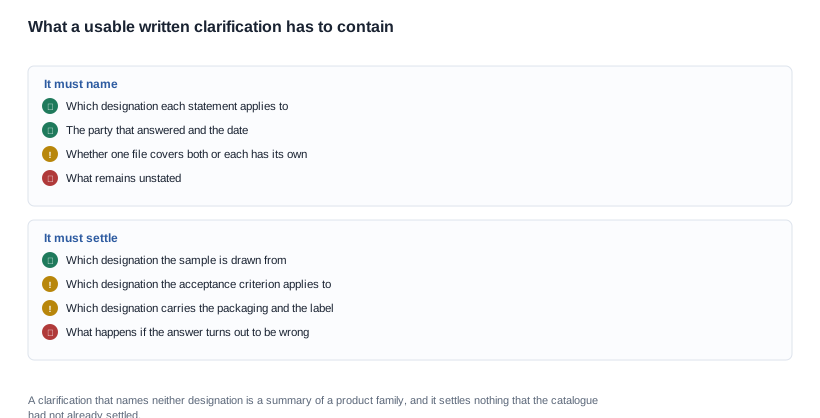
The checklist is the test a buyer can apply to a reply before accepting it. A reply that names the designation for each statement, names the party who answered, and names the date is usable. A reply that describes the product family without saying which designation it refers to is a summary, and it settles nothing that the rows had not already settled.
The lower group is the part that makes the answer binding. A clarification that says which designation the sample comes from, which designation the acceptance criterion applies to, and which designation carries the packaging is a document that can be attached to a purchase order. One that does not is a conversation, and a conversation cannot be enforced.

How this affects the two axes a buyer actually chooses on
A buyer who reaches this comparison with a specific question in mind can usually get to an answer faster than a buyer who has read both rows and found them identical, because the question itself tells you what to ask for.
If the question is endurance. The published figures match, so the endurance axis is settled and offers no reason to prefer either designation. What is not settled is the daily profile each one is used at, and a channel that intends to publish a runtime will have to measure it. Since the specifications are the same, the measurement programme is the same, which is a saving: one set of samples and one protocol can cover both designations.
If the question is charging. The published method and the ceiling match, so a channel stocking both will run one charging routine and one set of support instructions. What it must not do is assume the hardware behind the method is common to the two, because that is exactly the part the rows do not reach.
If the question is supply. This is the question the identical rows make urgent rather than settled, and it is where a channel that has not asked will find out that it has ordered two names for one thing, or one thing with two names. The published data cannot help here at all, and the only criterion that can is a written answer about what each designation is for.
If the question is the file. Identical specifications make it tempting to assume that one file covers both. It may or may not, and the answer determines whether the programme needs one document or two. The question costs nothing to ask and is expensive to get wrong.

How to order against a pair of designations without doubling the programme
If a channel orders both designations, four costs are incurred twice, and only one of them is obvious.
The documentation is the obvious one. A file is issued against a designation, so two designations are two files unless the answer says otherwise, and the second one is a second request with a second elapsed time.
The samples are less obvious and more expensive. An approval sample validates one designation. Two designations mean two sample sets, two approvals and two acceptance criteria, and a measurement programme that was costed for one.
The artwork and the label double only if the two are presented differently, and the clarification decides this. If the two are the same product under two names for two channels, the artwork is one artwork with two packaging variants, which is a modest cost. If they are two products, the artwork is two, and the catalogue and the listing are two.
The support cost doubles in the way it always doubles when a customer holds a product the desk cannot identify. A desk that can look at a unit and see which designation it is can handle a claim. A desk that cannot will ask the customer.
Three ways to handle it, and the criteria for each
The first option is to order one designation and treat the other as a name rather than as a product. This is right when the clarification says the two differ in nothing that reaches the customer, and it is the cheapest outcome by a wide margin, because one product is one programme.
The second is to order both as an alias of a single product: one specification, one file, one sample set, two names, with the artwork and the label carrying the name the market expects. This is right when the difference is commercial, and it is a good outcome when it is available, because it costs the least and it is entirely reversible.
The third is to order both as separate lines, with separate files, separate samples and separate acceptance criteria. This is right when the clarification says the two differ behind the rows, and it is the expensive option, so it should be entered deliberately rather than by default.
The criteria for choosing between the three are simple: what the clarification says, what the channel actually needs, and what the total cost of each option is once the documentation, the samples, the artwork and the support are counted together. A buyer who has priced all three can choose, and a buyer who has priced one is choosing by default.
The order of operations
There is an order that avoids most of the expense. Clarify first, because the answer decides which of the three options applies and the answer is free. Then order one designation, because a single product keeps the programme small while the clarification is being acted on. Then decide about the second, with the first already in production, which is the cheapest point at which to add a line.
The order that costs the most is the one a channel usually starts from, which is to order both, because it looks like a bigger commitment. A bigger commitment with an unresolved question at the centre of it is not a bigger commitment; it is two programmes started at once.
The position we take on two designations with the same data
The published rows for these two designations are identical, that this is a fact about the catalogue's level of detail rather than a statement that the two are the same product, and a channel choosing between them cannot use the published data to do it. We will not manufacture a difference, because a manufactured difference is a claim about two products that neither the supplier nor the buyer has established, and it is the kind of claim that is very difficult to withdraw once it is in a quotation.
We will also not state that the two are interchangeable, because the published record does not support that either. The honest position is that the rows match, that four things could differ behind them, and that the channel's own decision about which designation it is buying has to be taken on the answer to a written question rather than on a reading of two spec sheets.
What we will do is tell a buyer exactly which questions to put in the request, and in what order, so that the answer arrives in the form that can be attached to an order. The comparison between the LC-105-2 and the K02, which does have a published difference to work on, is set out in the comparison note for this model, and it is a useful contrast: two designations that differ on the page still need a request, because a difference in the rows is not a difference in the products.
Send us the two designations, the market each one is intended for, and the usage profile your channel intends, and we will mark the questions above against those three answers, tell you which of them are already covered by the printed rows and which have to go to the supplier, and give you the request in the form it can be sent. The answers come back as a dated document rather than as a conversation, and a document is the only one of the two that can be attached to an order, quoted in a listing and defended in a review.


