

Form factor is the comparison buyers make by handling the product rather than by reading a spreadsheet, and it is the comparison that decides what a product feels like in a pocket, on a desk and over a long session. The problem with making it for this pair of products is that the catalogue's own description of the form and the catalogue's own description of the runtime point in opposite directions, and a buyer who has read only one of them will reach the wrong conclusion.
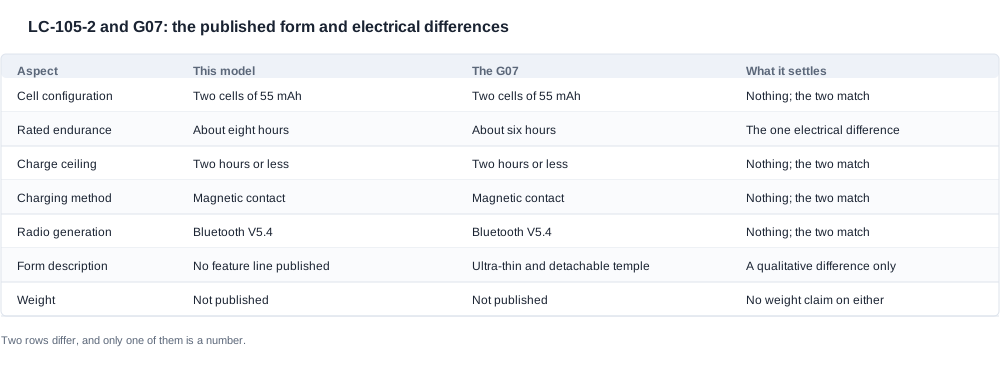
The G07 is published with a feature line describing an ultra-thin temple and a detachable temple, and with a rated endurance of about six hours. This model is published without a feature line at all, and with a rated endurance of about eight hours. So the product that is documented as slimmer and more modular carries the shorter published rating, and the product with no published form description carries the longer one. Nothing about that is contradictory, and nothing about it can be resolved by the catalogue, because the form description is qualitative and the rating is a published figure.
This page works through what the comparison can settle, what a detachable temple changes in the supply chain, why the combination of a slimmer form with a shorter rating is a real procurement question, and how to run the choice. The published field-by-field record for this model is set out in the specification listing, and this page only refers to the two fields that actually differ.
LC-105-2 against the G07: what the form comparison can actually settle
A form factor comparison is usually run on three things: the physical proportions, the modularity of the frame, and the runtime that follows from the cell that fits inside it. The third of those is where this pair becomes unusual, and it is worth starting there because it changes what the first two are worth.
Both products are documented on one cell configuration, one charge ceiling, one charging method and one radio generation. The one electrical field on which they differ is the rated endurance: about six hours for the G07 against about eight hours here. That is a two-hour published difference, and it is a substantial one in a category where a session is a working morning or a working afternoon.
Meanwhile the form descriptions are asymmetric in a way that is easy to misread. The G07 carries a published feature line naming an ultra-thin temple and a detachable temple. This model carries no feature line, which means the catalogue does not describe anything distinctive about it — not that it has nothing distinctive, and certainly not that it has the opposite. In practice, a buyer comparing the two on form is comparing a documented description against an undocumented one, and the honest conclusion is that the catalogue supports statements about the G07's temple and supports no statement at all about this model's temple.
That asymmetry is not a small point. It is exactly the situation in which a buyer's specification ends up with a claim in it that nobody can support, because the G07's description gets copied into a channel document and then applied to a product that was never described that way. The rule that follows is simple and worth writing into the purchase specification: the G07's published form description belongs to the G07, and this model's own form claims have to be obtained from the supplier or left unstated.

The one published electrical difference, and the one published structural difference
It is worth isolating these two, because they are the only two things the record says, and they are of completely different kinds.
The electrical difference is a number. About six hours of rated use against about eight hours. It is comparable, it is quotable as a rating, and it is directly usable in a duty-cycle calculation. Its limitation is the same one that applies to every rating in this range: no test condition is published with it, so it is a planning figure and not a measured duration, and a pair of ratings published without conditions may not rest on the same measurement at all. A buyer who wants to lean on the two-hour difference should ask for the reference condition behind each rating, and should treat the difference as provisional until it is answered.
The structural difference is a description. An ultra-thin temple and a detachable temple, published as a feature line on one model and absent from the other. It is not measurable from the record, it is not comparable with a number, and it carries implications rather than values. Those implications are the subject of the next section, and they are the reason the structural difference is more operationally significant than the electrical one even though the electrical one is easier to talk about.
What neither of them settles is the weight. No weight is published for either product, and the G07's description of an ultra-thin temple is a statement about the temple rather than a figure for the whole assembly. A buyer who converts "ultra-thin" into a weight, or who assumes that a slimmer profile means a lighter product, has made an inference the record does not support. The same applies to any claim about how either product feels to use, because nothing physical is published for either.
The last thing to settle is the charging method, and here the two are the same: magnetic on both, with the same accessory chain and the same carton consequences discussed for this product. That is worth stating because it means the choice between the two is not a choice between a proprietary charging method and a standard one. It is a choice between two products that both require a stocked lead, and a buyer choosing between them should not expect the charging economics to decide the matter.


What a detachable temple changes in the supply chain
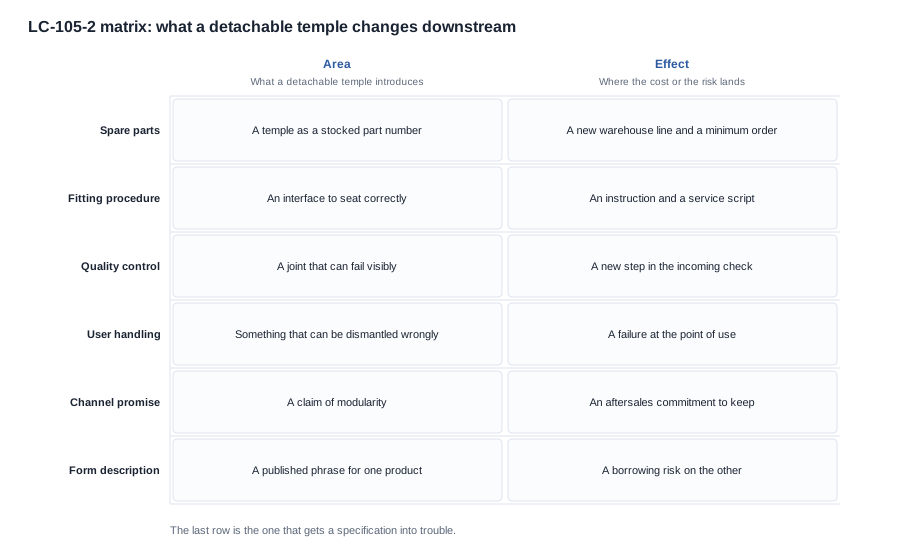
A detachable temple is a useful thing to have and an expensive thing to support, and the reason is that it turns a frame into an assembly with a joint. A frame without one is a single object; a frame with one has an interface that can degrade, can be seated incorrectly, can be lost and can be replaced with a part that is not the part that was intended.
The consequences run through the whole supply chain, and a buyer who has only thought about the form will not have priced any of them.
- Spare parts. A detachable temple implies a spare-parts line, with its own part number, its own minimum order quantity and its own shelf life in the warehouse. A business that did not plan for a parts business now has one.
- The fitment procedure. Somebody has to know how the temple goes on, which way round, and what to do if it does not seat correctly. That is an instruction, and it is a service-desk script, and it has to exist before the first unit is delivered.
- The quality check. A joint is a place where a product can fail in a way that is obvious to a customer and invisible to a production check that inspects the electronics. The incoming inspection plan needs a step for it, and it needs one written into the supplier's instructions.
- The user experience. A product that can be taken apart is a product a user can take apart incorrectly, and the failure appears at the point of use rather than in the warehouse.
There is a commercial side to this as well, and it cuts in a direction a buyer should think about deliberately. A detachable temple is a genuine differentiator in some channels, particularly where the product is carried rather than put on and left there, and it can carry a premium. It is also a promise: the product is advertised as modular, and a modular product that cannot be re-fitted without a service visit is a promise the brand has to keep. Whether that promise is worth making is a decision, and it is a decision about the aftersales budget as much as about the form.

The counter-intuitive part: the slimmer product carries the shorter rating
The combination of a documented slim profile with a shorter published endurance, against an undocumented profile with a longer one, is the reason this comparison deserves the attention it gets. It means that a buyer choosing on form alone, and a buyer choosing on endurance alone, can arrive at opposite products.
That is a useful situation, because it makes the decision explicit. The question is which attribute the deployment and the channel actually reward.
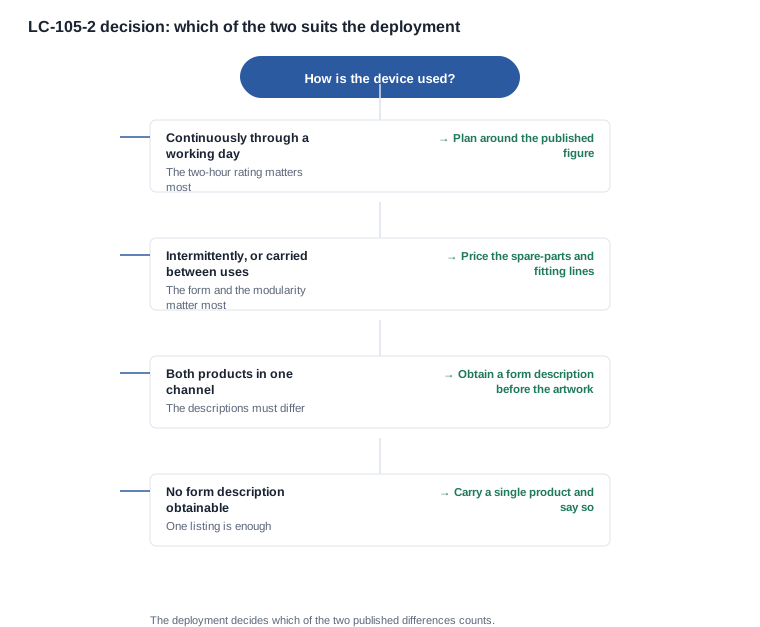
Where the product is carried between uses rather than put on and left there, a slimmer and more modular design earns its place, and the shorter rating is easier to absorb because the device is not in continuous use for a full shift. Where the product is in continuous use through a working day, the two hours of published rating is the more consequential difference and the form is the secondary concern. Where the channel is one where the buyer is explicitly asked to choose between the two on a shelf, the description is what the customer will read, and only one of the two has a published one.
Two cautions belong with this, and they are the two ways a buyer gets this wrong in the other direction. The first is to treat the published rating as a measured duration. It is a rating, without a stated condition, on both products, and the honest use of a two-hour published difference is to plan around it and to ask what it was measured under. The second is to read the absence of a feature line on this model as a statement about its construction. It is not a statement about anything except what the catalogue records, and the form claims for this product have to be established by asking.
There is also a question of channel discipline that a buyer will have to answer before the launch rather than after it. If both products are carried, the descriptions have to be distinguishable, and the only two descriptions the record supports are the G07's slim and detachable temple, and the absence of any such description here. That is a thin basis for two listings, and a buyer who wants two distinguishable products has to obtain a form description for this one from the supplier, in writing, before the artwork is produced. If that cannot be obtained, the honest answer is to carry one of them.
A decision path for a buyer choosing between them
- Establish the deployment profile — continuous use through a day, intermittent use, or a carried product — and record which one dominates the volume.
- Put the two-hour published rating difference against that profile. If the profile is a continuous working day, the rating is the first filter. If it is intermittent or carried, the form is.
- Request the reference condition behind both ratings, so that the difference is being compared on a stated basis rather than assumed to be one.
- Request a form description for this model, in the same terms the catalogue uses for the G07, so that the two can be described to a channel without one of them borrowing the other's language.
- Price the modularity costs in full if the detachable design is being chosen: the spare-parts line, the seating instruction, the quality-control step and the aftersales handling.
- Confirm the charging treatment for both, because it is identical here and the accessory chain has to be planned once rather than twice.
- Decide the channel position — one product or two — and write it down before the first listing is produced, because two products with the same radio generation, the same cell class, the same charging method and no published form description is a range structure that a customer cannot navigate.
The sequence is deliberately ordered so that the two published differences are settled before the commercial decision is taken, and so that the one thing that has to be obtained from the supplier is obtained while it is still cheap to obtain. A buyer who has a form description and a rating condition in hand can make the choice with confidence, and a buyer without them is making a choice on a description that belongs to the other product.
The criteria to apply at each step are worth stating separately from the steps themselves, because they are what a reader takes away. The first criterion is whether a difference is published or inferred, and the rule that follows is that only published differences may be used in a specification. The second is whether a difference is a number or a description, and the rule that follows is that a number may be planned around while a description has to be obtained before it can be planned around at all. The third is whether a difference survives the test of the channel, and the rule that follows is that a difference which a customer cannot perceive does not earn its place in the range. Applying those three criteria in that order is the difference between a shortlist of two products and a list of two specifications, and it is the reason the same piece of work produces a different answer for a carried product than it does for a fixed one.
There is a due diligence point as well, and it is the one most buyers skip. The comparison between these two products rests on two published fields and one document request. A buyer who treats that as sufficient is accepting an unquantified risk on the form, and the risk is not small: the entire form proposition of one of the two products is a phrase in a catalogue, and a phrase is not a specification. The diligence is therefore short and cheap, and it consists of asking for the form description in the same terms the catalogue uses for the other product, and asking for the rating condition. If the supplier answers both, the comparison is complete. If the supplier answers neither, the buyer knows something important about the product it is considering, and that knowledge is worth more than the two published fields it replaces.
Two further points belong with the choice, and both of them are about what happens after the launch rather than before it. The first is the re-order. A modular product creates a parts relationship with its own reorder rhythm, and a business that has not budgeted for that rhythm will discover it in the first year, when the spare temple order arrives on a different cycle from the product order and the two have to be planned separately. The second is the instruction insert. For a product with a detachable temple, the insert has to describe the seating, the orientation and the fault response, and that document has to be produced, translated and version-controlled exactly like the rest of the documentation. Neither of these is a form factor question in the usual sense, and both of them are decided by the form factor.
There is a third point, and it is the one that most often decides the outcome in practice. A buyer who carries both products has to give the channel a reason to stock both, and the published record gives exactly one such reason here: the slimmer, modular description on one of them and a two-hour longer published rating on the other. That is a real difference and it is a sellable one, but it is a single sentence, and a single sentence is fragile. If the channel's customers do not in fact distinguish between a two-hour longer rating and a slimmer profile, then the two products are competing for the same shelf space with the same cost structure, and the rational decision is to carry one of them and put the volume behind it. Working that out is not a comparison task; it is a range task, and it belongs in the same conversation as the deployment profile rather than after it.
Our own position is that the two products differ in exactly two published ways, that the difference in the form description is qualitative and cannot be converted into a weight or a performance figure, and that the difference in the rating is a published number whose condition is not published. We will not state that either product is lighter, more usable or better made, because nothing in the record supports any of those statements about either of them, and we will not use the G07's published description to make a claim about this product.
There is one more thing that is worth putting on the record, and it concerns how a buyer should describe this product in its own channel material. The description that belongs to this model is a description the catalogue has not given, and the only defensible source for it is a supplier document. That means a buyer who wants to talk about the form of this product in a listing has to obtain the description first, and a buyer who has not obtained it has to write the listing around the published fields instead. That is not a disadvantage; the published fields are enough to describe a product credibly, and a listing built on a charge method, a cell configuration, a rated endurance and a radio generation is honest in a way that a listing built on an adjective is not. The rule that follows is a good general one for this range, whatever the model: describe the product from the fields that are documented, and treat every adjective as something to be earned from the supplier before it is used.
If you are deciding between them, tell us the deployment, whether the device is carried or used in place, and whether the channel will carry one product or both, and we will return the two-field comparison with the questions that have to be answered before the choice is made.


