

This is the comparison in the range where the published rows almost match, and the near-match is what makes it interesting. Two of the five published fields are the same, a third is close enough to be misleading, and the two that genuinely differ are the two a buyer is least likely to have an opinion about. A comparison built on the assumption that a larger cell means a longer-running product would get this one wrong in a way that matters.
The K01 is published with two cells of 90 mAh, roughly eight hours of rated use, a ceiling of two hours on a charge, magnetic charging, and a radio at version 5.3. This model is published with a smaller cell class, the same rated endurance, the same charge ceiling, the same charging method, and a radio one generation further on. So the cell class differs, the radio generation differs, and the three electrical fields that a duty cycle depends on are otherwise the same.
That is a narrow difference on paper, and it is where the analytical work is. What follows sets out the two fields that differ, shows why the larger cell in one of them does not produce a longer published runtime, explains what a radio generation apart changes in the documentation, and gives the specification table a buyer should actually send to a supplier.
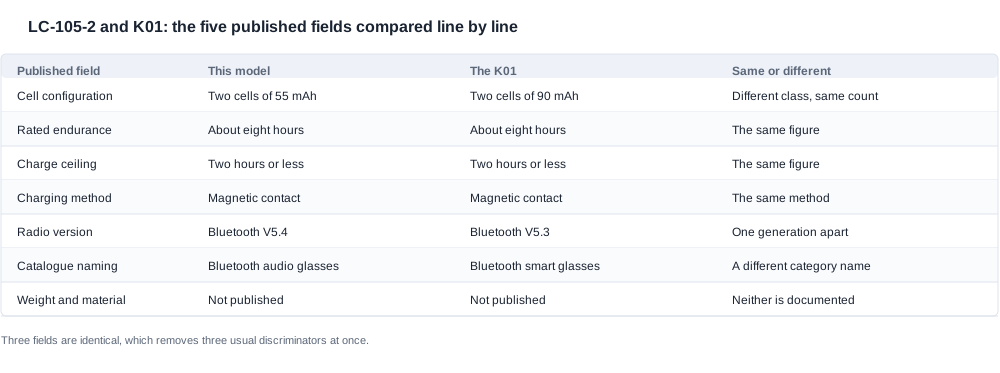
LC-105-2 against the K01: a comparison where two of the five fields match
Before the fields, it is worth being clear about what kind of comparison this is and what kind it is not. It is a comparison of two published records, and it is genuinely useful for two reasons: the fields that match tell a buyer that the operational planning is the same, and the fields that differ tell a buyer where to spend the diligence effort.
The fields that match are the ones that dominate a duty-cycle calculation. The cell count is the same, so the arrangement question — how two cells behave, what state the product reports when they are not matched — applies identically to both products and only has to be asked once. The rated endurance is the same, so a deployment that fits one of them fits the other, and there is no runtime argument to have. The charge ceiling is the same, so an interruption plan built for one works for the other. The charging method is the same, so the accessory chain, the spare-parts policy and the carton consequences are a single planning exercise rather than two.
There is a third point that belongs in the same list, because it changes how the shortlist is built rather than how the products are described. When three of the five published fields match, the buyer who is comparing on those fields is doing no work at all, and the effort that would normally have gone into the duty-cycle calculation, the charging plan and the accessory modelling can be released and spent on the two fields that do differ. In practice this is the single most useful outcome of a comparison of this kind, because the analysis of the matching fields is usually the expensive part of the work, and here it has been done once for the range rather than twice.
The corollary is that the diligence effort has to be concentrated rather than spread. A buyer who applies the same depth of checklist to every published field will spend most of the effort re-confirming what is already known, and will arrive at the same conclusion for both products. Concentrating it on the radio generation, and on the question of why the capacity difference does not appear in the endurance figure, is what makes the comparison produce a decision rather than a description.
That is a substantial finding, and it is the opposite of what a comparison page usually produces. In most comparisons in this range, the two products differ on the cell, on the runtime and on the charging method, and the analysis is about which difference matters. Here, three of the five fields are identical and the products differ on capacity and on radio generation, so the analysis is about whether those two differences are operationally significant, and the honest answer is that one of them is not.
The two differences, then, are the capacity class — two 55 mAh cells here against two 90 mAh cells in the K01 — and the radio generation, version 5.4 against version 5.3. Everything else on the published record is the same.
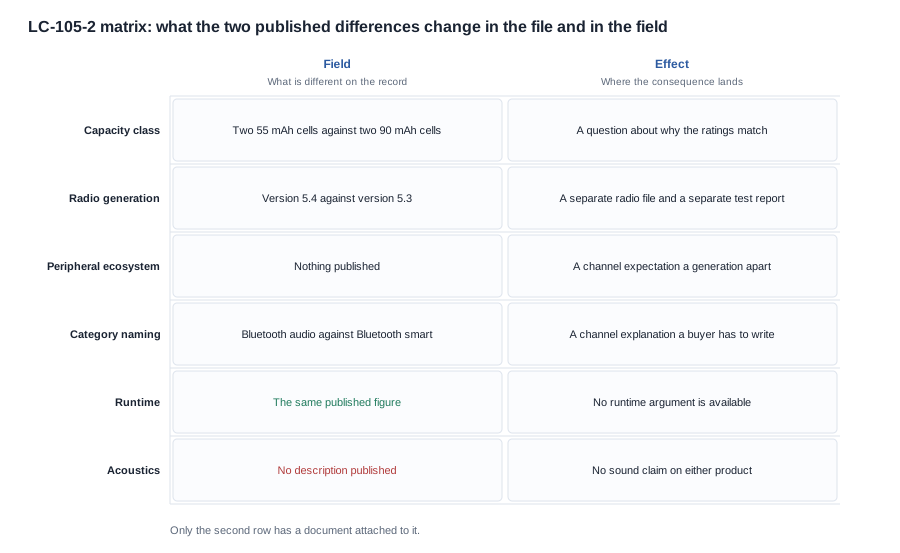

The two fields that differ, and what they do not tell you
The cell capacity. The catalogue publishes the capacity and the count for each product and publishes no total for either, so a buyer who adds the values has derived a figure and should label it as one wherever it appears. The difference between the two capacity classes is real and it is the only published capacity difference.
What the difference does not do is translate into a runtime difference, and this is the part of the comparison that catches people out. The product with the larger published cell class carries the same published endurance as the one with the smaller class. Whatever explains that — a different platform, a different radio, a different power budget, a different reference condition for the rating — it is not in the published record, and the effect is that capacity cannot be used as a proxy for running time anywhere in this range. A buyer who reads the capacity field and infers a runtime advantage has made an inference the record contradicts, and the contradiction is visible on the same page.
That leaves a genuinely useful question, and it is a question rather than a conclusion. Why do two products with different published cell classes carry the same published endurance? The candidate answers are that the ratings were measured under different conditions, that the products have different power budgets, that one of them includes the radio in the figure and the other does not, or that the platform simply differs in a way the catalogue does not record. Each of those answers has a commercial consequence for a buyer, and the buyer cannot tell which applies from the published fields. The right response is to ask for the reference condition behind each rating and to ask whether the two products were measured on the same basis.
The radio generation. One step apart, and it is a documented field on both. What a radio version settles is narrow: the generation of the radio, and with it the compatibility expectations a distributor or an accessory supplier will have, and the standards family that the test report behind the conformity file will reference.
What it does not settle is almost everything a buyer might want to know about it. The catalogue publishes no acoustic description for either product, no microphone arrangement, no range figure and no power consumption figure, so a radio generation cannot be turned into a claim about the sound, and a buyer who says the newer generation sounds better has invented the premise of the argument. The one thing that can be said is the thing the record supports: the two products are a generation apart.
The naming is worth a line, because it is a published difference that is easy to miss. The K01 is published as a Bluetooth smart glasses entry rather than as a Bluetooth audio glasses entry, and its catalogue title is correspondingly different. A buyer building a range should note what the two are called in the catalogue, because a distributor who receives two products with different category names and matching electrical rows will ask why, and the answer has to be a supply and positioning answer rather than a specification one.


Capacity, runtime and the fact that the larger cell is not the longer-running one
This deserves a section of its own, because the intuition it contradicts is the one that shows up in a purchasing meeting.
The instinct is straightforward: more published capacity means more energy, more energy means more running time, and therefore the product with the larger cell is the one for a shift-length deployment. The published record says something different, because the two products carry the same rated endurance despite the different capacity classes. Either the record is telling the truth about the endurance, in which case the capacity is being spent on something else in one of them, or the two ratings were established on different bases, in which case neither rating can be used until the basis is known. Both readings are available from the page, and neither of them supports a purchase decision on capacity.
That has a practical consequence for the way the two products should be short-listed. The shortlist criteria have to be the criteria that are actually different, and those are narrow. The duty-cycle test passes or fails identically for both, so it is not a discriminator and can be checked once. The charging plan is identical, so it is not a discriminator either. The accessory economics are identical, so they do not decide it. What is left to discriminate on is the radio generation, the platform differences behind the capacity figure, and the commercial terms — which are not published for either product and are the place where the real comparison will be made.
There is a second-order point that is worth making because it is the kind of thing that only becomes visible after a first programme. If the two products are genuinely close in their published profile, then a channel that stocks both is presenting a choice that a customer cannot make from the specifications. The customer will choose on the retail shelf, on the price, on the brand or on a channel instruction, and the first three of those are not technical. A buyer who stocks both is therefore making a channel decision as much as a product decision, and it is worth asking what the shopper is supposed to be choosing between before the range is locked.

A radio generation apart, and what it changes in the file
A radio generation is the kind of difference that sounds trivial and is not, for two reasons that both concern documents rather than performance.
The first is the conformity file. The radio in a product is tested against a cited standard, and the standards that apply to a given generation are not interchangeable with the standards that apply to the next one. A buyer holding a file for one generation cannot assume it covers the other, and the file has to be requested for whichever product is actually being shipped. That is a document request, a lead time and a cost, and it applies to both products here, because neither carries a per-model conformity row in the catalogue.
The second is the accessory and peripheral ecosystem. A generation apart is usually a generation apart in the peripherals that a channel stocks, in the compatibility expectations that a distributor will carry over from the previous product, and in the expectation that a customer has of a device that is one release behind. None of this is a published fact and none of it is a performance claim, but all of it is real, and a buyer who has not considered it will meet it as an objection from a partner rather than as a line in a specification.
What a generation apart is not, and this is the point to hold on to, is an acoustic advantage. Nothing published for either product describes how it sounds, and the radio version does not substitute for that description. A buyer who wants to write a sound claim has to obtain a document, and the document does not come from the version number.
That gives the comparison a clean shape. The radio generation is worth a place in the shortlist for file reasons and for channel reasons, and it is worth nothing in a sound argument. The capacity difference is worth a place in the shortlist because it tells a buyer that something is different that the catalogue does not explain, and it is worth nothing as a runtime argument, because the runtime is published as the same. Everything else in the comparison is either identical or unpublished, and the honest conclusion is that the two products are closer than their capacity difference suggests, and the decision between them will be made on price, on terms, on the supplier's answers and on where the business wants the product to sit in the range.
The specification table a buyer should actually send
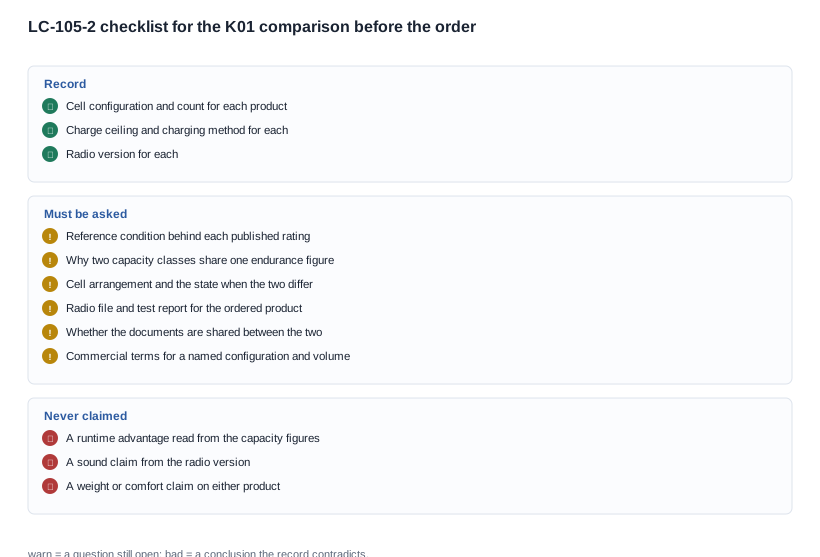
The table below is the one to put in front of a supplier, because it is a table of questions rather than a table of conclusions. It can be sent with a single covering note and answered line by line, and every answer is either a document or a decision.
- The reference condition behind each published rating, and whether the two were measured on the same basis.
- What accounts for the same published endurance across two different capacity classes — platform, power budget, radio, or measurement.
- The cell arrangement, and what state the product reports when the two cells are not matched.
- The measured charge time from a stated starting state, and the measured average against the published ceiling.
- The radio assessment for the product being ordered, with the standard applied, the laboratory, the accreditation scope and the sample identification.
- Whether the cell arrangement and the radio file are shared between the two products or must be obtained separately.
- The commercial terms for each, tied to a named configuration and a stated volume.
- What the catalogue does not publish for either product and when each item can be supplied.
There is a ninth question that a buyer will find they need later, and it belongs in the same list: whether the catalogue's two product names mean that the two products are sold into different channels, or simply that they were entered separately. The naming difference is published, and its commercial meaning is not. A buyer who has assumed that a category name indicates a distribution channel will make a range decision on the assumption, and a buyer who has checked will make it on the answer.
The tenth question is about the sample rather than the document, and it is the one that converts a comparison into a decision: what a unit of each product does through a full session, charged the way the deployment charges it, and what the user has to do to make it work at the end of that session. Three fields differ on the record and none of them decides the purchase, which is precisely why the sample has to.
The last line is the one that makes the table work. A specification request that only asks about the fields that are published comes back with the published fields, and the buyer learns nothing. A specification request that names the gaps gets the gaps closed, and the gaps are where the two products actually differ.
A closing note on our own position, because the shape of this comparison makes it easy to overstate. We publish the rows for both products and nothing further. We will not say that either one runs longer, sounds better, is lighter or is more comfortable, because the catalogue supports none of those statements about either product, and the published capacity figures in particular must not be read as a running-time argument. What we will do is tell you which of the two published differences is operationally significant, which is the radio generation, which of them is a question rather than a capability, which is the capacity, and which questions have to be closed before the comparison can be made at all.
One more thing belongs in the specification table, and it concerns the two products rather than the documentation. A buyer who intends to carry both needs a written answer to a question a customer will ask on the shelf: what is the difference between them? On the published record the answer is that one is a radio generation further on and the other carries a larger published cell class with the same published endurance, and that is a thin answer for a shelf. A buyer who wants a better answer has to obtain a form description, a material statement or an acoustic description for one of the two, and one of those three documents will do more for the channel than the entire capacity comparison. That is worth stating plainly at the end of a specification exercise, because it is the point at which the two questions — which product and how is it different — turn out to be the same question.
The broader question of how a buyer should organise the questions that a catalogue does not answer is set out in the buyer question set, and it is the same set of questions that applies here whichever of the two products a business is going to order.
If you are holding quotations for both of these and want them read against the published rows, send them with the target volume and the destination markets, and we will return a line-by-line comparison showing which lines are comparable, which differ because the scope differs, and which are still open questions that have to be put to the supplier before the order is placed. We will also mark the one place where the two products genuinely differ in a way that changes the planning, and the one place where the published capacity figures must not be read as a runtime argument.


