

The published rows for these two models are almost identical, and that is the finding rather than the obstacle. Of the lines the catalogue prints for each, three match exactly: the rated endurance, the ceiling on the charge time, and the charging method. Two do not match: the cell configuration, and the radio generation. A buyer looking for a comparison therefore has two real differences to work with and four identical rows that settle nothing, because a row that is the same on both sides of a comparison cannot decide anything.
That framing matters, because the standard way this comparison is done is to put the two products side by side and let the reader find the difference. On a catalogue sheet with two similar products that works well enough. On two rows that agree on three lines and differ on two, it produces a page that looks like a tie and says almost nothing, and the buyer is left with a reading rather than a decision.
This article works through the two differences properly, states what the published data can and cannot settle about each, and then gives the questions to ask so that the remaining comparison can be made by somebody who has the units in front of them. There is a case to be made for either model, and this article does not make it: the published data does not make it, and a channel that is about to spend money on a line of either product should know exactly which two questions close the question for them.
LC-105-2 smart glasses vs K02: the comparison the published rows actually support
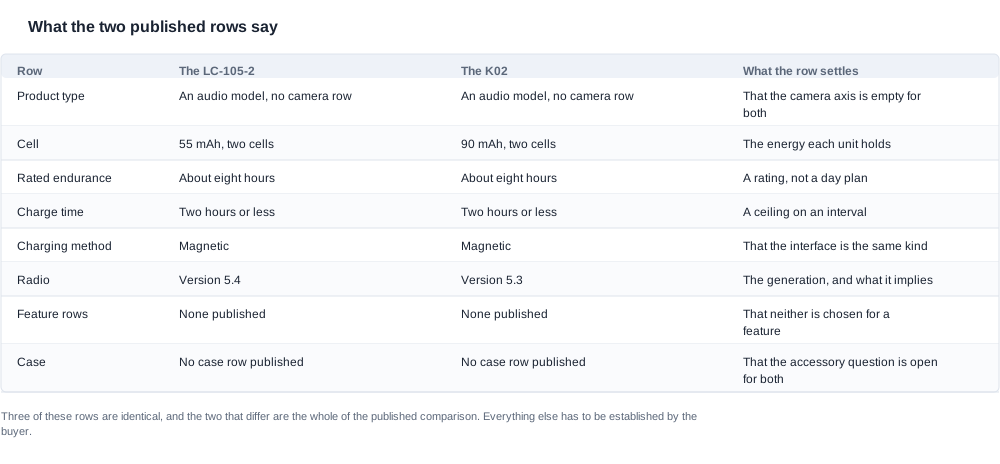
Both are audio models, and neither publishes a camera row, so the camera axis is empty on both sides and does not need to be argued about. Neither publishes any feature row, so there is no feature to choose either of them for, and no feature to lose by choosing the other. Neither publishes a charging case row, so the accessory question is open for both in exactly the same way.
What remains is a comparison about power and about the radio, and it is worth noticing that the power comparison is the more interesting of the two, because the published rows make it look like something it is not.
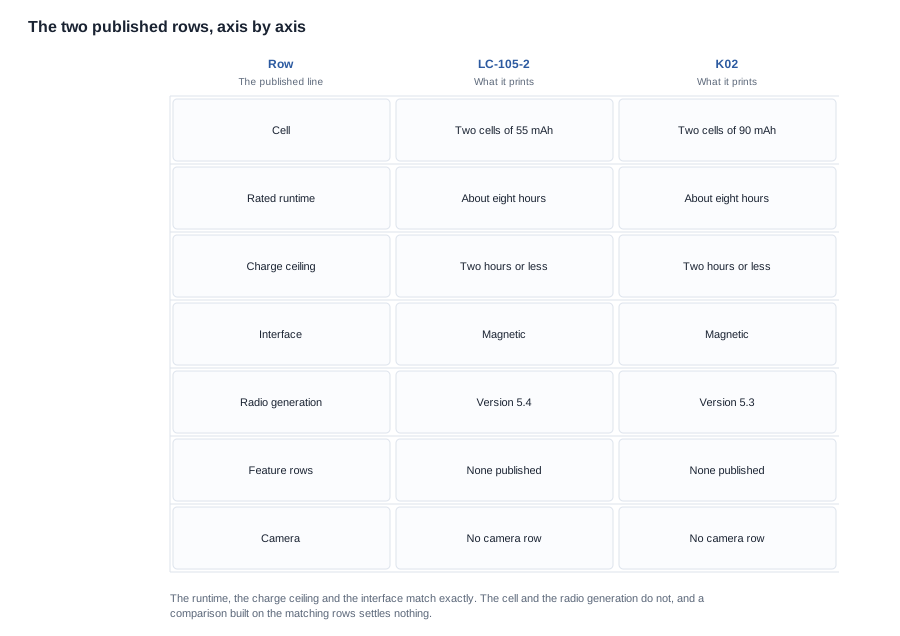
The three rows that match, and why they settle nothing
The rated endurance is about eight hours on both. The charge ceiling is two hours or less on both. The charging method is magnetic on both.
None of those three can choose between the models, and their usefulness is narrower than it looks. What they establish is that a buyer does not have to run two different charging routines, two different accessory programmes or two different training routines for the two products, which is a genuine saving in a channel that stocks both. What they do not establish is that the two products behave the same, because an identical published figure is a statement about the published rows and not about the hardware underneath them.
The charge ceiling deserves one specific caution, because it is the row most often turned into a promise. Two hours or less is a ceiling on an interval, and the same ceiling on two different products says nothing about how quickly either of them restores its charge in practice, because the catalogue does not publish the state the interval starts from, and the two products may not start from the same one.

The cell difference that the runtime row does not explain
The cell rows are the first place where the two published rows part company. The LC-105-2 publishes two cells of 55 milliampere-hours. The K02 publishes two cells of 90 milliampere-hours.
Those are the catalogue's own figures and they are not comparable as single numbers, so the comparison has to be made carefully. Added together for the sake of working out the difference, the two products carry 110 milliampere-hours and 180 milliampere-hours respectively, and those totals are derived rather than published, which is why they are set out here in words rather than in a table column.
The interesting part is what happens when the two totals are set against the two identical runtime figures. A larger cell and a smaller cell producing the same rated runtime means the two products are not doing the same work under the same conditions. The catalogue publishes no duty cycle for either model, no audio profile, no pairing behaviour and no measurement condition, so the difference cannot be attributed to any one of those. What it can be said to mean is that something differs, and the catalogue does not say what.
There are three readings, and a buyer cannot choose between them from the published data.
- The two products run different loads. A product with more energy available and the same runtime is, on the face of it, carrying a heavier load or a longer duty cycle. That is a plausible reading of a camera-free audio product with a larger cell.
- The two products were measured under different conditions. A runtime figure produced with a different volume level, a different pairing state or a different sample set is a different measurement, and the catalogue publishes no conditions for either.
- The smaller-cell model is the harder figure to defend. If the two products are closer than their cells suggest, then the runtime published for the smaller-cell model is the one that has to survive scrutiny first in a review.
The practical consequence is the same in all three readings: the runtime row cannot be quoted as a like-for-like comparison. A buyer who writes that both models run for about eight hours and stops there has written a statement that is accurate about the catalogue and useless as a comparison, because it is the row on which the two products happen to agree.
The question that closes the axis is short: what load was each model running when its runtime was measured, and at what setting would the channel's own customers be running them? That is a question for the supplier and a measurement for a sample, and the answer is more useful to a buyer than the two totals put together.
What the cell difference is worth commercially
Even before the load question is answered, the difference in the published cell configuration is worth something to a buyer, and it is worth more than a runtime figure because it is the one place where the two products are plainly not the same hardware.
The first use of it is negotiating. A buyer who knows that one model carries more energy in total than the other, and who has asked the supplier what load each was measured at, is asking a question that cuts to the heart of the comparison, and the answer is a design fact rather than a marketing one. Suppliers answer it readily, because it is a question about their own engineering, and the answer tells the buyer which of the two products the supplier considers the more substantial. That in itself is a useful signal about which one will hold up in a channel.
The second use is the programme. A channel that intends to publish a runtime figure has to publish it for one model, and the model whose cell configuration is smaller is the one whose figure is more likely to be challenged, because the arithmetic between energy available and time claimed is tighter. A channel that wants the simpler conversation should start with the model whose numbers leave more headroom, and a channel that has established a heavy usage profile should start with the model that can carry it.
The third use is the one that costs the buyer nothing and is worth doing anyway: the totals are derived, so they must be handled as derived. A figure that appears in a quotation, a specification or a listing as though the catalogue had published it is a figure the channel is on the hook for. The honest way to use a total is in the reasoning, where it belongs, and not in the copy.
The radio generation, and what it actually changes
The second difference is the radio generation, and it is the one that buyers most often under-rate, in both directions.
The LC-105-2 publishes Bluetooth version 5.4. The K02 publishes version 5.3. That is a real difference, and it is a real difference in the part of the product that decides whether a customer's phone, laptop or car connects without friction.
What it changes in practice is narrower than the version numbers suggest, and a buyer should be clear about the narrowing. It is not a quality difference in the audio, and the catalogue does not publish anything that would let a buyer claim one. It is a difference in the radio generation, which reaches the customer in a handful of specific ways: how quickly a device pairs the first time, how the unit behaves when a phone is already connected to something else, and what a customer with older equipment encounters. It is also a difference that reaches the paperwork, because the radio and the electromagnetic compatibility work are two separate frameworks with separate scopes, and a file that covers one does not cover the other.
What it does not change is equally worth stating. It does not make either model better at anything the catalogue publishes about the other, because neither publishes a feature row, and it does not settle the runtime question, because the radio generation is not the load that produces a runtime.
Why a generation number is not a tier
The most common error in this category is to read a radio generation as a quality tier, in either direction. It is tempting because the numbers run upwards and because a newer number sounds like a better product, and the temptation is not supported by anything the catalogue prints.
A generation number says what the radio in the unit is. It does not say how the radio performs in a room with interference, how quickly the unit recovers from a lost connection, how it behaves next to a particular phone, or what it does to the battery. Those are all measurable and none of them is published for either model, which is precisely why the generation is the wrong thing to build a preference on.
The two things a generation number does justify are worth keeping precisely because they are limited. It tells a buyer which framework the radio work sits under, which matters for the file. And it tells a buyer which generation of equipment the unit was designed against, which is a useful input to the pairing test rather than a substitute for it.
The consequence for a channel is a practical one. The radio axis should be decided by a pairing test on a sample, against the phone models the channel's customers actually own, and not by a version comparison written on a slide. The version comparison is worth having in the file; it is worth very little in the listing.
The paperwork consequence, and why the two frameworks stay apart
The radio rules and the compatibility rules sit in separate frameworks with separate scopes, and a file that covers one does not cover the other. That is not a technicality for a channel that is choosing between two models, because it means the two models may arrive with different amounts of documentation behind them even when the radio generation is the only published difference.
The practical question is therefore narrow and worth asking early: for each model, which of the two frameworks has been worked on, and which has not? A supplier who answers precisely is telling a buyer where the elapsed time sits, and a supplier who treats the two as one is telling a buyer that the file will arrive later than the schedule assumes.
The related question is about scope rather than speed. Where the radio generation differs between two models, the two files are not interchangeable, and a channel that has asked for one file and assumed it covers both will find out at the review. The two requests are cheap to make together and awkward to make separately.
So the radio difference is real, and it is the wrong axis to choose a product on unless the channel's customers are specifically affected by it. The honest way to assess it is to ask what the generation actually changes in practice for the equipment the channel's customers own, and to test the pairing flow on a sample rather than to reason about version numbers.

How to choose between two audio models on a two-cell difference
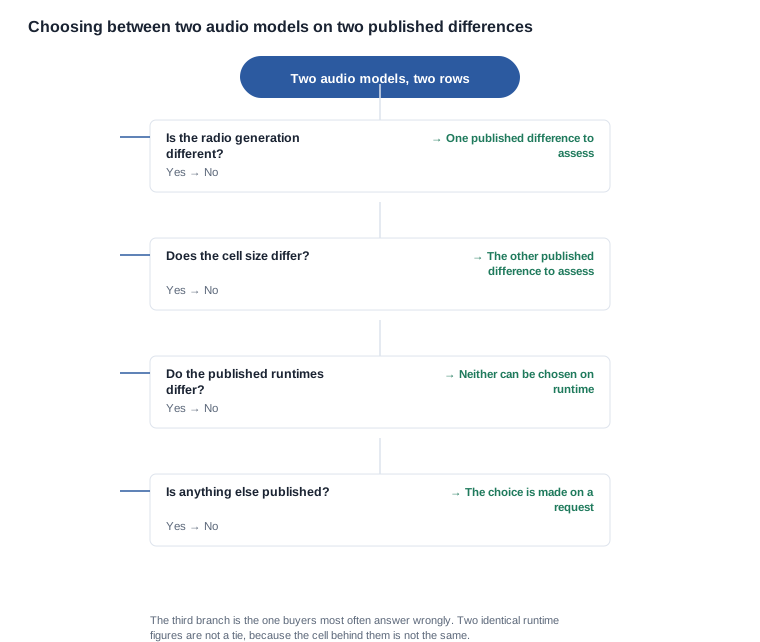
The decision chart above is the whole published comparison reduced to four questions, and the third branch is the one buyers most often answer wrongly. Two identical runtime figures are not a tie, because the cell behind them is not the same, and the useful follow-up is not "which runtime is better" but "what was each of them measured doing".
The fourth branch matters just as much. If nothing else is published for either model, then the choice cannot be made from documentation at all, and it has to be made from a request and a sample. That is not a weakness of the comparison; it is the normal shape of a decision between two products whose published records are this short.
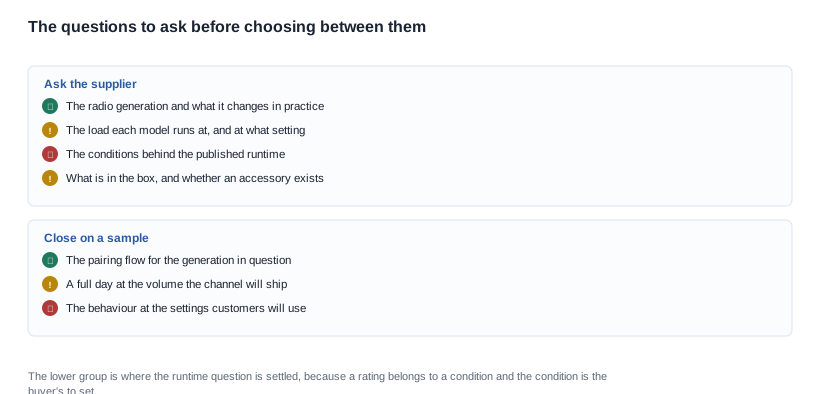
The questions that close the comparison
- What load was each model running when its runtime was measured, and at what volume, pairing state and setting? This is the one question that turns the runtime row from an unusable agreement into a comparison.
- What does the radio generation change in practice for the equipment our customers own? Not what the version number means, but what a customer experiences.
- Does the pairing flow on each model behave well against the phone models our customers actually carry? A sample question, and a cheap one.
- What is in the box, and is an accessory available for either model? The published rows are silent on this for both, and the difference between the two answers can decide the question on its own.
- Which model can we actually get the volume of, and which one can we reorder? The commercial terms are not published for either, and a channel that has not asked cannot compare the two.
The trade-offs a buyer is really making
Behind those five questions there are three genuine trade-offs, and it is worth naming them because a buyer who can name them can make the decision, while a buyer who cannot will keep looking for a specification that resolves them.
Capacity against flexibility. The model with the larger cell configuration gives a channel more energy to work with in principle and, if the load question is answered favourably, more headroom for a channel that wants to specify a heavier usage profile. The model with the smaller cell configuration asks less of the factory to supply and is, in a channel with a straightforward audio proposition, entirely adequate.
One radio generation against another. The newer generation is the one a channel will find easier to explain to a customer in three years' time and the one that will sit more comfortably next to the equipment people carry. The older generation is the one whose behaviour is already known to the supply chain that has been shipping it. Neither of those is a quality claim, and the choice between them is a channel's judgement about its own customers.
A settled product against a fresher one. This is a commercial trade-off rather than a technical one, and it is invisible in the catalogue. A model that has been in the range longer has a documented history, a known failure pattern and a supply chain that has been exercised. A model that is newer to the range carries the opposite: a more current proposition, and a shorter track record. A channel that has decided it wants both, rather than one, has to decide deliberately which one it puts at the front of the range, and that decision is worth more than the difference between the two published cell figures.
The mistakes this comparison invites
The first is treating the matching runtime as the answer. The second is treating the cell totals as the answer, since they are derived rather than published and they say nothing about the load. The third is reading a radio generation as a quality tier, which the catalogue gives no support for. The fourth is building a shortlist on two products and calling it a shortlist, when a buyer who has the choice should be looking at the whole audio range rather than at a pair that happens to have been compared before.
The position we take on this comparison
The published rows support two differences and not more, and a comparison which presents a conclusion is presenting something the documentation does not carry. We publish what the catalogue prints for each model, we do not reduce the cell configurations to a total and present the total as a published figure, and we will not turn a radio generation into a quality claim or a runtime rating into a day plan.
What we will do is help a buyer work out which of the two axes actually decides the question for their channel, and then make the request that closes it. The two axes are the load behind the runtime and the radio generation in practice, and they are closed by a supplier answer and a sample respectively, which is a short piece of work compared with a decision made on a reading of two spec sheets.
The comparison against the other designation in the same family is a separate exercise, and it is set out in the note on the two LC-105 designations.
Send us the equipment your customers carry, the volume you expect to order and the audio profile the product will be used at, and we will mark the two axes against those three answers, tell you which of them a sample closes and which one needs the supplier, and leave you with a shortlist of two models and a set of criteria rather than a verdict.


