

A procurement team reading the published endurance for this model will find a band, not a number, and that single observation changes how the product has to be evaluated. The row reads six to eight hours, which is two different results rather than one, and the catalogue does not say whether the band runs across units or across operating conditions. A buyer who plans a shift pattern on the upper end of a band whose lower end is unknown is planning on a number nobody has measured. The workable approach is to establish what produced each end of the band, fix the duty cycle the channel intends to ship, and then measure whole working days on a sample at that setting, with the criterion written into the purchase order rather than into the listing copy.
The other half of the row is a ceiling, not a duration. The catalogue prints a charge time of two hours or less, which bounds an interval without saying what state the cell was in when the interval started or what state it reached when it ended. That is the correct way for a catalogue to publish a charge figure, and it is also the reason a channel cannot advertise a recharge time in the form a customer would understand it.
This article takes the published row apart, cell by cell, and then works through what each cell settles and what it leaves open. It is written for a buyer who has to sign a purchase order against these numbers rather than for a reader who is shopping for a product.
MT5 smart glasses battery life: the published row and the four numbers in it
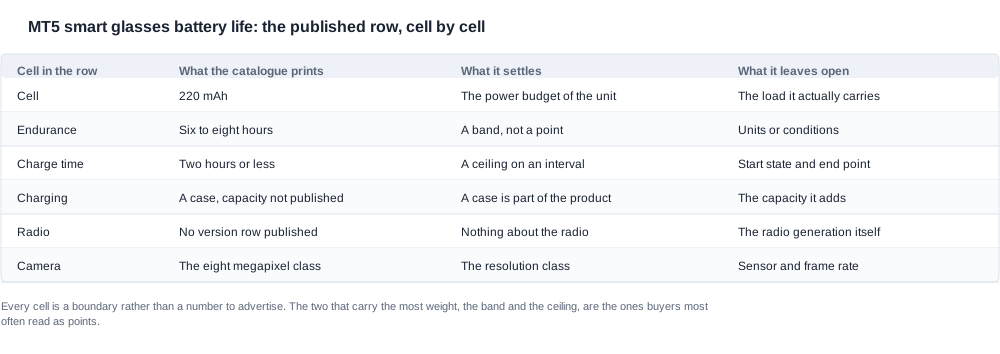
The row for this model carries six entries. Four of them carry a number, one of them carries a boundary, and one of them carries nothing at all. Reading them in that order is the whole exercise.
The cell and what it fixes
The cell is published at 220 milliampere-hours. That is a number, and it is a useful one, because it is the only figure in the row that does not depend on a condition. It fixes the energy the unit can hold, and with it the ceiling on what a single charge can deliver.
What it does not do is tell a buyer how much of that energy the unit needs to do its work. A unit that carries a camera, a sensor and a radio has a load that changes with what it is doing, and the catalogue does not publish a duty cycle for any of that. So the cell figure is a denominator, not a result: it says how much is available, and the question of how fast it is spent is precisely the question the band exists to raise.
The endurance band and why it is not a point
The endurance cell is where this model differs from most of the range, and it is worth being precise about why.
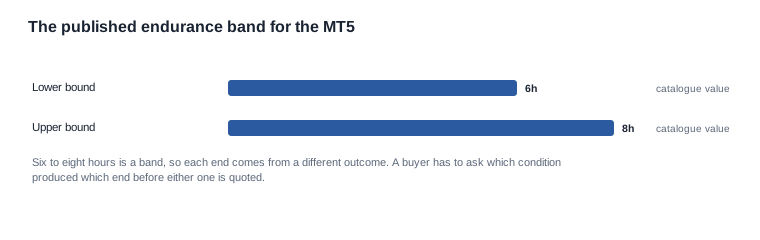
A single figure such as "about eight hours" is a rating: one outcome, produced under a stated or unstated condition, that a buyer can compare with another single figure. A band such as six to eight hours is two outcomes, and a band can only be produced in one of three ways. It can describe a spread across units, so the slowest unit in a sample gives the lower end and the fastest gives the upper end. It can describe a spread across conditions, so the same unit gives different results depending on what it is doing. Or it can describe a spread across measurement runs on nominally identical units, which is the least useful of the three and the one a buyer most needs to have explained.
The catalogue does not say which of the three it is, and that single unanswered question is worth more than any other item in the row. The three readings lead to three different buying decisions, and none of them can be chosen by inference.
How a buyer should evaluate the band against a competing figure
Comparing this model with another is where a band becomes expensive, because a band cannot be compared with a point. If a competing product publishes a single figure, the two numbers are not the same kind of number, and a quotation that puts them side by side is comparing a range with a measurement.
The criteria that make such a comparison honest are therefore about method rather than about value. Ask, of each product, what the figure was measured at, whether it is a single outcome or a spread, whether the spread runs across units or across conditions, and what the unit was doing while it was measured. Two products that answer those four questions the same way can be compared, and two that answer them differently cannot be compared at all, however close their numbers look.
The trade-off is a commercial one as much as a technical one. A broad band is more honest and less quotable; a narrow band is easier to sell and harder to defend. Where you do not yet know which kind of number you are holding, the safest position is to compare the conditions rather than the figures, and to record both as unanswered until the conditions are on file. The red flags in a comparison sheet are simple: a figure with no condition, a figure with no units, a single number presented where a spread should be, and a figure that appears in a competitor's material without a source. A checklist that asks those four questions of every candidate is more useful than any table of numbers, and it is the part of an evaluation that does not need a sample order to run.

What the 220 milliampere-hour cell settles and what the charge ceiling does not
The cell figure and the charge figure are often read as a pair, and they behave very differently. One is a number that describes what the unit holds. The other is a number that describes an interval, and an interval has a beginning and an end that the catalogue does not state. Treating them as a pair is how a channel ends up advertising a capacity and a recharge time as though they were both measurements of the same thing.
The charge ceiling and the cell it is attached to
The charge cell reads two hours or less. Three things are worth separating about it.
First, the direction of the claim. "Two hours or less" is a ceiling, and a ceiling can be satisfied by an interval of one hour or of exactly two. A listing that promises a recharge inside two hours is making a different and stronger assertion than the catalogue makes, and the difference between those two sentences is the difference between a true claim and an invented one.
Second, the starting state. Nothing in the row says whether the interval begins from empty, from a partly discharged cell, or from a cell that has been left in storage. A ceiling measured from empty and a ceiling measured from a maintenance charge are different intervals.
Third, the destination. A charge time says how long the interval runs, and it does not say what state the cell is in at the end, how much of the capacity has been restored, or how the restored capacity compares with what was taken out at the start. For a buyer building a weekly usage promise, the last of these is the one that matters.
The case that the row publishes and the capacity it withholds
The charging column of this model is not a charging method. It records that a case is published for this model and that the case's capacity is not published. That is unusual enough to be worth reading twice, and it is worth reading as what it is: a partial row that tells a buyer an accessory exists and refuses to tell them what the accessory is worth.
A case is commercially significant in two directions at once. It can add usable energy to a customer's evening, which changes the endurance arithmetic in a way a buyer can price. And it can be the place where a channel's accessory proposition is won or lost, since a case that ships in the box is a different commercial object from a case sold as an upgrade. Neither of those can be sized while the capacity is unknown, because a case of unknown capacity cannot be compared with a case of known capacity, and it cannot be included in a total energy budget either.
The catalogue also records no Bluetooth version for this model, which is a separate kind of boundary rather than a contradiction: where a radio is present, its generation has to come from the supplier, and it is a question to ask rather than a figure to read. The camera entry is published at the eight megapixel resolution class and nothing further, which is the correct level of detail for a resolution figure and a boundary for everything around it.
Turning a published band into a day plan a buyer can defend
The practical work starts once the row has been read as a set of boundaries rather than a set of specifications. What follows is the sequence that turns a band into something a channel can promise and a buyer can enforce.

Step one: establish what produced each end of the band
This is an email to the supplier, and it is the highest-leverage question in the whole sequence. The answer is one of three things, and each of them changes the programme.
If the band describes a spread across units, then the useful number for a channel is the lower end, and the useful sample size is large enough to make that end reliable. If it describes a spread across conditions, then the useful number depends entirely on the condition the channel will ship in, and the answer is effectively a request for a measurement at the channel's own setting. If it describes measurement variance, then the band tells a buyer very little, and the programme needs a sample measurement before anything is promised.
A supplier who answers this question precisely is telling a buyer that they have a repeatable test. A supplier who answers it vaguely is telling a buyer that the two numbers came from somewhere and should not be quoted.
Step two: fix the duty cycle before anything is measured
A camera model does not have one load. It idles, it records, it connects, it does all three, and the published band almost certainly reflects at least two of those states. The duty cycle a channel intends to ship is therefore a decision, and it has to be made before the sample is measured rather than after the result arrives.
The decision is not only technical. A channel that intends the unit to sit in a pocket and capture short clips has a different duty cycle from one that intends continuous recording, and the two produce different numbers from the same hardware. A specification that leaves the duty cycle unstated is a specification that cannot be tested, and a test that cannot be specified cannot be written into an order.
Step three: measure whole days, not hours
A band of hours is an abstraction from a working day. What a customer experiences is a day, and a channel's support cost is generated by days. The measurement should therefore record, for each unit and each day, the hour the unit was put into service and the hour it was taken out of it, and the number of days on which the unit completed its work without being rescued by a charge.
The spread matters as much as the average. A channel that accepts the average of a sample will discover the worst day through a customer, and a channel that accepts the best day will discover it through a recall. The pass condition should be the least complete day in the sample, and it should be expressed as a count of days at a stated setting rather than as a number of hours.
Step four: put the criterion in the order
A criterion that lives in an email is an intention, and a criterion in the purchase order is an acceptance standard. For this model the clause has three parts: the number of complete working days at the stated duty cycle, the units the sample is drawn from, and the remedy when a lot misses the criterion. The third part is the one that is usually omitted and the one that is worth the most when a delivery is held.
The clause also has a natural trigger. A change of firmware, of the cell, of the camera module or of the radio is exactly the kind of change that can move the band, and an obligation to give notice before such a change is what stops the published figure drifting away from the goods being shipped.

The open questions that belong in a supplier request
Everything above is a method. What makes it a method rather than an opinion is the request that goes with it, and the request is short.
The four questions that settle the endurance
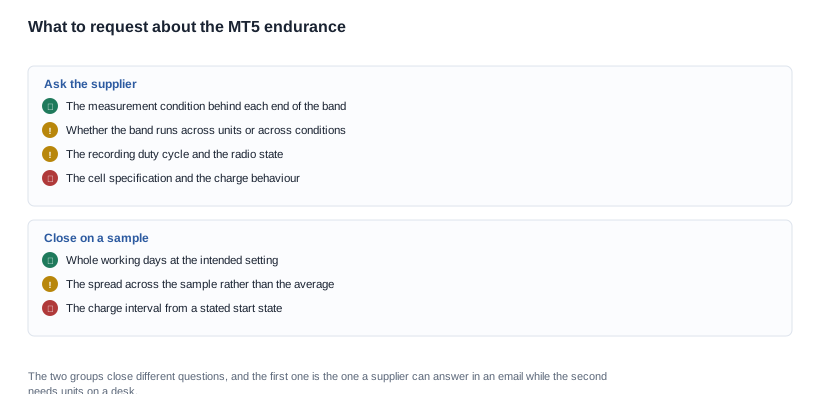
- What measurement condition produced each end of the published band, and is the spread across units, across conditions or across runs?
- What is the recommended duty cycle for a working day, and what does the unit consume in each of its states?
- What is the cell specification for the cell as fitted, and what does the charge interval restore from a stated starting state?
- What does the case add, and what is its capacity? This one has to be asked directly, because the row does not answer it.
Questions one and two can be answered in an email and should be asked before the sample is ordered, because their answers determine what the sample is for. Questions three and four are best answered on the sample itself, since they are properties of the fitted unit.
What a buyer can do with the answer
The value of the request is not the answer alone. It is that the answer converts the endurance row from something a channel has to be careful with into something a channel can state. A buyer who has the condition behind the band, a duty cycle, a sample and a criterion can write a listing sentence that a reviewer, a retailer and a customer will all be able to check. A buyer who has only the row has a sentence that all three of them will be able to challenge.
That is the practical difference between a published figure and a usable specification, and it is the whole of the procurement task on this model.
What the endurance figure is worth commercially, and where it has to be written down
An endurance figure is worth something in three places, and only in three: the listing, the support policy and the purchase order. Everywhere else it is a number in a spreadsheet, and the work of the evaluation only pays off when it has been moved into one of the three.
The listing can carry the published band and nothing narrower. A listing that says six to eight hours, described as the published endurance, is accurate. A listing that says eight hours, because that is the end of the band a channel wants to quote, is a claim that will be tested by the customer who runs out at six, and the seller will not have the condition behind it. The question to put to a channel is not whether its number is accurate but whether it is the number the supplier's own measurement produced under the condition the customer will actually be in.
The support policy has to be built around the lower end rather than the average, and it has to be built around days rather than hours. A support desk that assumes a full working day per charge handles a different queue from one that assumes a day and a half, and the total cost of that assumption is the cost of a returns queue built on the wrong number. The due diligence is cheap here: the log from the sample measurement says which of the two you are running, and the log costs nothing to keep once it exists. It is also what lets a desk verify the cause of a flat unit instead of assuming one.
The purchase order is where the figure stops being descriptive and becomes binding. Five clauses earn their place: the number of complete working days at the stated duty cycle, with the sample size the result is drawn from; the condition behind each end of the band, restated as a schedule to the order; an obligation to give notice before a change of firmware, cell, camera module or radio; a clause reopening the criterion if a component or a standard changes; and the remedy when a lot misses the criterion, including which side carries the cost of re-testing a replacement lot.
The questions to ask before you order are therefore not about the number at all. They are about who measured it, at what setting, on how many units, and what happens to the agreement if the goods turn out to be worse than the band. A buyer who has those four answers can write a specification that survives a review, and a buyer who has only the number has written a marketing line that will come back to them as a complaint.
Where our own documentation stops
We publish the power-related rows for this model as the catalogue prints them, and we do not extend them. That means the cell, the band, the ceiling on the charge interval, the note that a case is published and its capacity is not, and the camera resolution class are available to anyone, and the conditions behind every one of them are not.
Where a figure is a band rather than a point, we will not choose which end to quote, because choosing is the buyer's commercial decision and the condition behind the choice is the supplier's to state. Where a figure is a ceiling, we will not convert it into a duration, because the two sentences mean different things and a customer will hold the seller to the one that was printed.
What we will do is tell a buyer which of the questions in this article we can answer from our own records today, which are supplier questions, and which need a sample on a desk. The full list of what this model does not publish is set out in the limits note for this model, and the questions a channel is actually asked are collected in a separate piece.
Bring us the duty cycle your channel intends to ship, the markets in order, and the sample size you are planning, and we will mark each of the seven steps against those three answers.


