

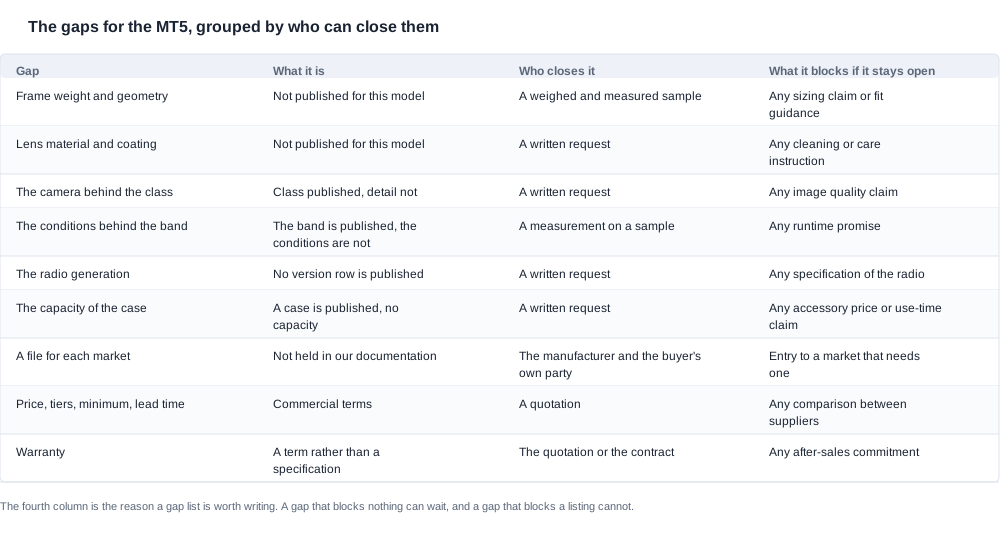
A limitations article is only worth writing if it is a working document rather than a list of apologies, and the difference is structural. A list of gaps tells a buyer what a supplier has not published, and it leaves them with nothing to do about it on Monday. A list of gaps grouped by who can close each one turns the same information into a schedule: a measurement, a request, a determination or a negotiation, each with an owner, a method and a consequence if it stays open.
That is what this article is for. Every item below is something our documentation does not carry for this model, and every item is written so that somebody can act on it. The fourth column of the table is the important one, because a gap that blocks nothing can wait until the programme is under way, while a gap that blocks a listing has to be closed before the artwork is approved.
Two framing points before the list. The first is that the gaps here are gaps in the published record, not defects in the product. Nothing below implies that the product behaves badly; it implies that a buyer cannot yet quote something about it. The second is that the size of the list is normal for this category and is not a reason to avoid the model. It is a reason to write a scope, which is what the closing section is for.
MT5 smart glasses limitations: the gaps, grouped by who can close them
The four kinds of gap, and why they should not share a queue
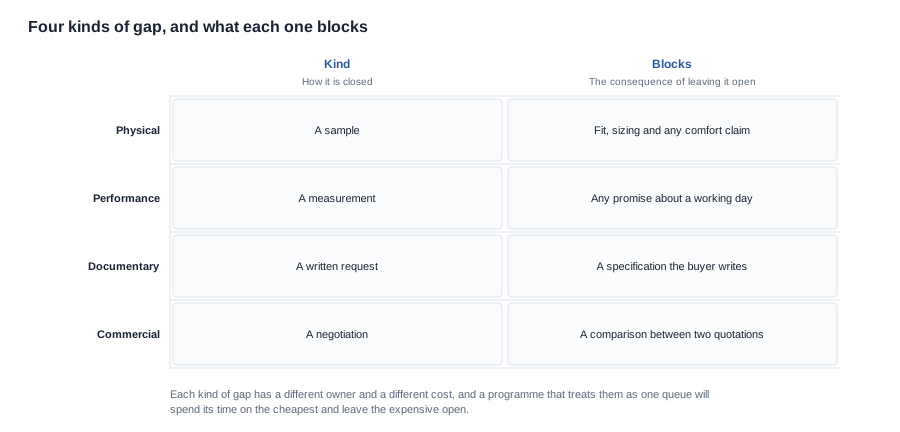
The matrix above sorts the same list by kind rather than by topic, and the sorting is worth doing because the four kinds behave differently in a programme.
A physical gap is closed by a sample and by measurement, and the result belongs to the buyer afterwards: a weight, a dimension, a fit, a spread. It is the only kind that produces a number the buyer can quote on its own authority, and it is also the kind that takes the longest, because a sample has to be ordered, shipped and used.
A performance gap is closed by a measurement under a stated condition, and the condition is the part that is usually forgotten. A measurement of how a unit behaves across a working day is worth nothing without the duty cycle, the starting state and the number of units behind it, and those three are the buyer's to set.
A documentary gap is closed by a request, and the result is a document the buyer then carries, re-checks and re-issues when something changes. The elapsed time belongs to the other party, which is why documentary gaps should be raised on the first day rather than the day the artwork is due.
A commercial gap is closed by a negotiation, and it is the only kind that a channel can usually close by itself, with a decision rather than a request. The reason it is a gap at all is that the published record contains no commercial terms, which is entirely normal, and the reason it is on the list is that a comparison between two suppliers cannot be made until both have been asked on the same basis.
The order in which they should be closed

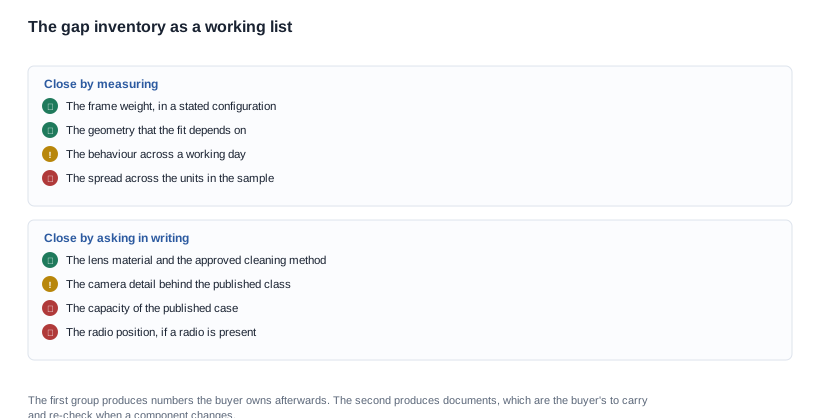
The sequence in the last image is short because the method is simple, and the step that matters most is the first one. A gap written as an absence has no answer, so a gap has to be written as a question with an answer: not "the lens material is not published" but "what is the lens material, and which cleaning method is approved for it". A gap phrased as a question can be sent, a gap phrased as an absence can only be reported.
The step after that is the one that saves the most time. Naming the party and the method in the same message means the reply is usable, because the common failure is a reply that answers a slightly different question and arrives three weeks later.

The physical gaps, and why they have to be measured rather than estimated
Four of the gaps in the table are physical, and all four belong to the same owner and the same method.
The frame weight. Nothing in our documentation gives the weight of this model, and the fact that the number is missing is more consequential than it looks, because a camera product is carried rather than worn and a buyer cannot describe how a customer will hold it without a figure. The figure also has to be stated with its configuration, because a frame weighed without its cell is not the object the customer holds.
The frame geometry. The dimensions that determine whether a unit fits are not published either, which means that any sizing guidance a channel wants to give has to begin with a measurement rather than with a table. A tolerance is the part that matters commercially, because a tolerance is what turns one measured unit into a size range that can be sold.
The fit behaviour. How the frame sits over a nose and around a temple, and what happens after a week of use, is the kind of thing that a photograph answers and a specification does not. It is a measurement only in the sense that a sample and a written observation produce it.
The spread across the units. This is the gap that the first three feed, and it is the one most often skipped. A single unit gives a number; a buyer who has measured one unit and quoted its weight has quoted a fact about that unit. The number that can go on a listing is the one that has been measured across a sample and reported with its spread, which is why the acceptance sample has to be sized before the measurement rather than after it.
The reason none of these can be estimated is not caution. It is that an estimated weight, printed on a listing and later contradicted by a customer holding the product, is a claim the channel made and cannot withdraw cheaply. The cost of measuring is a sample order; the cost of being wrong is the channel's name on a specification it did not verify.
The four physical gaps also interact with each other, and that interaction is what makes them a programme rather than a list. The geometry determines where the frame sits and therefore how long it can be held before the fit is a problem. The weight determines how the fit feels over a whole day rather than over a first minute. The lens material determines whether the instruction on the card is safe. And the camera's behaviour over a working day determines whether the unit is put back in the box at the end of it. A buyer who measures one of them in isolation gets a number; a buyer who measures the four together gets the information that a fit, a care instruction and a day plan need, because the same unit has to satisfy all of them at once.

The documentary gaps, and the ones that belong to a determination
The documentary gaps fall into two groups, and the difference between them is the difference between a request and a decision.
The ones a request can close
The lens material and the coating, together with the approved cleaning method. A buyer that cannot name the material cannot print a cleaning instruction, and a channel that prints one anyway is asking a customer to test the supplier's product on its behalf.
The camera detail behind the published class. The resolution class is published and everything behind it is not: the sensor, the lens, the angle the lens covers, the rate at which it captures, what it stores and in what form. Each of these is a request, and each is a request with a method attached, because a figure without a method cannot be compared with a figure from another supplier.
The capacity of the published case. A case is published and its capacity is not, and the request is the only way to close it. What the capacity blocks is a use-time promise, and it also blocks any comparison between this accessory and another.
The radio position. This model carries no published radio version, so if a unit is fitted with a radio, its generation is a question rather than a figure.
The one that belongs to a determination
A file for each market is not a request in the same sense, because the question of which requirements apply in a market, and for which age band, is settled by the party that carries the obligation in that market, against the finished product. It cannot be purchased, it cannot be delegated to a factory, and it cannot be inferred from a catalogue. It is the one item in the list that a buyer closes internally, and it is also the one that has to be closed first, because what it decides determines which of the other documents are needed.
The consequence for this model is that the documentary gaps and the determination have to be requested and produced in parallel rather than in sequence. A request that goes out before the determination has been made is a request for the wrong set of documents.

The commercial gaps, and the difference between a gap and a negotiation
The last four items in the table are commercial, and they are on the list for a reason that is easy to misread. A missing price is not a weakness in the model. It is a commercial term, and a commercial term belongs in a quotation, where it can be compared, negotiated and written into an order.
What is worth saying is what a buyer can and cannot do about each of them, because the difference decides how much of the programme a buyer controls.
The price and the tiers can be negotiated, and the structure of the tiers is the part worth examining. A tier that exists only at one volume is a tier that the channel will not be able to use, and the structure of the price should be established before the volume is committed rather than discovered afterwards.
The minimum order quantity is negotiable in one direction only, and the direction depends on how many configurations the order is split across. A minimum that is comfortable for a single configuration can be uncomfortable for three, and the multiplication is the buyer's problem rather than the supplier's.
The lead time is not really negotiable, and a buyer who negotiates it anyway ends up with a number that is optimistic in a way nobody wrote down. What is negotiable is the sequencing: which tranche ships first, and what the gate between tranches is.
The warranty term is a term rather than a specification, and it is settled in the quotation or in the contract. The commercial question worth asking early is not the length of the term but what the remedy is and how a claim is made, because a long term with a slow claim path is worth less to a channel than a shorter one that is easy to use.
The nine items, in the order to ask for them
The list is long, and the order is what makes it manageable. Asked in this sequence, the first answer shapes the next request, and the buyer never asks for a document that the determination has already made unnecessary.
- The determination for each market. Ask your own compliance party first, because this decision sets the scope of the rest of the list.
- The camera detail behind the published class. Ask for the sensor, the lens, what the lens takes in, the frame rate, the storage and the file format, each with the method that produced it.
- The lens material and the approved cleaning method. Ask for both in one message, because a material without a method is half an answer.
- The capacity of the published case. Ask whether the case holds energy of its own before asking how much of it, because the first answer decides whether the second one matters.
- The radio position. Ask, if a radio is present in the unit, what generation is fitted and what it was evaluated against.
- The cell specification and the safety documentation. Ask for the cell as fitted in this model, not for a cell in the abstract.
- The frame weight and the geometry. Ask for the dimensions with their tolerance, and for the weight with the configuration stated.
- The commercial terms. Put these in the enquiry rather than into a call, and ask for them on the same basis as every other supplier so that the answers can be compared.
- The warranty term and the claim path. Ask what the remedy is and how a claim is made, not only how long the term runs.
The first item is the only one that the buyer closes alone, and it is the one that makes the rest of the list answerable. The second and the third are free to ask for and are worth asking for in the first message, because the reply arrives while the programme is still being shaped. The sixth and the seventh need samples, so the sample order is the critical path for them. The eighth and the ninth belong in the enquiry, and they are the two items a channel can close by deciding rather than by waiting.
Making two quotations comparable
The commercial gaps are the easiest to close and the easiest to close badly, because a quotation is written against a configuration and two suppliers will write their quotations against different configurations unless the buyer fixes one in advance.
The criteria for a comparable pair are four. The same configuration: the same variant count, the same label scope and the same destination markets, because a quotation that includes a market and a quotation that excludes it are not two prices for one thing. The same delivery basis, so that the freight and the duties fall on the same side of the comparison. The same tranches, so that the elapsed time can be read rather than inferred. And the same commercial questions put to both, including the warranty term and the claim path.
A buyer who does this ends up with two numbers that mean the same thing and a comparison that can be defended, and the whole effort is a single page of instructions issued to both suppliers. A buyer who does not do this ends up with two numbers that look like a comparison and are not, and the mistake is usually discovered at the point of an award, which is the worst possible moment to discover it.
The most common single cause of an incomparable pair is the variant count, because it multiplies both the price and the documentation scope, and because it is the item a channel is most likely to vary between the two requests without noticing. Fix it once, in writing, and send the same instruction to both.
The total cost of the open items
There is a cost to leaving the list open, and it is worth naming because the list itself is free. A gap that blocks a listing costs a reprint. A gap that blocks a comparison costs a lost supplier. A gap that blocks a market entry costs a season. And a gap that blocks nothing costs nothing, which is why the fourth column of the table is the one to read first.
The practical method is a simple triage. Sort the list by what each item blocks, take the items that block a listing or a market first, and leave the rest until the programme is running. A channel that does this ends up with a short list of genuinely urgent items and a long list of items it has already decided to live with, which is a far better position than a long list that everything is urgent on.
The position we take on the limits of this record
The record for this model is what the catalogue prints, and a gap is an accurate description of that record rather than a criticism of the product. We publish the rows we hold, we do not estimate the ones we do not, and we will not produce a figure for a buyer on the grounds that a figure would be convenient. Where the gap is physical, the sample closes it. Where the gap is documentary, a request closes it. Where the gap is a determination, the buyer's own party closes it. Where the gap is commercial, a negotiation closes it.
We will also not treat the list as a reason to decline a programme. The way this model behaves against the published record is a matter of what the buyer is prepared to measure and ask for, and a buyer who does both ends up with a specification that is defensible, because every line in it is either a published row or a result the buyer holds.
Where the model sits in the wider camera range, and what a comparison with another model can and cannot settle, is set out in the range note for this model, and it is the piece to read before a shortlist is put together.
Send us the configuration you are considering, the markets in order and the scope of the programme, and we will mark the list above against the three things you have told us, tell you which items your own programme already closes, and give you the request list for the ones it does not.


