

A question about what a model is best for is a question about a programme, not about a product, and the distinction decides whether the question can be answered at all. A channel buying this model is buying a camera product with a published resolution class and a small set of electrical rows, and everything that determines whether the order is a good one happens outside those rows: the proposition the channel is building, the number of dimensions the programme intends to change, and the standard the listing has to meet. This article takes those three in order, and then sets out what the model cannot be asked to claim.
The answer that the catalogue supports is narrow and worth stating first. This is a camera model, and the catalogue publishes its resolution class and its electrical rows and nothing else about it: no sensor model, no field of view, no frame rate, no storage capacity, no file format, no weighing, no pricing, no lead time, no warranty term. It is a perfectly ordinary position for a factory, and it means that every conclusion a channel draws from this model has to be a conclusion the channel has itself established.
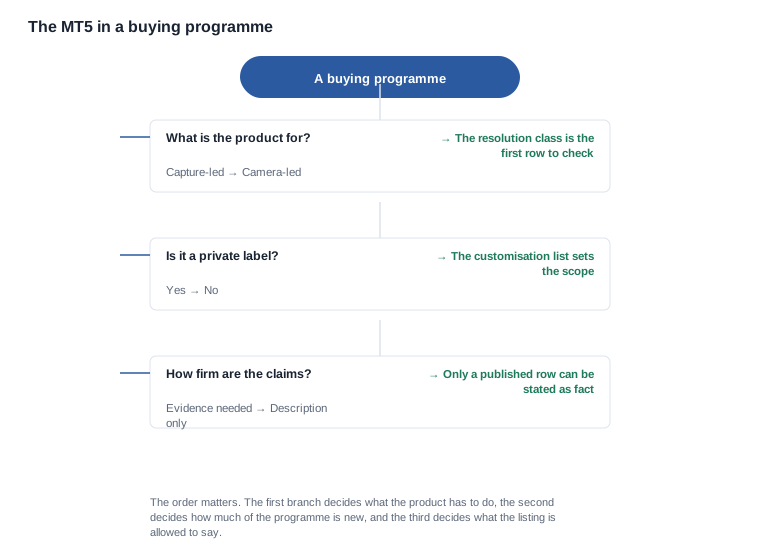
So the useful way to answer the question is not to describe the product but to describe the buyer. There are three branches, and a channel that has answered all three knows whether this model belongs in its programme before it has spent anything on samples.
MT5 smart glasses best for: which buying programme this model actually fits
Branch one: what the product has to do for the customer
The first branch asks whether the channel is selling a capture-led product or a camera-led one, and the difference is not marketing. A capture-led proposition is one where the customer uses the product to record something and the recording is the outcome. A camera-led proposition is one where the camera is an attribute of a wider proposition, and the customer is really buying the rest of it.
The published row relevant to this branch is the resolution class, and the catalogue publishes it at the eight megapixel level for this model. That is the whole of what it says. There is no published sensor behind the figure, no published field of view, no published frame rate, no published storage capacity and no published file format, so a channel that needs any of those has to establish them before it can write a specification.
The reason this branch comes first is that it determines the measurement work. A capture-led product is measured on what it captured and how long it kept running, and a camera-led product is measured on the rest of the proposition and barely on the camera at all. A buyer who answers this branch in the wrong order ends up paying for a measurement programme that the programme does not need.
Branch two: whether this is a private-label programme at all
The second branch separates two very different orders. A channel reselling a finished product under someone else's brand needs a sample, a document set and a price. A channel building its own label needs all of that plus a scope of changes, and the scope is where the cost and the elapsed time actually sit.
If the answer is no, the programme is comparatively short and the questions are about what is published and what arrives in the box. If the answer is yes, the programme acquires a second workstream that runs in parallel with the first, and the second workstream is the one that has to be scoped before a quotation is requested rather than after one arrives.
The distinction matters commercially because a private-label programme is quoted differently. A quotation for a finished product prices goods. A quotation for a programme prices goods plus changes, and the price of the changes is a function of how many dimensions are open, how many of them are already defined, and how many of them need a new sample before they can be approved.
Branch three: how firm the claims have to be
The third branch is about the standard the listing will be held to, and it is the branch most often skipped, because a channel that has never been asked for evidence does not yet know that it will be.
If the answer is that evidence is needed, then every statement in the listing has to trace to a document, and the programme has to include the work of producing those documents before the copy is written. If the answer is that description only is acceptable, the constraint is looser but the boundary is no less real, because a description that implies a performance is a claim in everything but the sentence.
A useful way to frame it is to ask which sentence on the product page would be hardest to defend. For most channels that sentence turns out to be the one about how the camera performs rather than the one about what the camera is, and the reason is that the catalogue supports the second and not the first.
What a channel can build on and what it has to build itself
Once the three branches are answered, the programme divides into two columns, and only one of them is free.
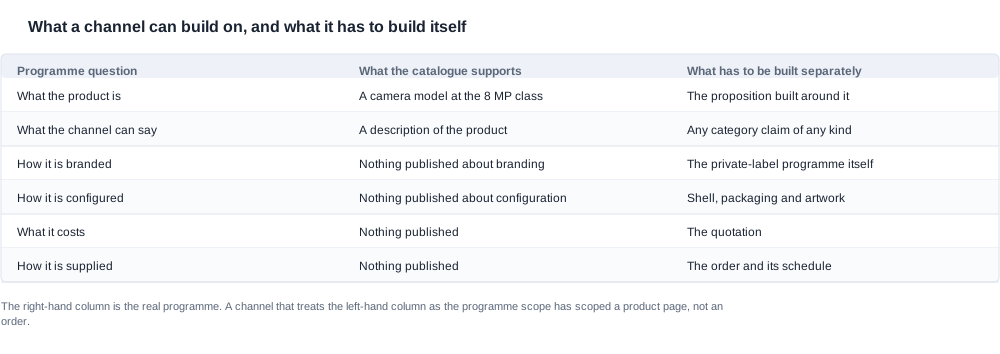
The left-hand column is what the catalogue publishes, and a buyer can rely on it without contacting anybody. The right-hand column is the programme, and every line in it is work.
The lines that are already settled
Three things are settled and can be built on directly. The product is a camera model, and its resolution class is published. The electrical rows are published, and the endurance question that follows from them is dealt with separately in the endurance piece for this model, because a band and a day plan are a different subject. And the absence of a Bluetooth version row is settled too: no radio generation is published for this model, so if a radio is fitted, its generation has to reach the buyer as a written answer rather than be read off a catalogue page, and a channel that has not asked for it will not be able to state it in a specification, a listing or a tender response.
Those three are enough to write a specification skeleton. They are not enough to write a listing, and the difference is the right-hand column.
The lines that have to be built
The right-hand column is longer than a channel expects, and the reason is that most of the lines look like product decisions and are actually programme decisions. The proposition around the product is yours, not the factory's, and the factory's only contribution is the product. The branding is yours. The configuration, the shell, the packaging and the artwork are yours, or they are a change request, and a change request has a lead time that belongs in the schedule from the first day. The price, the minimum order quantity, the lead time, the warranty term and the schedule are not published and arrive in a quotation, and the order you place is the order you signed against, not the one you assumed.
None of that is a criticism of the catalogue. It is the ordinary shape of a factory relationship, and the risk is in the assumption that the published product page is the programme.
The elapsed time of a programme, which is not the elapsed time of a product
A product lead time and a programme lead time are different numbers, and the second one is the one that matters to a launch date. The product lead time is how long the goods take once everything else is settled. The programme lead time is how long it takes to get to the point where everything else is settled, and it is composed almost entirely of steps that have to happen in sequence.
The typical chain in a private-label programme runs like this: a sample is chosen and shipped, the sample is reviewed and the review produces a list of changes, the changes are made and a new sample is produced, the new sample is approved, the artwork and packaging are produced against the approved configuration, the documentation is brought into line with what was actually built, and only then does production begin. Each of those steps waits for the one before it, and none of them can be compressed by working harder on any single one of them.
That is why a supplier who quotes one total figure for a programme has not answered the useful question. The useful question is what the chain looks like, which step is the longest, and which steps can run in parallel with which. A channel that knows that the sample review is the bottleneck can start the artwork in parallel; a channel that has been given only a total will discover the bottleneck after it has passed.
The criteria for judging the answer are three: is the chain given as a sequence rather than a total, is the longest step named, and is the point at which the documentation has to be re-issued identified. Those three answers are what allow a launch date to be set honestly, and they are the reason a programme should be scoped before a price is asked for rather than after one arrives.
How to compare two programmes that are both built this way
A channel evaluating this model against another has to compare the right-hand columns, because the left-hand columns are descriptions rather than commitments. The comparison criteria that hold up are the ones about the shape of the change: how many dimensions are open, how many need a new sample, how many reach the documentation, and whether the supplier has a repeatable process for the dimension that is hardest.
Where those answers are not available, the comparison is not yet a comparison. It is two product pages, and the honest position is to record the dimensions as unresolved and to price the programme only once the scope is written down.
The customisation dimensions a private-label programme has to scope
If the second branch came back yes, this is the section that matters, and the useful artefact is a list rather than a paragraph.
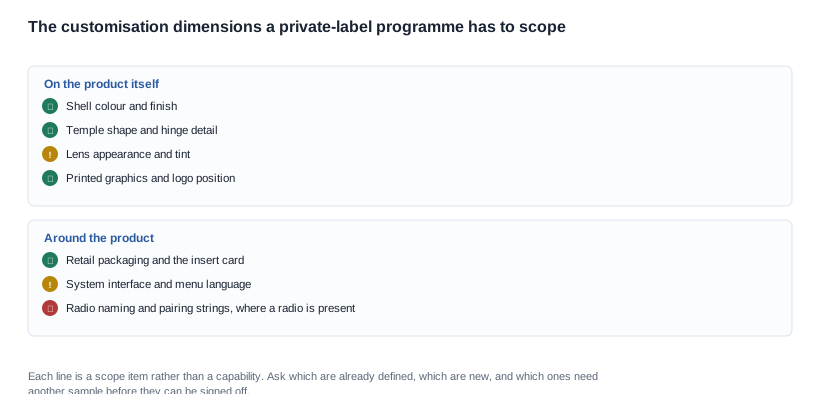
The list in the image is the set of dimensions a private-label programme around this model normally turns out to touch. It is not a claim about what the factory will do, because nothing about customisation is published for this model; it is the scope a channel should write down before asking, so that the answer has something to be measured against.
Four of the lines are on the product itself: the shell colour and finish, the temple shape and the hinge detail, the lens appearance and tint, and the printed graphics including the logo position. Three of them are around the product: the retail packaging and the insert card, the system interface and the menu language, and the radio naming and pairing strings where a radio is present.
The order that keeps a programme from being re-scoped

The sequence in the second image is deliberately front-loaded. A channel that lists its intended changes before asking a price gets a quotation that covers the programme, and a channel that asks a price first gets a quotation for goods with a note saying what happens if the shell changes. The first of those is a programme; the second is a conversation, and conversations become expensive in the second month.
Two questions do most of the work here. Which of the dimensions are already defined, because a defined dimension costs nothing to carry and an open one costs a sample. And which of the dimensions reach the documentation, because a change that touches what the document describes is a change that needs a re-issue, and the re-issue has to be scheduled rather than discovered.
The criteria for judging a supplier's answer are simple and testable. A good answer tells you which dimensions are already supported, which need a new sample, what each one costs in elapsed time, and which of them invalidate something that has already been filed. An answer that is a list of capabilities without elapsed times is a catalogue, and a catalogue does not scope a programme.

What this model cannot be asked to claim
A model with a small published footprint generates a specific set of claims that cannot be made, and knowing them before the artwork is approved is worth more than knowing them afterwards.
Nothing about the camera beyond its resolution class. The catalogue publishes the eight megapixel level for this model and no further detail, so a listing cannot state a sensor, a lens, a field of view, a frame rate, a storage capacity or a file format. Each of those is a request, and a request with a method attached is a document a reviewer can check.
Nothing about how the product performs under use. A published electrical row describes a condition, not a behaviour, and a buyer who writes a performance sentence on the strength of a specification row has written a claim that the document does not support.
Nothing about the physical product. The weight, the frame geometry, the hinge detail, the temple length and the frame material are all unpublished, and the channel's own measurements are the only ones it may quote. For this model we will not quote a weight, a unit price, a minimum order quantity, a lead time or a warranty term, because the first is a measurement and the other four are commercial terms that belong in a quotation.
Nothing about any outcome the customer is meant to feel. The catalogue publishes no audio, no imaging, no convenience and no health claim for this model, and the same boundary applies to every camera product in the range. A listing that promises an experience rather than describing a function is making a statement the documentation does not carry.
What can be written instead
Each of those four blocks has a legitimate version that a channel can publish today. The resolution class is published, so the class can be stated. The electrical rows are published, so they can be stated with their conditions attached. The measurements the channel has taken on its own samples can be stated as the channel's measurements. And the functions the product performs can be described as functions, which is different from promising what the customer will get out of them.
That substitution is the whole of the work. A listing built this way is narrower than one built on adjectives, and it is the only version of it that a retailer, a marketplace reviewer or a market surveillance officer can be satisfied by, because every sentence in it can be traced to something.
The questions to ask before you order, and the ones to ask again later
The decision path above produces a short list, and the value of the list depends on which of the questions are answered before the order and which are answered after it.
The four questions that shape the order
- Which dimensions of the programme are open, and which are already defined? This sets the sample count, and the sample count is the first number in the schedule.
- What is the delivered sample configuration, and how many units does the approval need? A sample that is not the configuration you will ship cannot approve anything.
- Which published rows will the listing rest on, and which sentences are yours to evidence? The two lists should be kept separately, because they have different owners and different lead times.
- What is the acceptance criterion for the first delivery, and what happens when a lot misses it? This is the clause that converts a description into a standard, and it costs nothing to write before the order and a great deal to write after one is held.
The questions that have to be asked again later
Three of them recur, and a channel that has planned for the recurrence will not treat it as a problem when it arrives. A change of firmware or of a component can move the electrical rows, and the notification obligation has to be in the order for that to be visible. A change in the programme scope moves the sample count and the price, and the order needs a mechanism for that rather than a conversation. And a change in the market the product is sold into changes what has to be documented, which is a question for a different owner in the organisation and a different kind of elapsed time.
Those three are the reason a channel that treated this model as a product page eventually finds itself holding a programme it has never scoped. The difference between the two outcomes is a list, written once, before anything is ordered.
The position we take on the decision
We publish what the catalogue prints about this model and we do not extend it. We will not choose a channel's proposition for them, and we will not estimate the items the catalogue does not carry. What we will do is take the three branch questions in the order above and tell a buyer which of them our documentation answers today, which of them the supplier answers, and which of them the buyer's own sample and measurement programme answers.
Bring us the proposition in one sentence, the list of dimensions you intend to change, and the markets in order, and we will mark the programme against the published rows and the open questions, so that the quotation you ask for covers the programme rather than the product page.


