

A sample review is worth doing only if it produces a criterion, and a criterion is worth something only if it is written down before the first shipment is accepted. Everything else about a review is preparation. That is the frame for this checklist: the items below are not a list of things to admire on a desk, they are the observations that turn a sample into a number a purchase order can enforce, and a number a supplier can be held to.
The order of the checklist matters more than the individual lines, and the reason is that a review done in the wrong order produces a result nobody can use. Checking the function first and the identity last means that a function finding cannot be attributed, because nobody has established that the unit is the configuration that was ordered. Checking the paperwork last is right, and checking the record never is not a review at all.
Three things shape the whole exercise. The catalogue publishes a resolution class and a set of electrical rows for this model, and nothing else, so the review can confirm that the published rows behave as printed and cannot extend them. The programme around the unit, its configuration and its dimensions, is not published either, and the dimensions a private-label programme touches are set out in the scope note for this model. And the paperwork that arrives with the unit is a separate object from the unit, with a different owner and a different elapsed time.
MT5 smart glasses buyer review checklist: what a sample can and cannot settle
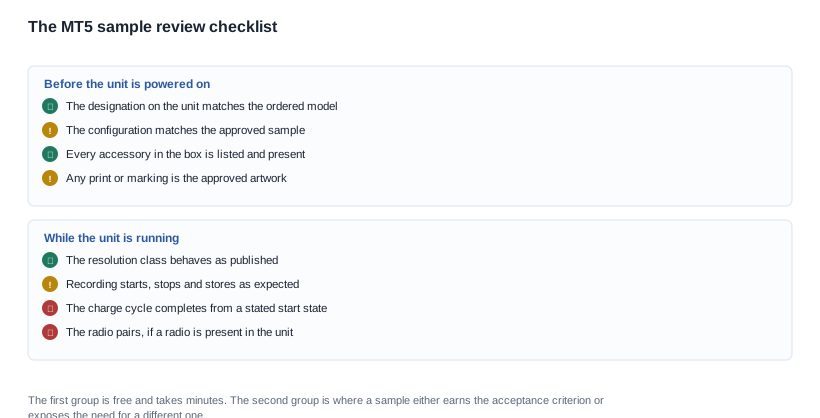
The checklist has two groups because a review has two halves that are usually confused with one another. The first group is about the physical unit and can be done by anybody with the box open and fifteen minutes. The second group is about the unit doing its work, and it needs a stated starting condition, a stated method and a written result. Confusing the two produces the most common review finding of all, which is a remark about how it felt.
What a sample can settle, and what it cannot
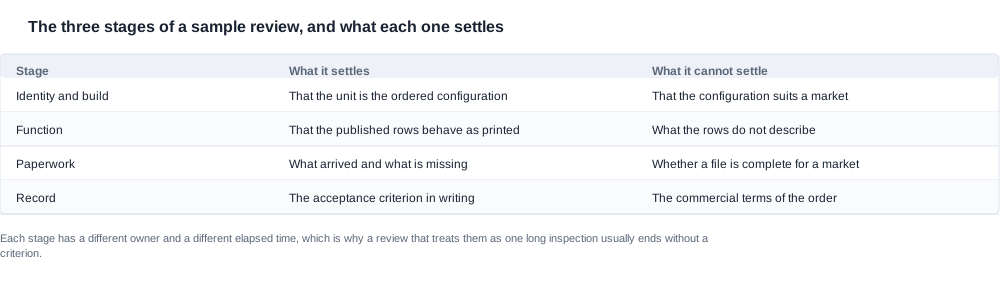
A sample can settle four things, and they are worth writing down as a list because a channel that knows the list in advance reviews faster and argues less.
- That the unit is the configuration that was ordered. Not that the configuration is right, only that it is the one that was agreed.
- That the published rows behave as published on this unit. The published electrical rows, and the published resolution class, are the only performance statements the catalogue makes, and a sample is the only place they can be checked.
- What actually arrived with the unit, and what did not. The box contents are the first evidence a buyer gets of whether a packing list is accurate.
- What the unit does that the catalogue does not describe. This is the most valuable output of a review, because it is the set of things a listing might accidentally promise.
What a sample cannot settle is equally worth stating. It cannot settle whether the configuration suits a destination market, because that is a determination made against the finished product by the party carrying the obligation. It cannot settle what the file contains, because the file is assembled by the manufacturer and arrives separately. And it cannot settle a commercial term, because no unit on a desk carries a price, a lead time or a warranty.

Stage one: identity and build, checked before the unit is powered on
The first stage is the one that is usually skipped, and skipping it makes everything afterwards unattributable.
The identity checks
Three observations, in this order. The designation printed on the unit has to match the designation that was ordered, character for character rather than in substance, because two models in this category differ by a single character and a reviewer working from memory will not see the difference. The configuration has to match the approved sample or the approved artwork, whichever is the reference. And the printed graphics, the shell finish and any marking have to be the approved versions rather than the standard ones, which is the point at which a private-label programme either holds together or quietly does not.
The build checks
The build of a camera product has a small number of places where it fails, and they are worth checking in a fixed order because each one is cheap to look at and expensive to discover later. The hinge is opened and closed through its travel, looking for play that was not there at the factory. The temples are checked against the bridge for alignment, because a unit that has been assembled out of true will not seat properly on a face and will not be worn. The lens is inspected for chips, for coating marks and for any print on the visible surface. The charging contacts are looked at, because a contact that is not clean is a contact that does not charge.
None of these is a test and none of them needs a protocol. They are observations, and a review that records them as observations rather than as passes and fails is a review that can be repeated by somebody else.
The box contents
The packing list is compared against the contents item by item, and the accessories are counted rather than glanced at. Two questions are worth asking while doing it. Whether the accessories that were ordered are the accessories that are present, in the right quantity. And whether anything is present that was not ordered, because an extra item in the box is usually a substitution that nobody has written down.
The record of this stage is short: the configuration confirmed, the build observations, and the contents against the list. It takes under half an hour and it is the part of the review that makes the later stages arguable.

Stage two: function, checked against the rows the catalogue actually publishes

The second stage is where a review earns or loses its cost, and the discipline is to work through one published row at a time rather than to try the product out and describe the impression.
The resolution class
The catalogue publishes this model's resolution class and nothing further about it, so the only honest check is whether the unit captures at the level that class describes, and whether the captures it produces are the ones the channel intends to ship. What cannot be checked from a sample is the sensor behind the figure, the field of view, the frame rate, the storage capacity and the file format, and a review that records an impression of image quality is recording a preference rather than a result.
The recording behaviour
Recording is a function rather than a number, so it is tested as a function: does it start, does it stop, is what it stored where the unit says it stored it, and does a long recording behave the same as a short one. A channel that intends the product to capture clips in a bag needs to know whether it keeps recording unattended, and that is a question the catalogue does not answer and a sample can.
The charge cycle
The charge cycle is where a review most often produces a number that is unusable, and the reason is that the starting state is not stated. Record the state of the cell when the unit goes onto the charger, the elapsed time to the point at which it is judged charged, and the state at the end. Two reviews of the same unit with two different starting states are two different measurements, and only one of them is a measurement of anything.
The published figure is a ceiling on an interval rather than a duration, and the endurance question that follows from it is set out separately, because a band and a day plan are a different subject from a review of one unit.
The radio, where one is present
If a radio is present in the unit, the pairing behaviour has to be checked, and so does what the unit reports about itself when it connects. No radio generation is published for this model, so a review cannot state one; what a review can do is record the behaviour and the naming strings, and hand them to the person who has to answer for the specification.
What the reviewer should not conclude
Three conclusions are tempting after a short session with a good unit, and all three are unreliable. The first is that the image quality is acceptable, which is an impression formed on one unit, in one room, on one subject, and which tells a buyer nothing about the model in a customer's hand. The second is that the unit is light enough, which is a weighing done in a reviewer's own hands, or an estimate of what a hand can hold, rather than a measurement of the frame in a stated configuration. The third is that the product is durable, which no amount of handling in a review can establish, because handling is not a defined protocol and produces no comparable number.
The remedy in each case is a method rather than an act of discipline. Quality needs a subject, a distance, a light and a stated pass condition. Mass needs a scale and a stated configuration. Durability needs a protocol, and the protocol belongs in the acceptance sample rather than in the review. A reviewer who writes that the unit feels light has written a sentence that will be quoted back at the channel once a customer says otherwise; a reviewer who writes the measured mass of the frame in a stated configuration has written a sentence that can simply be checked.

Stage three: what arrives with the unit, and what it is not
The third stage is a paperwork stage, and it is deliberately short, because the deep work on the file belongs to the person who assembles it rather than to the person who opens a box.
The observation is simply this: what came with the unit, and what is conspicuously absent. A channel that reviews samples should know whether a file was included at all, whether it names the designation in the box, and whether its issue date is inside any window the programme has set.
Two things must not be confused at this stage, and the confusion is common enough to be worth naming. A document that arrives with a unit is not automatically a document that is complete for a market, and a document that is complete for one market is not automatically complete for another. And the absence of a document in the box is not evidence of a failure; it is evidence of an open question with a name and a date against it, which is a different thing entirely.
The output of this stage is therefore a list rather than a judgement: the documents received, the documents expected and not received, and the owner for each missing one.
The review record, and the acceptance criterion it produces
The last stage is the one that turns a review into a contractual instrument, and it is where most programmes stop one step short.
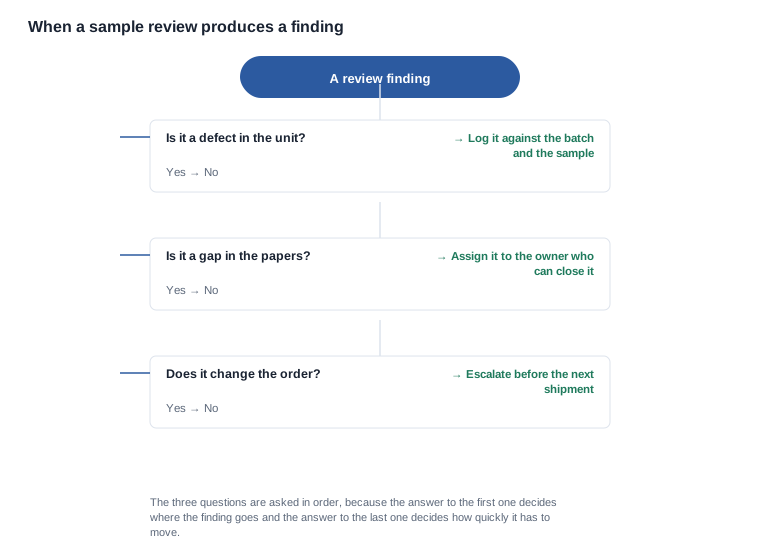
How a finding is routed
The decision chart in the image above is the routing rule for anything the review turns up. A defect in the unit is logged against the batch and the sample, because it is evidence about the goods. A gap in the papers is assigned to the owner who can actually close it, which is rarely the reviewer. And a finding that changes the order has to be escalated before the next shipment is booked rather than after it has shipped, because a criterion that arrives late is a criterion that arrives after the cost.
Six checklist entries, and the format that matters more than the length
Six entries, and the format is more important than the length. The identity of the unit, by designation and by configuration, so that the record describes a specific thing. The observations, stated as observations, with the condition attached where a condition was used. The numbers, with their units and their starting states, so that the measurement can be repeated. The documents received and the documents missing, with owners. The findings, each classified by the routing rule. And the acceptance criterion, written as a number that a lot can be accepted or rejected against.
The criterion that comes out of it
A criterion written from a review of one unit is a weak criterion, and it is worth saying so plainly. One unit establishes what is possible, not what is typical. The criterion that binds a shipment needs the spread, which means a sample of units rather than a sample of one, and it needs the states that the review found to matter, which is why the review's own findings are the best source for the criterion.
The practical sequence is therefore: review a sample, write down what the review found, run the same observations across the units in the acceptance sample, and derive the criterion from the spread. The criteria a buyer should compare two suppliers on are simple. How many units the acceptance sample runs across, how many observations the review covers, and whether the criterion is expressed as a number with a unit and a starting state, or as an impression.
How to brief the person doing the review
A checklist is only as good as the brief that comes with it, and the brief is usually what is missing. A reviewer handed a list of observations without a brief will produce impressions, and impressions are not records.
The brief has three parts and takes a page. The reference: what the unit is, which configuration was approved, and which artwork is the approved version, so that the reviewer compares rather than judges. The states: which of the observations matter to the channel and which are simply good practice, because a reviewer who is told that the starting state of the cell matters will record it, while a reviewer who is not told will record the charge time alone and the measurement will be unusable. And the output: what form the record takes, where it is filed and by when it is needed, because a review that lands after the shipment has been booked cannot stop it.
There is a fourth item worth more than it looks, and it is the one that is usually left out. Tell the reviewer what the review is not for. If the channel already knows that the file will be assembled separately by the manufacturer, say so, and the reviewer will not spend a day trying to reconstruct a conformity position from the contents of a box. The time saved is time that would otherwise have gone into the observations that the programme actually depends on.
The brief is also where the sample count is set. One unit establishes what is possible; a sample establishes what is typical. A reviewer sent to look at one unit and asked to report a typical result will report an impression of a typical result, and the number that comes back will not survive a later argument with a second supplier.
The position we take on the review
We publish the rows this review is able to check and we do not extend them. That means a review of this model can confirm that the published resolution class and the published electrical rows behave as printed on the unit in front of the reviewer, and can establish the configuration and the box contents. It cannot establish anything about the file, about the market entry position or about the commercial terms, and we do not supply those from a catalogue either.
We will also not tell a buyer what to look for. The items on a review checklist are the ones that decide whether a shipment is accepted or rejected, and a checklist written by the party that sells the goods has a different set of items from one written by the party that has to defend the claim later. The one thing we will say plainly is that a review which produces no criterion has cost a sample and bought nothing, and that a criterion derived from a single unit is a statement about that unit rather than about the goods.
What we will do is tell a buyer which of the observations our own documentation already supports, which are the buyer's own, and which depend on a file the manufacturer assembles. Send us the configuration you have approved, the states your programme actually cares about, and the markets in order, and we will mark the review against those three, so that the criterion it produces is one your purchase order can enforce.
What this review does not settle
It does not settle the market entry position, the commercial terms, or the questions that belong to a file rather than to a box, and it is worth keeping those three separate from the review so that the review's own findings stay attributable. Where a channel needs the file assessed, that is a separate piece of work with a separate owner. Where it needs the price and the schedule, that is a quotation. And where it needs the endurance to be a promise rather than a figure, that is a measurement programme on a sample of units rather than a check of one.
What the review does settle is whether the goods that arrived are the goods that were ordered, whether the published rows behave as printed, and what a buyer can write into the purchase order as a number. Those three answers are worth the sample and the half day, and they are the reason the checklist is arranged in the order it is.


