

The charging column for this model is not a charging method. It reads that a case is published for it and that the case's capacity is not published, and a buyer who has been expecting an interface there will misread the whole cell. That is the first thing to settle, and it is the reason this article exists: the interesting decisions in this model are all downstream of a row that has been written in a way that keeps its most valuable number to itself.
The second thing to settle is what the interface actually is. Across the range as a whole, seventeen of the twenty-eight models are published as charging magnetically, and this model is counted among them. What the model cell itself does not do is state the interface, because the cell is occupied by the case note. So a buyer has two facts and a gap: a case exists, its capacity is not published, and the way the unit charges is a question for the supplier rather than a figure to read.
The third thing is the one that turns a charging accessory into a product line. A case can be a dock that charges the unit, a portable store that carries energy of its own, or both at once, and the three readings produce three entirely different programmes. Nothing in the published cell distinguishes them.
MT5 smart glasses charging options: what the charging column actually says
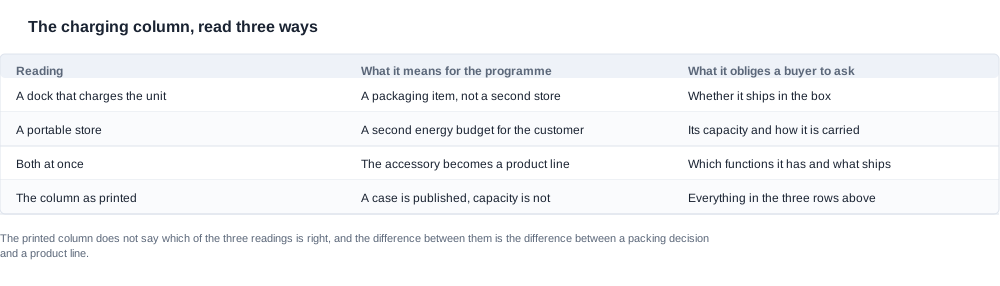
The table is the whole argument. The first three rows are the three possible readings of a published case, and the fourth row is what the catalogue actually gives: the existence of a case and the absence of its capacity. A buyer who has not asked which reading is correct is working with a single sentence and a blank.
Why a partial cell is worth so much attention
A catalogue cell that says "a case is published and its capacity is not" is doing two unusual things. It is publishing an accessory without publishing the accessory's specification, and it is leaving the cell that would normally describe the interface to something else.
That combination is unusual enough to be worth handling deliberately, because most buying habits are built for cells that are either full or empty. A buyer trained on full cells compares the numbers. A buyer trained on empty cells asks for the missing document. A buyer trained on neither tends to read a published case as a published accessory with known properties, and then finds out otherwise during the accessory programme rather than during the purchase.
What the absence of a capacity actually blocks
Three things, and all three are commercial rather than technical.
A comparison. A case with a published capacity can be compared with a case with a published capacity. Two cases with unpublished capacities cannot be compared at all, because there is no quantity to compare, and a channel that has two suppliers quoting an accessory has no way of knowing which accessory it is buying. The only workable position is to require the capacity in writing before a second quotation is compared with the first.
A total energy budget. A case that stores energy changes what a customer can do over a day or two, and that is the thing a channel would want to say. It cannot be said without the capacity, and the temptation to imply it without the number is exactly the kind of claim that turns an accessory into a liability.
An accessory programme. If the case is a genuine product line rather than a packing item, it needs its own artwork, its own packaging, its own carton, its own label, its own warranty and its own place in the box. The scope of all of that is a decision, and the decision needs the capacity, because the capacity is what makes the case worth a separate SKU.

The interface question, and why the range position does not answer it
The magnetic charging position is useful, and it is useful in a specific way: it tells a buyer that the charging method for this model is unlikely to be the kind of interface that generates friction, damage and returns. A magnetic contact that a child or a customer can seat one-handed is a better proposition than a connector that has to be lined up.
But it is a range-level statement, and a range-level statement is not a specification. The number of models in the range that charge magnetically tells a buyer what the house style is; it does not tell them what this unit sits on, how the contact is made, whether the contact is exposed or recessed, what happens when the connection is partial, or whether the case is the charging surface.
Those are the questions that decide the accessory programme, and they are all questions for the supplier:
- What does the unit sit on to charge, and is that surface the published case or a separate item?
- How is the connection made, and what does a partial connection do?
- Is the contact exposed on the product or housed inside the case?
- Does the case hold energy of its own, and if so at what capacity?
- What is the interface that a customer in a shop or at a desk would actually use, as distinct from the one in the box?
The fifth question is worth asking separately because the two are not the same thing. A product that charges in its case in the box and charges on a cable at a desk is a product with two charging paths, and only one of them appears in the carton. A channel whose retail experience involves a customer trying the product at a counter needs to know which path is available there.
Where the charging interval sits
The catalogue publishes a charge time for this model, and it is expressed as a ceiling rather than as a duration, which is the correct way for a catalogue to publish it and the reason it cannot be converted into a promise. The condition behind the interval, the state the cell starts in, and what the interval restores are all questions, and the answer to them is set out in the document position for this model, which is where the paperwork obligations of a cell that ships inside a product are handled.
The counter question, which is the one customers ask first
In a shop, the first thing a customer does with a product like this is put it down and try to charge it. That single gesture decides whether the product can be demonstrated at all in a physical store, and it is a question about the accessory rather than about the unit.
If the published case is also the charging surface, the store needs a case on the counter, and the channel has to decide whether the case is supplied for demonstration, whether it is sold at the counter, and what happens to a unit that has been connected and disconnected many times in a day. If the case is sold as an accessory, the product in the shop cannot be charged at all, and the store has to be told that before the first delivery rather than discovering it through a customer. Either answer is workable. What does not work is a channel that has not asked the question and has planned a retail experience around a product that cannot be demonstrated.
Why the accessory is usually the bigger decision than the product
The unit's proposition is fixed by the catalogue, and a channel can do very little to it. The case's proposition is open, and everything commercially interesting that a channel can do with this model lives inside it rather than around it.
The two-day use story, the counter demonstration, the unboxing, the gift set, the bundle with a second unit, the seasonal campaign with a different case finish: each of those is an accessory decision, and each of them is closed by the one number the catalogue does not publish. That is unusual, and it is the reason the accessory questions in this article deserve more of a buyner's attention than they usually get. The manufacturer's work is finished when the unit is finished. The channel's work starts with the case, and the channel's work is where the value is created.
The three ways a case can behave, and the question that separates them
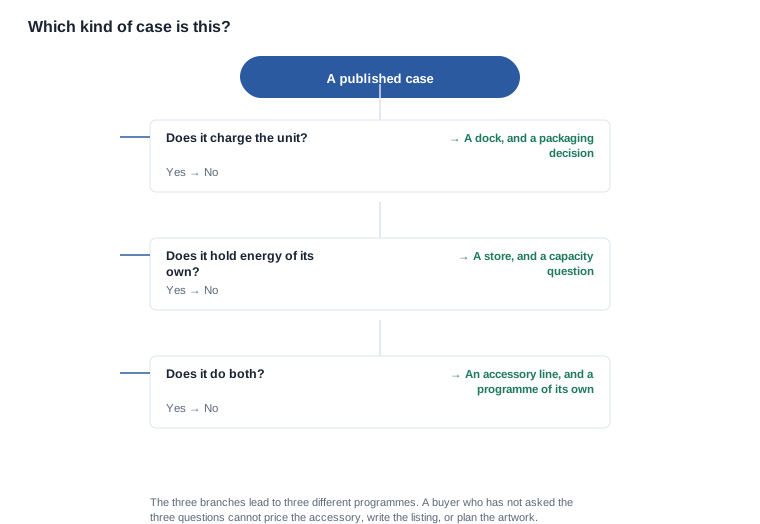
The decision chart gives the three questions and what each answer leads to, and the reason the third branch exists is that a case that does both is not a larger version of the first two. It is a different object with two jobs, two lifecycles and two failure modes, and it needs to be described, priced, warranted and stocked as such.
A dock
A dock that charges the unit and holds no energy of its own is a packaging decision. It is a nice object to put in the box, it protects the product in transit, it gives the product a place to sit, and it adds nothing to what the customer can do. Its value to a channel is presentational and protective rather than functional, and the questions about it are about artwork, about what is printed on it, and about whether it ships in the box.
A store
A store that holds energy and charges the unit from its own reserve is an energy proposition, and everything about it is an energy question. The capacity decides the use time. The capacity decides the weight. The capacity decides whether the channel can call it a two-day accessory. The capacity decides whether it is a regulated item on the transport side, which is a matter for the file rather than for the listing, and which is why the paperwork question is never entirely separable from the accessory question.
Both
A case that charges the unit and carries its own reserve is the case that most often surprises a channel, because it arrives as a packing item in a quotation and has to be re-quoted as an accessory once the scope is understood. It is also the case with the most value if the capacity is published and the most risk if it is not.
The question that separates them
One question does most of the work: does the case hold energy of its own? A yes means every downstream question — capacity, weight, transport, warranty, listing — becomes an accessory question. A no means the case is a dock, and the programme stays where it was.

What the case does to a channel's logistics, warranty and support
A case is not only a charging accessory, and the reasons a channel loses money on an accessory are rarely about the charging. They are about what the accessory does to everything around it, and all of that is affected by a capacity nobody has published.
It changes the shipping. A case in the carton changes the packed dimensions, the shipping weight and the volumetric weight, and those three numbers together decide what a unit costs to move. An accessory whose weight cannot be stated cannot be added to a freight calculation, which means a channel that quotes a landed cost including the case is either estimating or leaving the cost out. The questions are the packed dimension of the carton with the case in it, the shipping weight of the case on its own, and whether the case ships in the box at all or is a separate line in the same consignment.
It changes the warranty. A case in the box sits inside the product's warranty. A case sold separately needs a warranty line of its own, with its own period and its own claim path. A case that holds a cell has a third failure mode, because a cell can degrade in a way that a plastic shell cannot, and a claim about that cell has to be handled by somebody. None of this is difficult to arrange, and all of it is impossible to arrange without knowing what the case is.
It changes the support desk. A customer with a problem with the case contacts a desk that is set up to handle the product. If the case is not in the product record, the desk has no script, no spare, and no answer. The practical step is to put the case into the product record rather than into a separate accessory file that nobody opens until there is a complaint about it.
It changes the return rate. The case is the part of the package a customer interacts with least and understands least, and it is therefore the part most likely to come back. A channel that has not described what the case is for will get returns from customers who were expecting it to do something it does not do.

How a channel prices an accessory it cannot yet compare
A channel in this position has three routes, and they lead to different decisions.
The first is to take the first quotation and stop asking. That is legitimate when the accessory is a minor line and the programme is small, and it is a mistake when the accessory is a headline of the listing, because the price then carries a number nobody can verify and the channel cannot tell whether a second supplier is cheaper or better.
The second is to hold the accessory back until the capacity is published. That is the right answer when the accessory's value is a use-time promise, because the use-time promise is precisely what the missing number is for, and a listing that carries the promise without the number is a claim rather than a description. Holding the accessory back costs a season of the accessory line; making the claim costs the credibility of the listing.
The third route is the one that professional buyers use, and it is worth spelling out because it is not obvious. Ask the supplier to price the accessory in two ways: once with the capacity stated and once without it. The two prices are a commercial measure of the number, and comparing them tells a channel how much of the accessory's value depends on the missing figure. A supplier who is willing to quote both has usually already measured it, and the exercise frequently ends with the capacity appearing in the quotation without anyone having to insist.
The criteria for judging the answer, whichever route is taken, are the same. Whether the answer is a figure with a unit and a method, or an assurance. Whether it is given per designation rather than per family. What the supplier will put in writing. And what the accessory will require in the listing if the capacity is published, because that requirement is the artwork and the packaging work that has to be budgeted.
The checklist this page reduces to
If a buyer wants one sheet rather than an article, these are the lines that decide the accessory.
- Does the published case hold energy of its own? Everything else follows from the answer, and it is a question rather than a figure.
- What is the capacity of that energy, in the unit it is published in? A number with a unit and a method is usable; an assurance is not.
- What does the unit charge from in a store, and what does the store need to have on the counter?
- Does the case ship in the box, and if not, is it a separate line in the same consignment?
- What is the packed dimension and the shipping weight with the case included? These two numbers belong in the freight calculation, and without them the landed cost is incomplete.
- Who carries the warranty on a case that is sold separately, and what is the claim path?
The criteria for deciding whether the accessory is ready to be described in a listing are equally short: a capacity on file, a defined role in the customer's day, a shipping figure that can be added to the cost model, and a warranty line that somebody owns. A channel that cannot meet all four is not yet ready to sell the case, and the honest way to handle that is to keep it out of the listing rather than to describe it loosely.
The last of those four is the one buyers forget to check, and it is the one that costs the most. A warranty line needs a named owner, a period and a claim path before you order, because a case sold separately with no owner is a case whose failures are absorbed by the channel's general returns budget. Whether the accessory is worth a line of its own, and how to evaluate that against a quoted price, is a question for the buying stage rather than for the specification stage.
What to ask, and what we will not guess
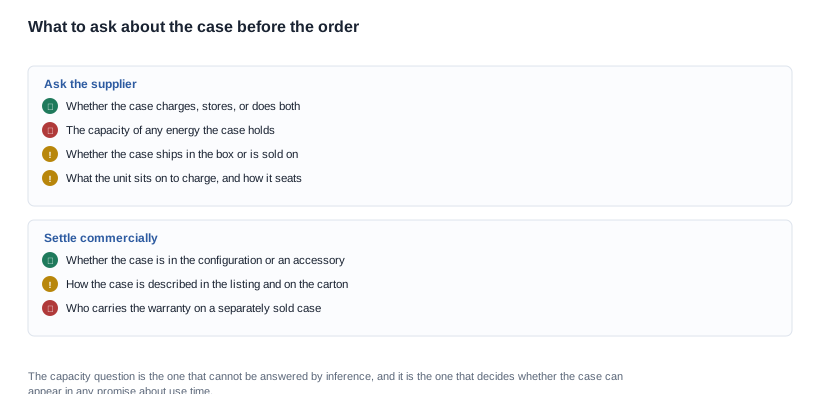
The request is short, and it belongs in the first message rather than in a follow-up, because the answer changes the shape of the order rather than the wording of a document.
The three supplier questions are the separation question, the capacity question and the interface question. The three commercial questions are whether the case is in the configuration or an accessory line, how it is described on the carton and in the listing, and who carries the warranty when one is sold separately. None of them can be answered by a catalogue, and none of them can be deferred past the sample order, because the sample is where the case is actually held in the hand and its weight and its bulk become obvious.

The sequence in the last image is deliberately ordered so that the accessory decision comes before the pricing decision, and so that nothing about the case enters a customer-facing promise until the capacity is on file. A channel that puts the case into a two-day use claim first and asks for the capacity later has created a claim it will have to withdraw, and withdrawing a printed claim is considerably more expensive than asking one more question.
The line we take on the case question
The catalogue prints a case against this model and does not publish its capacity, and we will not estimate it, will not infer it from the range position, and will not carry a general statement about it into any document we supply. A published case with an unpublished capacity is a partial record, and a partial record is the honest starting point for a request rather than the end of one.
What we will do is tell a buyer which of the three readings the case question has to be resolved into, which party has to answer each part of it, and where the answer lands in the programme. Bring us the case configuration under discussion, the decision you have taken on whether it ships in the box, and the markets in order, and we will mark the case against the configuration, the artwork and the paperwork, and tell you which of those three it actually touches.


