

The honest answer to the question in the title is short: there is no certification status to report for this model in our catalogue, because our catalogue contains no per-model certification row for any model in the range, and because the only certification-type material it carries is a company-level export page whose content is a set of patent certificates rather than conformity documents. A patent establishes that a design is new. It says nothing about how a product performs, nothing about how it was tested, and nothing about which market it may be sold into. A buyer who has read a page of certificates and concluded that a model is documented has confused novelty with conformity, and the confusion is expensive because it is usually discovered at a border or in a retailer's technical review rather than at the point of ordering.
So this article does two things. It sets out exactly what does and does not exist, so that a buyer knows what has to be requested rather than what has to be copied. And it lists the documents to request, with the party that issues each one and the wording each one has to carry, because a document that does not name the ordered designation is not a document for the goods that were ordered.
The distinction that governs the whole of this category is between a framework and a certificate. A framework states what has to be demonstrated and by whom. A certificate is a document a third party issues after the demonstration. Most of the confusion in this category comes from a document that is a method or a rule being presented as though it were a certificate, and from a company-level page being presented as though it were a per-model file.
MT5 smart glasses certification status: what exists and what does not
Three statements cover our own position, and they are the three a buyer needs before asking anyone else anything.
There is no per-model certification row anywhere in the range. No designation in our catalogue is mapped to a certificate number, an issuing body or a validity date, and there is no provisional or pending entry for any model either. The absence is complete, and it is the reason the request list below is a request list rather than a summary.
The company-level export certification page carries patent certificates, and its content is images rather than text. A patent is a novelty record. It settles that a design is new and nothing about conformity, and a file that relies on it will be returned by anyone who has to defend it.
No conformity marking is named in our catalogue text. We do not publish a statement that this model has been assessed against any marking scheme, and a buyer who needs that position has to obtain it in writing from the manufacturer, in the wording the manufacturer is prepared to stand behind.
What that means for a buyer in practice
It means the entire documentary work is a request, and the request has a shape. Two documents come from the manufacturer and cover the goods themselves: the technical file and the manufacturer's own declaration of conformity. Some come from a test body and cover a method that was applied. Some come from the cell source and cover the energy that is inside the product. And one comes from the buyer, is not purchasable at any price, and is the item everything else hangs on: the determination of which requirements apply in each market, for the age band the product is placed on the market for.
That last item is the one a channel most often leaves until late, and it is the one with the longest elapsed time attached to it downstream, because a determination that arrives after the artwork has been approved invalidates the artwork.
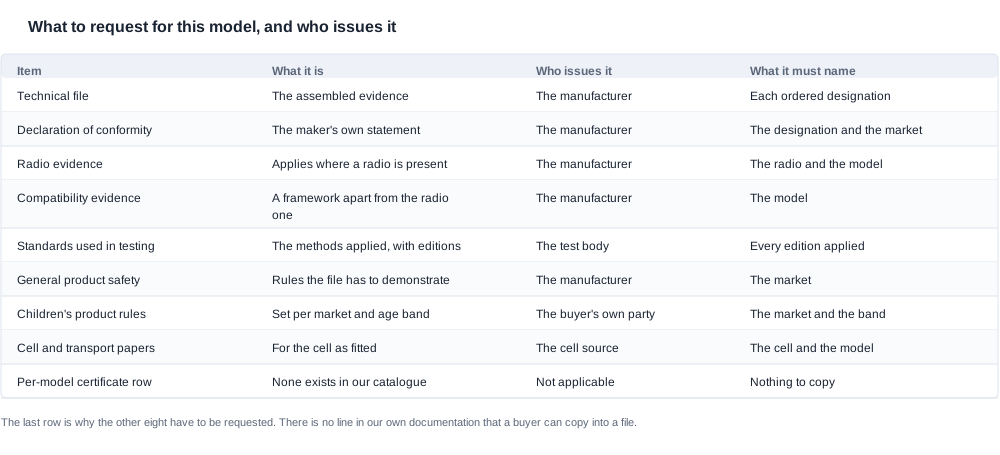

The documents to request, item by item

The sequence above is the working order, and the first two steps belong to the buyer rather than to the manufacturer. Fixing the markets in scope and the age band, and then having your own compliance party determine the requirements that follow from them, costs nothing but a conversation and it removes the single largest variable from the rest of the programme.
The two documents that come from the manufacturer
The technical file is the assembled evidence, and it is the document that a reviewer will open first. The declaration of conformity is the manufacturer's own statement about the goods, and it is a separate document from the file rather than a page inside it, which is worth knowing because buyers frequently ask for one and receive only the other.
Both have to name the ordered designation. A document that says smart glasses rather than a model is a document for a product family, and a retailer who asks for the designation to be named is asking for a reason.
The radio and the compatibility work, kept apart
Where a radio is present in this model, the radio framework and the electromagnetic compatibility framework are two separate instruments with separate scopes and separate numbers. The radio side is governed by the Radio Equipment Directive (EU) 2014/53/EU and the compatibility side by Directive (EU) 2014/32/EU. A file that covers one does not cover the other, and a supplier who answers both questions with a single document has answered neither.
This model publishes no radio version row, so the radio position has to be established in writing rather than read off a catalogue page, and where a radio is present, the question is asked conditionally. That is a difference in wording, not in substance: the buyer still needs to know what is fitted and what it was tested against.
The two standards most often named in this category are the EN 300 328 series and the EN 301 489 series, and the point about them is that they are methods rather than certificates. A test report that lists them is telling the buyer how the evaluation was carried out. The report is the evidence; the standard is the recipe, and a recipe on its own does not evidence anything. A buyer who puts a list of standards into a file and treats the file as complete has assembled a method and no result.
How to write the request, so it comes back complete
A request for a conformity file is usually answered in three exchanges instead of one, and the reason is structural rather than a matter of cooperation. A supplier asked for the certification for this model answers with whatever they hold for the model family, and the buyer is then left assessing whether what arrived covers the goods. A list prevents that.
The request that works is short and specific: the markets in scope, the designations in scope, the age band, and the nine rows of the table above with the issuing party and the naming requirement written next to each one. Add the question about whether a single file can cover two designations, because the answer changes the count of the programme and with it the schedule. Add the date by which the review team needs the file, because a date moves a supplier's prioritisation in a way that a polite request does not.
Four questions belong in the same message, because the answers change the schedule rather than only the paperwork.
- Which document will be the primary evidence for a reviewer in each market, and who issues it?
- Which of the nine items is the longest lead item, and does its lead time depend on the market?
- Does the manufacturer's file for this model already cover the radio and the compatibility frameworks, where a radio is present in the unit?
- Is the cell and transport documentation issued with the conformity file, or separately?
The due diligence here is not in the requesting, it is in the comparing. When a reply arrives, work through the nine rows one at a time and mark each as complete, partial or absent, and treat a partial as absent. A file that is complete on seven rows and partial on two is a file that will be returned, and the second exchange costs a week while a refusal at the border costs the shipment.
The general product safety rules and the children's product rules
The general product safety framework in the European Union, numbered (EU) 2023/988, applies to consumer products placed on that market, and it operates on the product rather than on a document. Compliance with it is demonstrated inside the technical file, and there is no separate certificate to collect.
The children's product rules are a separate matter, and the separation matters. In the European Union the toy standard EN 71 is the framework most frequently raised for a product intended for children, and in the United States ASTM F963 and the consumer product safety rules administered by the CPSC are the ones most frequently raised there. Which of them applies to a given unit, at a given age band, in a given market, is a classification your own compliance party makes against the finished product. It is not something a catalogue can state, and it is not something a supplier's product page can state either.
The cell and the transport papers
A product with a cell inside it is a regulated item on the transport side, and the record that travels with it has to be obtained for the cell as fitted in the model rather than for a cell in the abstract. Our catalogue publishes a cell capacity and a charging column for this model and publishes no cell safety report, no transport test reference and no cell specification sheet, so those papers are requests rather than documents to be forwarded.
The distinction to hold on to is between a cell capacity, which is a number we publish, and the evidence about that cell, which we do not. A buyer who has seen the capacity knows how much energy is in the product and knows nothing about how it was qualified.

The questions a buyer's compliance party will ask
The determination that everything else hangs on is produced internally, and it is produced by asking a list of questions that are not the same as the manufacturer's list. The manufacturer's list asks what evidence exists. The buyer's list asks what has to be true, and the two are answered by different parties on different timetables.
The questions, in the order they are usually asked, run like this.
- Which destination markets is this product being placed in, and in which of them is it a consumer product intended for children? The answer is a list, and the list is the input to everything that follows.
- What is the intended age band in each of those markets? The band is what a classification is made against, and it is the variable that decides which rules are engaged.
- On what basis is the product classified in each market — as a children's product, as a general consumer product, or as something with a specific intended use that its own compliance party has to assess separately?
- What does the determination require to be demonstrated, and which of those demonstrations are the manufacturer's to make? This is the question that turns the file request list into a schedule.
- What labelling and instruction language does each market require, and who produces the artwork? The artwork is usually the longest pole in a children's programme, and it is frequently started before the determination that governs it.
- What is the retention period for the file, and who holds it? A file that is assembled and then lost cannot support a review in the third year of a programme.
- Who is named as the manufacturer of record in each market, and does the private-label structure in that market change who that is?
The order matters because the first two questions determine the third, the third determines the fourth, and the fifth and the sixth are downstream of the fourth. A channel that asks them in a different order gets a determination that arrives after the artwork, and then the artwork has to be redone.

How the file behaves after it exists
A conformity file is often treated as a possession, something that is obtained once and filed. It behaves more like a live record with a life cycle, and the parts of that life cycle are what catch channels out.
It is per market and per designation, not per company. A file prepared for one market is not evidence for another, and a file prepared for one designation is not evidence for another. When a programme adds a market or a second product line, the file count grows with it, and a channel that assumed one file would cover the programme discovers this at the point of adding.
It expires by the standards it references. Editions move, and a file built against a superseded edition is a retest waiting to be triggered. The mechanism that prevents this is a review date against every standard in the file, and the obligation that the supplier tells the buyer when an edition changes rather than waiting to be asked.
It is sensitive to component changes. A change to the lens material, to the cell, to the radio module or to the frame material can invalidate parts of a file that was expensive to obtain. The notification obligation belongs in the purchase order rather than in a relationship, because a relationship produces a conversation and a conversation produces no record.
A copy is not a file. The most common finding in a review is a file that is complete in substance and incomplete in form: it names a family rather than a designation, it carries no date, it has no edition recorded against a standard. Those are not reasons to refuse the file. They are reasons to return it, and returning it costs a week while discovering the same gap during a review costs the shipment.
It is a cost, and it is a countable one. The total cost of a file is the fee plus the elapsed time plus the rework that a late or incomplete file causes, and the third of those is usually the largest. A buyer who prices only the first has priced the cheapest part of the problem. The commercial questions worth settling before the order are how many files the programme needs, which of them can be produced in parallel, and who bears the cost when one of them has to be reissued.
The criteria for comparing two suppliers' files
Two suppliers' files are usually compared on the number of documents they have produced, which is the one measure that rewards the wrong behaviour. The criteria that survive a review are narrower, and they are the ones a buyer can evaluate before you order.
Whether the file names the ordered designation. A supplier whose file names a model rather than a family has done the harder work. A supplier whose file covers a family has left the buyer with a second exercise.
Whether the standards carry their editions. A file that names a standard without an edition cannot be checked against the current version, and the buyer finds out that it is out of date when a reviewer does.
Whether the lead time is given per document rather than as a total. A total is a planning figure. A per-document sequence is a schedule, and the second is what lets a launch date be set honestly.
Whether a re-issue is available, and on what terms. A supplier who will reissue a document when a component changes has a documentation process. A supplier who has never had to do it has not had one.
The red flags are the mirror image, and a buyer is better off writing them down before being tempted to stop asking. A file that arrives as one combined document with no index. A response that quotes a family rather than a designation. An answer about a standard that carries no edition. A lead time given as a single figure for the whole programme. None of those is a reason to walk away from a supplier, and each of them is a reason to ask one more question before the order, which is what the checklist above is for.
The record that has to be reviewable, and the position we take on it
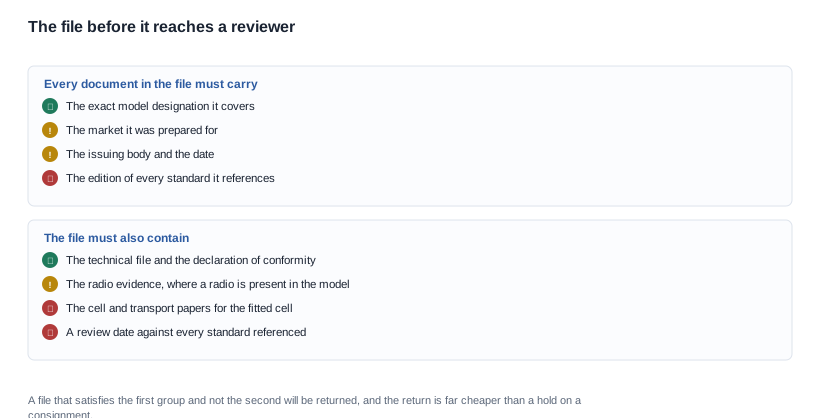
A file is not a folder. It is a record that somebody can follow, and the two groups in the checklist above are the two things that make it followable: the attributes of each document individually, and the attributes of the file as an assembly.
What each document has to carry
Four items, and every one of them is a line that a reviewer will look for. The exact model designation the document covers. The market it was prepared for. The issuing body and the date. And the edition of every standard it references, because frameworks move and a file built against a superseded edition is a retest waiting to be discovered in the second year of a programme.
What the file has to contain as a whole
Four more. The technical file and the declaration, as a pair rather than as one. The radio evidence, where a radio is present in the model. The cell and transport papers for the fitted cell. And a review date against every standard referenced, because a file with no review mechanism expires quietly and the expiry is discovered by somebody else.
When a file does not arrive
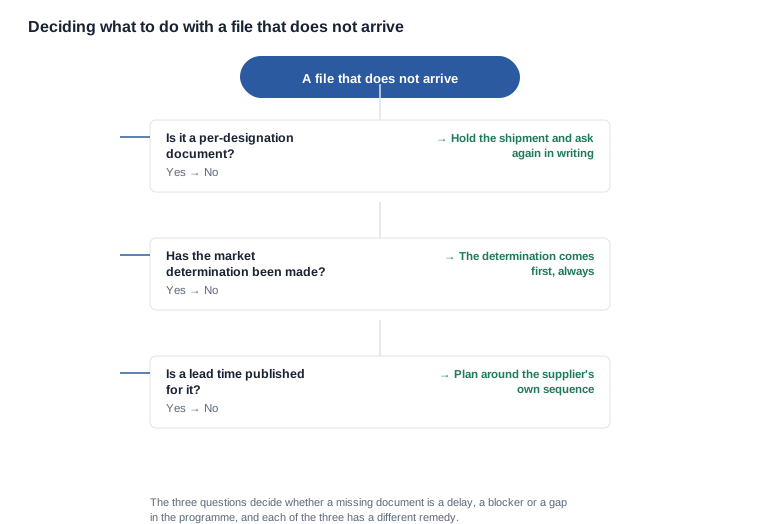
The routing rule in the image is the practical part, because a missing document has to become an action rather than an anxiety. A missing per-designation document stops the shipment and goes back as a written request. A missing market determination is not a supplier problem at all, because it belongs to the buyer's own party and has to be produced internally. A missing document with no published lead time is a planning problem, and the remedy is to schedule around the supplier's own sequence rather than to invent a date.
Our own position on the certification question
Here the position is narrower still. What we print on this subject amounts to one page of images and a complete absence of per-model rows, so we will not summarise a status we do not hold, and we will not tell a buyer that a model is documented, because a statement of that kind cannot be traced to anything in our documentation and would be a claim we had made on the manufacturer's behalf.
What we will do is tell a buyer which of the items above the manufacturer produces, which the test body produces, which the cell source produces, and which one the buyer's own compliance party has to produce, and in what order they have to be asked for. The observations that belong to a sample rather than to a file are a different piece of work, and they are collected in the sample review list for this model.
Send us the markets in scope, the designations under consideration and the age band the product is being placed on the market for, and we will mark the nine rows above against the four parties and tell you which of them you can start today, before anyone has been asked for anything.


