

Seven questions account for most of the correspondence about this model, and the reason they recur is not that the product is difficult to understand. It is that six of the seven have two halves, a published part and an unpublished part, and the published half is short enough to sound like a complete answer. A supplier who gives the short half has not misled anybody; they have simply answered half the question, and the buyer discovers the other half later, usually at a point where it is expensive.
The pattern below answers each of the seven in the same three-part form, because consistency is what makes an answer usable across a sales team, a support desk and a tender response. What is published, stated as a row rather than a summary. What is not published, named explicitly so that nobody has to infer a gap. And where the answer actually comes from, which is either a supplier document, a measurement on a sample, or a quotation.
This article is about the questions and the shape of their answers. It is not a place for the file itself, for the sample review, for the accessory scope or for the commercial terms, each of which is a piece of work with its own owner and its own elapsed time. What follows is the intake layer: what a buyer asks, and what a good answer looks like.
MT5 smart glasses common questions: the seven that get answered loosely
Why these seven and not others
The seven were chosen because they are the ones where a loose answer is possible. Questions about the function of the product have an obvious answer, because the function is published. Questions about the market entry position have a definite owner, because somebody has to make a determination. The dangerous middle ground is the set of questions where the catalogue contains a fragment of the answer, and the fragment is enough to sound complete.
Three of the seven are fragments in that sense. The resolution is published as a class and nothing else is published about it, so a question about the camera has an answer that is real and partial. The endurance is published as a band, so a question about the battery has an answer that is real and partial. The charging column publishes a case and withholds its capacity, so a question about the box has an answer that is real and partial. The other four are straightforward absences, and an absence is easier to handle honestly than a fragment.
The three-part form, and why it survives contact with a buyer
A published row, a named absence, and a named owner. It survives because it is reusable: the same three-part answer can be pasted into a quotation response, a tender answer, a channel briefing and a support macro without any of them implying something the documentation does not carry.
The failure mode it prevents is the one where a second colleague answers the same question differently, because the second colleague was not given the boundary. If the boundary is written into the answer, the second colleague inherits it.

What the catalogue answers, and where every answer stops
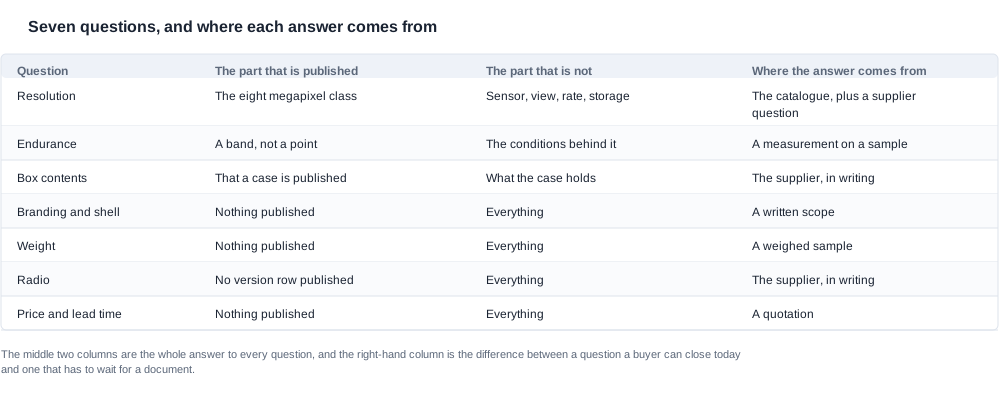
Before the seven are answered one by one, it is worth putting them in a single list, because the pattern is easier to see in a list than in a sequence of conversations.
- What resolution does it record at? The class is published; nothing behind it is.
- How long does the battery last? A band is published; the day plan is not.
- What is in the box, and is the case included? That a case is published; what it holds is not.
- Can we put our own branding on it? Nothing is published; a written scope is needed.
- How much does it weigh? Nothing is published; a weighed sample is needed.
- Which radio does it carry? No version row is published; a written answer is needed.
- What is the price and the lead time? Nothing is published; a quotation is needed.
Three of the seven are fragments, in the sense that the catalogue carries part of the answer. The other four are absences. An absence is comparatively easy to handle: say that it is not published, say who can close it, and stop. A fragment is the harder case, because the published part is usually the part a buyer would have quoted anyway, and the unpublished part is the part that changes the decision.
That difference explains the pattern of most mistakes in this category. The question about the camera gets a confident answer because the class is published, and the buyer believes the camera question is closed. The question about the battery gets a confident answer because a band is published, and the buyer believes the battery question is closed. Both beliefs are wrong, and both are made by the same mechanism: a partial answer that sounds like a complete one.
The discipline that prevents it is to treat every published row as half an answer unless the catalogue says otherwise, and to write the second half into the same note as the first. A row on its own is a fragment; a row with its boundary attached is an answer. The boundary is not a disclaimer to be added at the end of a document. It is the second half of the answer, and it belongs in the sentence rather than in the appendix.
The seven questions, answered in the form a buyer can use
"What resolution does it record at?"
Published: the eight megapixel resolution class, and nothing else about the camera.
Not published: what sits behind the class, how much of the scene the lens takes in, how many frames a second the unit manages, what it writes and in what form, and how much can be stored.
Where the answer comes from: the catalogue for the class, and a written request to the supplier for the six items behind it, with the method attached to each.
The practical note is that "eight megapixels" is a class and not a measurement, and that a buyer comparing it with another model should establish whether the other figure was produced the same way before treating the two as comparable.
"How long does the battery last?"
Published: an endurance band rather than a single figure, and a charge time expressed as a ceiling rather than a duration.
Not published: the conditions behind either end of the band, the duty cycle the band was measured at, the state the cell starts in, and what a charge interval restores.
Where the answer comes from: a measurement on a sample, run at the duty cycle the channel intends to ship, recording whole working days rather than hours. The band is published; the day plan is not, and it is the day plan that a customer actually experiences.
"What is in the box, and is the case included?"
Published: that a case is published for this model. Nothing else about it.
Not published: the capacity of the case, whether it holds energy of its own, whether it charges the unit, its packed dimensions and its shipping weight, and whether it ships in the carton or is a separate line.
Where the answer comes from: the supplier, in writing, and the answers decide whether the accessory is a packing item or a product line. The case question has its own consequences for the retail experience and for the freight model, and both of those are set out in the charging note for this model.
"Can we put our own logo and our own colours on it?"
Published: nothing. No customisation position is published for this model.
Not published: everything, including which dimensions are already defined and which need a new sample.
Where the answer comes from: a written scope. The dimensions a private-label programme around this model usually touches are set out separately, and a channel that has not scoped them will get a quotation for goods rather than for a programme.
"How much does it weigh?"
Published: nothing.
Not published: the weight of the frame, the weight with the cell fitted, and the tolerance.
Where the answer comes from: a weighed sample, with the configuration stated. A weight quoted without its configuration is not a weight, and the configuration that matters is the one the customer will hold, which is not always the configuration in the box.
"Which Bluetooth version does it carry?"
Published: no version row at all for this model.
Not published: the radio generation, and the behaviour of the radio once it is paired.
Where the answer comes from: the supplier, in writing, and conditionally: if a radio is present in the unit, its generation has to be established rather than assumed. The wording matters more than it looks, because a listing that names a radio version for a model with no published row is a claim nobody in the channel can trace.
"What is the price and the lead time?"
Published: nothing. Neither is a product specification and both belong to a quotation.
Not published: the price structure and the tiers that exist, the minimum order quantity, the elapsed time, the capacity behind it, and the warranty term.
Where the answer comes from: the enquiry. The useful thing a buyer can do here is to make the two quotations comparable, which means fixing the configuration, the variant count, the label scope and the destination markets before the price is asked for, and asking for the elapsed time per tranche rather than as a single figure for the order.
Two questions that arrive as one
A buyer frequently asks for the camera and the battery in a single sentence, and the two questions have opposite shapes. The camera question has a published answer with a boundary attached, and it closes in one line. The battery question has a published band with a real gap under it, and it closes only after a measurement. Answering them together, in the order they were asked, produces one sentence that is half a specification and half a deflection, and the listener hears a single answer to both.
The remedy is to split them and to answer in the order that closes the cheapest one first. The camera question closes immediately, and answering it immediately builds the confidence that makes the buyer accept a request rather than a refusal for the second one. A question answered with a row is what earns the right to answer the next one with a date.

What a buyer's own channel has to answer without us
Five of the decisions behind these questions can only be taken inside the buyer's own organisation, and a channel that has not taken them cannot use the answers to this model at all.
The proposition. What the product is for, in one sentence, written before any specification work starts. Every later decision inherits it, and a channel that has two propositions has two programmes.
The duty cycle. What the unit will actually be doing in a customer's day. This is a decision rather than a discovery, and it is the single input that turns a published endurance band into a measurable number.
The markets, in order. Which market is entered first and which come later. The order decides which documentation and which label set is needed first, and it is the only lever that changes the shape of the first shipment.
The scope of the programme. Which dimensions are open and which are fixed. The scope is what the quotation prices, and an unscoped programme is quoted as goods.
The claim position. What the listing will say and what it will not say, agreed before the copy is written rather than after it is printed. A claim position settled late is settled under pressure, and the copy inherits the pressure.
The trade-offs among them are real, and they are usually made badly, because each one is decided by a different person. A marketing lead settles the proposition, an engineer settles the duty cycle, a compliance owner settles the markets, a buyer settles the scope, and a reviewer settles the claim position. The failure is not that any of them decides badly. It is that the five decisions are made in isolation and meet for the first time at the artwork.
Two practices fix it, and neither is expensive. The first is a single page where the five answers are written, dated and signed by the five owners, and that page becomes the artefact the rest of the programme is measured against. The second is a review of that page before the artwork is approved, which is the point at which the contradictions are still cheap to fix rather than expensive to reprint.

How to answer a question you do not have an answer to
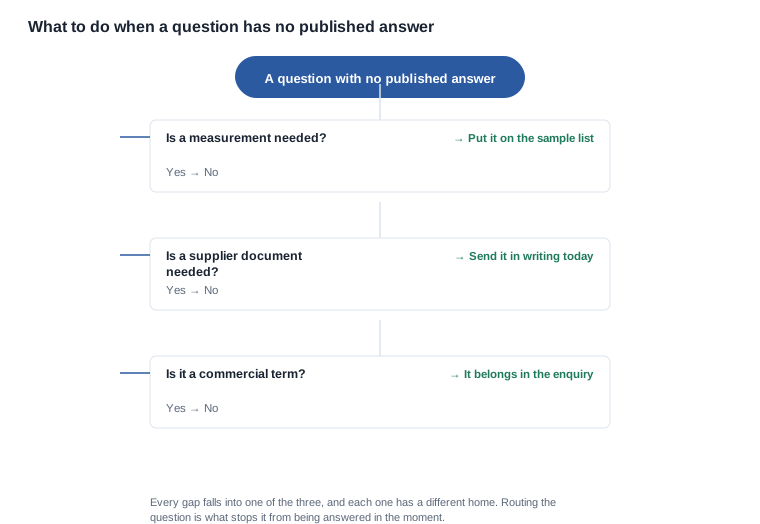
The routing rule above is the practical discipline, and it works because every unanswered question about this model belongs to one of three homes.
A measurement. The weight, the fit, the behaviour of the unit under a stated duty cycle, and anything else that is a property of the goods rather than of the paperwork. These go on the sample list, with the method written next to each one, and they are the only questions a sample can close.
A supplier document. The radio generation, the capacity of the case, the items behind the resolution class. These are sent in writing the same day, because they cost nothing to request and they are the ones that stop a conversation from turning into a guess.
A commercial term. The price, the tiers, the minimum order quantity, the elapsed time, the warranty. These belong in the enquiry, and answering them on a call creates a commitment that nobody has costed.
The order of the answers

The sequence in the image is the one a channel can standardise across a sales team, and the two steps that matter most are the third and the fourth. Naming the open items with their owners is what stops a buyer from assuming that an unanswered question is a weak answer. And not filling a gap with a typical figure from a neighbouring model is what stops a number from travelling into a listing, because a borrowed number becomes this model's number the moment it is written down and quoted back.
What to have in front of you before a call
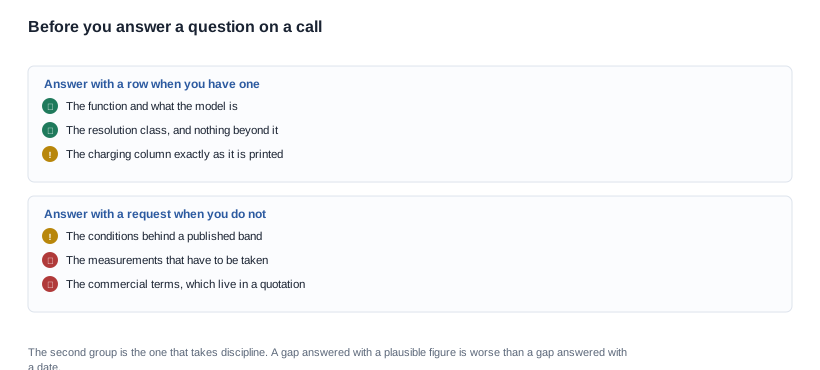
The checklist is short on purpose. The upper group is what can be answered immediately, and the lower group is what has to be answered with a request rather than with a sentence. A channel that keeps this page in front of the person taking the calls gets the same answer on the third call as on the first, which is the only way an answer stays an answer.
The two non-answers to avoid
It depends. The most common non-answer in this category, and the hardest to give up, because it is technically true. It depends on what is the question that has to follow, and the answer is usually a condition the catalogue does not publish. The version of it that works names the condition: the answer depends on the duty cycle, and the duty cycle is yours to set.
Typically. This one is worse, because it substitutes a number that nobody measured for a number that was not measured at all. A typical weight, a typical charge time, a typical runtime borrowed from a neighbouring model, and the word moves into a listing within a week and is quoted back at the channel by a customer who weighed their own unit.
The test for both is simple. If the sentence contains a number that is neither in the published rows nor in a report the buyer has seen, it is not an answer. If it contains a condition, it is a question, and a question can be sent, dated and closed.
The intake checklist, and the four criteria behind it
Every question that comes in should be run through the same four criteria before it is answered, and those criteria are the reason the answers stay consistent across a team rather than depending on who took the call.
Is the answer a published row? If it is, say the row, and say what sits behind it. If it is not, the answer is a request, and a request has an owner and a date rather than a sentence.
Does the question have one answer or several? A question about a function has one. A question about a measurement has one per configuration, and the configurations have to be named before two answers can be compared.
What would a reviewer say if this sentence appeared in a listing? That is the shortest useful test of a sentence. If a reviewer would ask what the number was measured at, the sentence is missing its condition, and the condition has to be added before the sentence is used anywhere.
Who inside the buyer owns this answer? Some of these questions belong to a department rather than to a supplier, and the department is the party that has to do the work. The questions to ask before you order are mostly owned on the buyer's side, and a channel that knows which is which answers faster.
A channel that runs its intake this way gets a measurable improvement within a month, and the measure is simple: how many questions went out with a date against them, and how many answers reached a document without being checked first. The first number goes up and the second goes down, and the second is the one that protects the channel.
The position we take on the questions we cannot answer
We publish the rows the catalogue prints for this model, and we do not extend them, and we will not estimate the ones it does not. That means the resolution class and the electrical rows can be quoted as they are printed, and that the weight, the radio generation, the case capacity, the customisation scope and the commercial terms have to be answered by somebody else, in writing, with a method.
We will also not fill a gap for a buyer because a gap is inconvenient. A number produced for this model by us would be a figure we had invented, and it would be quoted back to the channel as though it had come from a test. A date is a better answer than a figure, and a request is a better answer than a date, and a measurement is better than all three.
What we will do is tell a buyer which of the seven questions our documentation closes today, which of them are supplier questions, and which of them need a sample on a desk. Send us the configuration under discussion, the markets in order and the duty cycle your channel intends to ship, and we will mark the seven against those three answers, and tell you which of them can be answered before the next call and which of them cannot.


