
Choosing between camera models in this category is not a ranking exercise, because the catalogue does not publish the information a ranking would need. It publishes, for every camera model, a small set of rows: a resolution class, a cell, an endurance figure, a ceiling on the charge time, and a charging column. That is enough to place a model on several axes, and it is not enough to say that one model is better than another. Any comparison that claims to have decided which is better is either using a number the catalogue does not carry or is using a number the catalogue carries and reading more into it than it can bear.
So the useful question is not which camera model is best. It is which axes a channel's proposition actually depends on, what the published rows settle on those axes, and what the comparison has to leave open. This article works through that for this model, and it says plainly which buyer it suits and which one it does not.
Two things are worth saying at the outset. The first is that a position in a range is not a verdict, and the second is that the gaps a model has on its own are the same gaps it has in the range, because the range adds other models rather than adding information. A comparison that produces a shorter open-item list is a comparison that has quietly borrowed a figure from somewhere else.
MT5 smart glasses how it compares: the axes the catalogue actually publishes
The range publishes seven axes that a buyer can actually compare on. There are others a buyer would like to compare on, and they are not on the list because the catalogue does not carry them for this class of product.
The seven that are published are the resolution class, the cell, the endurance figure, the ceiling on the charge time, the case position, the charging interface where it is printed, and the feature rows. Each is a row on a model page rather than a paragraph, which is what makes them comparable, and each stops well short of what a buyer wants from it.
What is not published for this class, and therefore cannot be compared at all, runs to a longer list. Price, lead time, minimum order quantity and warranty terms are commercial rather than product facts, and they arrive in a quotation. Weight, frame geometry, hinge detail and temple length are physical facts that have to be measured. The sensor behind the resolution class, how much of a scene the lens takes in, how many frames a second it manages, what it can store and in what form, are camera facts that have to be requested. The feature rows are empty for most of the camera models, so the feature axis compares scarcity against scarcity and settles very little.
That list is not a complaint about the catalogue. It is the reason the method in this article works, and the reason a buyer who has read only a product page has, in practice, read four or five comparable facts about a product and nothing at all about the differences.
Why the axes are not equally useful
Two of the seven are strong, three are moderate and two are weak, and a comparison that treats them alike will produce a conclusion that does not survive the first question from a technical reviewer.
The resolution class is strong in the sense that it is a published class shared across the range, so two models can be placed on the same scale. It is weak in the sense that everything behind the class is unpublished, so the class is a label rather than a comparison of output.
The cell is strong as a fact and weak as a comparison, because a cell size means nothing without a load, and the load is not published for any of the camera models.
The endurance figure is moderate: it is published, and it is comparable in the way that any two ratings are comparable, which is to say only once the conditions behind them are known.
The ceiling on the charge time is strong as a fact and weak as a discriminator, because it is the same ceiling across the range and therefore distinguishes nothing.
The case position and the charging interface are strong where they are published and absent where they are not, which makes them unusually informative about a model precisely because the range is inconsistent about them.
The feature rows are the weakest axis, and the honest way to use them is as a filter rather than a comparison: a model with no published feature rows cannot be chosen for a feature, and a model with some can be chosen for one of those.
How the axes behave when the comparison crosses suppliers
The seven axes work the same way when the comparison is between two suppliers' catalogues rather than between two of our own models, and that is where they are most valuable, because the gaps in a supplier's material are usually wider than the gaps in ours.
The criteria for a comparison that crosses suppliers are three. Both sides have to publish the same kind of fact, or the comparison has to be declared unequal rather than resolved. The measurement conditions have to be stated on both sides, or the numbers have to be treated as incomparable until they are not. And the comparison has to be written so that a reader can see which of the two was stronger on which axis, because a buyer who cannot see that has been given a conclusion rather than a comparison.
What usually goes wrong is a buyer who treats a fuller brochure as a better product. A supplier who publishes a sensor model, a field of view and a frame rate has not thereby produced a better camera than a supplier who publishes none of them; that supplier has produced a more comparable one, at least for the camera axis, and the additional detail has to be tested before it is believed.
The trade-off is the same one that runs through the whole of this category: more published detail makes a product easier to evaluate and easier to write about, and it also makes it easier to claim things that the detail does not quite support. The check that keeps those two apart is the one in the checklist below, and it applies to a supplier's brochure exactly as it applies to our own rows.

Which buyer this model fits, and which one it does not
The position on the axes only becomes useful when it is attached to a proposition, so this section attaches it to four buyer situations and says plainly who should not be looking at this model.
It fits a channel whose proposition is capture-led and whose programme can carry a case. A camera product sold around what the customer records, rather than around the rest of the specification, is the situation this model supports, and the published case is an asset in that proposition rather than an accessory question. The one thing such a channel must be ready to do is measure the unit's behaviour itself, because the published endurance figure is a band and the day plan behind it is not published.
It fits a channel entering its first market with a single designation. A model that carries a case and a camera keeps the number of things to document down, and a channel that is building documentation from zero will prefer one file to two. What it does not remove is the work of the determination itself.
It fits a channel that will run its own measurement programme. A model whose endurance is published as a band, and whose camera details are published as a class, is a model that rewards a buyer who measures. The gaps on this model are of the kind that measurement closes, and a channel with a sample programme will get more out of this model than a channel that expects a datasheet to do the work.
It does not fit a channel that needs a published runtime for its listing. If the listing has to carry a single number for how long the product runs, this model's published figure is a band and the two ends of it have to be explained. That is workable, but it is work, and a channel that has not budgeted for it will discover the problem at the copy stage rather than at the sample stage.
It does not fit a channel that needs to price a case as an accessory line. The case is published and its capacity is not, so the accessory cannot be compared with another accessory and cannot be given a use-time promise. A channel whose commercial model depends on a bundled accessory with a stated value has to close that number before it can commit.
It does not fit a channel whose proposition depends on a named radio version. No version row is published for this model, so where a radio is present its generation has to be established in writing. A channel that builds its proposition on a specific generation should treat that as an open item rather than as a given.

Where the MT5 sits on each axis, and what each position does not tell you
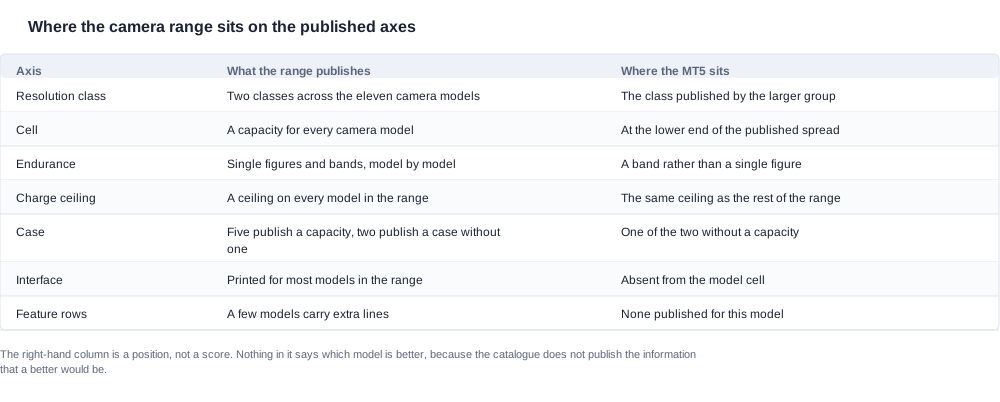
The right-hand column of that table is a position and not a score, and each position carries a gap of its own.
The resolution class places this model in the group published by the larger number of camera models, and the class is the same one that most of the range publishes. What the position does not tell a buyer is anything about the sensor, the field of view, the frame rate, the storage or the file format, and it does not tell them that one camera in the range is faster than another, because the catalogue publishes no frame rate for any of them.
The cell places this model at the lower end of the published spread across the camera models, which is a fact about the spread rather than about performance. A smaller cell with an unstated load says nothing about how long the unit runs, and the endurance row is where the runtime information sits, not the cell row.
The endurance is a band where several other camera models publish a single figure, which makes this model the more demanding one to write about. A band has to be explained in a listing, and an explanation takes more space than a figure does.
The case is the position that separates this model from most of the range and the one that has the most commercial consequence. Across the camera models, the published situation is uneven: a group publish a case with a stated capacity, a smaller group publish a case with no capacity, and another group — four of them — publish no case row at all, so a comparison written from the catalogue alone carries four blanks in the accessory column. This model belongs to the second group, alongside one other, and the two things that follow from that are that the accessory cannot be priced against the models with a published capacity, and that the case is a genuine accessory decision rather than a packing detail.
The interface is the one axis where this model is quieter than the range. A charging column is printed for most models in the range, and this model's cell carries the case note instead. A reader comparing models on how they charge is therefore comparing a published cell against a published cell for most of the range and against a question for this one.
The feature rows are empty for this model, which means it cannot be chosen for a feature. A buyer whose proposition needs a feature should look for the model whose rows carry it, and a buyer whose proposition does not need one should stop reading the feature row and go back to the other six axes.
How to choose against the other models without producing a ranking
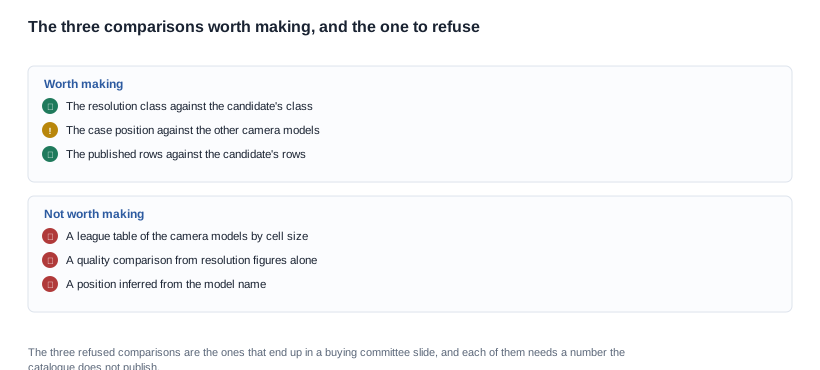
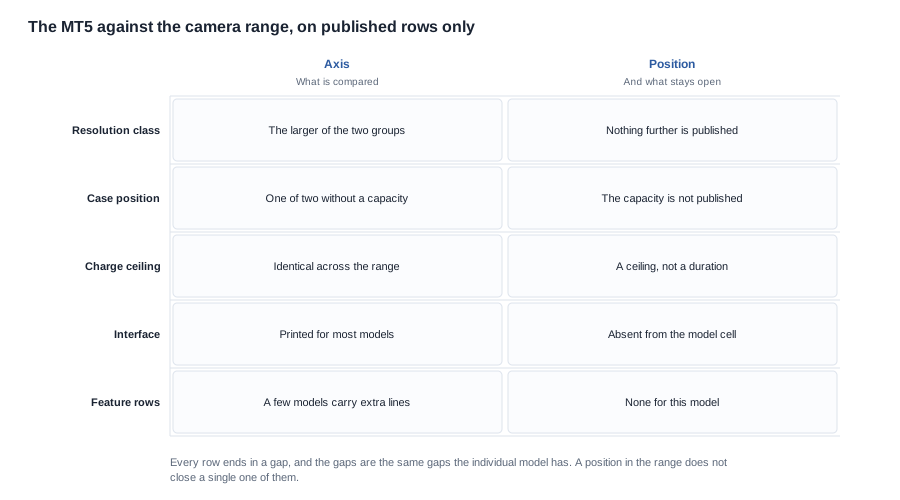
The upper group in that checklist is short, and its shortness is the finding rather than an omission. Three comparisons are worth making, and each of them uses a published row on both sides.
The resolution class against the candidate's class. If both models publish the same class, the comparison has established that the class does not decide the choice, which is itself useful because it removes an axis. If they differ, the comparison has established a difference in a published figure, which is a legitimate starting point and a poor conclusion.
The case position against the other camera models. This is where a comparison earns its keep, because the case positions across the range are inconsistent, and a buyer who is building an accessory line needs to know which models can be compared with which.
The published rows against the candidate's rows. Not a line-by-line score, but a check that the candidate publishes the same kinds of thing. A model with a fuller row set can be compared more easily, and a model with a sparser one has to be assessed on what is there.
The lower group is the set of comparisons to refuse, and each of them is tempting because it produces a number.
A league table of the camera models by cell size. It is a number, it is easy to build, and it means nothing, because a cell is an input rather than an output and the load is unpublished across the range.
A quality comparison from resolution figures alone. Two models publishing the same class are not thereby equivalent, and the class is the only camera fact either of them publishes.
A position inferred from the model name. A designation carries no meaning in the catalogue, and a naming convention that a buyer or a channel has invented internally will be quoted back at the supplier as though it were published.

The sequence in the last image is the method in six steps, and the fifth one is the whole discipline. Write the conclusion as a conditional rather than as a verdict: if the channel's proposition depends on a capture-led use and it is prepared to measure, then this model is a candidate, and if the channel needs a published runtime or a priced accessory line, then it is not. A conditional can be acted on, tested against a sample and revised. A verdict can only be argued with, and the argument is usually about a number that was never measured.
The questions a buyer should ask before the shortlist is signed
- Which axis does the proposition depend on, and does the catalogue publish that axis for both models? If it does not, the comparison cannot be made and the gap has to be closed first.
- What do the two models' published rows settle, and what do they leave open? Two lists, side by side, with the gaps written into the same document as the rows.
- Which of the open items can be closed on a sample, and which need a document from the supplier? The sample list and the request list are different documents with different elapsed times.
- What is the total cost of the comparison, once the measurements and the requests are counted? A comparison that needs three samples and four documents is a programme, and it should be scheduled as one.
- Which red flags are present in the candidate's material? A number with no method attached, a number with no unit, one value standing in for a spread, and a value with nothing behind it.
Where a shortlist on this model usually goes wrong
The common failure is a shortlist that starts from a name. A channel that has seen a designation in a competitor's material, or that has assumed a naming convention, begins the comparison at the wrong point and then spends the rest of the process defending an assumption.
The second failure is a shortlist that compares the two models on the axis that is easiest to compare rather than on the axis the proposition depends on. Resolution class is the easiest, because both models publish it, and it is very often the least decisive, because it is the only camera fact that is published for either of them.
The third is a shortlist that treats the gaps in one model as a reason to reject it, when the same gap sits on the other side of the comparison as well. A gap is only a reason to reject when the alternative has no gap, and a range of camera models with sparse published rows produces gaps on both sides of most comparisons.
The position we take on the MT5 in the range
We publish the rows the catalogue prints for this model and we do not extend them, and we will not produce a ranking of the camera models, because the rows we hold are four or five comparable facts per model and they do not support one. A model placed on a table next to another model is a legitimate statement. A model placed above another model is not, and the difference between the two is a number that would have to be invented.
What we will do is mark the position of this model on each published axis, state what each position does and does not tell a buyer, and name the items that have to be closed before the shortlist can be signed. The seven questions a channel is actually asked, and the three-part form their answers take, are set out in the intake note for this model, and it is the most practical starting point for a buyer who has not yet separated what is published from what is not.
Send us the two or three models you are weighing, the axis your proposition depends on, and the markets in order, and we will mark each of them against the seven axes, flag the comparisons that cannot be made, and tell you which of the open items your sample programme can close.


