
MT5 smart glasses vs CY03 price positioning is a question about two cost structures, not about two price tags. Neither model has a published price, a price tier, a unit price or a landed cost, and no such figure can be derived from a catalogue that does not contain one. What the documentation does contain is enough to establish that the two models sit on opposite sides of the accessory question: the CY03 ships with a 1400 mAh case whose capacity is printed, and the MT5 ships with a case whose capacity is not printed at all.
That single difference cascades into almost everything a buyer would use to position either product. It changes the carton, the freight class, the in-box experience, the endurance story a channel can honestly tell, and the questions that have to be answered in writing before a first shipment. Positioning that ignores it is positioning built on a blank.
MT5 smart glasses vs CY03 price positioning: the rows that actually differ
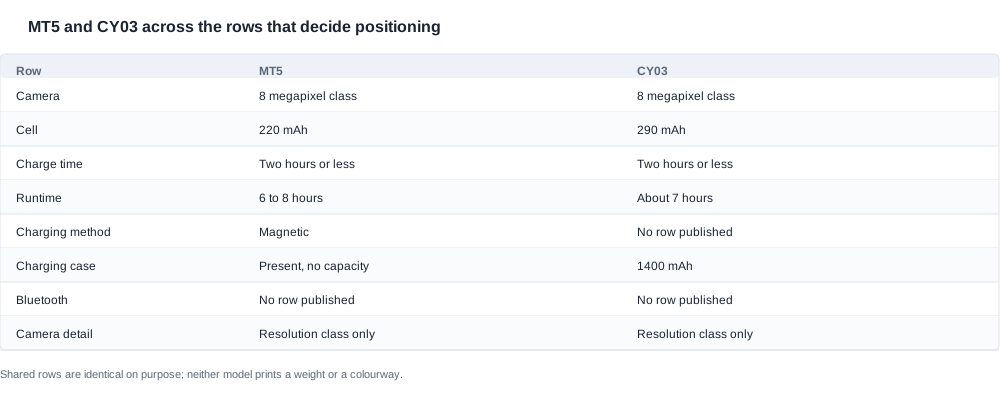
Two camera models in the same catalogue group differ on far fewer rows than a product comparison page usually implies. Here is the complete set.
Identical on both models. Both sit in the eight-megapixel resolution class. Both publish a charge time of two hours or less, and both publish it as a ceiling rather than a measurement. Neither publishes a sensor model, a field of view, a frame rate or a video format, so neither supports an imaging claim beyond the resolution class. Neither publishes a Bluetooth version, which is true of all eleven camera models in this catalogue and false of every audio model. Neither publishes a weight, a colourway or any descriptive feature line on its page.
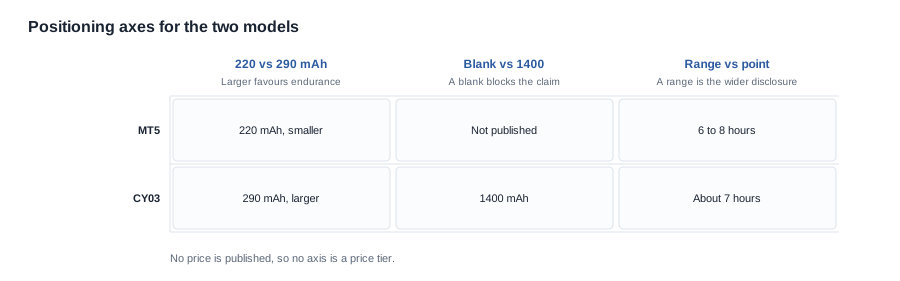
Different: the cell. The MT5 is published with a 220 mAh cell. The CY03 is published with a 290 mAh cell, a value it shares with the L2 Utral and the CY05, and the L1 Pro. That is a difference of seventy milliamp hours, and it is a real one — but it is a difference in a component whose contribution to the delivered cost is smaller than the accessory sitting next to it.
Different: the charging case. This is the decisive row. The CY03 publishes a 1400 mAh case, the largest case capacity printed anywhere in the camera group, shared with the CY05 and the L1 Pro. The MT5 publishes a case with no capacity stated. Across the eleven camera models, five print a case capacity, two are documented with a case and no capacity, one — the V03 Pro — has no charging-case row, and three carry no charging-case row at all. The MT5 is in the second group, and the CY03 is in the first.
Different: the charging method. The MT5 publishes magnetic charging. The CY03 publishes no charging-method row at all, which is a genuine absence rather than a different method. Four camera models share this absence — the CY05 and the CY03, and the L1 Pro and the MT6 — and all four of them do publish a case capacity. A model that publishes no charging method but does publish a case is telling you the case is the charging route and leaving the interface undescribed.
Different: the runtime shape. The MT5 publishes a range of six to eight hours. The CY03 publishes a point of about seven hours. Neither carries a test condition. The point figure is easier to write on a page; the range is a wider disclosure about how many conditions were measured.
The two accessory regimes, and what they cost you to plan
The accessory is where these two models separate, and it separates them into two different kinds of problem rather than a better one and a worse one.
The CY03 regime is a planning problem with an answer in hand. A 1400 mAh case is published, so the accessory can be sourced against a capacity, described against a capacity, and quoted against a capacity. What remains unknown is its weight and its external dimensions — neither is published for any case in this catalogue — and whether the case recharges the frame or only holds a spare cell. Those are real gaps, but they are gaps in the physical envelope rather than in the core proposition. A buyer can proceed with the case identified and the measurements requested.
The MT5 regime is a planning problem without an answer in hand. The case is documented as present and its capacity is not stated. Until that number arrives, the accessory cannot be quoted, the carton cannot be finalised, the freight class cannot be modelled, and the endurance story cannot be written in a way that survives a customer's question. This is why a price positioning conversation on the MT5 keeps returning to the same document: there is not enough to position against.
The asymmetry is worth stating plainly for a buyer. A published number is a commercial asset even when it is not the number you would have chosen, because it converts an open item into a costed one. An unpublished number is not a small disadvantage; it is an open item that has to be closed before the positioning work can start, and the supplier's lead time to close it sits on your critical path.
Two knock-on effects follow that buyers regularly miss. First, the return exposure: a channel selling a case-based endurance story on a product with an unknown case is exposed to returns driven by a claim it cannot evidence. Second, the listing risk: a product page that says "includes a charging case" and cannot say what it holds invites exactly the kind of question a competitor can answer better. Both are positioning problems, not hardware problems.
Why no price tier can be derived from this catalogue
It is worth being explicit about the limits, because the temptation to fill them is strong.
No unit price, minimum order quantity, lead time, tooling charge, private label fee or landed cost is published for either model. No sales ranking exists. No competitor pricing exists. Nothing in this catalogue supports the statement that one of these models is cheaper than the other, cheaper in any tier, or better value at any volume.
What can legitimately be derived is a cost direction. A model with a 1400 mAh case in every unit carries a second lithium cell and an accessory that a 220 mAh model with an unsized case may or may not carry. That is a statement about physical content, not about money, and it is the furthest the documentation allows.
The practical consequence for a buyer is that the value comparison has to be built from the supplier's quotation, not from the catalogue, and the catalogue's job is to tell you which questions to put in that quotation. That is a narrower and less satisfying deliverable than a price table, but it is the one that survives an audit.
Two disciplines protect a quotation built this way. The first is to hold the specification and the commercial terms in one document, so a change in one is visible in the other. The second is to treat any figure that reaches you without a unit and a condition as absent rather than provisional, because a number without a condition cannot be defended later and will be relied on anyway.

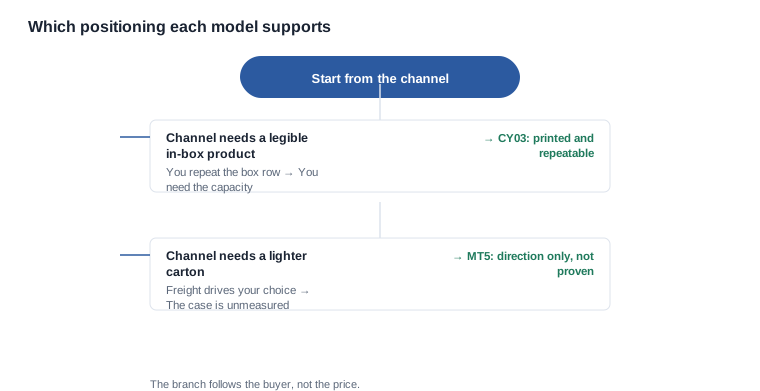
Which positioning each model supports
This is a decision about channels, and the criteria are visible rather than calculated.
A channel that needs a legible in-box product. The CY03 is the easier of the two to position, because a printed case capacity is something a product page, a retailer listing and a customer service script can all repeat without anyone having to check. If your channel competes on clarity rather than on price, that is the criterion that decides this pair, and it decides it in the CY03's favour.
A channel that needs a smaller carton and a lower freight class. The MT5's 220 mAh cell works in that direction, and it is the only published row on that model that pushes the same way as the rest of its proposition. But the unsized case pushes back, and until the case is weighed the direction is theoretical.
A channel that is building a private label line. Both models work here, and the decision moves from hardware to platform management. The MT5 asks less of you to describe and more of you to request. The CY03 asks more of you to describe — because a 1400 mAh case is a promise about endurance that you now have to keep — and less of you to request. The AI camera glasses which model to pick piece sets the range-wide version of that trade-off out.
A channel that is deciding on a range rather than a model. Then neither question above applies, and the right comparison is between platforms rather than products: the 220 mAh group against the 290 mAh group. Four published cell values exist across the eleven camera models, and each one is a separate accessory and packaging decision.
The two questions that decide the quote
If a buyer has time for only two requests on this pair, these are the ones that change the commercial outcome.
- What is the MT5's case capacity, stated in the same format used for the CY03? One sentence closes the largest planning gap on the cheaper-feeling model and makes it comparable for the first time. If the answer is that no capacity is published, that is also a usable answer, because it tells you the positioning cannot include a case-based endurance claim.
- What is the packed unit weight of each model, with its case in the carton, on a calibrated scale? This is the only measurement that turns the comparison from a description of components into an input to a freight model, and it applies to both models because neither publishes a weight for the frame or for the case.
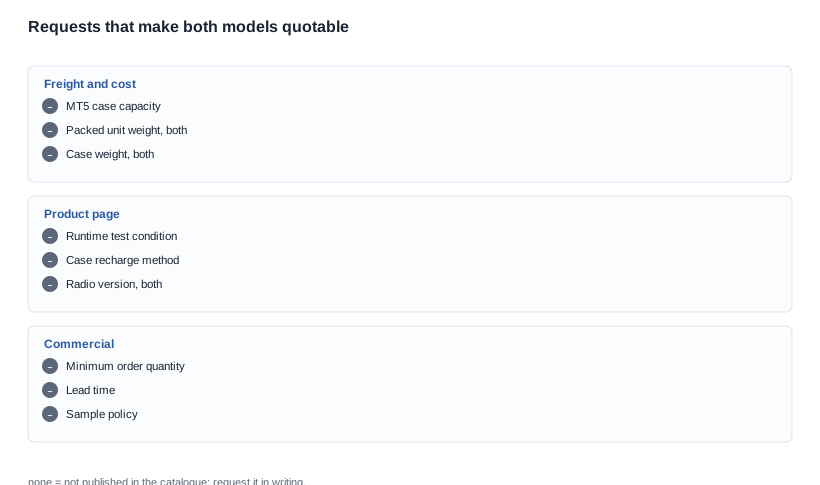
Around those two, four further requests are worth sending in the same message because they cost nothing extra to ask and everything to receive:
- Whether the case recharges the frame or only holds a spare cell, for each model.
- The runtime test condition behind the MT5's six-to-eight-hour band and the CY03's roughly seven hours, asked in the same words for both.
- The minimum order quantity, lead time and sample policy for each model, since none of these is published.
- A per-model compliance declaration with verifiable references, and the radio version for each model, neither of which appears anywhere in the catalogue text.
The reference point for that compliance question is straightforward: the catalogue carries a company-level export certification page holding ten patent certificates — eight appearance-design patents and two utility-model patents — and no per-model certification row anywhere. For European Union buyers the relevant buyer-side instrument for radio equipment is the Radio Equipment Directive (EU) 2014/53/EU; the electromagnetic compatibility directive, (EU) 2014/32/EU, is a separate requirement and is routinely confused with it. Ask for the scope that applies to the model in your purchase order.
What a positioning brief should contain, and what it should not
The purpose of a positioning brief on a two-model comparison is not to persuade. It is to record which claims each model can carry, so that the claims end up on the packaging, on the product page and in the customer service script in the same words. That sounds obvious and is regularly skipped, because the brief is usually written once and then used by three teams who each edit it slightly.
A usable brief has six fields and no more. First, the published rows for each model, copied from the model documentation rather than summarised from a listing. Second, the claim each row supports and the claim it does not support — a 220 mAh cell supports a small-parcel statement and supports nothing about endurance. Third, the open items, each with an owner and a date. Fourth, the runtime treatment, which on this pair means stating the MT5 band and the CY03 point with the explicit note that neither carries a test condition. Fifth, the compliance position, recorded as "no per-model row in the documentation" rather than as an assurance. Sixth, the sign-off, which belongs to whoever owns the purchase order rather than to whoever wrote the copy.
What the brief must not contain is the usual set of accretions: a price tier inferred from a distributor, a landed cost built from a case weight nobody weighed, a certification reference lifted from a neighbouring model, or a runtime figure converted from a range into a guarantee because a competitor's page did the same thing. Each of these is individually plausible and collectively fatal, because once a claim appears on packaging it is very hard to retract.
The practical test before anything goes into the brief is simple: can this sentence be traced to one printed row? If yes, it belongs. If it requires two rows and a piece of inference, it belongs in a request list instead, addressed to the supplier, where it will either become a commitment or become a documented non-answer. Both outcomes are useful. A claim that entered the brief without a row behind it is neither.
Negotiating the answers into commitments
Once the requests come back, the negotiation is not about the numbers — it is about what happens if a number turns out to be wrong later. The four commitments worth pressing for are cheap to obtain and expensive to lose.
A tolerance, not just a figure. A packed unit weight stated without a tolerance band cannot be used in a freight model that has to survive an audit. Asking for a band rather than a single figure usually costs nothing and converts a descriptive number into a usable one.
A commitment in the purchase order rather than an assurance in an email. Every figure that goes into the specification annex should appear in the commercial document as well, with a remedy attached to a departure from it. An assurance that arrives by email binds nobody, and the gap between an assurance and a contract term is where most of the loss in this category actually occurs.
A named technical owner. When the runtime protocol, the sensor detail or the radio version needs an answer, the request should go to a person rather than to an address. In practice this shortens the loop more than any other single change to a request list, because it removes the step where a query is forwarded internally and answered by someone who cannot interpret the question.
A review point before the second production run. Gaps that cannot be closed before the first shipment should be carried on a named list with a review date, rather than being closed by silence. That single habit is what stops an open item from becoming a permanent feature of the product, and it costs nothing to establish.
The trade-off to be deliberate about is scope. A buyer who requests everything at once gets a slow, partial answer; a buyer who requests the two decisive questions plus the four cheap ones gets a fast, complete one. The criteria for choosing are urgency and dependency, not volume — and on this pair the two decisive questions are the MT5's case capacity and the weighed packed unit, because everything else about the comparison can be written around them but nothing can be costed around them.
The failure modes this comparison invites
Three mistakes are specific to comparing these two models, and each is worth naming because each is easy to make from the documentation alone.
Mistaking an absent row for a negative one. The CY03 publishes no charging-method row. That is an absence of documentation, not a statement that the model has no charging interface, and the four camera models that share this absence all publish a case capacity — which implies the case is the charging route. Treating the blank as "no method" leads to a product page that says something untrue, and to a specification annex that asks the supplier to confirm something that was never in doubt.
Mistaking an absent case row for an absent case. The three camera models that carry no charging-case row at all are not the same as the one model has no charging-case row. An absent row is an open question that costs one email to close. An explicit statement that there is no case is a settled fact that changes the carton. Conflating the two makes an open item look like a closed one, which is the more expensive error of the two.
Ranking on the cell figure. It is tempting to treat 290 mAh as the better model and 220 mAh as the value option. That ranking has no published basis, because no endurance test condition is attached to either figure, and because the cell is a small share of the delivered cost when an accessory sits next to it in the carton. What can be said is structural: one model has a printed accessory capacity and the other does not. Everything beyond that belongs in the quotation, not in the comparison.
The general form of all three mistakes is the same, and it is the reason specification comparisons go wrong in this category: an empty cell in a catalogue table gets filled in by whoever is writing the page, and it gets filled in the same way every time. The discipline is to let the cell stay empty until a supplier answers it in writing.
What we will not do is publish a price, a price tier or a comparative value ranking for these two models, because the documentation contains none and an invented figure would be worse than an acknowledged gap. What the rows above do settle is which model can be positioned today and which one needs two answers before positioning can start — and that is a decision you can make this week.


