
AI camera glasses cannot be shortlisted by ranking a specification sheet, and the reason is structural rather than editorial: eleven models publish the same five or six rows, and those rows describe how the product is built rather than how well it will perform in your channel. There is no score in the data. What there is, instead, is a set of constraints you already know — what the box has to contain, how long the unit has to run between charges, what the environment is, what the marketing claim has to be — and a catalogue that tells you which models can satisfy each one. This article routes those constraints onto the published rows and then tells you the question to put to a supplier for every gap the rows leave behind. It deliberately stops short of naming a winner for any scenario, because the winner depends on facts the catalogue does not publish.
AI camera glasses selection starts with the constraint, not the specification sheet
The eleven camera models in this range are the CY05 and the S7, the CY03 and the L2 Utral, the MT5 and the KY06, the V03 and the V06, the V03 Pro and the L1 Pro, and the MT6. They publish between them: pixel count, cell capacity, charge time, endurance, charging method, and — for some of them — a charging-case capacity. That is the whole published surface.
A buyer who tries to rank them on that surface runs into three separate problems, and it is worth naming them before going further.
First, the rows are not commensurable. Cell capacity is not endurance. Endurance is not charge time. A model with a larger cell can publish a shorter rated runtime than a model with a smaller one, because the cell may be serving a camera, a radio and an audio subsystem rather than a pair of speakers. The rows are inputs to a judgement, not a scorecard, and any spreadsheet that adds them together is producing a number the catalogue never asserted.
Second, the range contains gaps that matter commercially and are not visible in the table. Four of the eleven camera models publish no charging method at all. Two publish a charging case without publishing its capacity. Three publish no charging-case row whatsoever, and one is presented without a case. Only two carry an ingress rating, and only two publish a removable inner frame. None of them publishes a field of view, a sensor part number, a brightness figure, a lens specification, a weight — with one exception — or a certification number.
Third, and most important for a buyer, the specification sheet cannot answer the questions that actually determine whether the programme works. Those questions are about what is in the box, what the unit weighs, what the documentation covers, how the supplier treats a repeat order, and what happens when the goods reach the port. They are not answered by any row in the table.
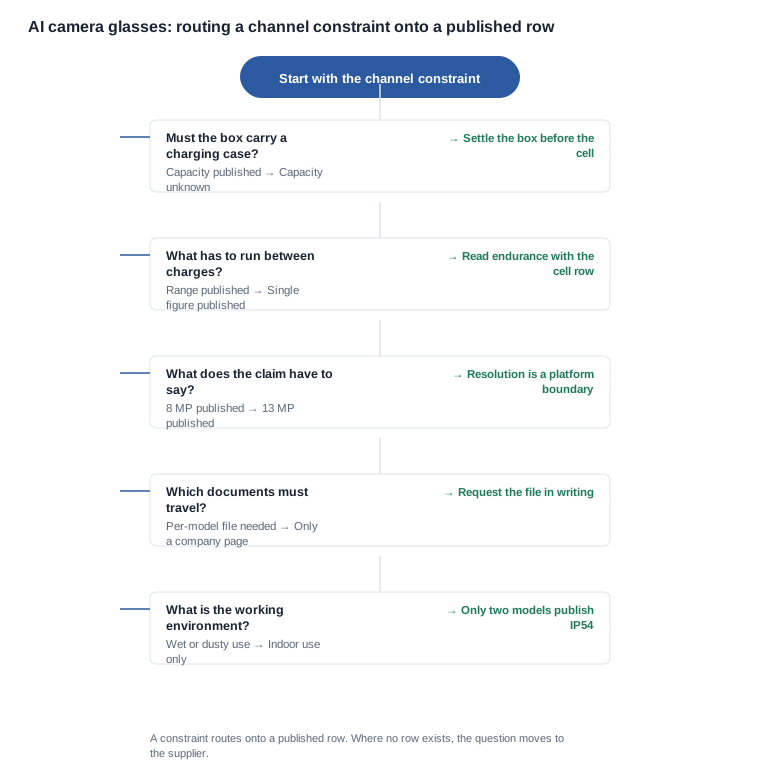
So the working method for this range is a routing exercise rather than a ranking exercise. Start with the constraint you cannot change, find the published row that bears on it, and where no row bears on it, write the question. The AI camera glasses battery comparison handles the power rows in more depth, and the AI camera glasses charging case options handles the box contents specifically.
AI camera glasses case rows split the range into four groups
The charging case is the single row in this range that changes the object the customer buys, and it is the row most often missing from a shortlist because it is not a performance figure. It alters parcel weight, it alters what the unboxing looks like, it alters the lithium content of the shipment, and it alters the number of cells that have to be covered by a transport document.
Reading the catalogue carefully, the eleven camera models fall into four distinct groups on this row, and the distinction between "not published" and "explicitly absent" matters more than it might appear.
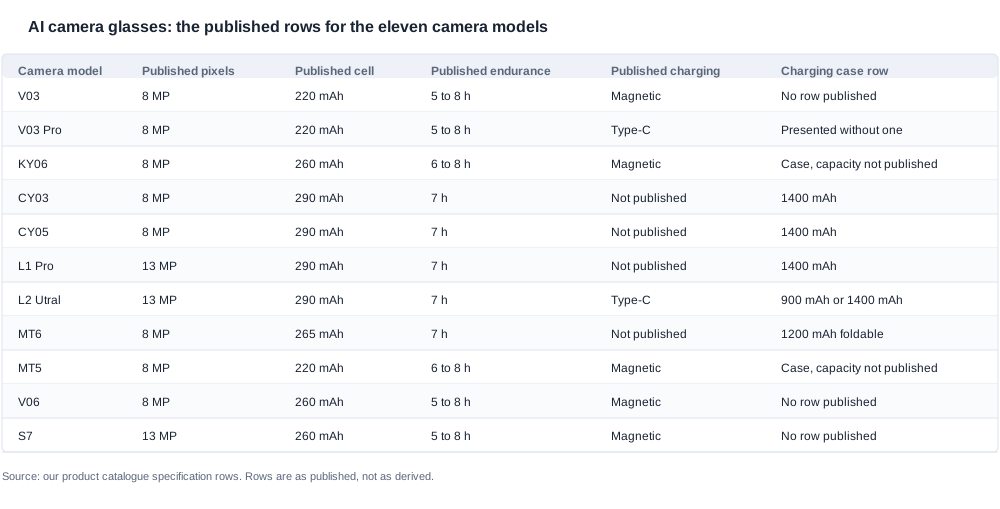
Case capacity published. Five models state a charging-case capacity. The CY05 and the L1 Pro, and the CY03 each publish a 1400 mAh case. The L2 Utral publishes a case in two capacities, 900 mAh and 1400 mAh, which means the case is a selectable configuration rather than a fixed part of the box. The MT6 publishes a 1200 mAh foldable case and, alongside it, the only weight figure published anywhere in this range: 158 g for the glasses unit itself, including the 265 mAh cell and the camera, and excluding the folding case.
Case present, capacity not published. Two models state that they charge magnetically with a charging case, but do not give the case capacity. That is the KY06 and the MT5. For a buyer this is an open commercial line rather than a defect: it is one of the two questions the case row forces you to ask.
No charging-case row at all. Three models publish no charging-case row whatsoever: the S7 and the V03, and the V06. The catalogue is simply silent on the subject for these models, which is different from the catalogue saying there is no case.
Presented without a case. The V03 Pro is the one model the catalogue presents with no charging case at all — no case row, no case in the product presentation, and a Type-C charge port instead of a magnetic pad.
| Camera model group | Case position in the catalogue | What this means for the buyer |
|---|---|---|
| CY03 and CY05, and L1 Pro | 1400mAh case published | A second cell travels with the product; the transport file has to cover it |
| L2 Utral | 900mAh or 1400mAh published | Case capacity is a configuration choice and belongs on the purchase order |
| MT6 | 1200mAh foldable case published | The foldable case and the 158 g unit weight are two separate published facts |
| KY06, MT5 | Case stated, capacity not published | Ask for the capacity in writing; treat it as a quotation line |
| V06 and V03, and S7 | No charging-case row published | Ask whether a case exists for your configuration before you price the box |
| V03 Pro | Presented without a case | The lightest parcel in the range, on the evidence published |
AI camera glasses resolution and battery rows narrow a shortlist further
Once the box question is settled, three published rows do the rest of the narrowing, and each of them is a legitimate filter because it is a fact rather than an opinion.
Resolution splits the range eight to three. Eight models publish 8 MP: the V03 Pro and the MT5, the CY03 and the CY05, and the V06 and the V03, and the KY06 and the MT6. Three publish 13 MP: the L2 Utral and the S7, and the L1 Pro. Note what travels with the 13 MP group. The L1 Pro carries a 290 mAh cell and a 1400 mAh case. The L2 Utral carries the same 290 mAh cell and a selectable case. The S7 carries a 260 mAh cell, publishes no charging-case row, and is one of the two models with an IP54 ingress rating. Resolution therefore correlates with the packaging question, not with a simple quality gradient.
Cell capacity runs across four values. The V03 and the MT5, and the V03 Pro publish 220 mAh. The V06 and the KY06, and the S7 publish 260 mAh. The MT6 publishes 265 mAh. The L2 Utral and the L1 Pro, and the CY05 and the CY03 publish 290 mAh. A buyer who needs a runtime figure should read the endurance row alongside the cell row, because the two do not move together. The V03 publishes 220 mAh and an endurance range of five to eight hours; the S7 publishes 260 mAh and the same five to eight hours; the MT5 publishes 220 mAh and six to eight hours.
Endurance is published for all eleven, as a range for six of them and a single figure for five. The V03 and the S7, and the V06 and the V03 Pro publish five to eight hours. The KY06 and the MT5 publish six to eight hours. The L2 Utral and the MT6, and the L1 Pro and the CY05, and the CY03 publish about seven hours. None of these figures comes with a starting state of charge, an end-of-test criterion, a volume setting or a test protocol, which is why they can rank models loosely but cannot be used to size a shift.
Charging method divides the range three ways, and one of the three is silence. Five models publish magnetic charging: the S7 and the V06, and the V03 and the KY06, and the MT5. Two publish a Type-C port: the V03 Pro and the L2 Utral. Four publish no charging method at all: the MT6 and the CY05, and the CY03 and the L1 Pro. Those four are the same models, without exception, that publish a charging-case capacity. That pattern is worth noticing for a structural reason rather than a technical one: the case appears to be the charge path for those models, but the catalogue does not say so, so it is a question and not a fact.
Two models carry an ingress rating and two carry a removable inner frame. The V06 and the S7 are the only models in the whole range publishing IP54, and they are also the two publishing a removable inner frame. The G07 in the audio range publishes a detachable temple. Removability matters commercially because it changes what a distributor can service locally and what a customer can replace after a knock.
What the resolution row deliberately does not tell you. A pixel count is a count of what the sensor is able to record, and it says nothing about how much of the scene the lens is able to put in front of that sensor. No model in this range publishes a field of view, a sensor part number, a lens aperture, a frame rate, a video resolution or a still-image format, and the catalogue text contains no such row for any of the eleven. A buyer therefore has a published resolution figure and no published optical figure. That is a legitimate reason to treat the 8 MP and 13 MP split as a packaging and platform boundary rather than as a quality ranking, and it is the reason the resolution question belongs in the supplier questionnaire rather than in a shortlist comparison table. The same applies to every other unpublished measurement: the honest description of what the catalogue gives you is a set of structural facts, and a buyer who wants a performance comparison has to assemble it from documents the supplier supplies.
AI camera glasses questions to put to a supplier before a shortlist is signed
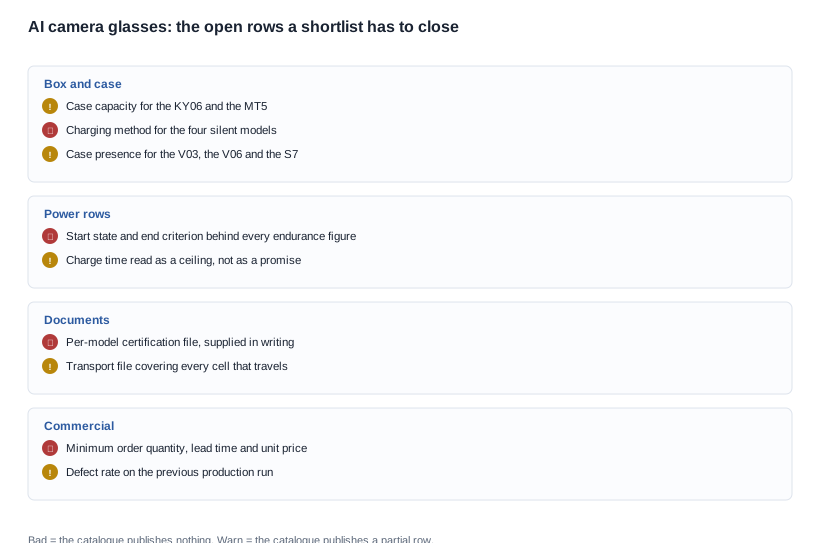
The routing above produces a specific list, and it is more useful than a recommendation because it can be sent to a supplier the same day. These are the questions that fall out of the published rows.

-
For the KY06 and the MT5: what is the charging-case capacity in mAh for the configuration we are quoting, and is the case included in the carton at our order quantity? This is the one open cell-capacity figure in the range.
-
For the CY05 and the L1 Pro, and the CY03 and the MT6: what is the charging method, and does the 1400 mAh or 1200 mAh case charge the glasses directly, or does the case itself take the charge? Without this answer the parcel, the retail box and the transport document cannot be finalised.
-
For the S7 and the V06, and the V03: does a charging case exist for this configuration, and if it does, what is its capacity and what does it add to the shipped weight? The catalogue publishes no case row for these three.
-
For every model on the shortlist: what is the starting state of charge and the end-of-test criterion behind the published endurance figure, and at what playback or recording load was it measured? All eleven publish a figure; none publishes the protocol.
-
For every model on the shortlist: what does the 158 g MT6 figure exclude, in your own words, and what is the equivalent total shipped weight for the other models? Only the MT6 publishes any weight at all, and the catalogue does not publish a weight for the remaining ten models.
-
For the S7 and the V06: what exactly does the IP54 rating cover, and which components does it exclude? Both publish the rating; neither publishes a test reference in the catalogue.
-
For the V03 Pro: confirm in the quotation that no charging case is included, and confirm the lens configuration and the temple variant as separate line items, since the catalogue lists a flexible temple, photochromic lenses and three colours as options.
-
For any model in the shortlist: what is the minimum order quantity for this configuration, what is the lead time, and what is the quoted price per unit at our volume? None of these three is published for any model in the range, and all three are commercial terms rather than specification facts.
-
For any model in the shortlist: which certification documents exist for this exact configuration, and does each one name the model or the configuration on it? Our catalogue does not publish a per-model certification row, so this has to come as a document rather than as a line in a specification table.
-
For any model in the shortlist: what is the defect rate on the previous production run, and what is the quality control process at the end of the line? The catalogue publishes nothing on either, and both affect the cost of the first shipment more than the unit price does.
-
For any model in the shortlist: what is the optical specification — field of view, sensor part number, lens, video and still formats — and is it the same across the colourways? The catalogue publishes the pixel count and nothing else optical, so a buyer who needs the number has to ask for it and then hold the answer against a written configuration.
-
For any model in the shortlist: what is the warranty period, what is the returns procedure, and who carries the freight on a defective unit? None of the three is published, and a camera product with a moving part and a cell in the same enclosure tends to generate more returns conversation than a plain audio product does.
AI camera glasses failure modes that only show up after the first shipment
Most of the ways this programme goes wrong are not visible at the quotation stage. They surface in the weeks after the first container lands, and each of them traces back to a specific gap between what the catalogue publishes and what a channel actually needs.
The case is in the carton and not in the file. A model that ships with a 1400 mAh case carries two cells, and the second cell changes the transport classification, the declared weight and the carton configuration. A device that was cleared on its own and a device that was cleared with a case are two different transport products. For the four models whose charging method is not published, this gap is very easy to create by accident, because the case looks like an accessory rather than a powered component.
The charging method is assumed rather than confirmed. A shortlist built on the assumption that a magnetic pad is standard will be wrong for the V03 Pro and the L2 Utral, which publish a Type-C port, and it will simply be blank for the four models that publish no method. An assumption here also propagates into the packaging artwork, the instructions in the box and the retail listing, all three of which have a lead time of their own.
The endurance figure is treated as a measurement. An eight-hour range read as a guaranteed eight hours will be compared against a duty cycle it was never measured against. In the field this shows up as returns and as support tickets, and it is the failure that most often damages a launch, because it happens in the hands of the customer rather than in the factory.
The published weight is read as a frame weight. The 158 g figure belongs to the MT6 glasses unit, including its 265 mAh cell and camera and excluding the folding case. It is not a frame weight and it is not a weight for any other model in the range. A buyer who quotes it as a frame weight will overstate the product by the weight of the case and will have no figure at all for the other ten models.
An ingress rating is applied across the range. Only the V06 and the S7 publish IP54. Copying that rating onto a shortlist that also contains the CY03 and the L1 Pro, the V03 Pro and the V03, and the MT6 and the L2 Utral, and the KY06 and the CY05 or the MT5 is a false claim, and it is the kind of false claim that surfaces at a retail listing audit rather than at a factory gate.
A certification claim is inferred from the company-level page. One export certification sheet exists at company level, and it is made of images rather than prose; the written catalogue, meanwhile, names no CE mark, no FCC mark and no RoHS statement, and carries no per-model certification row for any camera. A buyer who treats the existence of that sheet as evidence about a specific model is inferring a product fact from a corporate page, which is exactly the inference that a compliance audit later reverses.
AI camera glasses: what this catalogue does and does not publish
The position is narrow and deliberate. We publish specification rows for the models in this range, and we publish them in the form the factory builds them. We do not publish prices, minimum order quantities, lead times, production capacity, warranty periods, field of view, sensor part numbers, brightness figures or certification identifiers, and we are not going to start publishing numbers we cannot stand behind.
What that means for a buyer working through this article is specific. Where a constraint maps onto a published row — the case row, the pixel row, the cell row, the endurance row, the charging-method row, the ingress row — you can narrow the range today without asking us anything. Where a constraint does not map onto a published row, the question list above is the shortest path to the answer, and the answer has to arrive as a written line in the quotation rather than as a verbal assurance.
Three things follow from that. The first is that a shortlist built this way is defensible: every exclusion traces to a published row, and every inclusion traces to a constraint the buyer set. The second is that the gaps are visible to the other side of the table, which is where negotiation happens — a supplier who has priced a configuration that you assumed was standard will show it in the quotation, and a supplier who cannot produce a file for the configuration you specified will show that too. The third is that nothing here should be read as a recommendation. We publish the rows; the choice among them belongs to the buyer who knows the channel, the box, the budget and the market.
The AI camera glasses bulk ordering article takes the same published rows into a volume context, and the AI camera glasses customization options article covers the configuration questions that sit on top of this range.


