
The MT6's catalogue page is the only page in the range that carries a weight, and it is the only page in the range that pairs a weight with a folding charging case. That is a stronger starting position than most camera models in this catalogue offer, because a buyer can quote a figure and a case capacity from the page rather than requesting both. It is also where the temptation starts, because a page that answers some questions well invites the assumption that the questions it leaves open are minor.
They are not. The charging method row on this page is unfilled, the camera is published as a resolution class with nothing behind it, and the weight figure and the case descriptor sit on the same line without the page saying what the weight measures. Three gaps sit alongside three things a channel can use immediately, and the whole point of a pre-order list is to keep the two apart.
What to check before ordering to know about MT6 smart glasses: a case that folds and a cell it does not explain
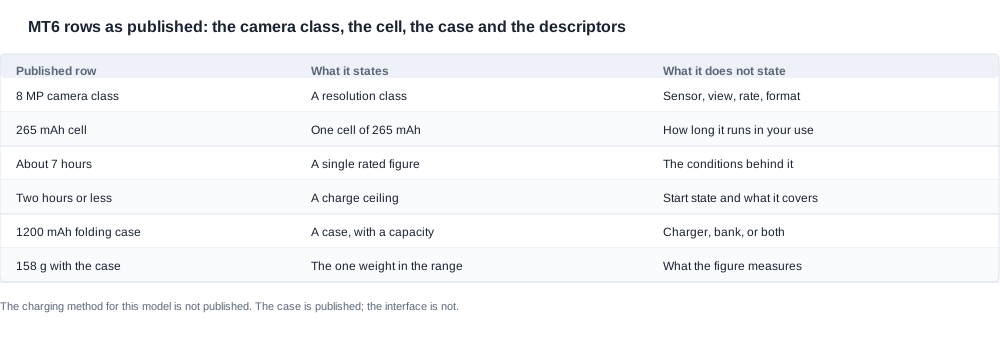
The published row for this model reads: an eight megapixel camera class, a 265 milliampere-hour cell, roughly seven hours of rated use, a charge time of two hours or less, a 1200 milliampere-hour folding charging case, and three descriptors — portable, ultra-light, and a line that carries 158 grams together with the folding charging case.
Each of those items settles something, and none of them settles everything.
The camera class is one of the two classes published across the camera models in this range, and this model sits in the eight megapixel one. A pixel count is all that figure is, and it says nothing about the imaging chain behind it, the optics in front of it, how much of the scene the camera takes in, how fast the frames come, what the footage is written into, or how the picture behaves in a dim room. Nothing behind the class is published for this model any more than for any other.
The cell is 265 milliampere-hour, and the camera models in this range publish their cells in four groups: 220, 260, 265 and 290 milliampere-hour. This model is in the 265 group, which it occupies on its own, and a cell figure of this size is a real specification with a real consequence for how long the product runs and how long it takes to get back to a usable state.
The endurance is published as about seven hours, and that makes this one of the camera models that carry a single figure rather than a band. Several camera models in the range publish a range of five to eight hours or six to eight hours instead, and the difference is worth noticing on its own: a single figure can be quoted as a rated use, while a band cannot be quoted without its conditions attached.
The charge time is two hours or less, which is a ceiling, and as with every model in the range the start state of the cell and the point at which the charge counts as finished are not published.
The case is the item that makes this page unusual. A 1200 milliampere-hour folding charging case is published, with a capacity, and the page also names the case as folding. Two consequences follow. The first is that the case is a real, specified accessory rather than an unknown, and a channel can price it, stock it and describe it. The second is that a folding mechanism is a mechanical feature, and a mechanical feature brings its own questions about wear, about what happens when a case is dropped, and about what a returns inspection looks like when a hinge is involved.
The descriptors are the catalogue's own words, and a buyer can quote them as descriptors — portable and ultra-light, with a weight and a folding case on the same row. What they are not is a measurement of anything except the 158 grams, and the weight question is worth a paragraph of its own.
One comparison is worth making here and nowhere else in the catalogue: a case with a published capacity and a case with no published capacity are different objects for a buyer, and so is a model whose page carries no case row at all and a model whose page says in words that no case is supplied. This unit sits in the first of those three, and the distinction is not a technicality — it decides whether the accessory line exists at all. The way a case position differs across camera models, and the four different readings a buyer can draw from it, are set out in the MT5 pre-order list.
The 265 milliampere-hour cell, and the only weight figure the catalogue publishes
The weight is the number a channel will use and a customer will ask about, and this model carries the only weight figure in the whole catalogue: 158 grams, printed on the same feature row as the folding charging case. No other model in the range publishes a weight at all, which means there is no second data point to compare it with and no way to sanity-check it against anything else in the range.
That is a strength and a risk, and the risk is entirely about what the figure covers. The catalogue places the weight and the case on one line, and it does not say whether 158 grams describes the glasses on their own or a packaged configuration. A 1200 milliampere-hour case is a separate object with its own mass, and a figure that were meant to include it would describe a different product from the one a buyer is holding. The question is therefore not rhetorical: the factory has to state what the 158 grams measures, and it has to state what the folding case weighs on its own, which the catalogue does not publish.
There are three further questions that the weight raises rather than settles. The criteria that decide whether this model can be listed are the same for all of them, and the questions to ask in writing are the ones that separate a published figure from a borrowed one. Does the figure hold for every configuration the model is offered in, or does it change with anything the page allows a buyer to vary? Is the figure measured with the battery and the camera fitted as they ship, which is the figure a customer would feel? And is the weight quoted in the same unit a customer would see on a scale at home, or in a unit chosen for the row? A weight that is quoted precisely and defined loosely is worse than one that is quoted approximately and defined properly, because a channel will use the precise number in a comparison it cannot support.

The two descriptors that sit next to the weight are where a buyer has to be careful in a different way. Portable and ultra-light are the catalogue's characterisation of this model, and quoting them as descriptors is legitimate. The weight is what makes the second of them checkable, and it is the only measurement in the range that a buyer can point at when a customer asks why the model is described that way. There is no further published data behind either descriptor — no dimensions, no hinge rating, no dropped-test result, no figure for the case — so the honest position is that the catalogue says portable and ultra-light, the catalogue publishes 158 grams, and everything else about the physical product is a question for the supplier.
On the cell itself, the number a channel can use is the endurance figure of about seven hours, and the number a channel should be careful with is the same one. About seven hours is a rated value, and the catalogue does not publish the conditions behind it: not the volume, not the codec, not what the camera was doing, not how much of the session was spent with the radio connected, not whether the case was in use. This model publishes a single figure rather than a band, which makes it easier to quote and no easier to defend. The question to put is the same one that applies to any rated figure in this catalogue, and it is worth asking it for this model in particular because a single number is the number people repeat.
The remaining physical questions are ordinary and answerable: what are the frame dimensions, is there any adjustment, what is the size and weight of the case on its own, and what does the folding mechanism mean for how a customer stores the product. None of them is published, and all of them are the kind of thing a first sample answers in an afternoon.
The charging method row the catalogue leaves unfilled
This is the gap that is easiest to overlook on this particular page, because the page is otherwise so well populated. The charging method for this model is not published. What the page does publish, on the charging side, is the 1200 milliampere-hour folding case — the accessory, not the interface. Nothing on the page names how the frames themselves take their charge.
That distinction decides four things, and each of them is a decision a buyer has to make before the first order rather than after it. The first is the box: a model that charges over a named interface ships with a cable, and a model that charges against a contact ships with a dock, and the two have different replacement habits, different packing instructions and different spares. The second is the accessory line, because a 1200 milliampere-hour folding case is a case for charging or for holding — and which of those it is determines whether it extends the product's day or merely stores what another charger put there. The third is the two-hour charge ceiling, which is published without a statement of what it applies to: the frames, the case, or the pair of them charging together. The fourth is the returns path, because a unit returned with a dead case and a unit returned with a dead frame are two different problems with two different costs.
The folding aspect adds a second layer. A folding case is a hinged object, and hinges have a failure mode that a rigid case does not have. What a buyer should ask is what happens in the field when the case is folded and unfolded, how many cycles it is expected to survive, whether a damaged case is replaceable on its own, and whether the frames are protected when the case is closed. None of that is published, and all of it is the kind of detail that becomes a support ticket at the second or third month of ownership rather than at the first.
The camera side of the same page is equally open. Beyond the resolution class, this page publishes nothing further: the sensor is unnamed, the angle the camera covers is unstated, the frame rate is missing, and so are the file format, the storage and the destination of the recorded footage. The camera models in this range do not publish radio versions either, so the question of what this model connects to is a question rather than an answer.
A useful way to structure the request is to separate what the page has already settled from what it has not, and to send the second group as a numbered list. The first group for this model is short: a camera class, a cell, a rated use, a charge ceiling, a case capacity, a case that folds, and a weight. Everything else is an open row, and an open row that is not written down becomes a complaint later.
Building a pre-order list from what is published and what is not
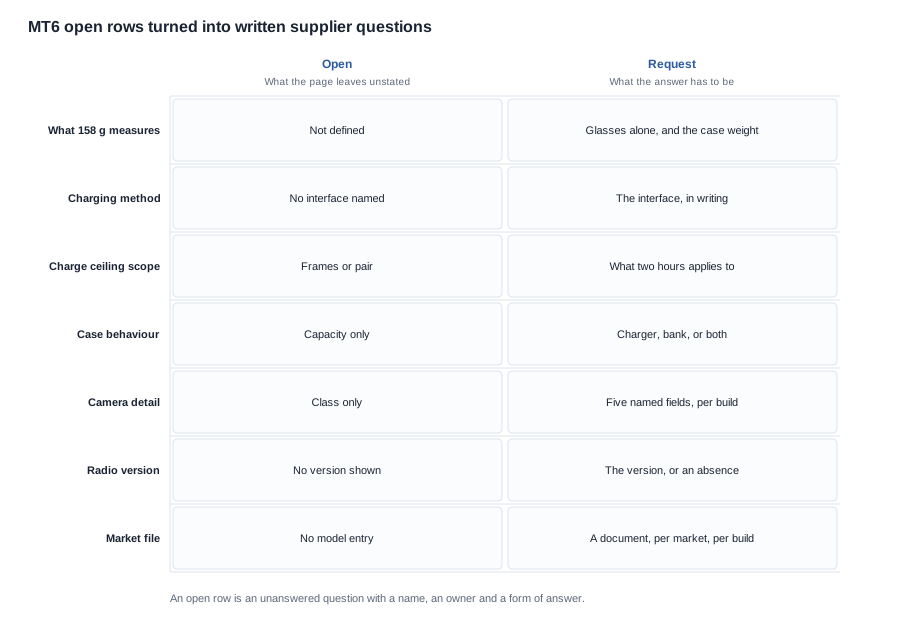
The list below is the order this model should be checked in, and each item is written as the request that closes it. It is arranged so that the items which cannot be answered from stock documentation — the weight definition, the market file — travel with the sample request rather than behind it.
- What the 158 grams measures. The glasses on their own, with the battery and camera as they ship, or a packaged configuration? And what does the folding case weigh separately?
- How the frames take their charge. Which interface the unit uses, and whether the folding case is what puts the charge into the frames or only what holds a charge placed into it by other means.
- What the two-hour ceiling applies to. The frames, the case, or the pair charging together — and from which cell state?
- What the case is. A charger, a power bank, or both; how many full frame charges a full case gives; whether a case is supplied with every unit; whether a damaged case can be replaced on its own.
- The camera behind the class. Sensor, field of view, recording rate, file format, storage capacity, and where recorded footage goes.
- The radio. Whether this model carries a radio at all, and if so which version — the camera models in this range do not publish one.
- The functions that carry no row. Which capabilities exist in the product without a published descriptor, and which of them a listing could state.
- The endurance conditions. What was running during the published seven hours, and what the figure is at a given volume, in a given environment, over a session.
- The physical details. The measurements of the frame, what the unit weighs, and the size and weight of the folded case — the catalogue publishes the 158 grams for the glasses body and nothing else.
- The market file. Which certificates and declarations cover this model and this build, for which destination markets they were issued, and which body issued each one; the catalogue provides no per-model certification entry for it.
- The condition claims. Nothing in the catalogue supports a statement about water, sweat or rain for this model, and the two camera models that do carry such a marking are not this one — so if a condition claim is needed for a market, it has to come as a written statement from the factory.
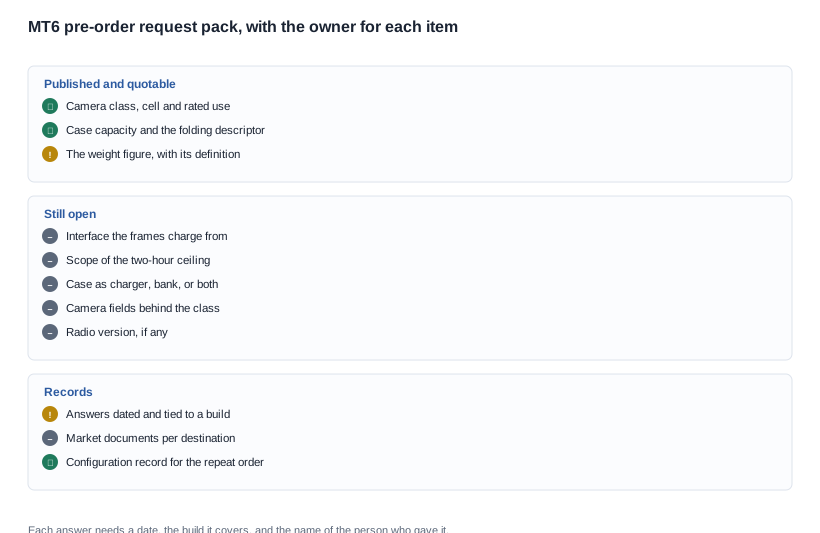
Two of these carry more weight than the rest, and it is worth saying why. The first one is the weight, because it is the number a channel will publish and the number a customer will check on a kitchen scale, and because a weight that is published precisely and defined loosely will be quoted back at the seller. The second is the charging method, because it determines the box, the accessory line, the meaning of the charge ceiling and the returns path all at once, and because it is the one item on this page where the catalogue is genuinely silent rather than merely incomplete.
There is a criteria question underneath the eleven items, and it is worth settling before the list goes out rather than after the first answer arrives. What does a closed file look like for this model? For a page with this much published, the answer is specific: a written statement of what the 158 grams covers, a written statement of the charging interface, a written statement of what the two-hour ceiling applies to, a written statement of whether the case charges the frames or stores a charge, and the market documents for the destinations the order will ship to. Write that definition down before the list is sent, and the first reply can be judged against it. Without it, the temptation is to treat a partial reply as a partial file, and a partial file is what a shipment is held up against three months later.
The red flags in a reply are easy to name and easy to miss under schedule pressure. An answer that describes the case instead of stating its behaviour. An answer that gives a weight for a configuration nobody sells. An answer that quotes the two-hour ceiling without saying what it covers. A promise of a document "shortly" with no date attached. And a reply that answers for the model rather than for the build. Numbering the list is what makes those visible, because each of them leaves a specific item unanswered and an unanswered item is easy to count.
The trade-off in sending all eleven at once is the same trade-off as anywhere else in this catalogue: a longer request asks more of the supplier, and the time comes back as delay. The reason to send them together is that the alternative is eleven separate exchanges scattered across a production schedule, each arriving after the decision it was meant to inform. One request attached to the sample gets the answers and the unit in the same round, and it is the only way the first batch can be judged against a specification rather than against an impression.
What closes the file is the same for this model as for any other: a written answer per item, each naming the build it covers, the market documents for the destinations the order will ship to, and a configuration record that lets a second order reproduce the first. A verbal answer does not close it, and neither does an answer given for the model in general rather than for a build.
A closed file on this model produces a short acceptance record, and the first shipment is measured against it. What arrives has to be what the catalogue describes, the case has to match the case row, the weight on the record has to be the weight the factory confirmed, the capture has to behave as observed, and the papers that travel with the unit have to name the build and the market it is for.
This page does not tell a buyer which programmes the MT6 fits, does not rank it against the other camera models in the range, and does not say which requirement it is best suited to. Nor does it carry a price, a lead time, a minimum order quantity, a sensor detail or a field of view, and a conclusion drawn from an empty field would be an opinion rather than a published fact. What the catalogue does publish for this model is unusual: a weight, a case with a capacity, and three descriptors. The checks above turn that into a specification that can be ordered and then judged.
Tell us which row on this list your own operation cannot work around, and we will draft the request for it in the wording our documentation team uses on a build file.


