

Returns handling is usually discussed after something has gone wrong. It should be designed before the first purchase order, because the terms agreed for a platform determine whether a defect investigation costs a buyer a week or a quarter. The reason this is unusually hard in this category is not that returns are complicated, it is that the documentation the returns process depends on is largely missing. The product record for this catalogue covers twenty-eight models and states for every one of them that no product photographs, no video and no detection reports have been supplied. The catalogue pages publish specification rows and no test conditions. So a returned unit arrives with a model code that may not exist, a configuration that may not be tied to a capacity, a colour that may not be published, a runtime figure that carries no condition, and no batch evidence at all. A returns clause that assumes those things exist will be unenforceable in exactly the situations where it is needed.
What a return claim has to state, and what it can lean on
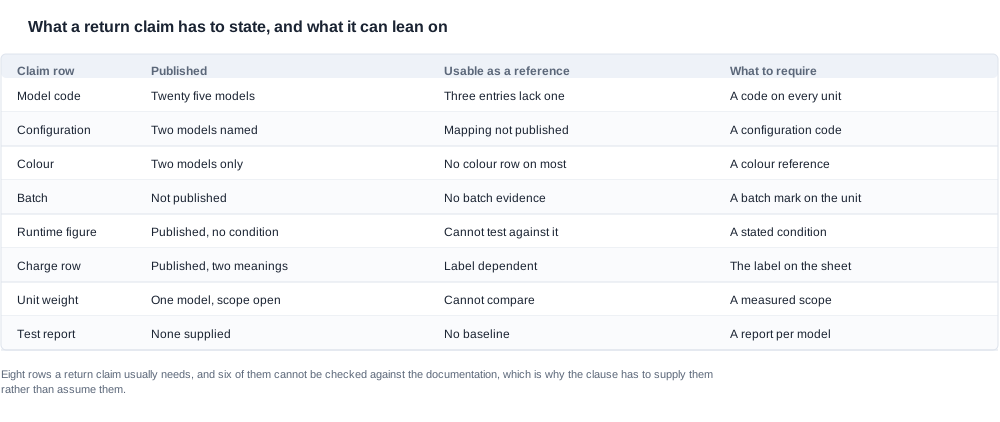
The table below lists the rows a return claim normally needs, and for each one, whether the documentation supports it.
| Claim row | Published | Usable as a reference | What to require |
|---|---|---|---|
| Model code | Twenty five models | Three entries lack one | A code on every unit |
| Configuration | Two models named | Mapping not published | A configuration code |
| Colour | Two models only | No colour row on most | A colour reference |
| Batch | Not published | No batch evidence | A batch mark on the unit |
| Runtime figure | Published, no condition | Cannot test against it | A stated condition |
| Charge row | Published, two meanings | Label dependent | The label on the sheet |
| Unit weight | One model, scope open | Cannot compare | A measured scope |
| Test report | None supplied | No baseline | A report per model |
Six of those eight rows cannot be checked against the documentation, and that is the finding that shapes everything else about a returns clause for this range.
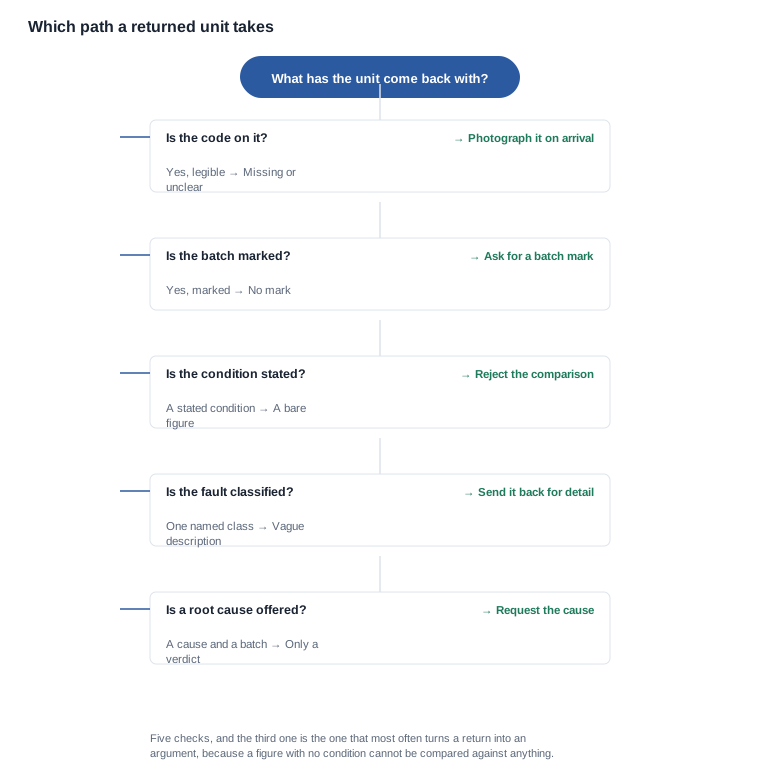
The runtime row is the sharpest case. The catalogue publishes an endurance figure for every model, in one of three shapes, and it publishes no test condition on any of them. So a returned unit that does not last a working day cannot be tested against the published figure, because the figure describes a condition nobody has stated. Both parties in that dispute can be entirely reasonable: the buyer is looking at a unit that stopped working partway through a day, and the supplier is looking at a published number that was never tied to a working day. The only way out of that argument is to write the condition into the clause, before the first order, so that the comparison has something on both sides of it.
The charge row has the same shape for a different reason, and it is worth being precise about because it looks like a clerical issue and is not. Across the camera range, the catalogue uses the same words for two different quantities. On some pages a row labelled with a charge duration carries a charge limit of two hours or less, and on other pages a row with the same label carries a run time of five to eight hours. So a return sheet that says "charge duration does not match the specification" is ambiguous without naming which quantity is meant, and the ambiguity is a live dispute waiting to happen.
The identity rows are the hardest ones to fix, because they are not a documentation gap that a clause can close by itself. Three entries in the record have no model code issued at all, so a return for one of them cannot name a model. Two camera models publish two variant names and two charging case capacities without stating which name goes with which capacity, so a return against one of them cannot identify the configuration. Two other entries publish identical specification rows with no stated difference between them, so the specification cannot tell them apart. And twenty-six of the twenty-eight entries publish no colour row, so "what colour was it" is answerable for two models and unanswerable for the rest. All of that is why the clause has to require a configuration code and a batch mark as a condition of the claim, rather than assuming that the documentation will identify the unit when it comes back.

Why the definition is the whole argument
Most return disputes are not disagreements about quality. They are disagreements about what counts as a defect, and the disagreement is usually resolved by whoever has more patience rather than by whoever has the better case. That is why the defect definition is the first thing to write rather than the last.
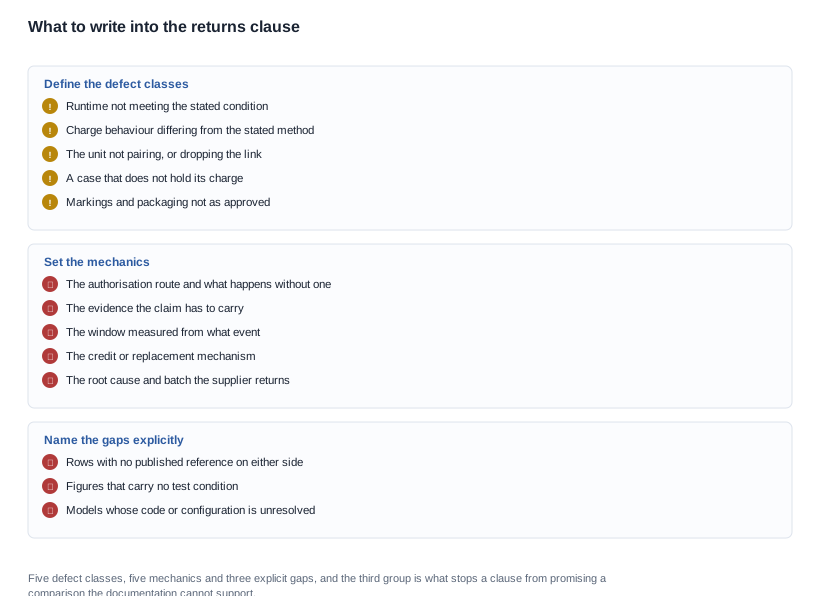
The definition has to be in categories, not adjectives. "Battery does not meet the agreed runtime under the agreed test condition" is usable because it names a quantity and a condition. "Poor quality" is not usable because it names nothing, and it cannot be applied consistently by two parties who disagree about what quality means. The categories that matter for this range are also the ones that follow from what these models actually publish: a runtime that falls short of the stated condition, a charging behaviour that differs from the stated method, a unit that will not pair or drops the link, a case that does not hold its charge, a unit whose markings or packaging do not match what was approved, and an ingress marking that turns out not to hold.
The second half of the definition is the part buyers get wrong in both directions. A definition so narrow that it only covers a total failure will produce a returns process that is easy to administer and useless to the channel, because a unit that runs for half a working day is a return the customer will make and the clause will reject. A definition so wide that it covers anything a customer is unhappy with will produce a process that resolves nothing, because there is no line between a manufacturing fault and a customer expectation. The useful discipline is to write down, in advance, which classes are the supplier's problem, which are the buyer's problem, and which are a shared one, and to accept that some of them are going to be the buyer's problem. That is a commercial decision, not a technical one, and it belongs in the clause rather than in a negotiation that starts after the first return.
There is a practical way to make that three-way split that avoids most of the argument, and it is to classify by whether the row is published, whether the property is characterised, and who controls the condition. A row that is published and characterised, such as a charge method that is stated on the page, is the easiest class to handle, because the claim can be checked against the documentation and both parties can see the same answer. A row that is published but not characterised, which is the case for every endurance figure in this range, belongs in a shared class, because the buyer needs the condition agreed and the supplier needs the figure honoured under that condition. A row that is not published at all, which is the case for the sensor, the lens, the capture format, the frame dimensions, the charging input and the packaged weight, has to be closed by the buyer before it can be classified, and the classification then follows the measurement rather than the documentation.
That third group is the one worth dwelling on, because it is where a returns clause quietly becomes unenforceable. If a buyer writes a defect class covering capture quality, and the catalogue publishes no sensor, no lens, no field of view, no capture format and no frame rate for any model, then the class has no reference and the buyer will be arguing about a photograph. The same applies to a class covering weight, where the only published figure in the whole catalogue belongs to one model and does not state what it measures, and to a class covering ingress, where the marking appears on two models as a catalogue annotation with no test report number behind it. The honest handling of those classes is to define them against a measurement the buyer has taken and the supplier has agreed to, rather than against a published value that does not exist.

The six OEM ready platforms stages, and what each one produces
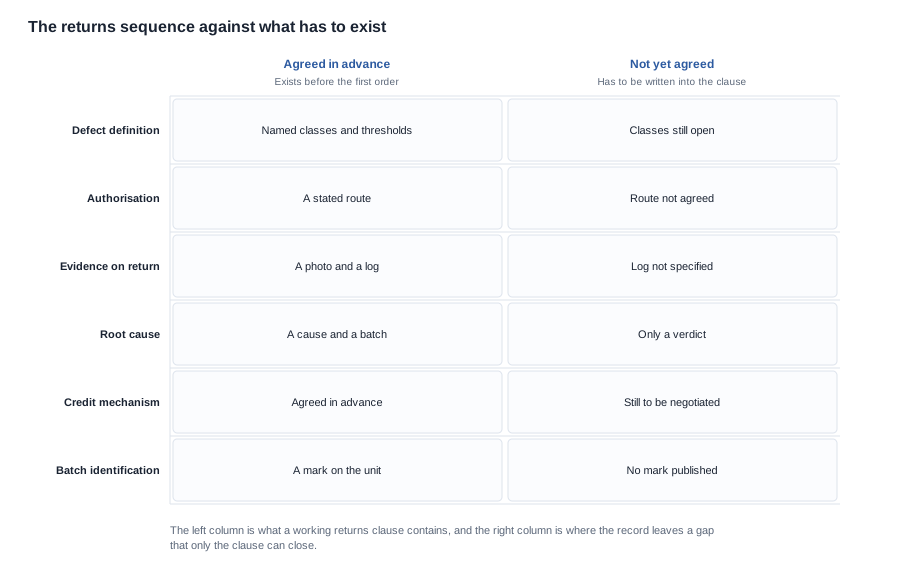
The sequence is short and every stage has to be written down before the first order ships.
- Agree the defect definition in writing. Categories and thresholds, with the runtime, capture, pairing, charging and cosmetic classes named explicitly, and with the ownership of each class stated.
- Set the return window and the authorisation method. How the clock starts, from dispatch or from delivery, and whether a claim needs a pre-issued authorisation number. A return shipped without one is the most common cause of a rejected claim, and it costs the buyer more than it costs the supplier.
- Decide what evidence a claim carries. Whether the physical unit has to come back, and what a claim has to include either way: photographs, the condition the unit was used in, the configuration, the batch mark and a description of the fault in the terms of the agreed classes.
- Require the root cause and the batch. Not a verdict that the unit was defective, but a statement of what went wrong and which batch it belongs to. This is the stage that protects the next order, and it is the stage that the current documentation cannot support, because no model in the record carries batch evidence.
- Agree the credit or replacement mechanism in advance. Negotiating it after the fact weakens the buyer's position and delays the season, because the dispute is then about the remedy rather than about the fault.
- Close the loop on the next run. Corrective action is what turns a returns process into a quality process, and it only works if the root cause from stage four reaches the production file.

The gaps the clause has to name
Some returns terms are commercial and belong in a quotation rather than in a clause, and this piece will not guess at them. Minimum order quantity, warranty period, defect rate tolerance, production capacity and lead time are all absent from the record, and any figure printed here would be wrong for a specific order. They belong in the purchase order, agreed against a configuration and a market.
Three gaps are different, because they sit inside the returns clause itself and a buyer can close them by writing them down. The first is the set of rows with no published reference on either side. If no test condition exists for the runtime, the clause cannot promise that a runtime failure will be accepted as a defect; it can instead promise that the test condition will be agreed in advance, which is the thing that actually makes the comparison possible. The second is the figures that carry no condition, which is the same point applied to the endurance rows and the charge rows, and the third is the models whose code or configuration is unresolved, where the clause has to require a code and a configuration identifier on the unit itself rather than relying on the model name to identify it.
There is a further point about the distinction between a platform purchase and a programme that goes beyond what a ready model already covers. A ready model comes with a set of configuration axes already recorded for its category, and the record states which those are per category. Anything the programme adds on top of that is the buyer's own specification, and the more of it there is, the more of the returns question the buyer owns. The criterion for how much a returns clause has to do is therefore the criterion for how much is being added, and both questions are answered by the same short list: which of this model's recorded axes are already defined, and which are being introduced by the programme. The answer belongs in the clause, because it determines which failures are defects and which are the buyer's own design choices.
The categories also differ in how a return will actually be argued, and a clause written for one of them will not transfer to another. A camera programme will argue about the capture, because the sensor, the lens, the field of view, the capture format and the frame rate are unpublished for every model, so every capture complaint is a complaint with no reference. An audio programme will argue about the sound, because the product record states plainly that acoustic performance has no third-party measurement behind it, so an acoustic complaint has no baseline either. A sport programme will argue about the water resistance, because the ingress marking on the two models that carry it is a catalogue annotation with no test report number, so the claim can only be settled by a laboratory and not by either party looking at the unit. And a programme in the children's category is arguing about something larger than a fault, because the record states that certification information is entirely not provided for those models and that children's products usually carry additional requirements in most markets, which means the question is not whether the unit failed but whether it should have been sold into that market at all. The sequence of stages below is the same for every model, and the difference between models sits entirely in the clause written at stage one. Those four arguments have a common structure, and it is worth naming because it is the reason one clause cannot cover the range. In each case the dispute is about a property that the documentation does not characterise, and in each case the property is the one the product is sold on. Which is why the useful question for a buyer is not which fault classes to write, but which properties on this model have never been characterised at all, because those are the properties the returns clause has to define from a measurement rather than inherit from a page. It is also why the criteria for the clause have to be applied per model: a clause for a camera model and a clause for an audio model look similar in structure and cover different ground, and the difference is which property the customer is actually buying.
What a returns clause commits us to, and what it does not
The criteria for deciding what a clause has to cover, then, are four. Which properties on this model are published and characterised, so a claim against them can be checked against the documentation. Which are published but carry no condition, so the clause has to supply the condition. Which are not published at all, so the clause has to define the class against a measurement rather than a figure. And which of the identity rows are unresolved, so the clause has to require a code and a configuration on the unit. A clause that answers those four for one model is usable, and the same four questions applied to the next model will produce a different clause, which is the correct outcome rather than a problem with the method. The trade-off worth naming is that a clause covering only the first group is short, quick to agree and almost useless, because the failures customers actually bring back are in the second and third groups. A clause covering all four groups takes longer to write, which is why it is worth writing before the first order rather than after the first argument.
A returns agreement is part of the product rather than paperwork that follows it, and a clause written against the gaps in the record is worth more to a buyer than a clause written against the assumptions everyone would prefer to make. We would rather lose a unit on a claim than win an argument in a way that damages the relationship on the next order, and we will not agree a defect definition so vague that it protects us rather than the buyer. We will not present a runtime failure as a defect against a published figure that carries no test condition, because that comparison does not exist, and we will say so before the order rather than after the first return. We will not quote a defect rate, a warranty period, a minimum order quantity or a lead time that the record does not contain, and we will not identify a returned unit by a model name when the record shows that name is not unique.
What the record does support is a clause that names the defect classes, states the conditions each class is judged under, requires the evidence a claim has to carry, and identifies the unit by a code and a configuration rather than by a name. That clause is writable today, and it is the thing that turns a returns process from a sequence of arguments into a sequence of decisions. The OEM ready platforms range is where the model set starts, the development process description covers what happens between an order and a shipment, and the distributors and retailers piece covers the channel side where the documentation gaps are felt first.
Tell us the channel, the volume and the failure modes you actually care about, and we will put a written returns sequence against them, including what happens when the cause is genuinely a customer expectation rather than a manufacturing defect.


