

OEM ready platforms are usually described with a single dimension — yes or no — when customisation is in fact a ladder with five rungs, and each rung has a different cost, a different lead time and a different failure mode. The useful question for a buyer is not whether customisation is available but which rung is reachable for the specific models being considered, because the answer determines the artwork, the tooling exposure, the documentation obligations and the amount of supplier dependency you are accepting. This piece sets out the five depths, maps them against the published structure of this range, and explains how to evaluate a supplier's answer rather than take it at face value. Nothing here is a commitment: the catalogue publishes product structure rather than a customisation service list, so every rung below is something to ask about and have quoted.
OEM ready platforms and the five depths of customisation
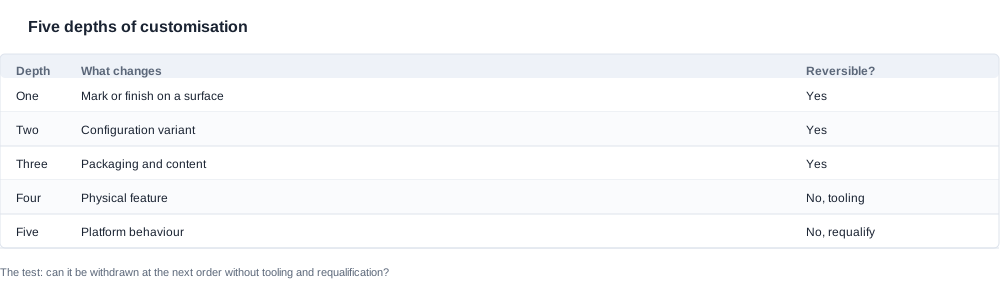
The ladder runs from a mark on an existing surface up to a change in how the product is configured, built or documented. Each rung is distinguishable by a single test: can it be reversed at the next order without tooling and without re-qualification? If yes, it is shallow. If no, it is deep.
Depth one is decorative. A mark, a print, an engraving, an insert, a colour finish on an available option. The product's function is untouched, the testing position is unchanged, and the change can be reversed by supplying different artwork. This rung is cheap, fast and low-risk, and most private-label programmes start here and stop here.
Depth two is configuration. Changing which variant, capacity, colour or bundle the customer receives, using options that already exist. This rung is deeper than decoration because it changes what the customer gets and therefore what your description must say — but it remains reversible, because the underlying product is unchanged.
Depth three is content. Changing what the packaging, documentation and labels say rather than what the product is. It is deeper than it looks, because content carries regulatory weight and because a content change propagates into every document that references it.
Depth four is structural. Changing a physical feature of the product or its accessory — a material, a finish, a component, a case type, a form factor. This is where tooling exposure begins, and it is the rung at which a repeat order can diverge from a first one.
Depth five is platform. Changing the underlying product in ways that affect its technical configuration, its documentation basis or its software behaviour. It is the deepest rung, the slowest, and the one on which the published material in this range is least able to support a decision.
Most buyer conversations jump between rungs because the word "customisation" covers all five. A quotation for a mark on a temple and a quotation for a changed case type are not comparable, and a supplier answering "yes, we can customise" has not told you which rung they mean.

Depth one and two: cosmetic and configuration changes
The range publishes more variation at these two rungs than anywhere else, which makes them the practical entry point for a programme.
For decorative work, the relevant question per surface is which process is used and what it can hold. A temple, a case lid, a carton face and an insert are four different production problems, and a brand that treats them as one artwork job discovers the differences at pre-production. The physical-finish interaction is the recurring issue: a mark that reads clearly on one finish can disappear on another, and the finish is a property of the model rather than of your artwork. The scope and approval mechanics are set out in brand guidelines that actually work, and the surface-by-surface question list is in branding options.
For configuration, the range publishes a genuinely varied set of options, and each of them changes what your description must state. Two camera models publish colour options — three colours on one, four on the other — while no other model in the range publishes a colour row. Five camera models publish a charging-case capacity, two are described with a case whose capacity is not published, and four have no case row at all — the S7 and the V03, and the V06 and the V03 Pro — and none of the four is published as having no case. One camera model publishes two variant names alongside two case capacities without stating which name goes with which capacity.
That last row is the one that catches programmes. A brand that inherits a model with an unresolved naming correspondence does not have a branding problem; it has a data problem, and it will surface at fulfilment rather than at review. Resolving the correspondence in your own data model before the artwork is finalised is the single highest-value action available at this rung, and it costs a conversation rather than a tool change.
The case configurations are equally consequential for commercial planning, and they are treated in detail in charging case options and in camera glasses customisation options.
A warning about models whose published rows are identical
There is a specific trap at depth two that is worth its own note, because it is invisible on a product page and obvious once you compare two pages properly.
Two audio models in this range publish exactly the same rows — the same radio version, the same cell configuration, the same charge time, the same endurance figure and the same charging method. Nothing on either page distinguishes them. A buyer choosing between them is choosing between two products with no documented differentiation, and the instinct to treat the difference as an opportunity for private-label differentiation is exactly backwards: the models that look identical on paper are the worst possible base for a programme whose entire value rests on being distinguishable.
The models that support differentiation are the ones with structural variation — a case configuration that differs, a colour option that differs, a feature row that differs, an ingress rating, or a published weight. The audio-side comparison is covered in the K02 and K01 spec comparison, and the general point is that model selection for a private-label programme is a differentiation exercise before it is a specification exercise.
Depth three: content, packaging and the documents that carry it
Content customisation is the rung where buyers most often underestimate the work, because the artefact looks simple and the obligations behind it do not.
A carton carries a model designation, a variant, handling information, and — for cross-border channels — market-specific declarations. Each of those has an owner, a language set, a minimum size and a regulatory context, and each one changes when any part of the configuration changes. The failure mode is a content sheet that is correct for the first order and wrong for the second, because a colour variant or a case option changed and the content was not revisited.
Two structural facts in this range make that more likely. Only one model publishes a weight anywhere in the range, and that figure explicitly excludes its foldable case, so any content that states a weight must state its scope or it will contradict a packaging document at some later point. And there is no per-model certification row anywhere, with no reference to CE, FCC or RoHS in the catalogue text, so any content touching compliance has to be sourced from documentation you request rather than from the product pages.
The packaging decisions that follow from depth three are covered in packaging options and in the photography requirements that follow a configuration decision in product photography. The programme documentation discipline is in development process documentation.

Depth four and five: structural and platform-level change
These are the rungs where the range's published material stops being able to help you, and where a buyer's diligence has to shift from reading documents to assessing capability.
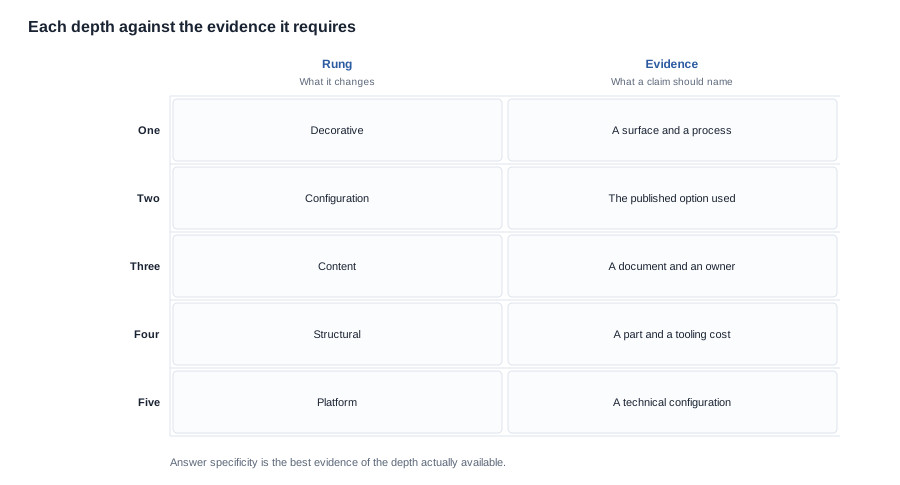
At depth four, the questions are engineering questions: what changes, what tooling or setup is involved, what is the lead time, what has to be re-qualified, and how does a repeat order guarantee the same result as the first. The structural facts published in this range constrain which models can plausibly be taken this deep — an ingress rating published on two models describes an enclosure treatment, a foldable case describes a mechanical feature with a wear path, and neither of those is a cosmetic property. Any depth-four proposal should state which published feature it modifies, and if it names none, the proposal is not yet specific enough to evaluate.
At depth five, the questions are about the product's technical basis rather than its appearance: its radio configuration, its documented behaviour, its software. The honest position here is that this range's published material does not support a depth-five discussion, because no model publishes a firmware row, an application row, a compatibility statement or a per-model certification row. That does not mean depth five is unavailable — it means you cannot evaluate it from published material, and any claim about it has to be assessed as a capability rather than as a documented option.
There is a specific discipline worth naming here, because it is the discipline the brief in this category most often violates: do not infer platform structure from shared specification rows. Two models publishing the same cell and the same endurance figure share a specification row, not a platform, and a claim built on that inference is a claim about a factory's internal architecture rather than about anything documented. The correct treatment is to state which rows are the same, to note explicitly that shared rows do not establish a shared platform, and to ask the question that actually needs answering.

How to evaluate which depth a supplier can actually reach
The evaluation is short, and it is worth doing before a quotation rather than after it.
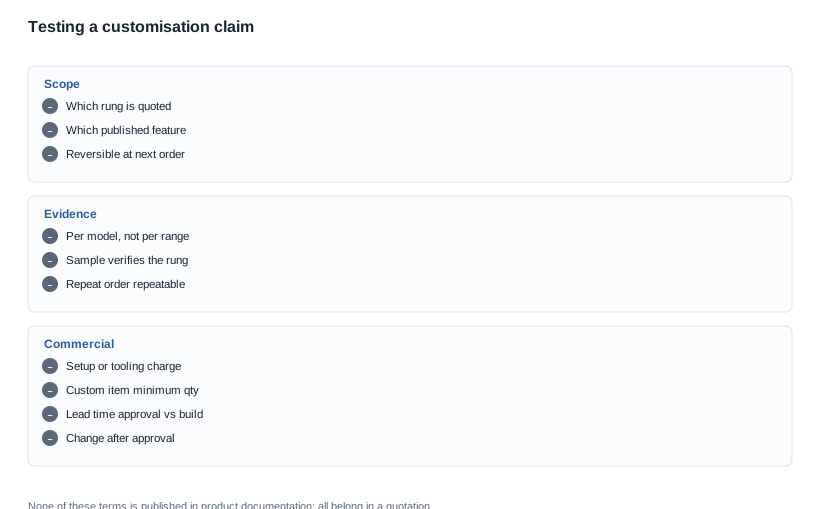
Ask which rung is being quoted. Name them explicitly — mark on a surface, configuration variant, content and packaging, physical feature change, platform change — and have the answer recorded. A supplier who cannot place the request on the ladder has not priced it, whatever the number says.
Ask what the change touches. A rung-three answer names documents. A rung-four answer names a part, a process and a tooling or setup implication. A rung-five answer names a technical configuration. The specificity of the answer is the best available evidence of the depth actually available.
Ask what is reversible. The reversal question is the discriminator: if the change can be withdrawn at the next order without tooling and without re-qualification, it is shallow; if it cannot, you are accepting a dependency. That dependency should be priced, dated and owned.
Ask what is not published, per model. The catalogue publishes product structure, so the customisation service list does not exist in the documentation and has to be requested. Where a supplier's answer covers the range but not a specific model, treat the range-level answer as context rather than as coverage.
Ask for the commercial terms in writing before the sample order: whether artwork or configuration changes carry a setup or tooling charge, what the minimum order quantity is for customised items, what a sample order costs, what the lead time is for approval versus production, and how a change after approval is handled and charged. None of these is published, and all of them belong in a quotation rather than in a conversation.
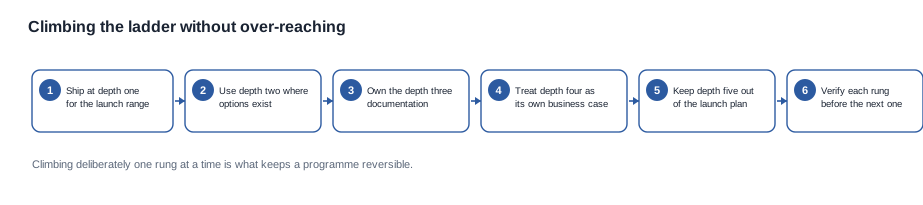
The pattern that recurs in successful programmes is that they climb the ladder deliberately, one rung at a time, with the previous rung fully verified before the next one is scoped. The pattern that recurs in unsuccessful ones is that a programme jumps to the rung its commercial model needs, and discovers the tooling and documentation exposure at the point where it is least reversible.
Shortlisting models against the depth you need
Before any supplier conversation is useful, the model list has to survive a filter, because customisation depth is constrained by which models are in scope and a programme built on the wrong base cannot be rescued by a good quotation.
The filter has three criteria, and they are applied in this order because each one eliminates a different kind of mistake. Differentiation — does the model carry a published feature that lets your programme be distinguishable? A model whose published rows are identical to another's, such as the two audio models that share every published specification row, fails this criterion outright. Configuration reach — does the model publish options that let you serve more than one configuration without a structural change? Two camera models publish colour options; five publish a case capacity; one publishes two variant names and two case capacities. Documentation reach — is there enough published structure to write an accurate customer-facing description without guessing? A model with no colour row, no case row and no feature rows gives a description almost nothing to work with, and a thin description is where support and compliance risk enter a programme.
Apply the filter before requesting quotations, not after. The cost of the wrong shortlist is not the time spent — it is the comparison you then conduct between quotations that answer different questions, because the models behind them support different depths.
Then run a second filter, which is a risk filter rather than a capability one. Which of your shortlisted models sits on an unresolved item? A model whose variant names have no published correspondence to its case capacities carries a data risk that is not obvious in a quotation and is certain to appear in fulfilment. A model with a foldable case carries a wear-path risk. A model with no charging-interface row carries a service-tooling risk. These do not disqualify a model, but each one belongs on the shortlist as a named risk with a mitigation, and a shortlist that carries unnamed risks will carry them into production.
The order of the two filters matters. Differentiation first, because a model that cannot be made distinctive in your channel will not be rescued by a deep customisation rung; reach and documentation second, because those determine what you can honestly describe and what you can safely commit to. Running them the other way round produces shortlists that are technically capable and commercially undifferentiated, which is the expensive kind.
Finally, evaluate the trade-off explicitly rather than defaulting to the deepest option. Depth one is reversible and nearly free but leaves your programme indistinguishable. Depth four is differentiating and expensive, carries tooling exposure and is not reversible at the next order. The commercially sound choice depends on how long you expect the programme to run and how much of its value depends on being distinguishable — and that is a question only your commercial model can answer. What the published material contributes is the constraint set that makes the answer honest.
Sequencing customisation against a product-line plan
The final planning question is how depth decisions relate to a wider range strategy, and the answer is that they should be decided per model rather than per programme.
A product line built on several models inherits the union of every model's constraints. If one model publishes a colour option and nine publish nothing, the line's colour story is the one model's story. If one model publishes two variant names with an unresolved correspondence, that ambiguity is inherited by every channel listing built from the line. The line-level description therefore needs to be written per configuration, and the work of doing that is set out in how to build a product line.
The sensible sequence for most programmes is: start at depth one for the launch range, because it is reversible and low-risk; use depth two where published configuration options already exist; reserve depth three for the packaging and content work that a launch requires anyway; and treat depth four as a deliberate programme with its own business case. Depth five belongs on a different plan entirely, and deciding that early prevents it from appearing as an unpriced dependency in a launch timeline.
Two programme controls sit underneath all of it. Sampling before bulk establishes whether the rung you paid for is the rung you received, and that discipline is covered in sample before bulk. Scaling requires the controls to be repeatable rather than personal, which is the subject of scaling up. And the model-selection question that precedes all of it — which models carry enough published structure to support a programme at all — is set out in which models are ready.
The honest summary position is that this range supports depth one comfortably, depth two with an evidence base you have to assemble, depth three with documentation work you have to own, and depth four only as a deliberate investment. Depth five cannot be evaluated from published material at all, and any claim about it should be assessed as a capability statement rather than as an option on a quotation.
One closing point belongs with that summary, because it changes how the whole conversation should be run. Customisation depth is a property of a model configuration and a supplier relationship, not of a product category, which means a statement about depth is only ever true for a specific model, at a specific date, against a specific quotation. Programmes that adopt a depth as a general capability — as a line in a supplier scorecard, or a claim in a channel conversation — will find the claim survives long after the configuration it described has changed. Keep the depth statement attached to the model, the configuration and the order it belongs to, and re-confirm it whenever the configuration changes. That single discipline is what separates a customisation programme that can be repeated from one that has to be renegotiated every time the range changes.
Related reading
- Customisation scope by category — AI camera glasses customization options
- Brand-side document — OEM ready platforms brand guidelines
- Programme sequencing — OEM ready platforms sample before bulk
- Model selection first — OEM ready platforms which models are ready
Tell us the models you have shortlisted, the levels of customisation your commercial model needs, and the markets you ship to, and we will tell you which rungs are reachable from published product structure, which have to be quoted, and which should stay out of the launch plan entirely.


