

Every supplier in this category will describe their hardware as OEM ready, and the phrase carries almost no information until somebody takes it apart. Two products sold with the same three words can sit an order of magnitude apart in the work a buyer has to do before the first sellable shipment leaves the building: one has a production configuration, a published electrical row and a settled branding surface, while the other is a prototype with a colour swatch and a label attached to it.
That gap is where procurement losses hide. A buyer who treats "OEM ready" as a finding rather than as a starting point commits to a programme with a unit price, a sample and a delivery date, and only discovers in month three that the sample was a generic unit, the colour was a mould that cannot be repeated in the required quantity, and the documentation covers a model designation nobody in the project has ever written down.
This article takes OEM ready apart into conditions you can test, and separates the conditions that are genuinely about readiness from the conditions that are usually presented as readiness. It is written for the buyer building a shortlist and having to defend it, not for the catalogue shopper.
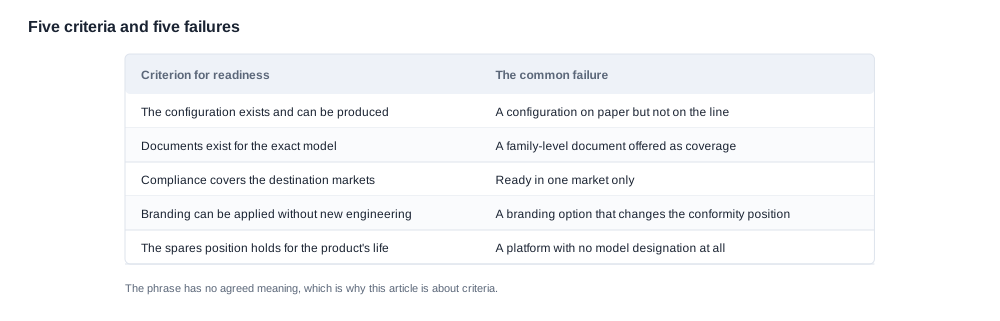
OEM ready platforms: what a brand actually receives
When a supplier uses the phrase honestly it is describing five separate things at once, and the buyer who separates them can negotiate each one on its own terms.
- A production configuration that already exists. Not a laboratory sample and not "we could do that". A configuration that sits on a production schedule with a bill of materials behind it, so the unit that arrives is the unit that was designed.
- A published electrical row. Cell configuration, charging method, interface, runtime, Bluetooth version, camera resolution and case capacity — the numbers a buyer uses to decide whether the product fits the use case and whether the product page can be written honestly.
- A branding surface that does not require engineering. A defined set of changes that can be applied without opening a development programme, and a set that is recorded per category rather than published as one list across the range. The question worth asking a supplier is therefore not what is generally possible but which lines its own record holds for the model you are buying.
- A documentation position, per destination market. What the supplier can actually show you, for which model, for which country, and what remains unstated.
- A supply position that survives the second order. Whether the configuration is still being produced when you reorder, and what happens to the spare parts and the firmware if it stops.
Our own published range is a fair illustration of why the first two items have to be held apart from the rest. The catalogue covers twenty-eight entries: eight audio models (D12 and LC-105-1, D11 and YK12, K02 and G07, and K01 and LC-105-2), three sport models (YKC02, D17, ZH12), eleven camera models (MT6 and L1 Pro, L2 Utral and V03 Pro, CY03 and CY05, MT5 and KY06, V03 and V06, and S7), three children's models (A05, A06, A07), and three further entries — AR glasses, an electrochromic model and a bone conduction model — that carry no model string at all.
Within those twenty-eight entries the completeness of the published rows varies enormously, and that variation is itself a readiness signal. Charging method is published for twenty-four of them, split seventeen magnetic and seven Type-C, with nothing published for L1 Pro and the CY03, and MT6 and CY05. The Bluetooth version appears for fourteen entries and for none of the eleven camera models, for A05 or A06, or for the bone conduction entry. Only five models publish a case capacity, and they do not publish it in the same order: the MT6 carries a 1200 mAh foldable case, the L2 Utral publishes 900 mAh or 1400 mAh, and the CY03 and L1 Pro, and CY05 each publish 1400 mAh. The KY06 and the MT5 have a case with no published capacity of any kind, the V06 and the S7, and the V03 have no case row at all, and the V03 Pro is explicitly listed without one.
None of that means those products are unavailable. It means that a buyer building a comparison table ends up with a table containing holes, and that the holes are a fact about how ready the product is rather than a failure of customer service.
The five items above do not stand alone, and the pairs that interact are the ones buyers most often miss. A published specification row without a documented configuration tells you about a family rather than a product. A branding surface without a documented configuration tells you what can be changed but not what is being changed. A supply position without a documentation position tells you the product will exist for three years but not what it is permitted to be sold as, which is a risk that only surfaces at the point of entry into a market rather than at the point of purchase of a factory slot. The useful discipline is to treat any two of the five as incomplete on their own and to require all five before the phrase means anything.
There is also a naming layer underneath all five, and it is more than pedantry. Three entries in our range — AR glasses, the electrochromic model and the bone conduction model — carry no model designation at all, and one of the camera entries carries the designation "L2 Utral" and is described with a further variant designation whose meaning we do not publish. A model designation is the key that every downstream document uses: it is what a test report names, what a declaration of conformity names, what a build sheet carries and what a warranty claim is resolved against. A product without a designation cannot be covered by a model-specific document, and a designation you have paraphrased cannot be matched against one. Ask for the exact string, in writing, and check that the string on the box, on the unit and on the documentation is the same string.
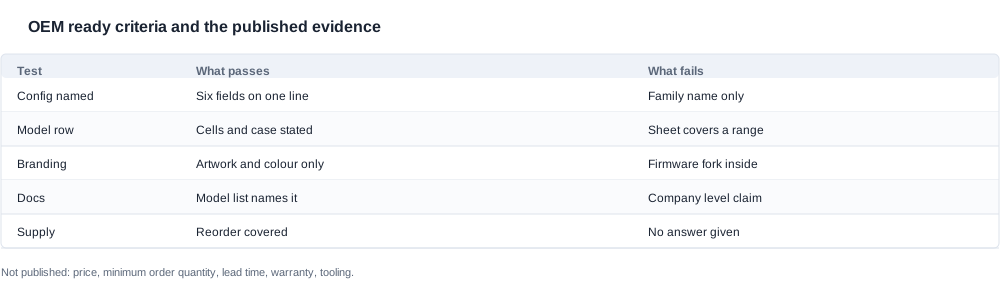
The five tests that separate an OEM ready platform
The word "ready" gets used for at least five different conditions in this market, and they are worth pulling apart because a supplier can satisfy one and fail the others completely.
Test one — can the configuration be named exactly? A configuration is one specific combination, and it has to be written out in full: which model, which cell, how it charges, which interface, whether a case is fitted, and which colour. If the supplier cannot write those six down as a single line, the configuration does not exist as a product yet. A family name is not a configuration. A model designation on its own is not a configuration, because the charging method and the case option are separate choices that change the unit you receive. Our range makes the point concretely: the L2 Utral publishes two case capacities, 900 mAh and 1400 mAh, which are two different products sharing one name, and the catalogue lists it under the designation "L2 Utral", a string a buyer should have confirmed in writing before it appears on packaging.
Test two — does the specification row exist for the configuration you intend to buy? Not for the family. For the exact unit. The published rows in this category are patchy in ways that are easy to miss: all eleven camera models publish a runtime, and the figure is roughly five to eight hours, on cells sitting between 220 mAh and 290 mAh, with no test condition stated; a charge time of two hours or less is published for twenty-six models, with about one hour published only by the D17 and ZH12; resolution arrives in two published figures, 8 MP across eight models, with 13 MP on the L1 Pro and the L2 Utral, and the S7; and the MT6 is the only model that publishes a weight at all — 158 g for the glasses alone, with its 1200 mAh foldable case excluded. A buyer can use every one of those rows. A buyer cannot use a row that is not there, and a supplier who offers a family-level sheet when you asked for a model-level sheet has answered a different question.
Worked across two of our own models, this distinction changes what you can write. The V06 publishes an IP54 ingress marking and four colour options, so a buyer can state a protection position and offer a colour range for that exact model. The V03 Pro publishes photochromic lenses with three colour options and explicitly has no charging case. Neither product is limited by the other, and neither limitation is a fault — but a catalogue excerpt that merges the two families will produce a product page claiming a case that does not exist for one model and a protection rating that does not exist for the other. Published rows are model-specific, and the discipline that saves a launch is checking each claim against the row that names the model the customer will be holding.
Test three — is the branding surface defined without engineering? The question is not whether branding is possible. It is whether your branding can be applied inside a standard programme, without a development contract, without a firmware fork and without a re-certification conversation. The published record answers that per category rather than in one list across the range. The camera tier holds seven recorded axes, the sport tier holds five, the photochromic entry holds three, and the children's tier holds two, with two further capabilities in that entry marked as awaiting verification, and the bone conduction entry lists nothing at all, so its customisation capability is entirely undisclosed. What the record gives you is the count and the status of each line rather than the lines themselves, so the count is the number to carry into a supplier conversation and the content of each line is the question to ask. That record is a useful pre-filter: it tells you which of your five branding ideas are inside the standard programme and which two are a development conversation you have not priced yet. The branding options discussion sets out the same ground in more detail, and the customisation overview separates the four layers of change.
Test four — does the documentation position exist for each destination? This is where most "OEM ready" claims collapse, and it deserves precision because suppliers are often not being evasive. Nothing in our catalogue body names CE, FCC, RoHS, the Radio Equipment Directive or EN 18031, and there is no per-model certification row either. The export-certification page in our own documentation is an image-only page carrying ten patent certificate images — eight of which are designs and two of which are utility models — with no per-model certification table behind it. So the honest position is not "our models are certified" and not "our models are not certified" — it is that we publish no per-model certification row, and a buyer has to establish the documentation position for their own configuration and their own markets before they can rely on it. A platform that is documented for one market is not documented for the rest, and the frameworks differ.
Test five — does the supply position survive the second order? A platform that is discontinued in eighteen months is not a platform for a two-year retail programme, and the evidence for this is usually not the supplier's answer but the shape of the question: is there a production schedule, is there a reorder policy, is there a spare-parts commitment, and what happens to your firmware if the platform stops. The lifecycle support commitments discussion covers the kind of commitment worth having in writing, and it is worth reading before the first order rather than after the second one is refused.


Testing an OEM ready claim before the order is placed
The five tests above are a due diligence sequence, and running it in order saves money because the cheapest questions come first. The order below is deliberate: each step either confirms the previous one or invalidates it.
- Write the requirement set before you contact anyone. Model family, tier, cell and runtime expectation, charging method, case requirement, destination markets, target quantity, and the branding you intend to apply. A requirement set written after a supplier's catalogue has already narrowed your thinking is a requirement set shaped by the answer.
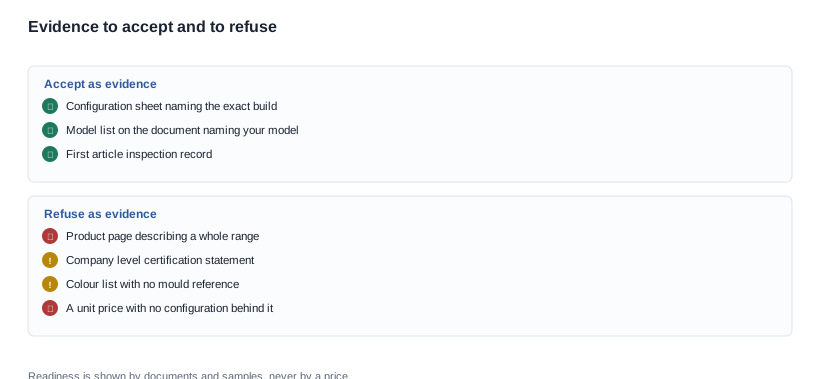
- Ask for the configuration sheet, not the product page. The sheet states what will be built. The page describes a range. The difference is the difference between a document you can file and a document you can quote.
- Ask which model designations the documentation names. Not whether certification exists — which designations it covers. A document naming six models is not documentation for a seventh.
- Ask for the not-published list for your configuration. Ask explicitly: "which of the parameters you would normally publish are not published for this model?" A supplier who answers this question well has told you exactly where your product page will run out of facts. It is a cheap question and it changes what your launch copy can say.
- Order a sample against the written request, and check it on arrival against the request. The sample is the only item that converts an assertion into a physical fact, and it is worth more before the order than after.
- Only then ask for the commercial terms. Unit price, minimum order quantity, lead time, warranty, tooling and non-recurring engineering costs each move with the configuration, the volume, the documentation scope and the schedule as it stands. None of them are published here, and they should not be quoted before steps one to five are settled, because each of them changes the answer to the previous ones.
The trade-off at every step is time against certainty, and the trade-off is asymmetric in a way that matters. A week spent confirming a configuration before ordering routinely saves a month spent re-opening a specification after production has started, because by then the decision has a tooling cost attached to it. Buyers under schedule pressure usually cut the confirmation step, and the confirmation step is where the schedule is actually determined.
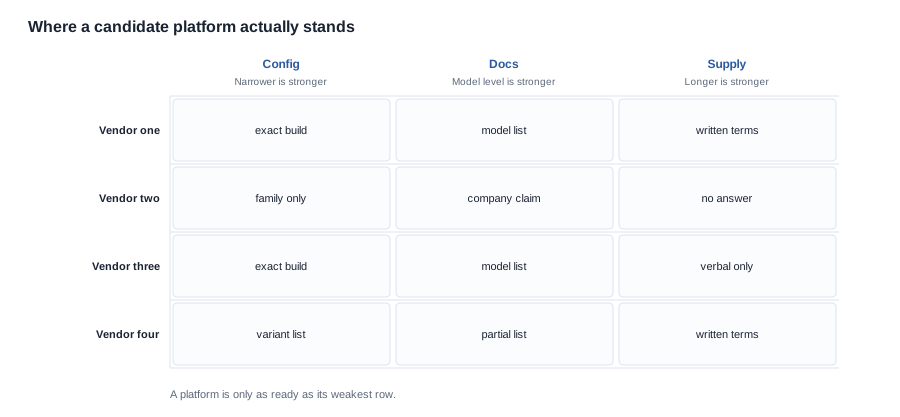
Scoring the responses is more useful than reading them. A simple three-column sheet — the five tests, the evidence supplied, and the gap — turns a conversation into a comparable record, and it makes the shortlist defensible later rather than merely intuitive. Most importantly it separates the two kinds of gap. A documentation gap is usually recoverable: the document exists, it simply has not been requested, and a supplier who produces it on request has answered the question properly. A performance gap is usually not recoverable, because the performance layer is what the platform is. If your product proposition depends on a figure the supplier does not publish — a field of view, an acoustic measurement, a frame weight, a runtime under a stated condition — then no amount of commercial effort will produce a page you can defend, and the honest answer is to change the proposition or change the supplier.
Evidence that does not make a platform OEM ready
Five things turn up regularly in supplier responses and are worth refusing explicitly, because each one feels like evidence and is not.
A product page. A page describes a product for a shopper. It is not a production slot, a bill of materials or a document. A page can describe a configuration that is discontinued, or one that exists only as an engineering sample.
A colour list. A colour within an existing mould is a finish decision, not a proof that the configuration is in production. It is useful for narrowing a shortlist and useless for proving readiness. Two models in our range publish a colour list at all: the V03 Pro in three options, and the V06 in four.
A general certification statement. "CE, FCC and RoHS" without model coverage is a statement about the company, not about your configuration, and it does not tell you which document supports which model. Given that our own catalogue publishes no per-model certification row, we would rather be judged on that basis than by a claim that is harder to verify than the row we publish.
A price. A price for a specific configuration is mild evidence that it can be produced. A price for a range is evidence of nothing, and it is the number a buyer is most inclined to treat as a commitment.
The phrase itself. "We are OEM ready" and "we support OEM" and "custom branding available" are marketing formulations with no agreed meaning. They are worth noting as an opening position and worth nothing as a conclusion.
What an OEM ready platform commits the buyer to
An OEM ready platform is not free. It is a trade, and the trade has a shape worth pricing before you commit to it.
What you gain is speed and reduced risk on the surface: artwork, colour, packaging and the Bluetooth name can be applied without a development programme, which removes the largest single non-recurring engineering exposure from a first order. What you accept is a fixed performance layer — the sensor, the field of view, the acoustic behaviour, the frame geometry, the cell configuration — which is where the published specification in this category is thinnest and where a brand's product claims will eventually be tested by a customer.
What it costs is money and it is not published. Minimum order quantity, production lead time, unit price, sample fees, warranty terms, tooling costs and non-recurring engineering charges are all confirmed per enquiry — every one of them is set by the configuration, the volume, the documentation scope and the schedule as it stands. We do not print a number we cannot defend, and a buyer comparing two platforms should be suspicious of any comparison that reduces to unit price alone. The comparison that counts is the total cash committed before the first sellable shipment leaves, covering the branding work, the packaging setup and any first-article approval, because the tooling and setup costs are largely fixed and they hit a first order disproportionately hard.
The shortlist criteria that follow from all of this are worth writing down before the first supplier call. A defensible shortlist scores each candidate against five things: whether the configuration can be named exactly, whether the model-level specification row exists, whether the required branding sits inside the standard scope, whether the documentation position for the destination markets is stated in writing, and whether the supply and spares position covers the reorder window you are planning for. A candidate that fails on documentation can often be rescued; a candidate that fails on the performance layer usually cannot, and that is the difference worth knowing before you spend time on it.
The last thing to test, once the shortlist has narrowed, is the golden sample. One unit, built to the written request, approved and then physically retained as the reference against which production units are compared. In this category that reference is worth more than it looks, because so many of the published rows are ranges or ceilings rather than exact figures: a charge time of two hours or less is published for twenty-six models, camera runtimes sit between roughly five and eight hours with no stated test condition, and the only published weight in the entire catalogue is the MT6 at 158 g. When the specification is a ceiling rather than a figure, the approved sample is what turns the ceiling into something you can write on a product page.
That last point generalises into the reason OEM ready platforms are still worth the trade-off. A platform buys you a settled performance layer, and a settled performance layer is exactly what a small brand cannot build. It cannot afford the engineering, the test infrastructure or the acoustic work required to characterise a product from scratch, and it will not be able to publish a defensible weight or a defensible runtime unless somebody else has done the characterisation and will stand behind the number. The trade is not readiness for money; it is a slower, thinner performance claim in exchange for a faster, cheaper launch. Buyers who want both should stop looking for a platform that makes no promises about performance and start looking for one whose performance promises are published, bounded and attributable to a model.
We publish the configurations, the electrical rows, the interfaces, the case capacities, the Bluetooth versions, the camera resolution tiers and the colour options we hold, and we mark everything else as not published — including every price, minimum order quantity and lead time. We will tell you which of the five tests a given model passes and which it does not, including where our own published position is thin, and we will not describe a model as documented for a market when the model list on the document does not name it. Readiness is demonstrated with documents and samples. It is not demonstrated with a price.
Send your requirement set and your target markets and we will tell you which criteria the matching models meet.
Related reading
- Smart Glasses OEM ready platforms
- OEM ready platforms and branding options
- Customisation options overview
- Lifecycle support commitments
Send your requirement set and target markets and we will tell you which criteria the matching models meet.


