

OEM ready smart glasses platforms are the route a brand takes when it wants a smart glasses product without commissioning one from scratch, and the branding options are what make that route worth taking. The question a buyer has to answer is how much of the product is theirs afterwards, because a platform carrying a logo and a platform carrying a logo area are very different commercial objects. Three different answers hide inside the word "branding", and the difference between them is the difference between a setup charge, a tooling programme and a documentation rewrite.
This article takes branding apart into the three places a mark can live, sets each of them against what our catalogue actually publishes, and converts the result into a set of questions that belong in a quotation rather than in an email. Nothing here is a commitment, because the commercial rows on this category — unit price, order floor, setup charge, schedule — are properties of your order rather than of the product, and publishing them out of context produces a number nobody can plan against.
The decision in front of a buyer is not which mark to print. It is which layer of the product the brand is taking ownership of, and the criteria that should settle that question before a sample order or a tooling commitment is agreed.
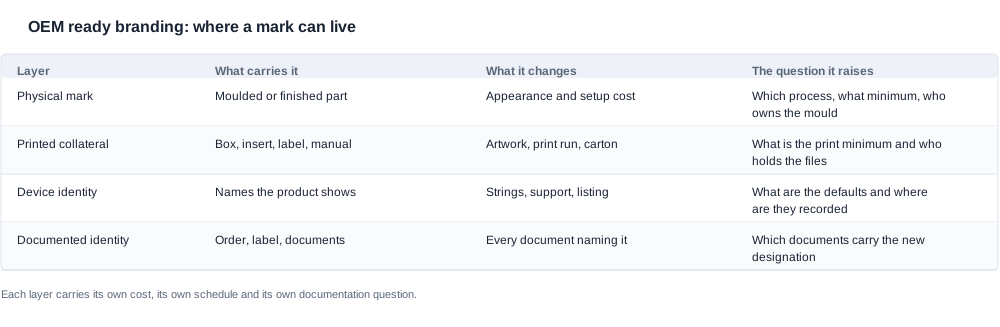
OEM ready branding: what a brand actually takes ownership of
Ownership of a branded product is not one thing. It is three, and they carry different costs, different schedules and different documentation consequences. Buyers routinely conflate them because a single word — branding — appears on the proposal, and the proposal then quotes a single setup charge against a single date. A buyer who wants a defensible answer should evaluate the three layers separately, because the criteria for accepting a physical mark and the criteria for accepting a device identity are not the same, and a single combined answer hides whichever layer is hardest.
The physical mark. A mark applied to a moulded or finished part: the temple, the case shell, a printed label, the box artwork. Ownership here is a manufacturing question. It asks whether the mark is applied in a step that already exists, whether the process needs its own fixture or plate, whether the appearance survives the wear pattern of the product, and whether the mould that carries it stays the buyer's property at the end of the relationship. The cost of a physical mark is a setup, and the setup is the part of the commercial terms that most often gets left unwritten.
The descriptive layer. The names and strings that appear when the product identifies itself: the Bluetooth device name, the name shown in a companion application, the name printed on the shipping carton, the model designation a distributor files under. This layer carries no tooling in the ordinary sense and no material change, but it is not free either, because a device name is a string that has to be set, versioned, and kept consistent across a production batch and across the packaging artwork. A brand that has decided the product should announce the brand rather than the platform is making a decision here.
The documentable identity. The designation that the paperwork carries: the model string on the order, the model list on any conformity document, the designation that appears on the label and in the channel listing and on the shipping paperwork. This is the layer that determines whether the product you sampled is the product that is shipped, and whether the documentation that arrives covers the goods in the carton. It is also the layer that is least visible in a product sample and most visible in a customs or regulatory inspection.
A fourth element sits alongside these three and is easy to mistake for one of them: the claim layer. The things a brand says about the product — the resolution, the runtime, the ingress marking, the certification position — are not branding, but rebranding interacts with them, and that interaction is where a branding programme quietly becomes a compliance programme. The last section of this article deals with exactly that.
The first question to ask when comparing a platform against a full programme is which of the three layers the proposed change actually reaches. That single answer removes most of the ambiguity from a supplier proposal, and it is also the answer that determines when to bring the legal and compliance work into the conversation rather than after the artwork is approved.
The useful consequence of the three-layer split is a diagnostic. When a supplier describes a branding option, the first question is which of the three layers it touches. A mark on the temple is a manufacturing line item. A device name is a configuration line item. A model designation is a documentation line item, and it is the one with the longest tail, because it propagates into every document that names the product for the rest of the programme.
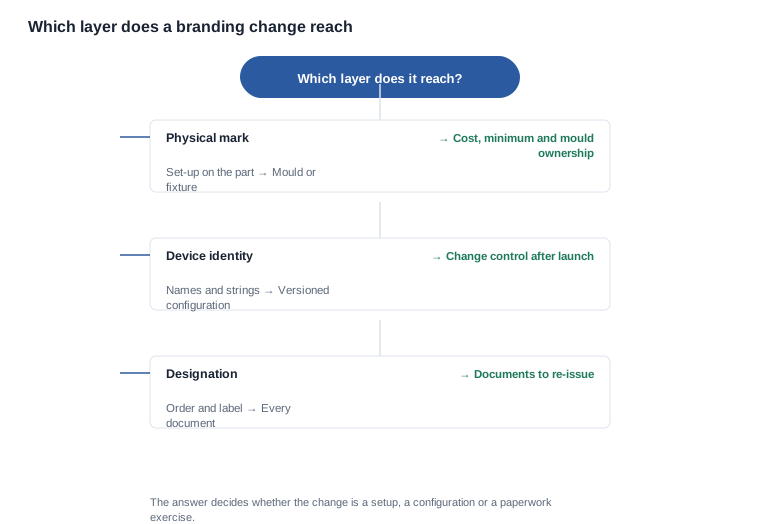
There is a practical test that separates the layers in about two minutes. Ask the supplier to name the artefact that carries the change: a mould, a template, a firmware string, or a document. If the answer is a mould, the change is physical and the ownership terms of the mould matter. If the answer is a template or a print file, it is a supply and setup question. If the answer is a firmware string or a configuration file, it is a change-control question, and someone has to own it after launch. If the answer is a document, then the model designation has moved, and everything that names the product has to move with it.

The three places a mark can live
On the product itself
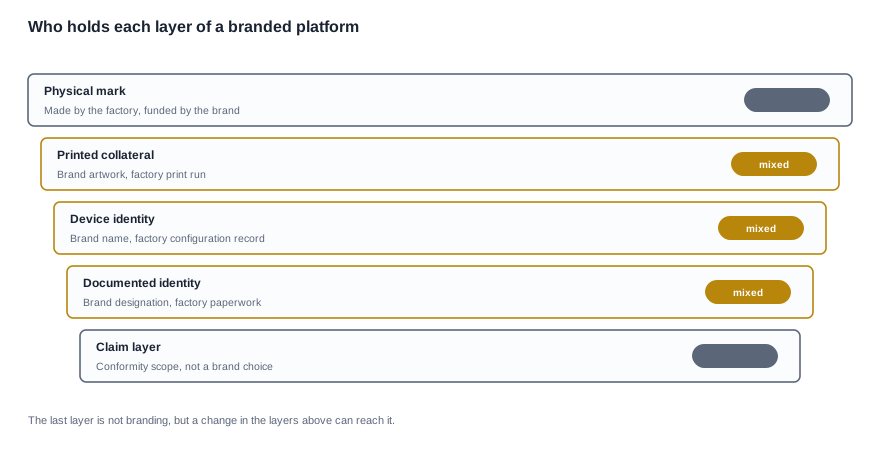
A mark on the product is the most visible form of ownership and the one with the longest mechanical life. It is also the one where a buyer has the least leverage after the first order, because once the mark is on the part, the part is specific and the platform's flexibility has been spent.
The catalogue constrains what can be reached here. Colour is the clearest published constraint: among the camera entries, exactly two carry a published colour row — the V03 Pro with three options and the V06 with four. Every other entry in the range publishes no colour list at all, which means a brand that has assumed a particular colourway is available across a range has assumed something the catalogue does not support. Two entries in a catalogue of twenty-eight is not a limitation to work around so much as a shortlist to build around.
The ingress marking is published on only two entries as well, the V06 and the S7, and that marking is a catalogue annotation without a third-party report number behind it. A brand whose marketing plan leans on a waterproof claim is therefore leaning on a marking that has to be evidenced separately, and the question of which report supports it is a question for the supplier rather than a row to copy.
The mechanical questions a buyer should put to the supplier about a physical mark are a fixed list, and they belong in the commercial section of the quotation: whether a separate charge applies for the marking setup, what the minimum order quantity is for that marking as opposed to the product itself, which application process is proposed and why, whether the mark is applied to the mould or after it, who owns the mould and any fixture at the end of the programme, and what the mark looks like on a production unit rather than on a sample.
On the packaging and the printed collateral
Packaging is where a brand's ownership looks most complete and costs least in engineering terms, which is why it is where buyers often start. It is also where the recurring cost sits. Artwork preparation is per language and per market, print runs have their own minimum, and insert changes propagate into the shipping carton, the carton count, the pallet configuration and the shipping paperwork.
The packaging decision interacts with the documentation layer more often than buyers expect. A proprietary carton changes the carton specification, which changes the freight calculation, which changes the unit landed cost that the business case was built on. A proprietary insert changes what is in the box, which changes the published specification, which changes what the product page says and what the distributor files. A change that starts as artwork ends as a specification change if the buyer does not check the direction of travel.
The packaging questions worth writing down are short: whether the packaging is bespoke or a standard carton with an insert, what the print minimum is and whether it differs from the product minimum, who owns the artwork files and the print plates, how many languages are required at launch, and what changes to the accessory list when the packaging changes. All of these belong in the commercial rows of the quotation, and none of them can be answered from a catalogue page.
In the software and the device identity
The third layer is the one with no visual impact on the product and the largest effect on the document set. The strings a platform puts into the world — the Bluetooth device name, the pairing prompt, the application name, the firmware identifier — determine what a customer sees on a phone, what appears in a support ticket, what a distributor lists, and in some cases what a regulatory document is written against.
The catalogue is conspicuously silent here, and the silence is uniform. No touch-control row appears anywhere in the range, and no translation row appears anywhere either. Every audio entry publishes a Bluetooth version while no camera entry publishes one at all, which is a useful structural fact for a buyer reasoning about what the platform documents and what it leaves open. The practical consequence is that the software and identity layer cannot be evaluated from published material at all, and has to be handled as an enquiry.
That enquiry should ask for four things: what the default device name is on each model, whether the name is set at the factory or by the buyer, whether the change is recorded as a versioned configuration rather than as a one-off adjustment, and what the change-control rule is once units are in the field. A branding decision made in the first month and not documented in the configuration record becomes a support incident in the sixth, and the cost of that is not the string, it is the batch that has to be recalled or relabelled.

What the catalogue records about each one
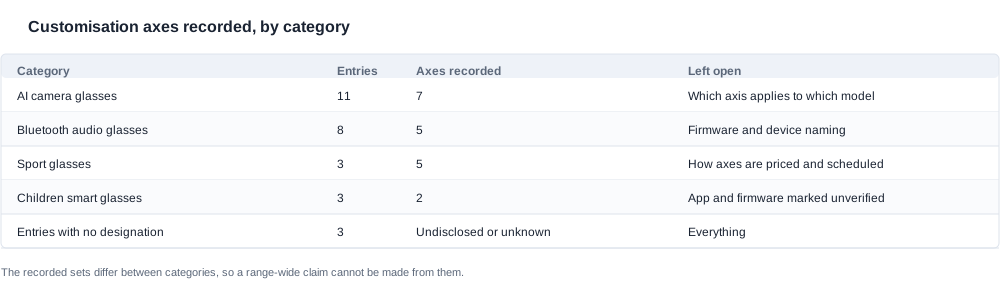
The product record behind these platforms is more useful than it first appears, and less complete than a platform proposal usually implies. It is organised by category rather than by model, and that distinction decides which questions a buyer can answer on paper.
| Category | Entries | Customisation axes recorded | What the record does not settle |
|---|---|---|---|
| AI camera glasses | 11 | 7 axes recorded | Which axes apply to which model |
| Bluetooth audio glasses | 8 | 5 axes recorded | Branding on firmware and on the device name |
| Sport glasses | 3 | 5 axes recorded | How the axes are priced or scheduled |
| Children smart glasses | 3 | 2 axes recorded | App and firmware work is marked to be verified |
| Electrochromic entry | no model designation | 3 axes recorded | Which entry would be built |
| Bone conduction entry | no model designation | not disclosed | Customisation capability at all |
| AR entry | no model designation | not published | Customisation capability at all |
Two findings in that table matter more than the numbers in it. First, the recorded sets are not subsets of one another. The three principal categories carry different recorded axes, and the sport group records a set that shares nothing with the camera group. A statement of the form "the platform is customisable across the range" is therefore not a usable statement, because what is customisable in one category is not necessarily customisable in the next. Second, the two categories a buyer cannot evaluate at all are the two with no model designation, and one of them records nothing. In those three entries the honest position is that the record is silent, and a silent record is a question to the supplier rather than an absence of capability.
The trade-off a buyer has to make with that record is therefore a choice about effort, not about capability. A category with seven recorded axes and eleven model designations supports a paper shortlist; a category with two recorded axes and no designation supports a conversation. Both can produce a product. Only one can produce a product on a date the buyer believes.
The rest of the catalogue constrains the branding decision in ways that are easy to miss.
Twenty-eight entries sit in seven categories, twenty-five of them carrying a model designation and three published without one. The camera group splits on resolution into eight entries at 8 MP and three at 13 MP, and the audio group publishes a Bluetooth version across all eight of its entries while the camera group publishes none. The charging case appears with a capacity on five camera entries, appears without a figure on two, and is absent as a row from four, so a brand promising a case of a known capacity is working with a short list rather than a range-wide feature. Colour options are published on two entries. A weight figure is published on one, the 158 g MT6 glasses figure, which excludes its folding case, so the shipping weight of that entry is a separate number that has to be derived rather than read. No entry in the range carries a published product photograph, a video or a test report, so every visual and evidential asset in a branding programme has to be produced separately rather than sourced from the catalogue.
For a buyer, that last point is the one with the largest commercial consequence. A platform route is often chosen because it is assumed to be a fast route to a finished branded product. The catalogue rows support the product decision. They do not supply the photography, the listing imagery, the manual artwork, the packaging files or the test evidence, and every one of those is a cost and a date that appears on the critical path of a launch.

Questions that put branding into a quotation
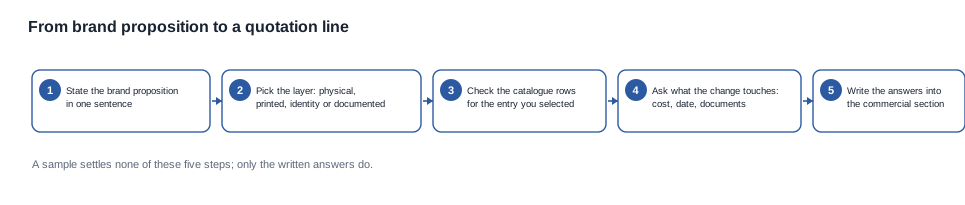
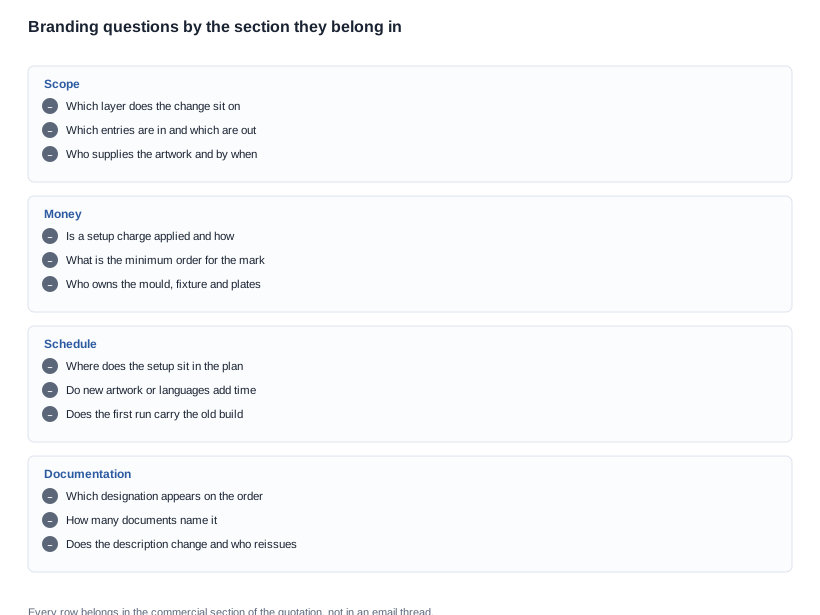
The following set is written so that each answer can be entered into a commercial document rather than left in a message thread. They are the questions to ask before you order, because a sample cannot settle any of them, and because a due diligence review that finds them unanswered is a review that finds them unanswered late.
On the scope of the branding itself. Which layer does the change sit on — the physical mark, the printed collateral, the device identity, or the model designation? Which models does it apply to, and which entries in the range are excluded? Is the artwork supplied by the buyer, and in what format and by what deadline?
On the money. Is a separate charge applied for the marking setup, and is it per model or per order? What is the minimum order quantity for the branded configuration, and does it differ from the minimum for the plain product? Which application process is proposed for the physical mark, and what does the choice do to the appearance on a production unit? Who owns the mould, any fixture and any print plate, and what happens to them when the relationship ends?
On the date. How long does the marking setup take, and does it sit before or after the first production run? Do new packaging artwork and new artwork for other languages extend the schedule, and by how much? If the firmware or device name is changing, when does the change enter the build, and does the first production run carry the old configuration or the new one?
On the documentation. What designation will the product carry on the order, the label, the carton and the paperwork? Which documents name that designation, and how many of them exist for this configuration? Does the change to the model designation or to the product description require the documentation to be re-issued, and who bears that work?
On the record. Where is the change recorded so that the next production batch reproduces it? What is the change-control rule once units are in the field, and who approves a change?
The last group is the one most often skipped and the one that protects the buyer longest. A branding decision that is not written into a versioned configuration record will be reproduced approximately rather than exactly, and approximate reproduction is what turns a small marking question into a batch discrepancy. If a supplier cannot say where the brand mark is recorded for a production batch, that is a finding about the platform rather than about the brand, and it is worth pricing as one.
Three answers are worth treating as red flags on their own. A setup charge quoted without a minimum order quantity attached to it is a charge that will move. A model designation proposed without the documents that have to carry it is a designation that will not match the carton. And a promise that a branding change does not affect the documentation is a promise made by someone who has not seen the configuration that will ship.
What branding changes in the documentation
A certification claim has to be re-established for the new brand, the new model string and the new market. That sentence is the practical reason branding is a documentation topic, and it is worth unpacking because the sequence in which buyers discover it is almost always the wrong one.
The catalogue's export certification page is a single page of certificate images — ten of them, eight appearance-design patents and two utility-model patents — sitting above the product pages rather than beside them. No entry in the catalogue carries a conformity statement of its own, and the catalogue text names none of the regulatory marks that a buyer will ask about. There is no per-model certification row anywhere in the range. That means the buyer has no published baseline to inherit and no published baseline to lose, and the only honest position is that the applicable scope for a given model in a given market is written material to request and file before the order.
The practical sequence, then, is this. A physical mark on the temple changes what the product looks like and usually nothing about what it is, so the documentation is usually unaffected. A change to the device identity or the companion application can change how the product presents itself, and whether it touches the technical description depends on the product rather than on the brand. A change to the model designation changes the string that every document has to carry, and a change to the lens or the optical configuration can change the technical description itself. The safe procedure is to fix the exact configuration — model string, colourway, case, accessories, packaging level and destination market — and then request the scope for that configuration, in writing, before the order rather than after it.
Two published facts make the request easier to frame. The ingress marking appears on two entries only, the V06 and the S7, and it is a catalogue annotation without a third-party report number behind it, so any brand relying on it is relying on material that has to be requested. The children's entries record their certification position as entirely not provided, which means that range is not a question of extending an inherited file but of building one, and that cost belongs in the commercial rows rather than in the schedule of a launch plan.
What we will do with any of this is place a proposed change against the layer it actually touches, tell you what it does to the cost, the schedule and the documentation, and state plainly where the entry you have chosen differs from the range as a whole. Unit prices, minimum order quantities, setup charges and production lead times are not published on this site and are settled per enquiry, because each of them depends on configuration, quantity, branding scope and the state of the current schedule. Send us the brand proposition, the target market, the volume and the configuration, and we will tell you which branding level fits and what it changes.
The total cost of a branding programme is the sum of the marking setup, the artwork and print commitment, the documentation work and the schedule risk, and it is the sum rather than the setup figure that belongs in the business case. How to choose between two platform routes on this basis is a shortlist exercise, and the shortlist is much smaller once the three layers have been separated.
Related reading
- The platform range and the rows that separate models
- The customisation options behind these entries
- What a change costs downstream
- What a change does to the document set
- Tooling ownership and the end of the programme
Send the brand proposition, the target market, the volume and the configuration, and we will tell you which branding level fits an OEM ready platform and what it changes.


