

Open ear audio glasses look like a simple product — no camera, no display, a pair of speakers and a Bluetooth radio — and the certification scope is correspondingly narrow. That makes it a good place to understand the framework, because the same structure applies to the more complex models in the range with additional rows rather than a different approach.
Since open ear audio glasses smart glasses certification requirements are common to all radio products, the pattern below applies to our audio models and, with more rows, to the camera models as well.
The practical value of reading this in a narrow category is that every row below can be checked against a real document before it is relied on, and a buyer who has done it once on a simple product can repeat it on a complicated one without relearning the structure. The disciplines are: name the market, establish what applies there, collect the evidence, and then check the evidence rather than accepting it.
Open ear audio glasses: what the directive covers
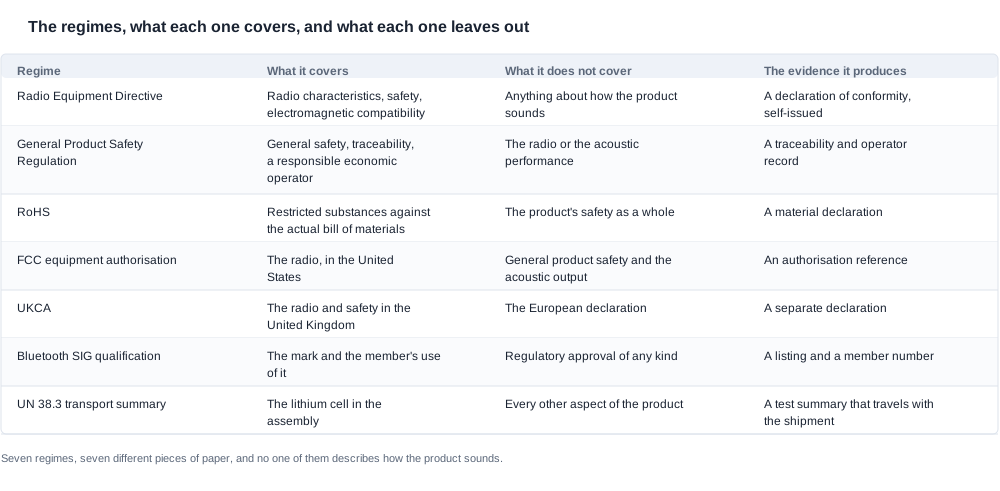
The Radio Equipment Directive is the central instrument. It covers radio characteristics, essential health and safety requirements, and electromagnetic compatibility as one framework for any product containing a radio. Open ear audio glasses with Bluetooth sit squarely inside it.
The scope of a Bluetooth audio product under that framework is narrower than the scope of a camera product, and the narrowing is worth understanding because it is what makes the audio range a good place to learn the process. There is no radio-transmitting function beyond the Bluetooth link, there is no camera, and there is no display. What remains is the radio, the electrical safety of the product, the electromagnetic behaviour of the radio, and the restricted-substance position of the bill of materials. A camera model adds a radio configuration question, a storage question and often a privacy-marketing question on top of the same four.
That narrowing has a commercial consequence, which is that the audio models in this family are the cheapest thing in the catalogue to make compliant in and the easiest to re-qualify. When a brand needs a second market opened quickly, or a colour variant approved under a new private label, the audio models are where the documentation effort is smallest — provided the file is maintained rather than assumed.
What the camera models add to the same file
The camera models in the same catalogue sit under the same radio framework, and they add rows rather than a different structure, which is why the audio range is a sensible place to learn the process. Three additions matter for a buyer moving from one to the other.
A radio configuration question. The audio models publish a Bluetooth version, so their radio is a single well-defined configuration. The camera models in our catalogue do not publish a Bluetooth version at all, which means their radio configuration has to be established and named before the file can be assessed, and any change to it is a change to the file. A buyer moving a camera model between a brand label and a private label has to establish that version first, because every other row is downstream of it.
A configuration-variant question. Several camera models publish an adjustable or interchangeable element — the V03 Pro publishes a flexible temple and photochromic lenses with three published colours, and the V06 and the S7 publish a detachable inner frame, with the V06 publishing four colours. Every one of those is a variant, and a variant is a line in the model list. A file that covers the base model and not the variants is a file for a product that does not exist in the channel.
A sealing question where one is published. Only the V06 and the S7 publish an ingress marking, and the marking attaches to the product as built rather than to the family. That is the row most likely to be quoted on a listing page and least likely to have been checked against the specific variant being shipped.
What the framework does not do is tell you anything about how the product performs acoustically. This is the point that trips people up more often than any other in this category, so it is worth stating plainly: a complete, current, correctly-mapped conformity file for an open-ear audio product is still a document set that contains no statement about output level, leakage, microphone performance or comfort. A buyer who believes a compliance file is a product evaluation will read the certification status as a quality signal, and it is not one.

Why a CE marking carries no certificate number
CE marking is a self-declaration. This point is worth its own section because it changes what a buyer can ask for. There is no CE certificate number, because no authority issues one. The document is the manufacturer's Declaration of Conformity, which must name the specific model, identify the directives applied, and be signed.
A supplier who offers you a "CE certificate" is offering you something that is not the document that matters, though they may also hold it — an EU-type certificate from a notified body is a real instrument, but it is used in a limited set of cases and it is not the evidence for a self-declared marking. The practical consequence for a buyer is that the request has to be phrased correctly. Ask for the signed Declaration of Conformity naming the model, and ask which directives the manufacturer has applied. A supplier who can produce that document quickly is a supplier with the file in order; a supplier who has to go looking for a "CE certificate" is telling you the file exists somewhere else.
There is a related discipline here that costs nothing and catches a lot. The declaration should name the model, and the model on the declaration should be the model that will appear on your box artwork. A declaration that names a series rather than a configuration is a real document for a different product, and the difference is invisible unless somebody compares the strings. The private-label version of the same problem is a branding change that touches the enclosure and moves the product out of the existing file, which is the difference between a project and a programme.

The regimes beyond the European Union, and what each one leaves out
The General Product Safety Regulation adds general safety obligations, traceability requirements, and a named responsible economic operator. For an overseas manufacturer selling into the European Union, that last point is a real operational question and not a formality: somebody has to be named, and somebody has to be able to answer for it.
RoHS covers restricted substances, and the declaration has to correspond to the actual bill of materials rather than to a generic statement. In practice this means the declaration follows the product, so a change of a component supplier can invalidate it, and the buyer who has a private-label programme needs to know which changes trigger a re-issue.
United States. FCC equipment authorisation covers the radio. It does not cover general product safety, and it says nothing about the acoustic output of the product. The second half of that sentence matters for a brand that has one product file and a habit of reusing it.
United Kingdom. UKCA is a separate marking following the transition away from CE recognition, with its own declaration and its own radio requirements. Buyers who assume UKCA is a formality are usually right that it mirrors the European declaration, and occasionally wrong when it comes to the specifics.
Bluetooth. If the product uses the Bluetooth mark, qualification with the Bluetooth SIG is a separate matter from regulatory approval, and the two are frequently conflated. A product can be fully compliant and unlicensed, or licensed and non-compliant.
Battery transport. Applies regardless of destination. Lithium cells require a UN 38.3 test summary when shipped, and carriers check for it.
Bluetooth qualification is not regulatory approval
The Bluetooth point deserves expanding because it is the most common conflation in this category and because it has a specific commercial consequence.
Regulatory approval and Bluetooth qualification answer different questions and are held by different bodies. Regulatory approval asks whether the product may be placed on the market in a territory: the radio's behaviour, the safety of the product, the material restrictions. Bluetooth qualification asks whether this company may use the Bluetooth mark on this product, and whether the design meets the Bluetooth specifications. Neither body certifies the other, and a product that has one has not, as a matter of logic, got the other.
The commercial consequence shows up when a brand is asked by a retailer for a "compliance pack" and assembles it from whatever documents are on hand. A Bluetooth listing will be in that pack, because it is easy to obtain and it has a number on it. A retailer checking that pack against a regulatory requirement will find a document that does not address the requirement, and the brand will have to go back to the manufacturer with a delay that has nothing to do with the actual work.
The right sequence is the one in the flow below: regulation first, qualification second, and the two recorded separately so that a later reviewer can see which is which.
What the battery transport summary has to travel with
The battery transport documentation is the only item in this list that applies to every destination market regardless of what else is required, and it is the one that most often causes a held shipment rather than a rejected product.
Two details decide whether it is right. First, the summary is for the cell, and where a charging case ships as part of the product, the case assembly is a second cell and needs its own coverage. Second, it is checked by carriers and freight forwarders rather than by customs, which means the failure mode is a container held at a port with a timeline that nobody in the commercial team controls.
That second point is why it should be treated as a lead-time item rather than a shipping formality. A buyer who requests it with the other documents, and who requests it against the cell that is actually fitted to the model being ordered, has removed a failure mode that has no early warning. The battery-side of the range is covered in more detail under battery certification requirements.


The evidence pack to collect per market, and the three checks on it
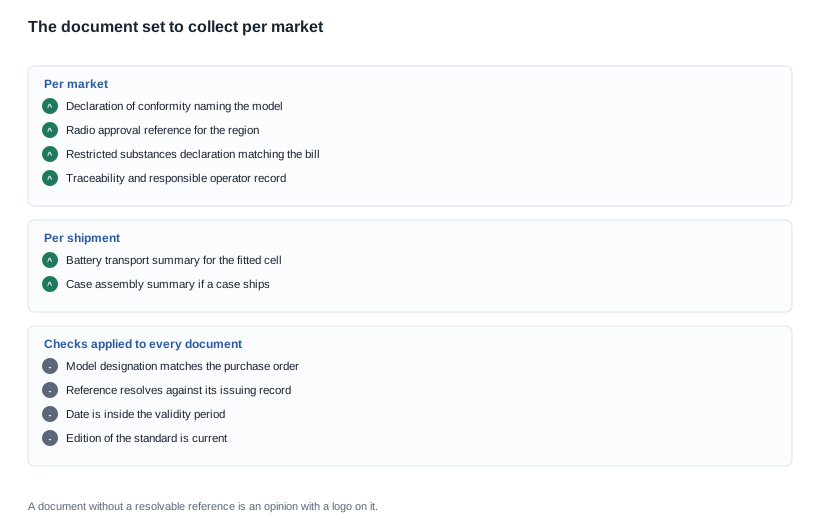
Four documents form the pack: the Declaration of Conformity for each market, the radio approval for each region, the battery transport summary, and the restricted-substances declaration matching your model.
Then verify three things on each: the model designation matches what you are buying; the date is current; and where a family approval exists, the specific variant is named or demonstrably covered. The third check is where buyers most often find out that the approval they paid for does not cover the thing in the carton.
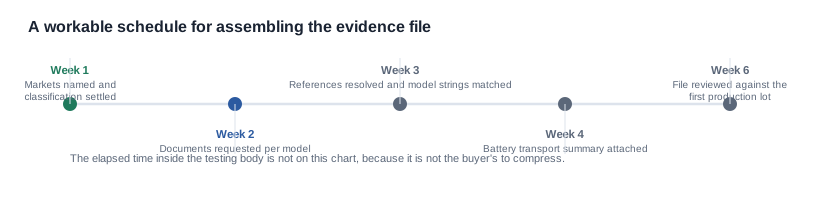
The schedule above assumes the buyer controls the elapsed time, and for the collection steps that is mostly true. The elapsed time inside the testing body is not, and the chart is drawn so that the buyer's steps come first and the supplier's come second. A buyer who needs the file in three weeks should discover at week one that a new model requires a new test rather than at week three.
The three checks deserve a note on what they each catch, because they catch different things and a buyer who applies only one of them will still be caught out:
- The model designation check catches a family-level document that has been treated as model coverage. It is a string comparison and it takes minutes.
- The date check catches a document prepared against a superseded edition of a standard, and it catches a document that was issued for a previous production run and never renewed.
- The coverage check catches the variant that was added to the range after the file was assembled. It is the one that fails most often, because it is the one that requires somebody to know the full list of configurations you intend to ship.
For validity periods and what renewal involves, our certification checklist covers it in more detail. The practical question to put to a supplier is therefore not "are you certified" but "which models, which markets, which standard editions, and which references" — and the answer to that question is a document rather than an assurance.
The questions to put to the supplier when the pack arrives
Receiving the pack is the easy part. The questions to put to it are the ones that decide whether the pack is usable, and they are worth writing as a fixed list so that every supplier is asked the same thing in the same order.
- Which exact model designations does each document cover? Not the family and not the series — the designations, written out. This is the question that produces the model list, and without it nothing else can be checked.
- Which market is each document for, and which standard edition does each reference? A document without a market is a claim, and a reference without an edition cannot be checked for currency.
- Which reference resolves against which issuing body's public record? This is the only check that can be completed without the supplier's involvement, and it takes about a minute per document.
- Which configurations are outside the coverage, and what happens to them? The V03 Pro's colour and lens combinations, the V06's inner frame, the S7's inner frame — the configurations that were added after the file was assembled are the ones that are not on the list.
- What triggers a re-issue? A change of radio configuration, a change of a safety-relevant component, a change of the restricted-substance bill of materials, a new edition of a standard. A supplier who answers this precisely has a maintenance process, and a supplier who does not will notify you late.
- Who holds the file, and who is allowed to update it? A file that only one person in the supplier's organisation can read is a file that will be unavailable the week you need it.
The six questions take about half an hour against a pack that is in order. Against a pack that is not in order, the first question alone will tell you that the rest is not worth asking yet, which is a useful thing to know before the sample session is booked.
Turning this into a standing checklist is what makes it affordable. The six questions become a short form that accompanies every document request, and the acceptance criteria for a returned pack become explicit: a pack is acceptable when every document names a model designation, a market and an edition, when every reference resolves, and when the configuration list matches what the buyer intends to ship. Anything short of that is a pack with a gap, and the gap is written down rather than discovered.
The gap in our own catalogue, stated plainly
One company-level export certification page sits in the catalogue the page holding images rather than text, and the catalogue text names no CE, FCC or RoHS anywhere in it. There is no per-model certification row for any model in the range. That is a real gap, not a caveat we have added for effect. The applicable scope for a model and a market is written material to be requested and filed before the order, and we do not publish numbers we do not hold.
The catalogue does carry an export certification section, and it is worth explaining what it does and does not give a buyer. It states that the products are exported with certification. It does not attach a per-model reference, a certificate number, an issuing body or a validity date to any individual model in the range, and it does not say which of the models in the catalogue are covered by which document. For a buyer who needs the paperwork, that section is a statement of position rather than a document, and the difference matters when a retailer's technical team asks for the file rather than for the claim.
If you need the documentation rather than the claim, that is a question for the manufacturer and we will tell you so rather than imply we can supply it. In practice that question is best asked early, because a document request made after the artwork is approved can move the launch date, and a document request made before the artwork is approved usually cannot.
What this article cannot give you
Two things are outside what any article can do, and naming them is more useful than a caveat at the end.
The first is the classification determination. Whether a given product falls under a particular regime, and against which edition, depends on the product's construction, its intended use and the destination market, and that determination belongs with the buyer's own compliance function. A supplier's opinion on it is useful as an input and useless as a protection.
The second is the answer to the question this article is really about, which is whether a specific product, in a specific configuration, in a specific market, is ready to ship. That answer exists only in the file, and the file exists only if somebody has assembled it and somebody else has checked it. The regimes are public, the documents are obtainable, and the checking is procedural — but the result belongs to the buyer's own file, and it is not something a catalogue page can settle.
Our position: we will state the compliance scope your market requires and we will not present a catalogue claim as a certificate. Tell us the markets and we will map the regimes you need.
Related reading
Tell us the markets and we will map the regimes you need and which documents you must obtain yourself.


