

Open ear audio glasses smart glasses key specifications falls into three tiers, and only the first tier can choose between two suppliers. The rows we publish for this tier — radio version, charge time, cell configuration, rated runtime, charging interface, control method and the feature rows — are enough to narrow eleven models down to two or three candidates and are nowhere near enough to choose between them. The fields that genuinely separate suppliers are the ones a buyer has to go and find: the temple architecture that sets the seal, the workload sitting behind the runtime figure, and whether a charger actually ships in the box. Everything else on the sheet is either a traceability anchor or noise dressed up as a differentiator.
The order of work matters more than the volume of work here, and the questions to ask are different in each tier. A procurement manager who reads the specification sheet in the order the supplier printed it will finish with a shortlist that reads as rigorous and a decision that rests on the Bluetooth version. A procurement manager who reads it in the order below will finish with a shortlist of two and a list of the measurements that separate them.
Open ear audio glasses: three tiers, and only one shortlists
The published position across the eleven audio-tier models
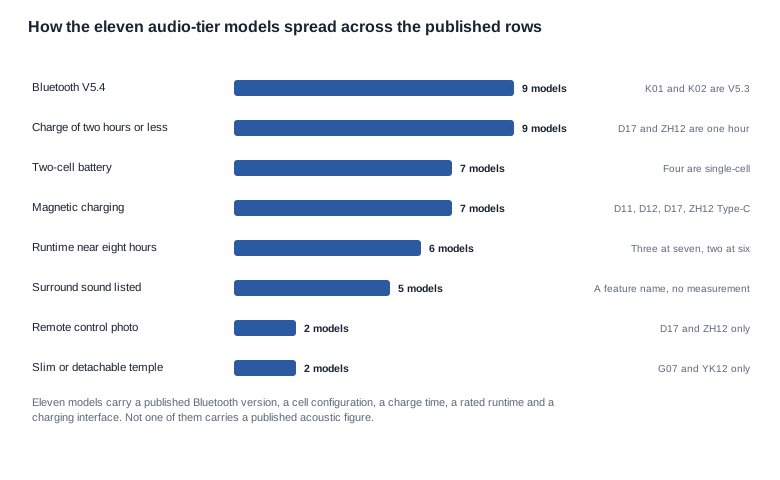
Our audio tier covers eleven models. Here is the complete published position, because the tier is small enough to state in full and that is worth more to a buyer than a selective extract.
The radio generation splits once: Bluetooth V5.3 on the K01 and the K02, V5.4 on the remaining nine. The cell configuration splits into two architectures. Seven models carry two cells — 90 mAh × 2 on the K01 and the K02, 55 mAh × 2 on the YK12, the LC-105-2, the LC-105-1 and the G07, and 70 mAh × 2 on the YKC02. Four models carry a single cell — 100 mAh on the D11, the D12 and the ZH12, and 115 mAh on the D17.
Charge time splits into two tiers as well, and this one is genuinely useful: nine models publish a charge time at or under two hours, while the D17 and the ZH12 publish at or under one hour. The rated runtime falls into three bands — about eight hours on the K01, the LC-105-2 and the K02, the YKC02, the ZH12 and the LC-105-1; about seven hours on the D11, the D12 and the D17; and about six hours on the G07 and the YK12. The charging interface splits seven magnetic models from four Type-C models, with the D11, the D12, the D17 and the ZH12 on Type-C.
The feature rows are thinner than the electrical rows. Surround sound is listed on the D11 and the ZH12, the YKC02 and the YK12, and the D17. Remote control photography is listed on the D17 and the ZH12. A slim or detachable temple is listed on the G07 and the YK12.
Same cell class, different runtime, already in the catalogue
The tier contains its own proof that capacity does not rank runtime, and a buyer who has not noticed this will get it wrong on the first comparison.
The G07 and the YK12 publish 55 mAh × 2 and about six hours. The LC-105-1 and the LC-105-2 publish 55 mAh × 2 and about eight hours. Identical cell class, identical total capacity, two hours apart, with no stated workload to explain the gap.
It runs the other way as well. The D17 publishes the largest single cell in the tier at 115 mAh and about seven hours, while the LC-105-1 and the LC-105-2 publish a smaller total across two cells and about eight hours. The ZH12 publishes 100 mAh in one cell and about eight hours, while the D11 and the D12 publish 100 mAh in one cell and about seven hours.
So the field that looks like the strongest quantitative signal in the sheet — total milliamp-hours — is not predictive, and the tier itself demonstrates it three times over. That is not a supplier failing to publish something. It is a property of the format: the runtime is set by what the electronics are doing, and the catalogued figures describe configurations rather than workloads.
The consequence for a buyer is specific. Ranking the tier by cell capacity produces an ordering that the catalogue contradicts. The only defensible use of the cell row is to establish what the power budget is and what the charging interface has to be, and to ask what workload the hours were measured on.
A field only decides when two real candidates disagree on it
A specification field earns its place on a comparison sheet when two candidates you are actually considering publish different values for it, and when that difference changes something you will have to live with.
Charge time is the clean example. The D17 and the ZH12 publish at or under one hour; the other nine publish at or under two. If your channel ships against a fixed weekend promotion or a rolling replenishment window, that difference is the difference between a unit that is back on a shelf on Saturday and one that is not, and it is worth more than the runtime difference between a six-hour model and an eight-hour one. If your channel is a distributor taking a quarterly container, the difference is worth nothing at all.
The charging interface is the second clean example, and it is the one most often missed because it sits in a row nobody reads. Seven models charge magnetically and four charge over Type-C. That determines the cable in the box, the cradle, whether a charging case can be built for the model at all, and what your customer finds in the packaging when the first cable is lost. It is a specification that propagates into packaging, into the accessory line, into the support script, and into the return rate, and it is decided before anyone talks about price.
The temple architecture is the third. Which models carry a slim or detachable temple is published on two of the eleven, and that single row determines the seal, the level the listener receives, the distance at which the sound becomes audible to a person nearby, and the pressure profile across a long session. It is a structural difference rather than a feature flag, and it is the difference that actually shows up in the field.
What a comparison sheet with three tiers looks like in practice
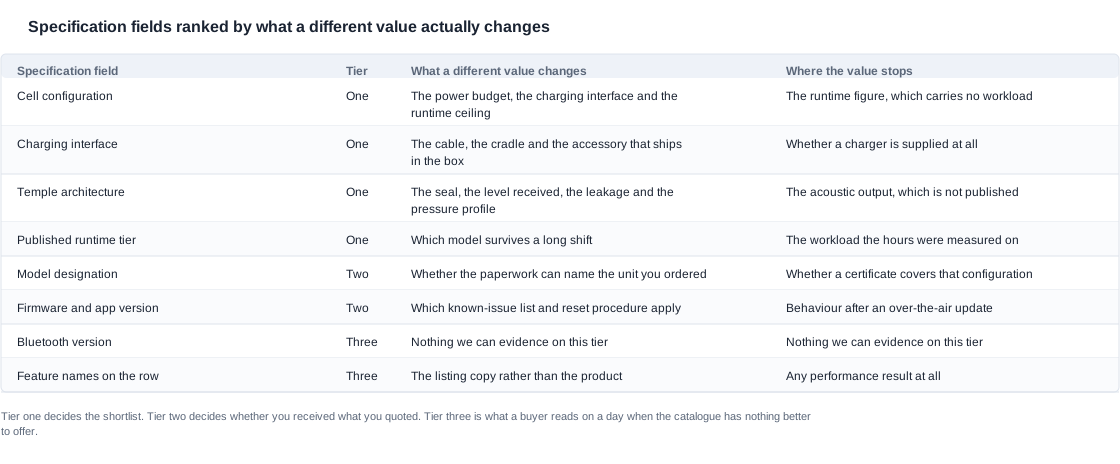
This is the working form. The first group decides the shortlist, the second group decides whether the shipment matches the order, and the third group is what a buyer ends up reading on a day when the catalogue has nothing better to offer.
The practical test for every row is the same: ask what happens to your programme, your cost or your customer if this value changes. If the answer is that a different figure would appear in a comparison you have to make, the field is tier one. If the answer is that a document has to name the unit correctly, it is tier two. If the answer is that a marketing page would read slightly differently, it is tier three, and it should not appear on the criteria sheet at all.
Tier two: the fields that prove you received what you quoted
Model designation and cell configuration as the two traceability anchors
Tier two fields do not choose between suppliers. They protect you after the choice has been made, and in this category they are the difference between a shipment you can ship and a shipment that stops at a customs query.
The model designation is the anchor. Every document in the file — the radio approval, the declaration of conformity, the battery transport test summary, the technical file, the packaging artwork, the customs declaration and the purchase order — has to name the same unit. In a family where eleven models share a Bluetooth version, four share a cell configuration and two share a charge time, a designation that is written loosely is a designation that can be satisfied by a different unit. The check is character by character against the artwork proof and the unit in the box, not a general description.
The cell configuration is the second anchor, and it matters more here than in most categories because it is the field most likely to be quietly changed. A single 100 mAh cell and two 55 mAh cells read differently on a shelf and can be reconciled in a conversation about cost. A change from 55 mAh × 2 to 70 mAh × 2 on a model whose artwork is already approved changes the runtime tier, the charge behaviour, the mass distribution across the temples, and the certificate coverage. Ask for the cell configuration as a line on the purchase order and as a line on the quotation, and treat any difference between the two as a stop condition rather than a query.
Firmware and app versions sit in tier two as well. They do not appear in the catalogue rows, which is precisely why they need a home in your file: the known-issue list is versioned, the reset procedure is versioned, and a support script that cites a procedure without a version is a script that will not resolve anything.
The commercial argument for spending time on tier two is straightforward. A unit with paperwork that does not cover it is a unit that cannot clear a channel, and the failure appears at the point of maximum cost — after the goods have shipped, after the artwork has been printed, after the launch. The records that prevent it cost one email before the deposit.
The four questions that turn tier two from a record into a control
-
What is the exact model designation on every document, and does it match the unit that will be packed? Ask for the designation written on the quotation itself, not only in the body of the email. A designation that appears in a quotation and differs from the one on the artwork is a discrepancy you will pay for later.
-
What is the cell configuration, in cells and in milliamp-hours, per model designation? Write it as two numbers rather than one total, because the architecture is the part that determines the charging interface and the mass distribution.
-
Which firmware build ships with this order, and what is the connection and reset procedure for that build? A version number, a procedure and a date. The procedure matters as much as the version, because it is what your support team will actually be given.
-
What is the charge time measured on, and what does the supplier supply in the box? The interface row tells you the connector, not the accessory. Ask for the charger, the cable length and whether a case is supplied, because the case is a second lithium cell, a second regulatory line and a second thing a customer can lose.
Why tier two is where the document review actually belongs
A specification sheet is a description of a product. A document pack is a description of a shipment. Buyers routinely conflate the two, then discover the gap when a shipment is held.
The practical move is to build a one-page matrix before the deposit, with the model designation down one side and the document types across the top, and to mark each cell as held, pending or not applicable. In this category that matrix typically has seven or eight columns: the radio approval, the declaration of conformity, the general product safety file, the battery transport test summary, the technical file, the packaging artwork, and the documentation pack in the market language. A cell that says pending after the deposit is a schedule item you did not price.

Tier three: the fields that look decisive and settle nothing
Bluetooth 5.3 against 5.4, and why it is the weakest row we publish
Two of our eleven models publish V5.3 and nine publish V5.4, and in our own data that row corresponds to no other product difference at all. The two models on V5.3, the K01 and the K02, publish the same 90 mAh × 2 configuration, the same charge time, the same rated runtime and the same magnetic charging interface as their V5.4 neighbours in the same section of the range.
The practical gap between the two generations is small for a product of this kind, because the profile set a device of this type actually uses is well established in both. Where a radio generation does matter is in the behaviour of the connection — whether the unit reconnects after a power cycle, how it behaves when the paired phone is on a call, how it behaves next to other radios in the same room. None of that is a property of the version number; it is a property of the antenna, the radio configuration, the firmware and the paired device.
So the row is tier three, and it is the row most likely to be promoted to tier one by a supplier who wants a talking point. It is also the row a buyer should still publish, because the buyer has to specify a radio generation and the customer will compare it. Publish it as what it is — the generation, not an outcome — and test the reconnect behaviour on a sample, which takes five minutes and settles the thing the version number cannot.
The feature rows are copy, not results
Surround sound is listed on five of the eleven models. Remote control photography is listed on two. A slim or detachable temple is listed on two. These are architecture names and feature flags, and they sit in tier three for a specific reason: no measurement accompanies any of them for any model in this tier.
That is not a gap in the range that a different supplier would fill for you, because the gap is a property of the format. An open-ear frame has no seal and no coupler, so the reference points the headphone world uses do not exist, and the numbers that would make these rows comparable have never been published for this category. A feature row tells you what was built into the unit and nothing about how well it performs.
There is one exception in practice, and it is worth separating out. The slim or detachable temple on the G07 and the YK12 is a structural difference rather than a marketing name, because it changes the geometry that sets the seal, the level and the pressure profile. That row is tier one when your requirement involves long sessions, and tier three when it does not. A row's tier depends on your programme, which is a reason to build the criteria sheet yourself rather than accept one from a supplier.
A warning about figures that are comparable but not comparable
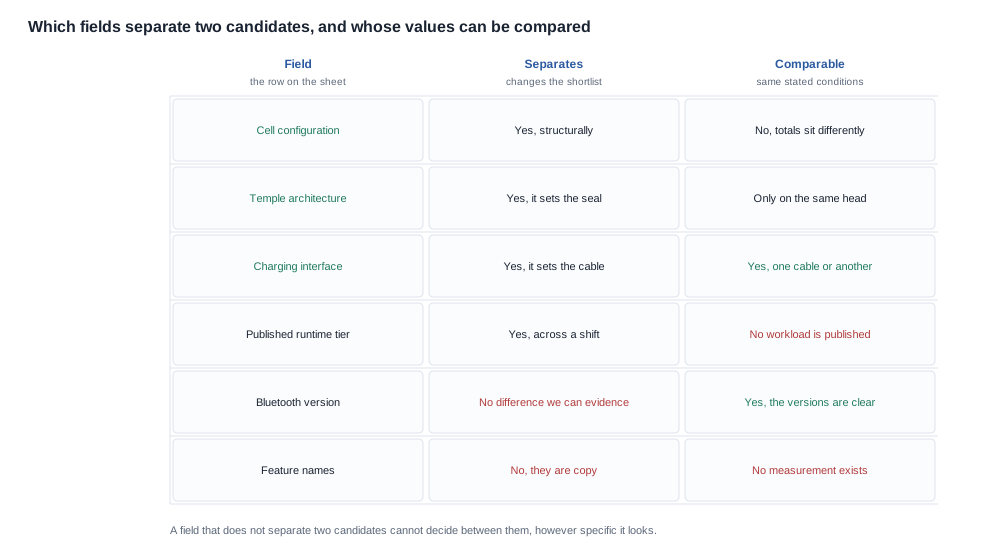
The left-hand column of that matrix is the shortlist rule and the middle column is the comparison rule, and the two are different tests. A field can separate two candidates and still not be comparable between them. The cell configuration does both: it separates a two-cell architecture from a single-cell one, and the two totals sit differently so the numbers are not comparable across the architectures.
The row that catches most buyers is the runtime. It separates candidates decisively — six hours, seven hours, eight hours is a real ordering — and it is not comparable, because no model in this tier publishes the workload behind its figure. Two suppliers quoting eight hours have measured two different things, and the difference between their measurements is larger than the difference between our own eight-hour models and our own seven-hour models.
This is why the specification sheet cannot settle an acoustic comparison. It carries the radio generation, the cell, the charge time, the runtime, the interface and the feature flags. It carries no acoustic figure at all, for any model, and the properties that decide whether the product is good for your customer are exactly the ones that are absent.

Running a shortlist by field order rather than by feature count
Counting the rows across the tier
Every model in this tier publishes the same nine or ten rows. The count is uninformative: the K01 and the ZH12 have exactly the same number of published rows, and one of them is a two-cell magnetic-charging model with a slim temple and the other is a single-cell Type-C model with remote photography. What separates them is the values inside the rows, not the number of rows.
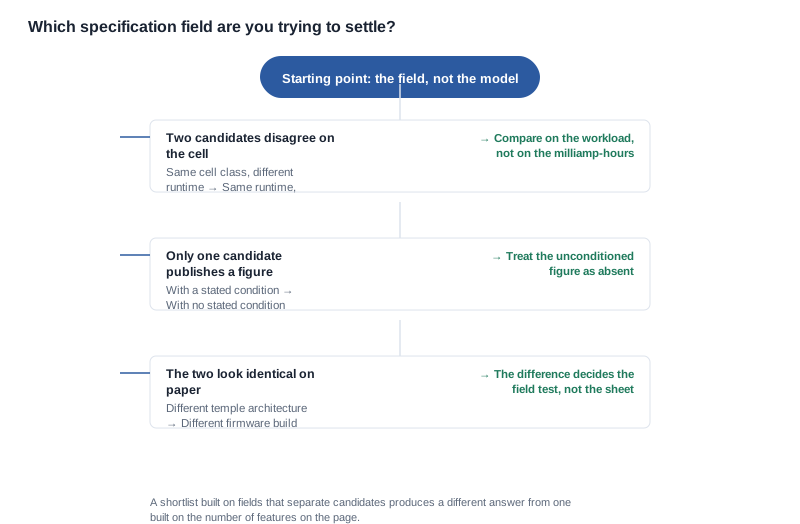
The decision path above is the shortest useful version of the whole discipline. Two candidates that disagree on the cell are compared on workload rather than on milliamp-hours. A figure published without a condition is treated as absent, which is a discipline rather than a courtesy — a conditional figure is worth negotiating over, an unconditioned one is worth discarding. And when two candidates read identically on the sheet, the difference is somewhere the sheet does not show, usually in the temple or in the firmware, and that is where the field test has to go.
A worked shortlist, built in field order
Consider a brand-side buyer narrowing this tier for a European channel that sells through two distributors and needs a charging interface that matches the cables already in the market. This is a hypothetical scenario, not a client project, and it is written to show the sequence rather than to report an outcome.
Step one, tier one fields. The Type-C requirement removes the seven magnetic models immediately, which takes the field from eleven to four: the D11, the D12, the D17 and the ZH12. That single requirement has done more work than any amount of feature comparison would have.
Step two, tier one fields again. Charge time splits the four into two pairs. The D17 and the ZH12 publish at or under one hour; the D11 and the D12 publish at or under two hours. For a distributor replenishing against a fixed weekly cut-off, the one-hour pair is materially better, and the two-hour pair is not eliminated, it is deferred.
Step three, the runtime and its condition. The D17 publishes about seven hours and the ZH12 about eight, and the buyer cannot yet rank them, because the tier publishes no workload. The D11 and the D12 both publish about seven hours, so on this row they are indistinguishable and the shortlist cannot use it.
Step four, the structural field. The ZH12 lists remote control photography and stereo surround sound, and the D17 lists remote control photography and surround sound. For a channel that will sell the photography feature, that is a differentiator; for a channel that will not, it is a cost. This is the point at which the buyer stops comparing rows and starts deciding what the channel is for.
Step five, the acoustic gap. Four candidates remain in play and not one of them publishes a leakage figure, a frequency response, a driver configuration or a microphone pickup figure. The buyer now knows the exact shape of the remaining unknown, which is the only useful thing a specification sheet can do at this stage.
Step six, the tier two fields. The buyer asks for the model designation, the cell configuration, the firmware build, the charger and the artwork proof for the two surviving candidates. The answer to that request, including how long it takes, is worth more than any remaining row on the sheet.
What changes when the shortlist is built in field order
The list shrinks faster, because a requirement like the charging interface eliminates seven models on its own. The comparison becomes about values rather than counts. The acoustic gap becomes explicit rather than hidden behind a table of electrical rows, which means it can be budgeted for as testing rather than discovered as a disappointment after launch. And the questions that go to the supplier are the ones that get answered, because a question with a field behind it has a pass line and a question without one does not.
Before you order on the strength of a sheet, the buyer has to write the criteria rather than accept a supplier's, and should you order at all is decided by the acoustic gap. That is the work, and it is the difference between a comparison and a decision.
What the catalogue settles, and where your own testing starts
The rows we publish and the rows we will not estimate
The short answer: we publish the electrical and interface rows exactly as the catalogue states them, and we publish the empty measurement rows beside them with the same prominence. For this tier that means: the radio generation per model, the cell configuration per model, the charge time per model, the rated runtime per model, the charging interface per model, the control method, and the feature rows including surround sound, remote control photography and the slim or detachable temple. We publish no acoustic figure for any model in the audio tier — no driver size, no frequency response, no leakage distance, no microphone pickup figure, no codec list and no latency — and we will not infer any of them from a method name or from a typical device.
We also publish no unit weight for any model in this tier, and we will not quote a weight from another model in the range to fill the gap. For completeness, the only weight our catalogue carries anywhere is the MT6 glasses body at 158 g, a figure that already counts the 265 mAh cell and the camera of that same model while leaving out its 1200 mAh folding charging case; the case weight is not published, and no bare frame weight has been published for any model in the range.
What we will not do is tell a buyer that two models in this range sound alike, or that one of them carries more bass, or that a particular runtime figure is the honest one. We do not publish a test condition for any runtime figure, and we will not apply an assumed efficiency to a rated figure to produce a usable one. Those are measurements, and they have to be taken on the unit that will ship.
Four questions to send us, and what we will answer
-
Send us the two or three candidates and the target market. We will tell you which published rows separate them and which of them are noise, which is the part of the exercise where a buyer loses the most time.
-
Send us the use case and the session length. We will tell you which of the tier's configurations the requirement actually needs, and where the requirement is a listening environment rather than a product feature.
-
Ask us for the cell configuration, the firmware build and the model designation on the quotation. These three are the anchors of the whole file, and we would rather hand them over precisely than have them approximated.
-
Ask us what we do not publish, before you write the criteria sheet. A criteria sheet built on rows we will not supply is a criteria sheet you cannot close, and it is cheaper to know that at the quotation stage.
The technology background is under open-ear audio, the microphone side is in noise control, the radio context is in Bluetooth connectivity, and the range itself is at Bluetooth audio glasses.
Related reading
Send us the candidates and the market, and we will tell you which published rows separate them and which are noise.


