

Lead time conversations in this category go wrong in one of two ways. Either the supplier quotes a number without a configuration behind it, in which case the number means nothing; or the buyer hears the number as fixed and then changes the specification on day three, which is the more common failure and the more expensive one. Open ear audio glasses smart glasses lead time factors is about what actually consumes the schedule, and the answer is almost never the electronics.
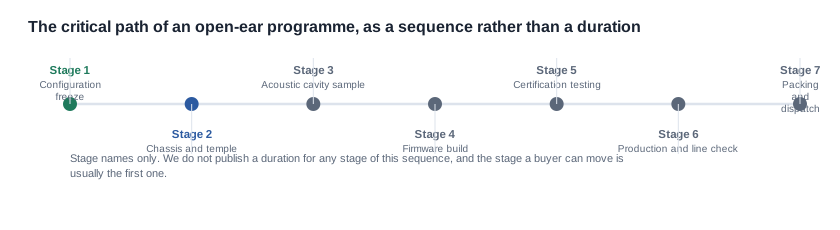
The audio module is a purchased part with its own cycle, and it is rarely the constraint. What consumes the schedule is everything around it: a chassis that has to be tooled, a retuned acoustic cavity, a plating finish nobody has qualified, a firmware build that has never been compiled, a certification scope that has to be redone for a market the product has never shipped into, and artwork that is approved after the production slot has been booked.
Open ear audio glasses: a sequence, not a duration
The sequence, as stages rather than a duration
The timeline above shows the shape of an open-ear programme as a sequence. It is deliberately not published with durations attached, for the same reason we do not publish a figure without its conditions: a duration without the configuration behind it is a guess with a number on it, and a guess gets compared against a launch date until somebody has to explain the difference.
The stage structure is more useful than a number because it tells you which stage to attack. Every stage is either a buyer decision, a supplier action, or an external queue, and only one of the three is compressible by spending money. That distinction is the whole of the negotiation.
Why the audio module is rarely the constraint
This is the assumption worth breaking first, because it is the one that leads buyers to negotiate on the wrong thing. Buyers arrive expecting the radio module to be the long pole, and in a range where the radio and the audio module are both catalogued configurations of an existing platform, that expectation is usually wrong.
The module has a cycle the supplier manages and can usually forecast. The chassis, the acoustic cavity, the plating line, the firmware build and the certification scope do not have that property. Each of them is a decision rather than a procurement, and a decision that is made late has a cost that is measured in a re-work loop rather than in a shortage.
The practical consequence is that the question to ask at the quotation stage is not "how long is your module lead time" but "which of these stages is longest for this configuration, and who owns it". A supplier who answers with a module number has not answered the question.
The two levers a buyer controls
There are exactly two decisions in the sequence that the buyer owns outright, and both are large.
The chassis profile. Any change to the temple cross-section, the hinge position or the frame silhouette puts tooling into the schedule and moves everything downstream of it. The available alternative is to achieve the intended silhouette with finish and temple styling on an existing profile, which in this tier is a real option because two of the eight audio models already publish a slim or detachable temple — so the geometry question has a precedent to test against rather than a blank sheet.
The market list. Selling the same electrical design into a market where approvals already exist is materially faster than selling it into a market that needs new testing. This is a decision the buyer makes before the quotation and can unmake afterwards at considerable cost.
The rest of the sequence is shared. The buyer sets the requirements and the supplier executes, and the buyer's leverage in that part of the sequence comes from the freeze dates rather than from pressure.

The chassis and the acoustic cavity, the two levers a buyer controls
What moves the schedule, who controls it, and what compresses it
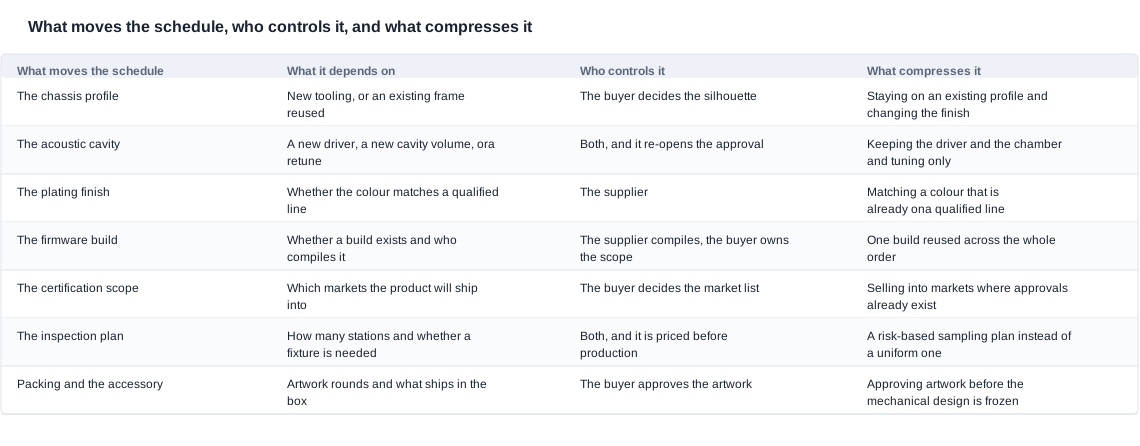
Read the second column of that table as a list of dependencies and the third column as a list of ownership. The two columns rarely agree, and the places where they disagree are the places where a programme stalls — because the party who owns the decision is not the party who controls the dependency.
The chassis profile and the tooling consequence
The chassis is the biggest single item in the schedule, and the question that settles it is not "how long does tooling take" but "is this an existing profile or a new one".
That question has a second half that is asked more often: what is the tooling consequence, and over what volume is it amortised. A buyer who is comparing a new profile against an existing one should be comparing the whole consequence rather than the tool cost, because a new profile also moves every downstream stage by the time it consumes, and it usually re-opens the acoustic verification because the temple geometry is part of the acoustic path.
There is a middle option that is worth testing explicitly before the order: whether the intended silhouette can be achieved by finish and temple styling on an existing profile. In this tier, the charging interface is already split — seven models magnetic, four over Type-C — so the accessory and the packaging route can also be differentiated without touching the profile at all.
The acoustic cavity, and why it re-opens an approval
Changing the transducer, or the cavity volume around it, changes the acoustic response, and the response has to be re-tuned and re-approved. This is the second decision that lands on the schedule, and it is the one most often treated as a component swap.
The point worth making to a buyer is that this decision cannot be deferred and then recovered cheaply. If the acoustic configuration is decisive for your product, the gap has to be closed during evaluation, and closing it with a physical sample is faster than closing it with a specification discussion — because a specification discussion about a design that has not been measured is a discussion with no conclusion available.
Note what is not published in our own catalogue for this tier: no driver size, no frequency response and no leakage figure for any of the eleven models. That gap is deliberate, and it means the acoustic decision cannot be made from the catalogue. It has to be made on a sample.
Plating lines, and a colour matched to an existing one
A colour matched to an existing plating line is a schedule item of a different order from a colour that needs a new line qualified. The question — "does this colour match a qualified line, and which one" — takes one email and is routinely asked far too late, usually after the artwork has been approved and the packaging has been printed.
The commercial reason it matters more here than in other categories is that the packaging in this tier is not trivial. Seven models charge magnetically and four over Type-C, and the accessory that ships with the unit is different in each case, and the quick start guide, the market labels and the documentation pack all follow the configuration. A colour change that forces a packaging rework is a cost that appears twice.
The firmware build, and why it lands last
A custom interface, a custom device name or a firmware fork has to be compiled, flashed and tested on every unit. It is not a long task in isolation, but it sits at the end of assembly, which means that any problem there lands directly on the shipment date rather than being absorbed earlier in the sequence.
The two questions that settle it are whether a build exists for this configuration already, and who compiles and flashes it. Both are worth asking at the quotation stage rather than at the sample stage, because the answer determines whether the firmware is a task or a milestone.
The certification scope per market
Selling into a new market may mean new testing; selling the same electrical design into a market where approvals already exist may mean none. This is a commercial question as much as a schedule question, and it belongs in the conversation before the quotation, because it is the item most often discovered after the packaging is approved.
The practical way to price it is per market rather than as a single line. Ask which of your target markets need new testing, which do not, and what each of them adds to the schedule. The answer is often surprising in the buyer's favour, because some markets are cheaper to enter than a buyer assumes.

Asking for a real date at the quotation stage
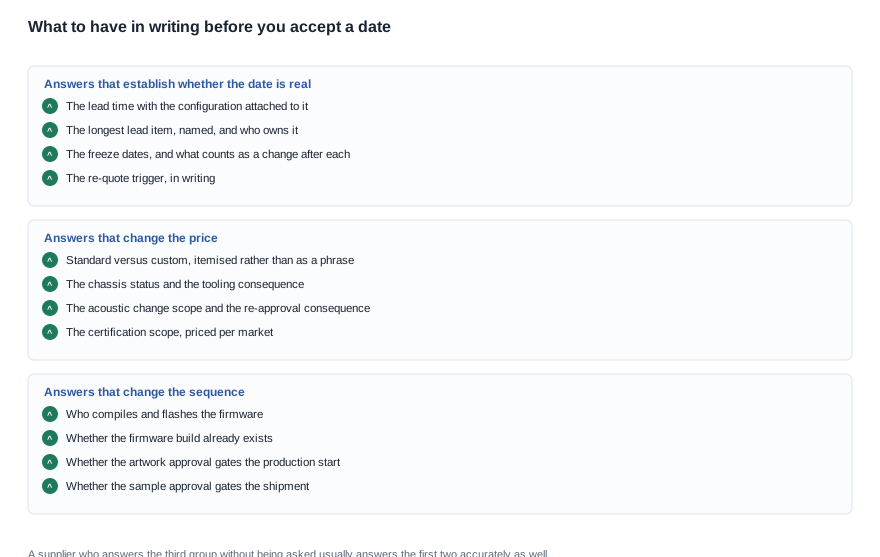
The seven questions that turn a quoted date into a usable one

The sequence above is ordered deliberately. The first question establishes whether there is a schedule to discuss at all, because a supplier who answers "it depends on the spec" has not quoted anything. The second identifies the constraint, which is the only stage worth negotiating against. The third and fourth separate the two buyer-controlled decisions from the rest.
The fifth question is the one buyers most often skip, and skipping it is how a programme loses two weeks at the end. A firmware build that has to be compiled from scratch is a schedule item; a build that already exists is a task.
The freeze dates and the re-quote trigger
The last question is the mechanism that makes the schedule hold, and it is the one that has to be in the contract rather than in the meeting notes.
A freeze date is a named point after which a change is a change request rather than a discussion. A re-quote trigger is the condition that produces a new quotation. Together they convert the relationship from "we will try to absorb it" into "here is the consequence and here is the price of the decision", which is a much more productive conversation and the only one that survives contact with a marketing team that has a good idea in month two.
The freeze points in this category should be set around the decisions the buyer owns. The chassis freeze has to come early, because a new profile is expensive to reverse. The acoustic freeze has to come before the cavity sample is built. The firmware scope freeze has to come before the build is compiled. The artwork freeze has to come before the packaging is printed, and it has to come after the configuration is settled, because the quick start guide and the market labels follow the configuration.
What to ask for in writing, and what to keep
Five items belong in the file before the deposit: the schedule with the configuration attached to it, in writing; the standard-versus-custom itemisation, itemised rather than as a phrase; the named longest lead item and its owner; the freeze dates and the re-quote trigger; and the chassis, plating and firmware status.
Two of those are the ones that get argued about later. The configuration attached to the date is what makes the date usable, and a date without it cannot be enforced or re-planned. The named longest lead item with its owner is what tells you whether a slip is coming, because a supplier who will name the constraint can manage it, and one who will not is a supplier whose schedule is a hope.

When the schedule slips, and what the agreement should say about it
The three ways a programme slips, and they are not equivalent
A slip is not a slip. Three of them behave completely differently, and the agreement should treat them differently.
The forecast moved. The stage was longer than expected and nothing about the configuration changed. This is the ordinary case, it is the supplier's problem to manage, and the clause that covers it is a notification obligation with a revised date. No money changes hands.
A decision moved. The configuration changed, or a decision that was open got taken late. Here the cost is real — re-work, re-verification, possibly a re-approval — and the clause that covers it is the re-quote trigger, with the price of the change stated in advance rather than negotiated after it.
A dependency moved. A component, a laboratory queue, a freight slot. Here the cost is usually outside both parties' control, and the useful clause is one that moves the milestone rather than one that moves the money.
Treating all three as the same event is how a programme ends up paying for a supplier's forecasting error, and how a buyer ends up unable to tell a supplier that a change is being made after a freeze date. The distinction is worth writing into the agreement, because it converts an argument about blame into a calculation about cost.
The early-warning signals in a schedule
Three signals are visible well before a date is missed, and each of them is available to the buyer if the reporting structure is agreed at the start.
Stage two not closing. If the chassis or temple sourcing stage has not produced a firm answer, everything downstream is already late, whatever the schedule still says.
A freeze date approaching without a decision. The re-quote trigger is a mechanism that only works if it is exercised before the freeze, and a freeze that passes without a decision is a change that has already been made informally.
A build that does not exist. If the firmware build for the configuration has not been compiled, the item that lands on the shipment date is the one with the least float.
The reporting structure that makes these visible is simple: a stage-level update against the agreed sequence, naming the stage, the owner and the constraint. A buyer who asks for a stage-level update rather than a single date will see the slip three stages before it happens.
The recovery clauses worth having before launch
Four clauses cover most of it. A notification obligation for a change to any configuration item after a freeze date. The re-quote trigger with the consequence stated, which stops the argument about who absorbs the cost. A right to split a delivery against a milestone rather than accept a late whole consignment, which converts a launch delay into a partial launch. And a clause tying the final delivery to the certification milestone rather than to a date the factory controls, because a date the factory controls is a forecast and a date tied to an external queue is at least an honest one.
None of these clauses is unusual and none of them is expensive to agree at the start. They are expensive to agree in month three, and by then they are being negotiated under pressure by people who would rather not be in the conversation.
Compression, and the trade-offs that come with it
What compression costs at each stage
Compression is available at every stage, and each one carries a different cost. Keeping an existing chassis profile compresses the schedule and costs you the distinctiveness of a custom silhouette. Using an existing qualified plating colour compresses it and costs you a colourway. Reusing one firmware build across the order compresses it and costs you a per-unit function. Selling only into markets where approvals exist compresses it and costs you market reach.
The stage that cannot be compressed is the acoustic re-tuning, because the acoustic response has to be re-tuned and re-approved whatever else happens. That is worth telling a supplier early, because a buyer who plans to compress by keeping the existing cavity has already made the decision that matters most.
The second thing that cannot be compressed is the certification queue, because the elapsed time is set by the test laboratory and the review queue rather than by anybody in the negotiation. The cost is per product family and the queue is external, so pressing on it produces a longer schedule rather than a shorter one.
The negotiation, and where the schedule actually gives
The schedule is negotiable in a specific and limited way: how much of it is the factory's to compress and how much is the buyer's. The standard-versus-custom split is the lever, because a configuration that keeps the existing chassis, the existing plating line and the existing firmware build is materially faster, and the supplier prices it accordingly.
Delivery splitting against a milestone is often granted more easily than a price concession, and in this category the milestone should be the sample approval rather than the shipment, because the sample approval is the point at which the acoustic configuration, the firmware build and the artwork are all still movable. Splitting the first run into two deliveries against a staged payment is the usual shape of that concession.
What is not negotiable is the certification cost and the certification elapsed time, the tooling cost, and the module's own cycle. The one-off costs are usually amortised across the first order, so the useful questions there are over what volume they are amortised and what happens to the tooling if the programme is discontinued.
Our position, and what a schedule conversation should produce
We do not publish our lead times in weeks, for a straightforward reason: a number without a configuration behind it is not information, and a buyer comparing two such numbers is comparing the vagueness of two suppliers.
What we will do is take a configuration and the date you need, and tell you the critical path and where the honest constraint sits — including, where that is the answer, that your target date does not work for what you have specified. A supplier who tells a buyer that a date cannot be met is doing the buyer a service that will be visible later, and it is the behaviour that makes the schedule worth planning against.
We will also be direct that the schedule is mostly the buyer's decisions rather than the factory's. The chassis, the colour, the firmware scope and the market list are four choices, and each of them can add work. A buyer who makes them early gets a schedule; a buyer who makes them late gets a story.
Configuration and target date
-
Send us the configuration and the target date. We will name the critical path and the longest item, and we will say plainly if the date does not work.
-
Send us the market list. The certification scope per market is a large part of the schedule and it is a decision you own.
-
Send us your freeze points. We will map them onto the stages in the sequence above and tell you which freeze dates have to come earlier than you think.
-
Ask us which of your decisions are still open. The most useful thing a supplier can tell a buyer in a schedule conversation is which of the buyer's own choices are still movable, because that is where the compression is.
A standard engagement starts on the standard OEM sample process page, what has to be decided first is in engineering customization, and the technology background is under open-ear audio.
Related reading
- Open-ear audio technology and specifications
- Engineering customization and its timeline
- Standard OEM sample process
Send the configuration and your target date and we will name the critical path and the longest item.


