
Open ear audio glasses: the four deciding questions
Four questions decide most open-ear audio orders, and none of them is the one buyers ask first. The first question is usually how loud it is, and it is the least useful of the four, because every open-ear design is loud to the person carrying it and quiet to the person one seat away — the number that actually decides a purchase is how much of the sound reaches the room. The second is whether the microphone holds up on a call, which is what separates a product that can be sold into a business workflow from a product that can only be sold into a consumer channel. The third is how long it runs, and the honest answer there is that the published runtime is a rating rather than a working day. The fourth is which model goes behind which configuration, and that is a shortlist problem rather than a specification problem. If all four are answered before the RFQ goes out, the sample round gets shorter and the supplier conversation gets shorter with it.
- How much of the audio reaches the room? Distance, environment, method, and the pass criterion you are willing to hold.
- Does the microphone hold up on a call in the environment you actually sell into? Far-end device, noise condition, and the recording you will judge.
- What is the runtime under the conditions of use, rather than under the rating condition? Volume, source, ambient temperature, and the starting charge state.
- Which model goes behind which configuration, and what does the shortlist rule out? Write the elimination rule down before the samples arrive, not after.
The reader behind these questions is usually one of three people, and each arrives with a different constraint. A brand-side product manager is opening a new material number and is frightened less of the unit price than of the launch date, because a new SKU means new artwork, a new technical file, a new packaging line and a new set of market approvals, and each of those can stop a launch on its own. A channel buyer already stocks the category and is deciding whether to add a second or third model, so the real question is not which product is best but which one does not cannibalise the one already on the shelf. A solution integrator is assembling a bundle for a customer and needs the audio to work with a specific application, which turns an open-ears question into an integration question before it becomes a product question.
What all three fear is the same in a different order: goods that arrive behaving differently from the demonstration, a return rate that lands in the quarter after launch, a certification document that names a different model than the one in the box, and a support queue that spends its time on a defect the supplier has already known about. None of these is a product defect in the engineering sense. All four are information failures, and every one of them can be closed before the deposit is paid if the right questions are asked in the right sequence. That sequence is the subject of this article, and the model-by-model detail sits behind the open-ear audio technology page.
Our catalogue publishes electrical rows for the open-ear models. It does not publish sound pressure levels, leakage figures, microphone noise floors, frequency response curves or driver sizes, and we would rather write that down than quote a number you cannot independently check. Where a figure is not published, the useful output is the question to put to the supplier and the threshold that makes an answer acceptable. The Bluetooth audio glasses range and the noise control technology page are the two other places in this site where the open-ear question gets treated at specification level, and the sample order process is where the first measurable units should come from.
What the published rows settle, and what they leave open
The published position in the audio part of our catalogue is narrow in a way that is easy to misread as a data gap. It is not a gap in the supply chain; it is what a category without a published performance baseline looks like from the outside. What exists is a set of electrical rows — cell configuration, rated runtime, charging method, Bluetooth generation — and what does not exist is any acoustic row at all. The table below is the whole published audio position, with the gap that each row leaves attached to it.
| Model | Published cell | Published runtime | Charging | Bluetooth | The row it does not settle |
|---|---|---|---|---|---|
| K01 / K02 | 90 mAh × 2 | ~8 h | Magnetic | V5.3 | Driver size, sound pressure level, room leakage |
| D11 / D12 | 100 mAh | ~7 h | Type C | V5.4 | Microphone noise floor, wind rejection, pickup pattern |
| LC-105-1 / LC-105-2 | 55 mAh × 2 | ~8 h | Magnetic | V5.4 | Frequency response, codec support, per-channel output |
| G07 | 55 mAh × 2 | ~6 h | Magnetic | V5.4 | Effect of the detachable temple on seal and on mass |
| YK12 | 55 mAh × 2 | ~6 h | Magnetic | V5.4 | Acoustic figures behind the slim surround-sound temple |
| YKC02 | 70 mAh × 2 | ~8 h | Magnetic | V5.4 | Ingress rating, sweat and pool-water conditions |
| Bone-conduction entry | 200 mAh | ~7 h | Type C | Not published | Response curve behind the published 35 dB gain |
Two features of this table decide more than the numbers in it do. The first is that the cell figures are published as a configuration — two cells for the K, LC and YKC families, one for the D family — and that the catalogue publishes the cell value with the cell count attached rather than a total. That is not a formatting preference; it is the difference between a figure you can use in a calculation and a figure that has to be re-derived before it enters one. When a supplier quotes a single total, ask for the cell value and the cell count, because a two-cell product and a one-cell product with the same total behave very differently when a cell degrades and the second cell carries the load.
The second is that the charge-time row is present for every model in the catalogue, while the runtime row is a range on some entries and a single figure on others. The charge-time figure is published in two hours or less for the audio family, and it comes with two conditions it does not state: the starting state of charge, and the criterion for "complete". That is not a reason to discount the figure. It is the reason to treat it as a laboratory upper bound and to build a charging plan that does not depend on reaching the bound.
The leakage question nobody asks out loud
Leakage is the acoustic fact that decides where an open-ear product can be sold, and it is almost never asked at the quotation stage. The question is simple: at what distance, in what environment, does the audio become audible to somebody who is not carrying the device? A product that answers with a sound pressure level at the ear says nothing about this, because the same output level produces very different room leakage depending on the transducer placement, the frame geometry and whether anything is sealing against the head.
The threshold to hold is a measurement, not a number borrowed from another product: a stated distance, a stated environment, a stated method, and a pass criterion the buyer sets before the sample arrives. A metre in a quiet office and a metre in a café are two different tests, and a supplier that reports the first and is measured against the second will produce a dispute rather than a delivery. This is the kind of figure that should be in the purchase order, because it is the one that governs whether the product can be sold into an open-plan environment at all, and it cannot be settled by a sample unit in a quiet room.
The commercial consequence is larger than it first appears. A leakage figure that fails a buyer's threshold does not mean the product is unusable; it means the product is aimed at a different channel. The same catalogue rows that will not pass an open-plan retail floor can be entirely appropriate for a warehouse, a training room or a vehicle fleet where the environment already has noise. Deciding which of those two worlds you are buying for is a decision worth more than any single acoustic specification, because it changes which models survive the shortlist.
Call quality in a moving vehicle
The microphone question surfaces later, usually after the first customer complaint, because open-ear products are bought for audio and then asked to do call duty as a bonus. The three variables that decide call quality are the noise floor of the capsule, the rejection of wind and road noise, and the position of the microphone relative to the mouth. Only the third is visible in a product photograph, and it is the one that is hardest to change late, because it is a consequence of frame geometry rather than of a component choice.
The published rows do not cover any of the three. That is why the audio family in our catalogue carries no microphone figures at all, and why we would rather not imply otherwise. A buyer who needs call duty should treat the microphone as a specification to be written, not as a feature to be assumed: pickup distance and source level, the far-end device to be used in the test, the noise condition to be reproduced, the acceptance criterion, and the sample size. A test run in a quiet office against a laptop, with the buyer speaking and listening to the recording afterwards, measures the microphone and almost nothing else.
This is also where the open-ear argument stops being an open-ear argument. If the product's job is to be heard in traffic, on a shop floor or in a warehouse aisle, then the microphone specification and the acoustic leakage specification are the same conversation: both describe how the device behaves in the environment where it will actually be used, and both are better settled with a protocol than with a catalogue line.

Turning a sound demo into a purchase condition
A demonstration is the most persuasive document in this category and the least reliable one, because it is usually run in the room where the supplier wants to win, with a familiar source, at a comfortable level, by someone who already knows what good sounds like. Converting it into something a purchase order can be written against takes five steps, each of which assumes the previous one passed.

Step one: fix the source and the level before anything else. A demonstration that uses a phone playing a mastered track measures the phone and the track. Write down what the source is, and if the acceptance test is about speech, use speech. If it is about music, use a track with a known spectral balance rather than a favourite. The point of this step is not to make the test difficult; it is to make it repeatable, so that the same unit produces the same result on your bench and on the supplier's.
Step two: measure the room, not just the device. Place a sound level meter at the seat next to the person carrying the unit, at the distance you specify, in the environment you care about. Record the background level first, because a background above the threshold makes the whole measurement meaningless. Ask the supplier to run the same measurement on their own unit and compare the two numbers. A large gap between your bench and theirs is not a defect; it is the most useful piece of information in the whole round, because it identifies how much of the demonstration was the room.
Step three: run the call test in the environment that produces the complaint. A call test has a far end, and the far end matters. Specify the handset, the connection, and whether the test is a live call or a recording played back at a known level. Then reproduce the condition the product is actually sold into — a vehicle, a shop floor, an aisle — because the number that decides whether the product is usable in a business workflow is the one measured in that condition, not the one measured in a meeting room.
Step four: run the battery protocol on the same unit. This is covered in the next section, and it is mentioned here because the ordering matters. A unit that has been on a call for an hour has a different battery profile from a unit that has been idle, and a demonstration unit that has been handled all afternoon is the worst possible basis for a runtime claim.
Step five: write the result into the order, not into an email. A measurement that lives in an email history is not binding on either side. A measurement that is attached to the purchase order as an acceptance criterion is, and a lot that fails it is a lot you can refuse or claim against. The distinction matters commercially: it converts a supplier's marketing material into a condition of sale, and it is the only part of this process that is enforceable.
A repeatable listening protocol
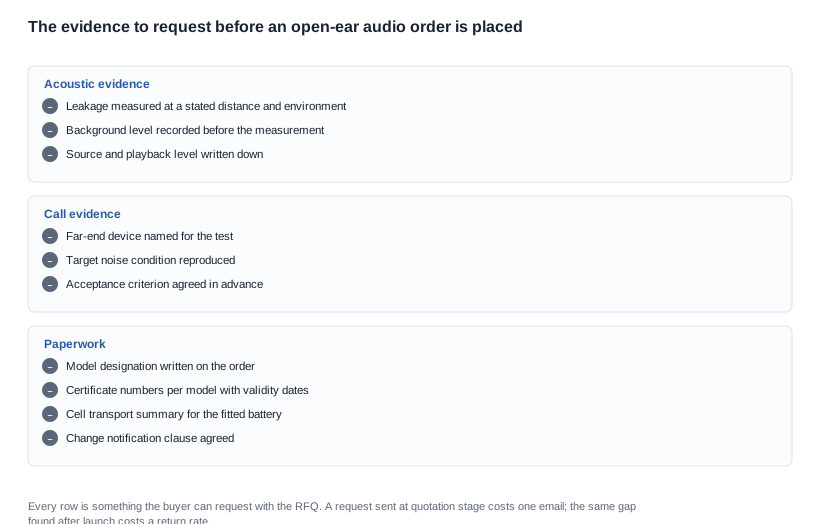
The protocol above is deliberately short, and it can be written on a single page. For each measurement, four things are recorded: the condition, the instrument or method, the reading, and the person who took it. The condition line is the one buyers skip, and it is the one that decides whether a dispute is avoidable. "Leakage at 1 m, café background 62 dBA, supplier unit, sample unit, measured 2025" is a record. "Leakage looks fine" is not.
The same protocol runs on your bench and on the supplier's, which is the point of writing it down. A supplier who declines to run your protocol, or who runs it and gets a materially different answer from yours, has given you information that is worth more than a price reduction would have been. Neither outcome is a reason to walk away on its own; both are reasons to stop negotiating on unit price and start negotiating on the acceptance criteria, because that is where the actual risk sits.
The battery figure that arrives with the demonstration
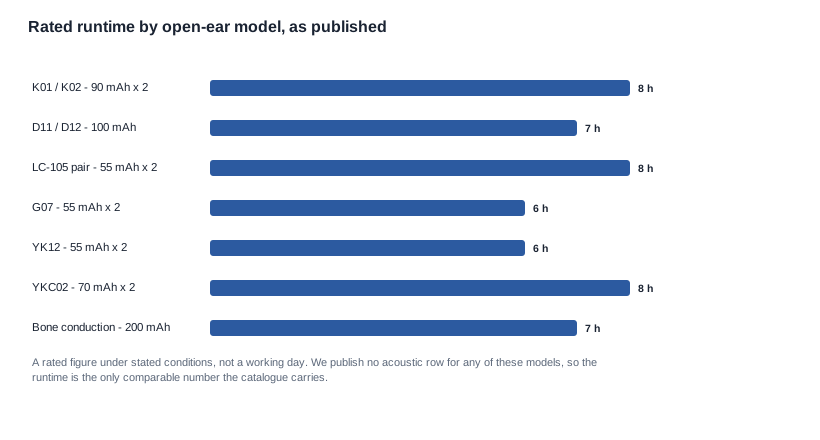
Runtime is the open-ear specification most often quoted and least often verified, and the reason is structural: the rated figure is produced under conditions the supplier controls, and the buyer's conditions are different by definition. Our catalogue publishes a runtime for every audio model, and those figures are ratings, not working-day claims. The K01 and K02 rows read roughly eight hours; the D11 and D12 rows read roughly seven; the LC-105 pair reads roughly eight; the G07 and YK12 rows read roughly six. The sport models read roughly eight on the YKC02, roughly seven on the D17 and roughly eight on the ZH12. The bone-conduction entry reads roughly seven on a single 200 mAh cell.
Read the two six-hour rows carefully, because they are the ones that surprise people. G07 and YK12 are the two models in the 55 mAh × 2 group that publish the shorter runtime, and they are also the two models with slim or detachable temples. A thinner temple changes the acoustic loading and the mass distribution, and both of those change how much current the amplifiers draw. The pattern is not a rule, and it is not a reason to reject either model, but it is a reason to ask whether the six-hour rating was taken on a finished configuration or on an earlier one.
More important than the comparison is the method. Ask for the test condition behind every runtime figure: the volume level, the source, whether the microphones were active, the ambient temperature, and the charge state at the start. A rating taken with the volume at 30 per cent and a rating taken at a level the customer will actually use are not the same measurement, and neither is a rating taken with the product in a pocket and one taken in continuous use. A supplier who can state the conditions is selling a specification. A supplier who cannot is selling a number, and the two are not interchangeable at the volume you intend to buy.
Where open-ear programmes fail after the sample passes
Most open-ear programmes do not fail in the sample. They fail in the weeks after the sample, when the units are in the channel and the questions that were answered in the room start arriving from the field. The four failures below are the ones that recur, and each of them has a symptom, a root cause, and a prevention that costs nothing at the sample stage.
The demonstration unit was quieter than the production unit. The symptom is a return cluster from one channel with a description that mentions volume. The root cause is usually that the acceptance test used a source or a level that the production unit will not reproduce, or that the supplier tested a pre-production unit with a different amplifier setting. The prevention is to make the test protocol part of the order and to check a second unit from the production lot, not only the sample that was sent to you.
The audio is fine and the calls are not. The symptom is complaints that arrive attached to a support ticket rather than a product return, which is worse for a channel business because the unit stays with the customer and the relationship does. The root cause is a microphone that was never specified, which is the normal state of an open-ear programme, and it is entirely preventable. The prevention is to write the microphone requirement — pickup, noise, wind, far-end device, acceptance criterion — before the sample order, not after the first complaint.
The documentation names a different model. The symptom is a customs query, a marketplace rejection, or a warranty claim that cannot be settled. The root cause is that a family-level document was treated as coverage for the branded configuration the customer ordered. The prevention is to make the exact model designation a written condition of the order, to check the string on the units on receipt, and to put a re-issue obligation in the contract for any configuration change.
The programme is a month late and the reason is a document. The symptom is a launch date that slips while the factory reports that the units are finished. The root cause is that the model identifier, the artwork and the technical file were all requested late, so each of them waited on the others. The prevention is to request the identifier in the first exchange and to treat the launch date as derived from the documentation path rather than from the production schedule.
What in an open-ear order can actually be negotiated
The commercial structure of an open-ear order has three layers and they behave differently. The variable layer is unit price, and the negotiation there is mostly about volume tier and how confident you are in the forecast. The setup layer is tooling, artwork and certification, and the negotiation there is about amortisation, the number of artwork rounds, and whether the setup is charged once across the range or once per model. The fixed layer is the acoustic and radio documentation, and there is no version of that conversation in which the certification fee or the laboratory queue gets shorter because the buyer asked more firmly.
The negotiating capital is therefore best spent on the setup layer and on the acceptance criteria, not on the unit price. Four things are worth asking for explicitly: the per-model minimum rather than the per-order minimum, because a range of five models has a different production profile from a range of one; a stated lead time that names the documentary preconditions, because a lead time quoted without them is a number the factory controls and you do not; a price tier that is tied to a written forecast so that a missed tier has a defined remedy; and the artwork round count, because each round is a week and rounds are usually cheaper to limit than to pay for.
One thing is not negotiable in any useful sense, and it is worth saying so early to avoid an argument later: a radio product sold into the European Union has to satisfy the Radio Equipment Directive (EU) 2014/53/EU and carry the conformity documentation that goes with it, and the cost and the queue for that work are a property of the test laboratory rather than of your order size. The same applies to the battery transport documentation under UN 38.3 for a lithium cell, which is a per-cell and per-product exercise rather than a per-unit one. Both are fixed in cost and in duration. The useful question is not whether the supplier can make them cheaper but whether the documentation covers the exact model, the exact configuration and the exact markets you are shipping into.
The lines to put in the order, and the one you cannot move
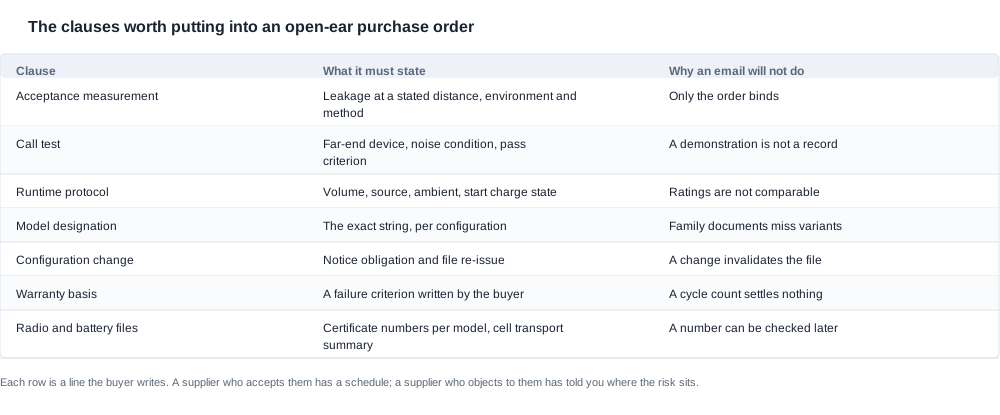
Here is a hypothetical evaluation, written to show the decision sequence rather than to report a client result. Assume a European channel buyer for a uniform supplier, who already stocks one open-ear model and has been asked to add a second one for a market that has a different noise profile. The constraint that matters is not the audio; it is that the buyer's existing model already handles the quiet-environment channel, and the new model has to justify itself on leakage and on call duty in a louder setting. The buyer has a realistic annual volume that crosses one price tier, and a decision to make before the winter buying window closes.
Step one: the leakage threshold, decided before the sample. The buyer writes down the environments the product will be sold into, chooses the loudest one, and sets the leakage criterion for that environment at a stated distance with a stated method. No model survives or fails this step on a catalogue number, which is the point: the threshold is a business decision, and the product is selected against it later.
Step two: the shortlist, cut by the environment. The buyer takes the published rows and eliminates on grounds that are already settled: the charging method that their distribution operation can support, the runtime that matches the usage pattern of the customer, and the configuration that their own packaging can carry. Two models remain, and they remain for a reason that has nothing to do with the audio figures, because no audio figures are published for any of them.
Step three: the sample, measured twice. The buyer receives units and runs the same protocol on their own bench and on the supplier's, and compares. The measurement of a call in a vehicle is the one that decides the shortlist, because the environment is the reason the second model is being added at all. Any unit that fails the leakage criterion in the target environment is dropped immediately, and the sample cost of two units is a price worth paying when the alternative is a channel-wide return rate.
Step four: the commercial structure. The buyer negotiates the setup across a committed model count, ties the price tier to a written forecast, asks for the lead time to name its documentary preconditions, and asks for the artwork round count in writing. The acceptance criteria and the measurement protocol are attached to the purchase order.
Step five: the claim. The buyer's listing describes the acoustic behaviour in the terms the evidence supports, without a number that was measured in a different room. Because the leakage figure is quoted with its conditions, the claim is defensible, and because the model designation is on the order, the warranty conversation in month seven has something to refer to.
The result of the walk-through is not a particular model. It is a shortlist built on thresholds the buyer set, a protocol that both parties ran, and an order that contains the criteria rather than the criteria sitting in somebody's inbox.
What we publish about open-ear audio, and what we do not
We publish the electrical rows for every model in the audio family: cell configuration, rated runtime, charging method and Bluetooth generation, and the charge-time figure that comes with each entry. We do not publish sound pressure levels, driver sizes, frequency response curves, microphone noise floors, pickup distances or leakage figures, because we have no verified figures for them and a number we cannot support is worse than a gap the buyer can see. We also do not publish a frame weight for any audio model; the only weight our catalogue states is for a different model entirely, and the discipline of not borrowing it is worth more than a quick copy line.
What we will do on request is walk through the published rows with you, tell you which configurations exist and which do not, and state plainly where a specification you have asked for is not one we hold. If a requirement in your brief is acoustic, the productive next step is to write it as a threshold with a method and put it in front of a supplier who is willing to be measured against it. That is the same route we would take, and it is the reason the sample order and the purchasing process pages exist alongside the product range: the Bluetooth audio glasses range is where the configuration question is answered, and the sample order process is where the acceptance criteria turn into units you can measure.


