

An open-ear audio spec sheet is complete in one sense and empty in another, and the pattern is consistent enough to explain. Every row on it is an electrical row or a feature name. Nothing on it describes how the product sounds, how it behaves on a call, or what happens when a second device connects. That is not a mistake in the document. A spec sheet is written to be compared, and the rows on it are the ones that can be put in a column and sorted. The consequence for a buyer is specific: the sheet will take you to a shortlist, and it will not take you to a purchase order. The decision has to be made on sound, on calls and on what is in the box, and those are the three things the sheet does not tell you.
Open ear audio glasses: what the spec sheet is built to compare
The rows that are there, and what they settle
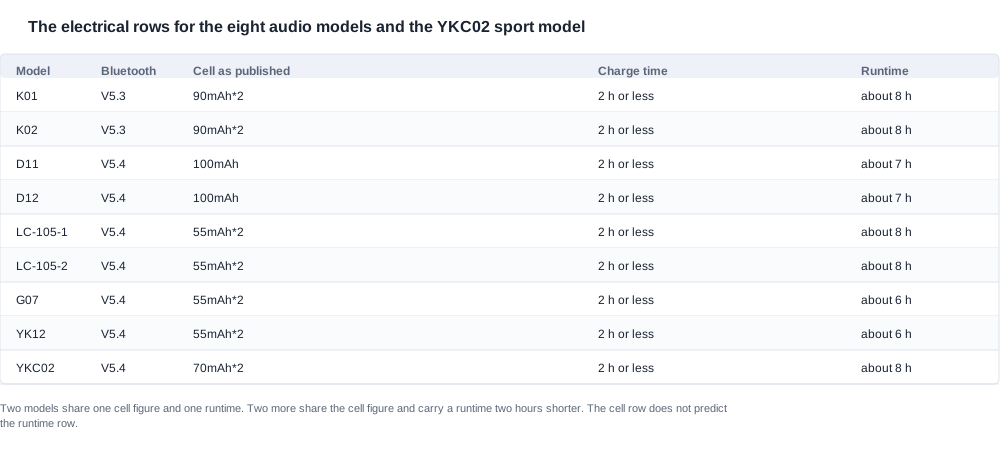
The Bluetooth generation. 5.3 on the K01 and the K02, and 5.4 on the D11 and the LC-105-2, the YK12 and the D12, the YKC02 and the G07, and the LC-105-1. It settles the protocol generation of the radio module and nothing else.
The cell configuration, and the doubling. A doubled 90 mAh on the K01 and the K02, a doubled 55 mAh on the LC-105-2 and the LC-105-1, and the G07 and the YK12, a doubled 70 mAh on the YKC02, and a single 100 mAh on the D11 and the D12. The doubling is a useful structural fact because it distinguishes the two-earbud products from the frame products, and it is also the row that tells a buyer which of the published runtimes belong to a different physical configuration.
The charge time and the runtime. Two hours or less to charge, and a published runtime per model, in every case a ceiling rather than a measurement, because no test condition is published for either.
The charging interface. Magnetic on most of the audio family and Type-C on the D11 and the D12. This is a retail decision as much as a hardware one, because a magnetic product needs a cradle, and a cradle is a separate line in the bill of materials and a separate item in the box.
The feature names. No published touch row on any model, surround sound on the D11, a surround sound slim temple on the YK12, ultra-thin and detachable temples as configuration options on the G07, and a long battery life positioning on the YKC02. These are the rows that actually differentiate the models, because the electrical rows are deliberately similar across the family.
The cell row does not sort the runtime row
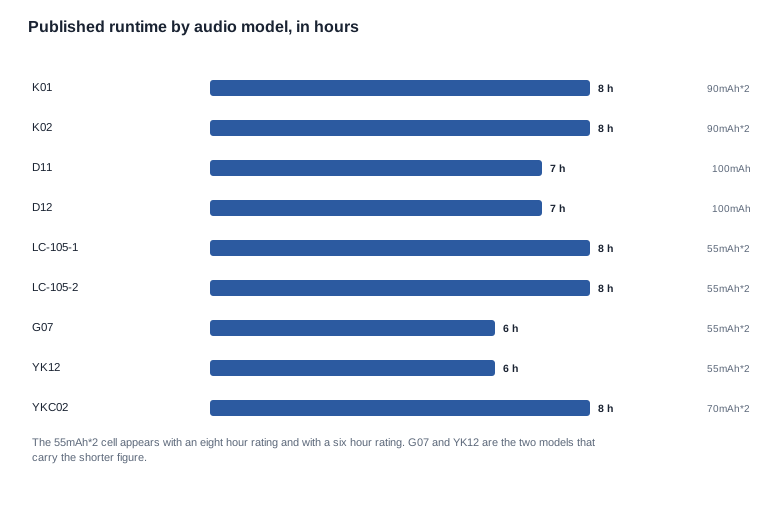
The chart above is the most useful single view in this category, and it is not in any datasheet. Four models share the 55mAh*2 cell configuration. Two of them are published at about eight hours and two of them at about six hours, and the two that run for the shorter period are the two with the slimmer temples — the G07 with its ultra-thin and detachable temples, and the YK12 with its surround sound slim temple.
The reading a buyer should take from this is not a suspicion that the figures are wrong. It is that the cell row and the runtime row are produced by different processes, and a comparison that uses one to predict the other is comparing a component specification against a system behaviour. If runtime matters to your channel, the runtime row is the one to read, and the cell row tells you very little about what to expect.
There is a second reason the cell row is worth reading carefully. The catalogue publishes the cell configuration as the catalogue states it, as a value and a number of cells, and a buyer who writes a comparison table that adds the two values together is producing a derived total that nobody has published. That is fine internally, as long as it is labelled as your own arithmetic, because the moment it appears in a product page it reads as a factory figure.
A shortlist method that survives the missing rows
A shortlist built only on the published rows is still a valid shortlist, and it is worth knowing how to build it so that the models which fail the acoustic tests are not discovered late.
The method has three filters applied in order. The first is the configuration filter, which removes the models whose charging architecture does not match what your channel can support, because a magnetic architecture without a cradle in the box is a returns problem rather than a preference. The second is the runtime filter, which uses the published runtime row rather than the cell row, and which compares the figure against the length of a working day rather than against the length of a meeting. The third is the feature filter, which uses the named structural features — the slim temple, the detachable temple, the surround sound — as the differentiators the channel can actually build a product page around, and it has to record that the catalogue publishes no touch row for any model, so touch cannot be one of those differentiators.
What the method deliberately excludes is any comparison of the models on sound quality, because the sheet publishes nothing that supports one. Two models that tie on all three filters are not tied: they are two candidates for the same acoustic protocol, and the protocol is what separates them. That is the correct conclusion from an incomplete sheet, and it is much better than the one most buyers draw, which is that the models are equivalent because the sheet looks the same.

The acoustic rows that are absent, and the decision each one would settle
Output level, and the ceiling on volume
No output level figure is published for any model in the family. Without it, a listing cannot state a maximum, and the practical limit on how far a customer can turn the volume up is unknown. The consequence is not abstract. The ceiling is the point at which the product stops being usable in a shared space, because a customer who can push the volume past the point where other people hear it will, at least once. The buyer who cannot state the ceiling is a buyer who cannot say where the product belongs.
Leakage, and the office question
No leakage figure is published, at any distance and at any level. This is the number that decides whether a product can be sold into an open-plan office, a shared desk or a train carriage, and it is the number most often quoted in marketing as a phrase rather than as a measurement. A claim that the product does not disturb the people around it is a claim about leakage, and it cannot be made from a spec sheet.
The driver, and what a feature name is worth
No driver size, no frequency response and no distortion figure are published for any model. A feature called surround sound tells you the manufacturer has made a decision about the sound. It does not tell you whether the decision was a good one, because a surround effect can be delivered by processing a narrow-range signal, and the processing is not described anywhere in the document.
For a buyer, the practical consequence is a question about the channel rather than about the product: does the channel sell this on a specification the customer can compare, or does it sell it on the experience? The first requires numbers the factory has to be willing to publish. The second requires that the factory and the brand agree on a short demonstration protocol, because nobody else will do it for you.
The microphone, and the call
No pickup distance, no noise figure and no description of what the noise reduction removes and what it leaves are published. For a product whose main use is a call, this is the largest gap on the sheet by a wide margin, and it is the gap that most often appears as a support cost rather than as a returns cost. The customer does not return a product because a call was quiet in a café. They return it when a colleague says they cannot be heard in a car, and the reason is that the noise reduction removed the customer's own voice along with the background.
The second device, and what is in the box
There is no multi-device specification, no connected-device limit, and no statement about whether the volume is stored per device or globally. A product that holds two connections and one volume register will overwrite the first setting every time it switches, and a buyer who deploys one to a customer who carries a phone and a tablet will find this in the first week.
Then there is the box. No cable, no cradle, no adapter, no spare tips are published for any model. These are the rows that generate one-star reviews, because the customer opens the box and finds a charging problem that the product page never mentioned.

Five measurements that turn the gap into a listing row
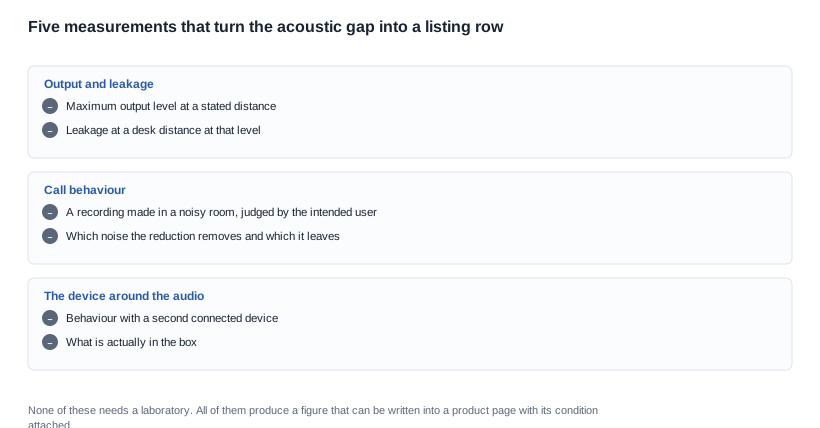
If a buyer can only do five things before placing an order, these are the five, and none of them needs a laboratory.
- The maximum output level at a stated distance, so that the ceiling a customer can reach is known and can be written into the listing.
- The leakage at a stated distance, at that level, so that the product can be positioned honestly for an open office, a train carriage or a shared desk.
- A recorded call in a noisy environment, judged by the person who will actually take the call, because intelligibility is not a number and cannot be reduced to one.
- The behaviour with a second connected device, which takes five minutes and settles the multi-device question, the volume behaviour and the reconnection behaviour in one pass.
- What is actually in the box, written down, which takes nothing and removes an entire class of complaint.
The value of all five is that they produce figures. A figure with a condition attached can go into a product page, be defended in a support call, and be used as an acceptance criterion at goods-in. A feeling about how the product sounds cannot do any of those three things, however confident the person who has it.

The order of the protocol matters more than the sophistication of the equipment. Fix the room, the distance and the background noise before the first reading, because a reading taken in an unsettled room is a number about the room. Then measure the output level, then the leakage in the same place, then make the call in noise, then connect the second device, and only then write the results up. Write the conditions next to the numbers as you go, because reconstructing them a week later is where measurement discipline usually breaks down.
Where the cost of a missing row actually appears
The returns are the smallest part of it
The cost of a missing acoustic row does not arrive as a factory defect. It arrives as a returns rate that nobody can explain, a support contact volume that is higher than the product category average, and a product page that a competitor can undercut with a number you do not have. The returns reserve is the part you can model. The support cost and the listing weakness are the parts you cannot, and they are the parts that decide whether the line is worth repeating.
There is a commercial structure worth noting here. A product that a channel positions on the acoustic experience has to be able to survive the comparison against a product positioned on a published figure. If your supplier will not produce the figures, the channel will eventually ask a competitor who will, and the difference between the two quotations is larger than any unit-price negotiation you could have run.
What you can and cannot negotiate here
The part of this category that genuinely moves in a negotiation is the measurement work itself. A supplier who will run a defined protocol on a sample, with the conditions written down, and hand over the results is offering something that costs them a technician's afternoon and saves you a launch cycle. That is worth asking for explicitly, and it is worth putting in the agreement, because the alternative is that the measurements are done once, informally, by a person who is about to do something else.
The part that does not move is the physics. The driver size, the transmission, the leakage and the microphone behaviour are determined by the acoustic design, and a supplier who offers to change them after a sample is a supplier describing a different product. The useful negotiation is about the evidence, the accessory set and the defect remedy, not about the acoustic figures themselves.
The total cost of an open-ear audio programme is the unit price plus the accessory cost plus the returns reserve plus the support cost of the claims you did not make carefully. Which one to press hardest depends on where your own channel is weakest, and the trade-off is usually settled in the sample protocol rather than in the price list.
A worked example: a brand opening a call-focused audio line
The scenario below is invented for the sake of the reasoning: it is not a client project, and it shows the order of steps rather than an outcome.
Assume a brand that sells productivity accessories into two markets, with a retail buyer asking for an open-ear audio product for hybrid work. The binding constraint is that the buyer wants a claim about call quality, and the brand has no figure to support it.
The shortlist is built on the published rows. The brand compares the models on the Bluetooth generation, the cell configuration, the runtime and the charging interface, and the shortlist narrows to three. This step is quick, and it is the only step where the spec sheet is genuinely useful.
The runtime row is read before the cell row. The G07 and the YK12 are published at about six hours against the eight hours of the models that share their cell configuration, and the brand's channel involves a full working day with the product on for calls. That is enough to keep the two slimmer-temple models on the list rather than to rule them out, because the difference may well come from the temple rather than from the cell.
The protocol is written before the samples arrive. The brand fixes a room, a distance, a level, a noisy scenario and a second device, and asks each supplier to run the same five measurements on the units it is quoting. Two suppliers answer with figures and conditions. One answers with a feature description. The third is not comparable at all, and the brand now knows that without spending a week of its own time.
The claim is written to the evidence. The listing describes what the measurements support — a maximum level at a stated distance, a leakage result at a desk distance — and does not use a phrase that no number in the file supports. The retail buyer, who wanted a claim, gets two figures and a narrower sentence, and accepts it because the figures can be reproduced by anyone who buys the product.
The accessory set is fixed in the order. A magnetic architecture means a cradle in the box, and the box list is written into the purchase order with the per-market plug treatment settled before the packaging artwork is released.
The result is a product page that a competitor cannot undercut with a single figure, and a support script that answers the call-quality question with a number. The decisive decisions were all made before the sample order, and the acoustic evidence was produced once, on a written protocol, rather than gathered separately by every person who touched the project.
What our catalogue publishes, and what we will not invent
Concretely, we publish the rows we have and mark the ones we do not, and in the open-ear audio family the published set is the electrical one. We publish the Bluetooth generation, the cell configuration and its cell count, the charge time, the rated runtime, the structural features and the charging interface, for every model in the family.
We publish no output level, no leakage figure, no driver size, no frequency response, no distortion figure, no microphone specification, no multi-device figure, no connected-device limit and no box contents for any model in the range. We will not estimate any of them, and we will not convert a feature name such as surround sound into a measured claim. A listing that says the product is tuned for calls when the range does not publish a microphone specification is a claim we cannot defend when a customer asks what it is based on.
What we will do is take two models, work through the five measurements with you, and report the numbers with the conditions attached, on a protocol you write rather than one we supply. The background is under open-ear audio, the row-by-row detail is on the open ear audio spec sheet, the recurring buyer questions are collected on open ear audio questions, and the microphone side of the product is covered under microphone quality.
Related reading
- The spec sheet row by row — the open ear audio spec sheet
- The microphone side of the product — microphone quality
- The questions buyers ask most — open ear audio questions
- The technique behind the rows — open-ear audio
Send the two models and the room you will measure in, and we will run the five measurements with you.


