

Open ear audio glasses: the questions that decide
Open-ear audio is chosen for awareness, and awareness is paid for in sound quality and in leakage. That is the trade, and it is a real one: a product that leaves the ear open lets the user hear the environment, and that same openness means the sound the product produces is not confined to the ear. A buyer who has not decided which of those two consequences matters more is not yet able to compare two quotations, because two suppliers will optimise for different outcomes and describe both with the same vocabulary.
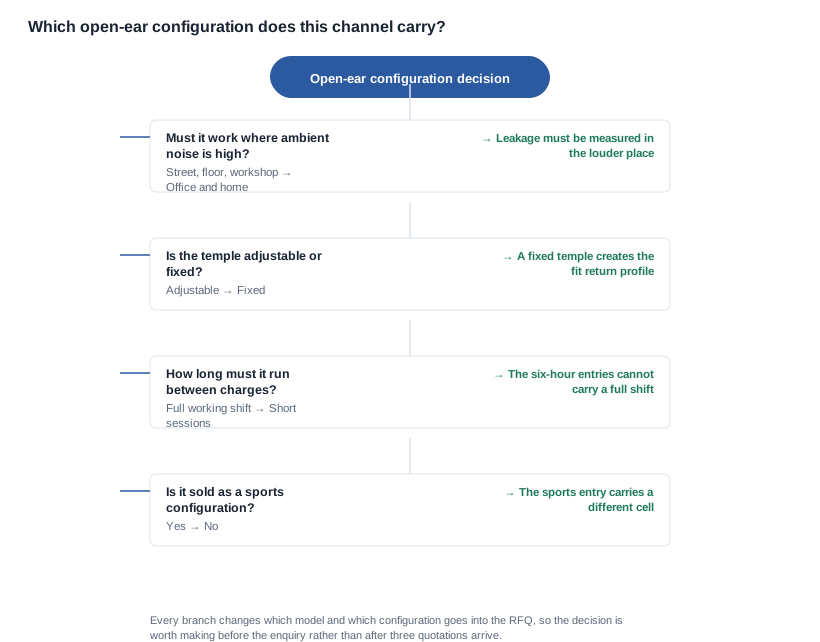
The conclusion for a procurement manager is therefore about sequence rather than about a number. Before you ask a supplier anything about open-ear audio, settle four things: the environment the product is sold into, whether the sound has to be private, how long the product has to run between charges, and whether it is sold as a sports configuration. Each of those changes which model and which configuration goes into the request for quotation, and each of them changes which rows of the resulting quotation are comparable with each other.
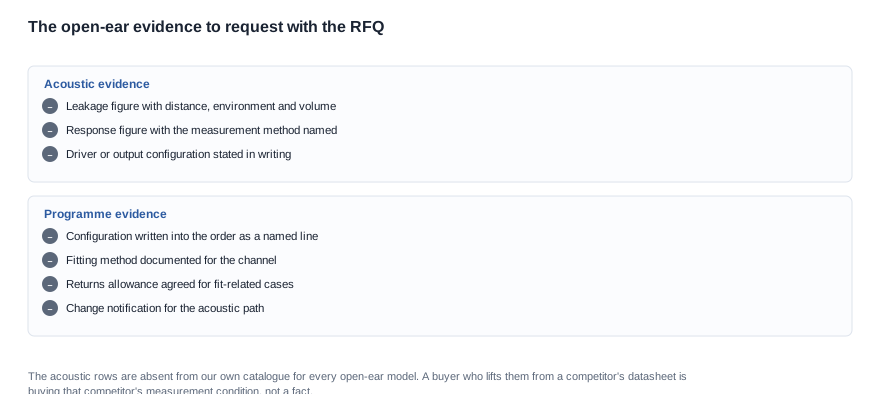
Once those four are settled, the evidence to request is short and specific. A leakage figure with a distance, an environment and a playback volume. A frequency response with the measurement method. The driver or output configuration in writing. The placement method, documented for the channel rather than left to the customer. And the configuration written into the purchase order as a named line rather than absorbed into a base model.
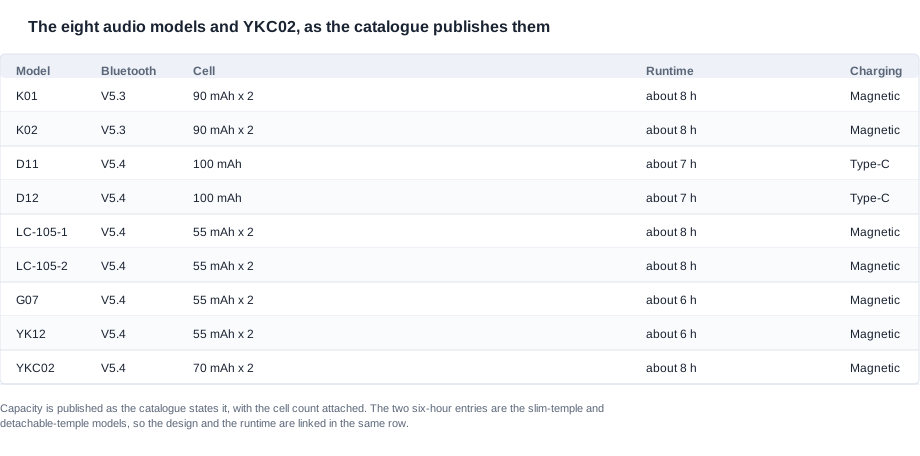
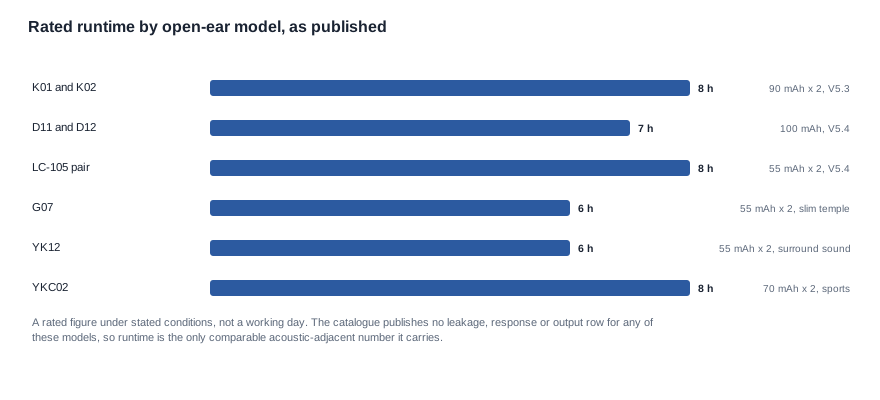
Our catalogue carries eight AI audio models, and they are worth reading as a set because the published rows move in ways a buyer would not predict from the category names. The K01 and the K02 publish Bluetooth V5.3, a 90 mAh by 2 cell configuration, roughly eight hours of runtime and magnetic charging. The D11 and the D12 publish V5.4, a single 100 mAh cell, roughly seven hours and Type-C charging. The LC-105 pair publishes V5.4, 55 mAh by 2, roughly eight hours and magnetic charging. The G07 publishes V5.4, 55 mAh by 2 and roughly six hours. The YK12 publishes V5.4, 55 mAh by 2 and roughly six hours. The sport models sit alongside them rather than inside them: the YKC02 publishes V5.4, 70 mAh by 2 and roughly eight hours as a sports configuration, the D17 publishes 115 mAh and roughly seven hours on Type-C, and the ZH12 publishes a single 100 mAh cell and roughly eight hours on Type-C.
That last group is the detail worth flagging, because it is the one buyers get wrong. The 55 mAh by 2 tier splits into two different runtime figures, and the split tracks the design: the G07 is the ultra-slim model with a detachable temple and the YK12 is the surround sound slim temple model, and those two publish about six hours, while the LC-105 pair on the same 55 mAh by 2 cells publishes about eight hours. The cell configuration is not the variable that decides the runtime here. The temple design is.
The five questions that go into the request for quotation
What is the environment? A street, a warehouse floor and a shared office produce three different products out of the same bill of materials. The environment decides whether awareness is the selling point or the leak is the objection, and it decides where the leakage measurement has to be taken.
Does the sound have to be private? If the product is sold into a shared workplace, a classroom or a client meeting, leakage is a channel constraint rather than a preference, and it needs a figure with a stated distance and volume. If the product is sold for running on a road, leakage is a much smaller concern and the figure is still worth having.
How long must it run between charges? The published runtimes in our range run from about six hours to about eight hours, with the children's models elsewhere in the range publishing considerably longer. A full-shift requirement and a short-session requirement are served by different models, and the six-hour entries are the ones that cannot carry a full working day.
Is it sold as a sports configuration? The YKC02 is published as a sports model with a 70 mAh by 2 cell and magnetic charging, which is a different bill of materials from the slim-temple audio entries. A sports channel also changes the environmental question, because the exposure is different.
What is the placement method, and what does the customer do when it is wrong? Open-ear audio is sensitive to how the product sits on the head, because the acoustic port has to end up in the right place. A product that is easy to place incorrectly produces returns that get attributed to the product rather than to the placement, and that shows up in the cost model as an unexplained margin loss rather than as a defect rate.
Who buys open-ear audio, and what they are actually buying
The reader here is a brand-side product owner working with a procurement manager, a channel buyer building a private-label audio range, or an e-commerce selector with a returns budget and no acoustic engineering resource. The situation is one of three: comparing quotations for an audio line, opening a new material number for a channel defined by an environment, or adding an audio configuration to an existing camera platform.
What that buyer is buying is a specific compromise, and the compromise is what the supplier is actually selling. Open-ear audio is not a smaller version of a closed headphone; it is a different acoustic architecture. The sound is produced by a small driver positioned near the temple and directed toward the ear, and the port through which it travels is open, which is what makes the environment audible. The buyer is buying that openness and its consequences, and the consequences are a leakage figure, a sensitivity to how the product sits, and a sound signature that is not the same as a sealed design.
Two buyers sit behind that one, and their requirements differ. The procurement manager is comparing cost and schedule and needs the configuration to be quoted as a separate line with its own minimum order quantity, because an audio variant is a different bill of materials from a base model and comparing the two on a single unit price is comparing different products. The product reviewer needs the acoustic behaviour to be describable in a listing, and needs it to be defensible, which means the measurement condition has to exist somewhere other than in a supplier's memory.
A third party is often present and is frequently the one who decides the programme. In an OEM arrangement the brand may be supplying the electronics, the firmware and the branding while the factory supplies the acoustic design and the production, and that split is where the specification fragments. The brand's firmware team believes the acoustic behaviour is a hardware matter, and the factory believes it is a tuning matter, and nobody owns the row that describes the result. Assigning that row to a named person before the sample order is the cheapest action in this category.
There is also a returns story that a buyer should model before the price is agreed, and it is characteristic of open-ear products. The failure is not a defective unit; it is a unit that is placed wrongly, in a place the product was never specified for, or that a customer expected to be quieter than it is. Neither appears in the defect rate. Both appear in the returns figure, and both are addressable by two documents: a placement method written for the channel, and a leakage figure with its conditions.
Where the cost of an open-ear configuration sits
The unit price of an open-ear configuration is where the cost comparison starts and where it usually goes wrong, because the visible difference between two quotations is small and the invisible difference is not. The reason is that the audio configuration changes the bill of materials, and in a camera platform it also changes the documentation scope.
The bill of materials consequence is the first thing to ask for and the easiest to get wrong in a comparison. An audio configuration brings a driver, an amplifier stage, a magnet, an acoustic mesh or port treatment, and a design change to the temple to accommodate the driver and the port. None of that is optional and all of it is per unit. When a supplier quotes an open-ear variant at the same unit price as a base model, the useful question is not whether the margin is good but where the acoustic parts are accounted for. A variant priced as a base model is a variant that will be substituted with something cheaper at production time.
The second cost is the acoustic consistency across a production lot. Open-ear performance depends on the port position and the seal around it, and small assembly variations move the sound signature. A design with a wide tolerance produces a wider spread of real-world performance than a sealed design, and that spread lands in the returns figure. The only defence is an acceptance criterion, and the criterion has to exist before the first lot rather than after the first complaint.
The third cost is the documentation scope. A product with an audio configuration is a product with a radio, and a radio is a certification route with a duration the factory does not control. Where the audio configuration is added to an existing camera platform, the question to ask is whether the radio and acoustic documentation for that combination already exists or has to be opened. That number belongs in the schedule as an external dependency, not in a footnote.
The fourth cost never appears on a quotation: the placement-related returns allowance. It is larger than an audio category average in most channels, and it is invisible to any comparison that is limited to unit price and lead time. Pricing it explicitly, as an agreed allowance in the cost model rather than as a surprise in the first quarter, is a commercial decision that has to be taken before the price rather than after it.
So the buyer's negotiating space sits in the configuration definition, the per-configuration minimum order quantity, the number of orderable variants and the acceptance criteria, including the placement and leakage criteria. It is not in the price of the driver.

Checking an open-ear answer before the order
Verification here combines documents with a short physical test, and the physical test is the part that cannot be delegated.
Step one: ask for the leakage figure and the volume at which it was measured. A privacy argument without a measurement is a marketing position. A buyer relying on it as a specification needs the number, the distance, the environment, the background level and the volume. If the supplier will not state the background level, the figure is not usable, because a leakage measurement is meaningless without knowing what it is leaking over.
Step two: ask for the response and the output configuration in writing. The measurement method matters more than the number, because a response figure measured with the product in a fixture is not comparable with one measured on a head.
Step three: test the awareness argument in the environment the product is for. This is the step that separates a product that works from a product that sounds convincing in a demonstration. Use a third-party customer rather than the person who set the product up, because placement changes the result more than most buyers expect, and run it at the volume the channel expects rather than at a normal working level.
Step four: test the placement method and read the in-box instructions. Put a first-time customer in front of the instructions without help and see what happens. That single test tells you whether the placement documentation is doing its job, and it is the test that most reliably predicts the placement-related returns rate.
Step five: ask for the configuration to be quoted as its own line. A different bill of materials deserves a different line, with its own minimum order quantity and its own lead time. Where the acoustic path differs between variants, ask whether they are separate orderable configurations with separate part numbers.
Step six: write the criteria into the purchase order. The leakage condition, the placement method as a deliverable, the acceptance criterion and the defect remedy for a unit whose measured acoustic performance does not meet the agreed figure.
How open-ear programmes fail
The quiet-room demonstration. The awareness argument did not survive the environment the product is sold into. The root cause is that the demonstration environment was chosen by whoever was present rather than by the requirement. The control is to add an environment test at the expected volume with a third-party customer to the sample evaluation.
The privacy claim with no measurement. A channel sold the product on a privacy argument that was never quantified. The root cause is that the claim was written by the marketing team rather than derived from a figure. The control is to require a leakage figure and a condition before the claim goes into the listing, and to give the channel the same figure rather than a paraphrase.
The placement that produced returns. Customers placed the product incorrectly and the returns were attributed to the product. The root cause is that the placement method was never documented for the channel. The control is to treat the placement instructions as part of the deliverable, and to test them with a first-time customer before they go to print.
The variant priced as a base model. Two configurations were compared on a single unit price and the difference was discovered at the order. The root cause is that the acoustic parts were never shown as a line. The control is to quote each configuration separately with its own bill-of-materials line, its own minimum order quantity and its own lead time.
The configuration that changed after approval. A production variant shipped with a different acoustic path from the approved sample and nobody was notified. The root cause is that the acoustic path was not on the change-control list. The control is to put the driver, the port treatment and the temple geometry on the change list with a notice obligation attached.
Each of these is routine, and none of them is grounds for moving the order to another supplier. They are reasons to put a line in the order.
The commercial terms an open-ear programme can move
Open-ear audio is a specification dependency rather than a free upgrade, and the cost of it should be visible in the quotation rather than absorbed into a feature list. Knowing which lines move is worth more than pressing hard on all of them.
The number of orderable configurations and the per-configuration minimum are the live numbers. Ask whether the variants are separate orderable configurations with their own part numbers, and commit to a configuration count rather than a unit count. Where the programme spans several audio configurations, the packaging artwork, the listing copy and the compliance scope all become per configuration, and the cost of that multiplicity is usually the largest hidden item in the quotation.
The placement method as a deliverable is negotiable and almost always priced as though it were free. A supplier will usually include instructions, and will usually treat an illustrated, channel-specific placement guide as a separate item. Asking for it explicitly costs little and it is the document that reduces the placement-related return rate.
Sample cost, evaluation unit quantities and first-article inspection allowances are negotiable and are frequently given away. Under pressure on a first order these are easy to obtain and cost the supplier very little, which is why they are worth taking before capital goes into anything structural.
The acceptance criteria are negotiable in wording and fixed in substance. A supplier will argue about the measurement distance and the volume. The criterion itself, and the consequence of missing it, are the parts that should not move.
Certification cost, certification time and any re-test caused by a configuration change are fixed. They are a per-family cost and a queue at the test laboratory, and pressing on either produces a longer schedule rather than a shorter one. A re-test is charged per configuration, which makes it the line that compounds across a range.
The acoustic architecture is not a commercial variable. If the requirement needs the product to leave the ear open, no negotiation turns it into a sealed design. What negotiation can do is change the number of configurations, the size of the first order, the artwork rounds, the documentation obligations and the acceptance criteria that bind them.
The clauses worth having in the agreement are these. The configuration definition, written into the order. The leakage figure with its distance, volume, environment and background level. The placement method and its documentation, named as a deliverable with an owner. The protection applied to the acoustic path. The defect remedy for a unit whose measured acoustic performance does not meet the agreed figure. And a change-notification clause covering the driver, the port treatment, the temple geometry and the firmware.
A worked example: a workplace supplier adding an open-ear line
This is a hypothetical case rather than a real engagement, and it exists to make the order of decisions visible rather than to report a result.
Assume a safety equipment distributor selling to logistics operators, currently supplying radio headsets, and considering an open-ear smart glasses line for warehouse staff who need to hear their surroundings. The constraint that matters is not the price. It is that the operator's safety procedure specifies a communication device in writing, and a product that cannot be written into a procedure is a product that never gets bought.
The first move is to write the exposure into the requirement. The warehouse has a racking aisle with a forklift, a packing area with a scanner, and a loading bay with traffic noise outside. The distributor asks for a leakage figure in the packing area, because that is where two people work close together, and for a response figure measured on a head rather than in a fixture. Two of the three quotations answer with a method and a condition. One answers with a figure and no condition, and the distributor now knows that the third is not comparable with the other two, which is a more useful outcome than a lower unit price.
The second move is the placement question, and it turns out to be the decisive one. The distributor's operator is a warehouse worker who puts the product on with gloves on, in a hurry, at the start of a shift. A supplier whose placement method assumes two careful hands is not selling into this channel. The distributor asks the two credible suppliers for a one-glove placement method, illustrated, and one of them produces it as a sample insert. That document becomes the deliverable, and it is the single change with the clearest return on it.
The third move is the run-time question. The shift is eight hours and the warehouse has no charging point on the floor. The catalogue runtimes of about six, seven and eight hours mean the buyer is choosing between a model that reaches the end of a shift and one that does not, and that is a specification question rather than a price question. The distributor chooses the eight-hour entries and drops the six-hour models from the range entirely, which simplifies the SKU count and the artwork at the same time.
The fourth move is commercial. The distributor asks for the acoustic configuration to be quoted as its own line with its own minimum order quantity, and for the placement insert to be named as a deliverable with a reprint price attached for the next run. Both are agreed. The distributor also takes the sample cost concession and the first-article inspection allowance, which were offered and would not have been requested.
The result is a product a safety procedure can name, a leakage figure the channel can use, a placement method that survives the environment, and a range with fewer variants than it started with.
What our catalogue publishes about open-ear audio, and what it leaves open
The published material on open-ear audio is the part of the specification we can stand behind, and everything else belongs in the supplier's own file. We publish the rows our catalogue states, we mark the open rows as open, and we will not fill an open row with a typical value from a general data sheet.
These are the rows we do not publish for any open-ear model:
- The leakage figure to the surroundings is not published.
- The frequency response and the driver or output configuration are not published.
- The number of drivers, the driver size and the amplifier configuration are not published.
- The placement method and the tolerance across head shapes are not published.
These are the rows our published data does settle, and they are the rows to use to structure a comparison:
- The K01 and the K02: Bluetooth V5.3, 90 mAh × 2, roughly eight hours, magnetic charging.
- The D11 and the D12: Bluetooth V5.4, a single 100 mAh cell, roughly seven hours, Type-C charging. The D11 is additionally published with surround sound and long battery life.
- The LC-105-1 and the LC-105-2: Bluetooth V5.4, 55 mAh × 2, roughly eight hours, magnetic charging.
- The G07: Bluetooth V5.4, 55 mAh × 2, roughly six hours, magnetic charging, published as an ultra-slim model with a detachable temple.
- The YK12: Bluetooth V5.4, 55 mAh × 2, roughly six hours, magnetic charging, published with surround sound and a slim temple.
- The YKC02: Bluetooth V5.4, 70 mAh × 2, roughly eight hours, magnetic charging, published as a sports model with surround sound and long battery life.
One point about reading those rows: the two six-hour entries are the slim-temple and detachable-temple models, so the runtime difference within the 55 mAh by 2 tier is a design difference rather than a capacity difference. And the totals for the two-cell entries are a derived figure, not a published one — the catalogue states the capacity per cell and the number of cells, and a buyer should compare on that basis rather than on a total the catalogue does not carry.
Two adjacent rows are worth knowing because they are asked for constantly. The battery life guidance covers how a rated runtime should be read, since a rated figure under stated conditions is not a working day. The AI features guidance matters for the audio tier because the voice assistant and the audio path share the same power budget. And the IP rating guidance is the answer to the question about the acoustic port, which is usually an open one. The bluetooth audio glasses range is where the eight AI audio models sit.
What to settle before you write the request for quotation
Settle the environment, the privacy requirement, the run-time requirement and the sports question before you write the request for quotation. Those four answers decide which model and which configuration you are actually buying, and they stop the comparison from being made across different products.
Then put five rows in the request: the leakage figure with its distance, volume and background level, the response figure with its method, the driver or output configuration, the placement method as a document deliverable, and the configuration written into the order as a named line.
Finally, put the placement-related returns allowance into the cost model before the price is agreed, and ask for it to be classified in the agreement. Send us the configuration, the quantity, the environment and the target market and we will tell you which of the published rows apply and which questions are the ones we would put to the factory ourselves.
Related reading
- What to ask before claiming an AI feature — AI features
- IP rating guidance
- What a runtime figure needs before you rely on it — battery life
- bluetooth audio glasses
- How open-ear audio actually behaves — open-ear audio
Send the configuration, the quantity and the environment, and we will say which parts of the open-ear specification are settled and which are yours.


