

Photochromic is a word covering at least two different technologies, and a checklist that does not force that distinction on its first line will produce a procurement error three weeks later. Our catalogue contains one dedicated entry described as electrochromic with no model designation, and one camera platform that lists photochromic lenses as a configuration option. Neither publishes an optical performance figure of any kind, which is why the checklist below is weighted heavily toward what you must request rather than what you can compare. Photochromic smart glasses buying checklist covers the selection stage only: how to screen a candidate before it enters your shortlist, what to ask, and what evidence has to exist before you commit a supplier to that shortlist.
Photochromic: rule zero, the mechanism in writing
This checklist is not a comparison of products. In this category there is no published performance baseline to compare against, and a buyer who arrives with a ranking in mind will end up ranking on the only thing that is comparable, which is price. The checklist is therefore a filter, and its job is to remove candidates that cannot support the programme you have in mind.
The first filter is the mechanism, and it is binary.
An ultraviolet-reactive lens is passive. It responds to ultraviolet light in the environment, which means it needs light to darken, it activates at a reduced level behind glass, and it performs differently in hot and cold conditions. It adds no cell, no driver, no firmware function and no charging routine to the product.
An electrically driven lens is active. It darkens in response to a signal rather than to ultraviolet exposure, which means its behaviour behind a windscreen does not follow from the mechanism, and it brings a power path, a control connection, a defined state and a flat-battery behaviour into the product.
A hybrid sits between them and has to be described precisely, because a hybrid that still needs ultraviolet for its full range has the passive lens's warm-weather weakness while carrying the active lens's power burden.
The question has to be answered in writing and on the quotation, because a mechanism named in a catalogue row and a mechanism named in a technical document are different things, and a programme built on the first one discovers the second one at the first article.
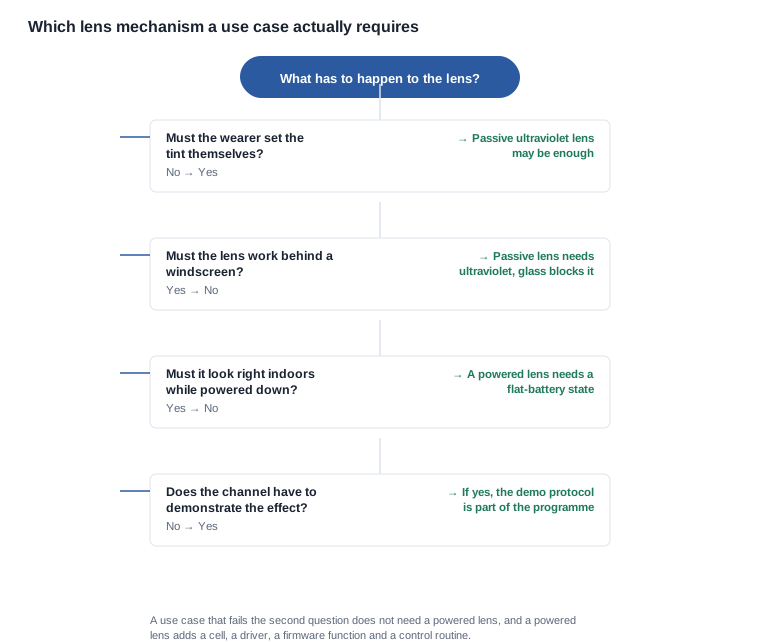
Working back from the mechanism is usually more productive than starting from the product. Four questions, asked in this order, will settle which route a use case needs before any supplier is contacted. Does the customer have to set the tint themselves? If not, a passive ultraviolet-reactive lens may be sufficient, and the programme loses a cell, a driver, a firmware function and a charging routine. Must the lens work behind a windscreen? If yes, a passive lens is in difficulty, because the ultraviolet it needs is filtered by the glass and the behaviour indoors becomes the behaviour in the car. Must the product appear correct when the power is off? If yes, a powered lens needs a defined flat-battery state, and that state is a design decision rather than a behaviour to be discovered. And can the channel demonstrate the effect at all? If not, the claim cannot be written, whatever the mechanism turns out to be.
The order matters because each answer eliminates a route. A programme that reaches the fourth question with both routes still open has done less work than one that answered the first question properly, and the first question is the one a buyer can usually answer from the channel description alone.
Screening questions one to three: mechanism, tint ceiling, timing
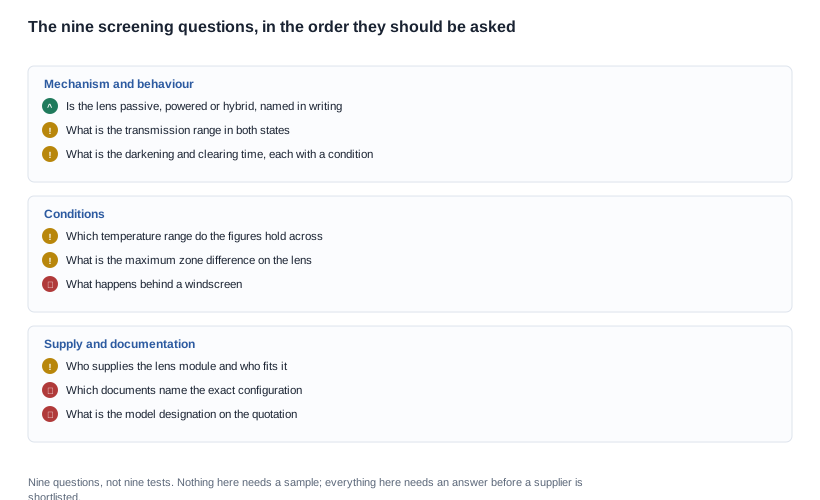
Question one is the mechanism, and it is a filter rather than a ranking criterion. A supplier that will not name the mechanism has not specified the product, and a product that has not been specified cannot be assessed against anything.
Question two is the tint ceiling — what transmission the lens reaches at its lightest and at its darkest, with the method attached. This decides whether a sunglass proposition was ever available, and it decides the claim you will be able to write. A supplier that answers with an adjective has answered the question in the only way that cannot be used, and that answer is a legitimate basis for removing the candidate.
Question three is the timing, in both directions, each figure with a light level and a temperature attached. A single figure covering both directions settles neither, and a figure without a condition is a marketing number rather than a specification. Two suppliers' timing figures are not comparable unless the conditions match, so the condition is the part you are actually buying.
The nine screening questions that decide whether a supplier reaches the shortlist
Nine questions, sent as one written request to every candidate, before any price discussion. A supplier who answers all nine has a specification habit. A supplier who answers three has a sales sheet.
Screening questions four to six: conditions, uniformity, endurance
Question four asks what conditions the figures hold across. Temperature is the one that matters most for a light-responsive lens, because the behaviour of both mechanisms is temperature-dependent, and the cold end is where a customer in a northern winter market will meet the product first.
Question five asks for the uniformity tolerance — the maximum difference between defined zones, measured on a stated grid, with the measurement points identified. A centre reading is not a tolerance, and a tolerance that is not agreed before the first article is a tolerance that has already been missed. This question is also a scheduling question, because a lens programme without a grid agreement has a first-article slot that nobody can plan around.
Question six asks about endurance with an end point: a cycle count and, more importantly, the transmission value at which the lens is considered failed. A cycle count without a failure criterion is a quantity with no consequence, and a warranty written against it cannot be adjudicated. The failure criterion is the buyer's to write, and the question to the supplier is which measurement method produces the number.
Screening questions seven to nine: supply, fit, documentation
Question seven asks who supplies the lens module and who fits it. Optical supply is specialised, and the lens is generally not made by the frame factory. If the module arrives pre-fitted, the transit risk, the warranty position and the responsibility for an assembly defect all change, and so does the cost structure of a failure.
Question eight asks for the fit rows: temple length, temple curve and the width at the temples, for the specific model designation. These are not lens questions, but they belong on the same request because a lens that changes state is fitted into a frame whose geometry governs how it sits, and the geometry rows are rarely on a lens quotation.
Question nine asks which model designations appear on the documents. This is the question that most often ends a candidate, and it is worth asking early rather than late. A family-level document does not cover your configuration, and a product with no published model designation is harder to place in a conformity file, harder to reference in a contract, harder to trace in the field and impossible to cover with a model-specific document at all.


The evidence pack a supplier must produce before it is shortlisted
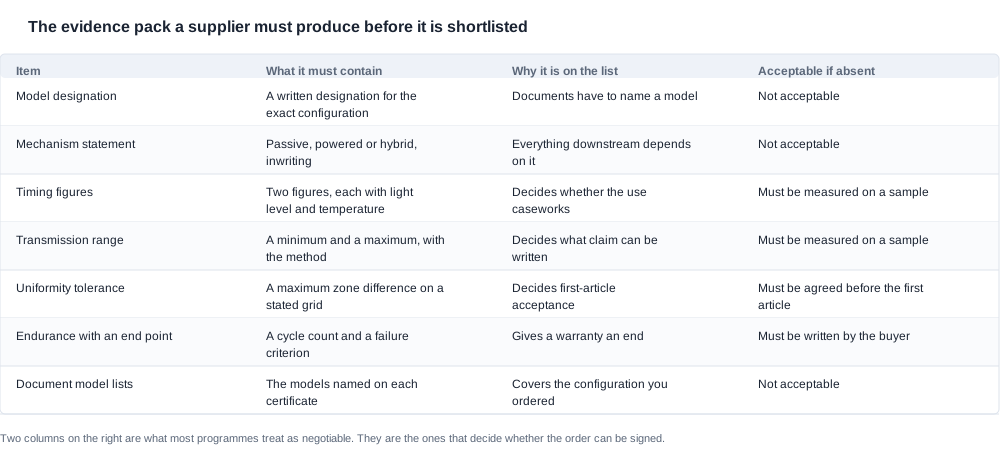
A screening question produces a shortlist. An evidence pack produces a purchase order, and the two are different documents with different consequences. The pack is what a supplier has to hand over before you put it in front of a pricing comparison, because the price comparison is only valid once the configurations are the same.
Seven items make up the pack, and the right-hand column of the table below says what happens when each one is absent. Two of them cannot be absent at all; the other five can be absent only if a buyer-run measurement is written into the acceptance criteria as a substitute.
What separates a document a supplier can produce from one it cannot
The practical test for a candidate is whether it holds documents or only statements. A supplier that produces the model's certificate numbers, with the issuing body and the validity dates, can be checked by your compliance team, your broker or a marketplace, and it can be checked years later. A supplier that produces a statement that the products are certified cannot be checked by anybody, and the difference between the two is the whole of the value.
The same distinction applies to the lens figures. A transmission range with a method is a document. A transmission range described in a meeting is a statement. The filter to apply is simple: if the answer only exists in a conversation, it is not evidence, and it does not move the candidate up the shortlist.

Filters that remove a candidate, as opposed to filters that rank one
Most checklists in this category are a ranking list, and a ranking list is the wrong instrument here. A rank requires a comparable scale, and this category has none: no lens performance figure is published for either of the two routes we offer, so the only axis on which two candidates can be honestly ordered is cost.
Removal filters and ranking filters have to be kept apart, because they answer different questions and they are used at different stages. A removal filter is a yes-or-no question asked before the candidate is worth any more of your time. Can the supplier name the mechanism? Will it commit to the model designation in writing? Will it supply figures with conditions? Can it evidence the documents for the exact configuration? A candidate that fails any of these is not a lower-ranked candidate; it is a candidate that will cost you the programme.
A ranking filter applies only between candidates that have already passed. Between those candidates, the axes that remain are the ones you control: the configuration count, the minimum order quantity per configuration, the price tier at your committed volume, the sample cost, the payment structure, the lead time against your launch date and the accessory and packaging scope. These are legitimate ranking axes and they are the ones a buyer should be negotiating on, because they are the ones that differ.
The mistake worth naming is running the ranking list before the removal filters. A buyer who compares two candidates on price, sample cost and lead time before establishing the mechanism and the model designation is comparing two different products, and will pick the cheaper one, and will discover the difference when the documentation arrives.
Three questions that are not lens questions and should not be on this list
Buyers routinely carry three non-lens issues into a lens selection and lose time on them. Prescription is a different supply chain with different vendors: a filled prescription lens and a tinted lens are made by different people, and an assembly is assessed against a face while tint is not. Weight is a frame property that a lens changes, and on our catalogue the published position is thin — one product weight exists, and it is the MT6 glasses body at 158 g including its fitted battery and camera and excluding the folding charging case, which holds 1200 mAh and whose own weight is not published. No bare frame weight is published for any model, so the weight consequence of adding a tinted lens is unquantified on every model and has to be requested. Ingress rating is not a lens property at all: two of our sport platforms carry IP54, which tells you nothing about a lens module and tells you nothing about the assembly the lens sits in.
Each of these belongs to a different conversation with a different owner, and putting them in the lens checklist dilutes the nine questions that actually decide the shortlist.
How to run the checklist when the shortlist is still empty
A buyer with no candidates at all faces a different problem from a buyer with eight, and the checklist has to be run in the other order. The first task is to establish how many candidates can realistically exist, because in this category the answer is often smaller than the list suggests. Suppliers who claim a light-responsive product usually hold one lens module and one assembly partner, and the lens module is the constraint: the number of distinct suppliers who can actually deliver a powered lens is limited, and two of them will often be offering the same module in different frames.
The second task is to write the use case in one paragraph before any request goes out, because the nine questions are only decidable against a stated environment. A channel that sells a commuting product needs a different answer from a channel that sells an outdoor product, and the difference shows up in the windscreen question, the temperature question and the timing question. A one-paragraph use case also protects the buyer against a supplier who answers a question with a specification that happens to suit a different channel.
The third task is to set the removal criteria before the requests go out, which sounds procedural and is not. If the removal criteria are written afterwards, they will be written to suit whichever candidate survived, and the shortlist will have been decided before it was assembled. The criteria to write first are the model designation in writing, the mechanism named, and the figures with their conditions.
What to do with the answers that come back
Most responses will be partial, and the handling rule matters more than the volume. A missing answer is not the same as a wrong answer, and the two need different responses. A wrong answer — a transmission range that contradicts the mechanism, a document naming a family where a model was required — is a contradiction, and contradictions do not close by negotiation. A missing answer is a gap, and gaps close by making the item a condition of the purchase order or by substituting a buyer-run measurement.
The third category is the soft answer: a figure delivered with no condition attached, or a claim expressed as an adjective. Soft answers should be counted, not argued with. A candidate that answered four of the nine questions properly and five of them softly has told you something real about its documentation, and the shortlist should reflect that rather than the volume of paper it produced.
Finally, record the answers where they can be compared across candidates. A simple sheet with nine rows and one column per candidate, with the missing entries left visibly empty, is worth more than a set of individual replies, because the point of the exercise is to see the shape of the gap rather than to read nine answers in sequence.
What we publish, and what we would have to obtain for you
We publish the existence of these options, because they exist, and we will not attach a tint depth, a response time or a transmission range to either route, because we have no measured figures for them. For the dedicated electrochromic entry what we publish is Bluetooth 5.4, a 100 mAh cell, charging in two hours or less, roughly seven hours of rated runtime, magnetic charging, and the fact that the lenses are electrochromic. For the V03 Pro camera platform we publish the camera resolution, the cell, the charge time, the runtime, the charging interface, the temple type, the colour options, and the existence of a photochromic lens configuration — the listing confirms the option exists and says nothing about the lens.
That means the honest position for a buyer is that our range offers two photochromic or electrochromic routes, and publishes no performance data for either. The checklist above is therefore weighted toward what you must request, and every item on it is answerable.
The shortlist we can complete from our own rows
If you send us the models, the quantities, the destination markets and the environment the lens has to work in, we will tell you which of the nine screening questions our own documentation answers today, which need a written answer from a supplier, and which need a buyer-run measurement on a fixed protocol. We will also say which of the two routes the requirement actually needs, because the mechanism question decides the programme before any of the other eight matter.
One thing we will not do is shortlist on your behalf. There is no published lens performance figure for either route, so any ranking we produced would be a ranking of documentation quality rather than of products — a useful diagnostic, but not a selection. What we can produce is the subset of the nine questions our own rows already answer, which on today's published position is the mechanism, the platform rows and the existence of the configuration. Everything else has to come from a supplier in writing or from a measurement on your own units, and the order of those two sources is a decision you should make deliberately: a written figure from a supplier is cheaper and faster but carries their conditions, while a buyer-run measurement carries yours and is the only figure that will defend the claim in your own channel.
The technical background is under photochromic lens. For how a tint interacts with a prescription programme, see prescription lens questions, and for the protocol that answers the questions a supplier cannot, sample evaluation. The compliance side is in photochromic certification.
Related reading
- Why a tint claim without figures is unverified — photochromic certification
- Separating tint from prescription — prescription lens questions
- Getting figures you can publish — sample evaluation
Tell us the environment the lens has to work in and we will say whether our documentation supports that use case.


