

Photochromic smart glasses certification cannot be answered from a catalogue, because our catalogue carries no per-model conformity row for this category and does not name the product at all. That is the situation, and it is worth stating before any regulation name, because the regulation names are the part everyone already knows and the part that is not in dispute.
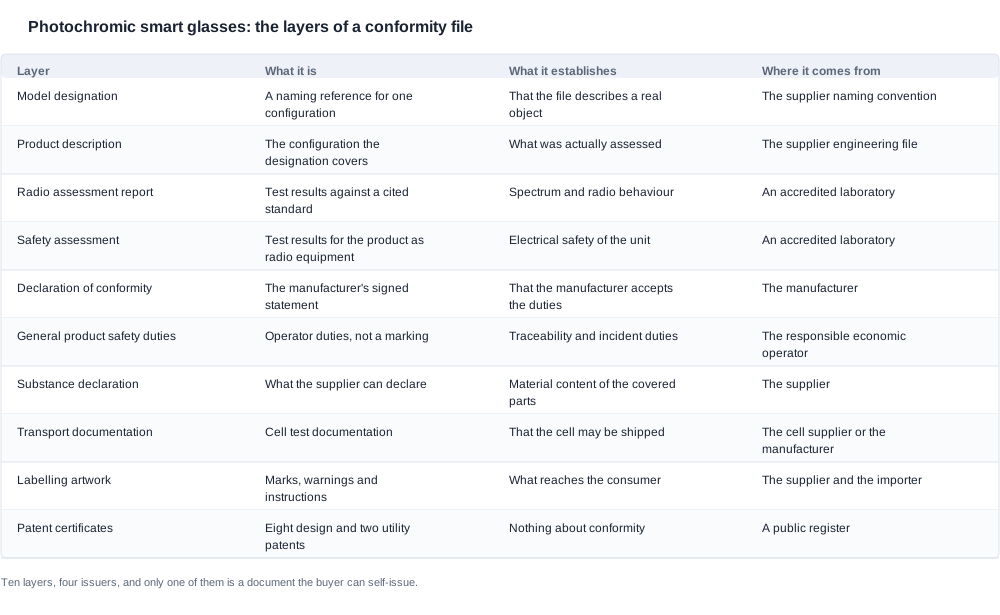
The entry in question is the AI electrochromic smart glasses line, published without a model designation. The catalogue does carry a company-level export-certification page, and the content of that page is images rather than text, so it cannot be read as a list of approvals held. The catalogue text contains no reference to the European conformity marking, to the United States radio-equipment authorisation, or to the restricted-substances declaration that buyers most often ask about, for any model in the range. Ten patent certificates appear on that page — eight appearance-design patents and two utility-model patents. A patent is evidence that an invention was registered; it is not evidence of conformity.
The conclusion follows directly: the file has to be requested, and it has to be requested in a deliberate order. What follows sets out the classification decision that determines which file applies at all, the two European instruments that must be kept apart, why a harmonised standard is evidence rather than a certificate, the sequence in which documents should be demanded, and the part of the question our own published material cannot settle.
Photochromic smart glasses: why an unnamed row is hard to classify
Conformity assessment attaches to an identified object. That is the whole difficulty, and it is administrative rather than technical — which is good news, because administrative obstacles have a known solution and a known cost.
The catalogue publishes this product line under a category name with no model designation attached. Before any assessment can begin, the object has to be named, and naming it is a manufacturing decision: the designation carries the tooling reference, the configuration and the labelling, so it cannot be invented by a buyer in an email and it cannot be borrowed from a neighbouring product in the range. In practice this means the supplier has to decide and publish a designation, and a buyer who has not obtained one cannot start a genuine due diligence conversation, because every document the buyer subsequently asks for will be issued against a name that does not yet exist.
The second consequence is traceability. A conformity file that is not pinned to a single designation has no value at the point where it is needed — at the port, in a distributor's warehouse, in a product recall, or in a consumer protection case. The designation on the purchase order, the designation on the carton, the designation on the product label and the designation on the supplier's declaration have to be the same string, and if they are not, the importer owns the mismatch.
The third consequence is commercial and is often the most expensive. A change of designation is a change of product, legally speaking. If the supplier issues a second designation for the same physical product because the first was used on paperwork that no longer applies, the buyer can no longer treat the two as interchangeable, and a re-order against the first name becomes a different product that has to be documented from scratch. This is one of the reasons a shortlist built on model names is worth more than a shortlist built on unit prices.
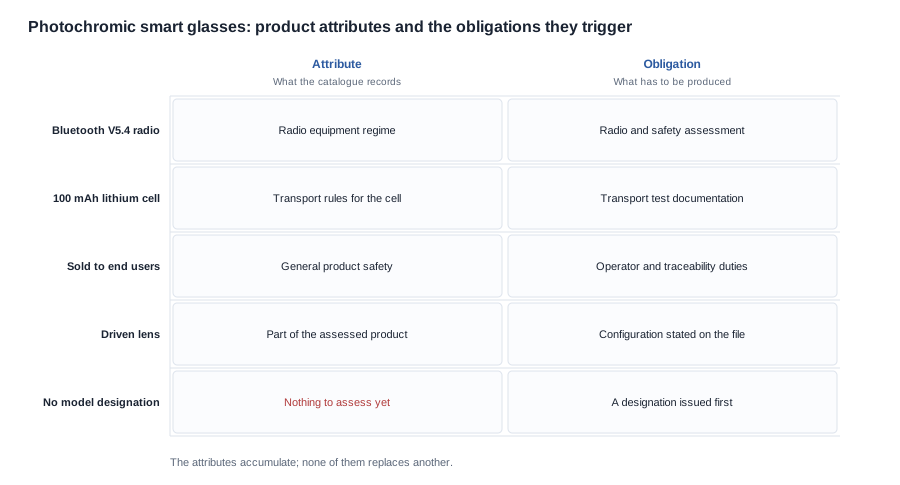
Now the classification itself, which is where the category becomes unusual. Four separate attributes of the object determine which obligations attach to it, and they accumulate rather than compete.
- It is a radio product. The catalogue records a Bluetooth version 5.4 radio, and a device that transmits sits inside the radio-equipment regime, which is the anchor for the whole file.
- It contains a lithium cell of 100 mAh charged through a magnetic lead, which brings transport documentation into the file for every shipment regardless of the destination.
- It is a consumer product placed on the general market for end users, which brings general product safety obligations on top of the radio regime, including traceability of the responsible economic operator and the information that must accompany online sales.
- Its defining feature is an optical element that changes state under electrical control. That matters for classification because a functionally active element is assessed as part of the product's operation rather than as a passive lens fitted afterwards.
So the file is the union of four obligation sets, and a buyer who expects a single document called a certificate will be disappointed. What the buyer is really assembling is an evidence package, and the skill lies in deciding which pieces are load-bearing before the first sample order is placed.
There is a further test that separates a category from a one-off, and it applies here more than most. A classification is only useful if it survives the next production run. Ask whether the assessment would still hold if the supplier changed the lens supplier, the cell supplier or the charging lead, and whether the answer is that the assessment covers the product rather than the components. Where the answer is that the file describes a configuration rather than a product, the buyer is exposed to a re-assessment every time a component changes, and the total cost of that exposure is a negotiation variable that a supplier will not volunteer.
The same logic applies to the relationship between the sample and the production units. A file that covers a sample covers that sample. The commercial question is how the supplier guarantees continuity, and the honest answer is usually a written statement about which changes trigger a new assessment. Buyers who ask that question early get a far better position at the point where a component is swapped for cost reasons in the middle of a production year, which is exactly when it happens.

Two European instruments that must be kept apart
The single most common structural error in a file of this kind is treating the radio regime and the electromagnetic compatibility regime as parallel obligations that both apply to the same product. They are not, and a supplier who lists both without explanation is telling you something about the care of the file.
The Radio Equipment Directive, (EU) 2014/53/EU, is the instrument for products that transmit. It brings together radio spectrum requirements, radio electromagnetic field exposure, and equipment safety, and the assessment it produces ends in a written declaration of conformity, the marking, and the placing of the declaration on the market. Any device with a Bluetooth radio of the kind recorded in the catalogue belongs here.
The Electromagnetic Compatibility Directive, (EU) 2014/32/EU, is the parallel instrument for equipment that is not radio equipment. It exists because equipment that does not transmit can still generate and be affected by electromagnetic disturbance, and it needs its own route. It is a common and consequential error to quote 2014/32/EU as though it were the radio directive, and to do the reverse is equally wrong. The check is short: a file that says the product is radio equipment and then also claims the electromagnetic compatibility directive applies to it has an internal inconsistency, and that inconsistency is worth raising before the goods move.
The general product safety regulation, (EU) 2023/988, sits above both. It is not a conformity regime and produces no marking; it places obligations on the economic operator responsible for the product, requires traceability from the consumer back to the responsible party, and carries reporting duties when a product presents a safety risk. For a category sold largely through online channels, the practical consequence is that somebody has to be identifiable in the European Union as the responsible party, and that is a contractual and legal fact rather than a technical one.
The practical procurement consequence of the three-instrument structure is that the buyer's file is not one document but a set of them, and each set has a different issuer. The radio assessment comes from a test laboratory, the declaration comes from the manufacturer, the general product safety obligations attach to the economic operator, and the transport documentation comes from whoever supplied the cell. A checklist that assumes one signature covers all four is a checklist that will come back with three of them missing.


Harmonised standards are the evidence, not the certificate
A second confusion runs alongside the directive confusion, and it is the one that produces the most disappointments at the point of customs clearance.
A harmonised standard is a published document. Its special status is that applying it in full confers a presumption that the manufacturer has met the relevant legal requirements — a presumption that can be challenged, which is why a supplier who has applied only part of a harmonised standard, or who has applied an older edition, may need an additional assessment. A standard is not issued for a product, it is not signed by a laboratory, and nobody can give you a certificate stating that a product conforms to it. The thing that exists in the supplier's filing cabinet is a test report, and the distinction decides whether your file is worth anything.
Two standard families belong in the file for a product of this kind. The EN 301 489 series covers electromagnetic compatibility for radio equipment, and EN 300 328 covers wideband short-range data transmission in the 2.4 GHz band, which is where a Bluetooth radio of this class operates. A supplier who has done the work will be able to tell you which edition was applied, which laboratory ran the tests, whether the laboratory's accreditation covers those specific tests, what the sample identification was, and the date. A supplier who answers with a scan of a cover page has given you the title of a standard, not a result.
The gap between the report and the product is where the risk actually lives. A test report describes a sample that existed on a particular date in a particular laboratory. It does not describe the units you will receive, and nothing in the report ties it to a product designation unless somebody deliberately makes that link. The link is the buyer's job to demand, and it is cheap to demand: the report should identify the sample, and the sample should be identified as the model you are buying, in the same configuration, including the lens, because the lens is the component most likely to vary between batches.
There is a second, separate radio question that no European document answers. The Bluetooth specification qualification regime is operated by the Bluetooth SIG, and it is a membership and declaration system in its own right, quite separate from any regulatory conformity assessment. A buyer can therefore do a check that no supplier document replaces: find the company in the SIG's own published listings and confirm that the product identifier it declares covers the design you are buying. A company that appears nowhere, or that declares a different product identifier, has told you something material and it costs one search to establish. The catalogue publishes nothing about SIG qualification, and it would be wrong to read the Bluetooth version figure as evidence of it.
Two further points belong with the standards rather than with the directives, because they are where the practical difficulties in this category concentrate. The first is edition control: standards are revised, and an assessment performed against a superseded edition may no longer produce the presumption it once did. A file that names an edition but not its date leaves the buyer unable to tell whether the assessment is current. The second is retention: the file has to survive the life of the product and the period in which a consumer can still make a claim, which means the documents have to be in the buyer's possession rather than the supplier's, and the supplier has to commit to supplying them again years later when a new buyer inherits the product line. That commitment is a clause in the supply agreement, and it is worth more than a discount of the same size.
The ten certificates on the company-level export-certification page deserve one sentence, because they are easy to mistake for conformity evidence. Eight of them are appearance-design patents and two are utility-model patents. They protect the appearance of the product and one mechanism within it. They say nothing about radio behaviour, electrical safety, electromagnetic behaviour or the substances in the product, and no importer should put them forward to a market-access authority as though they did.

The order in which the file should be requested
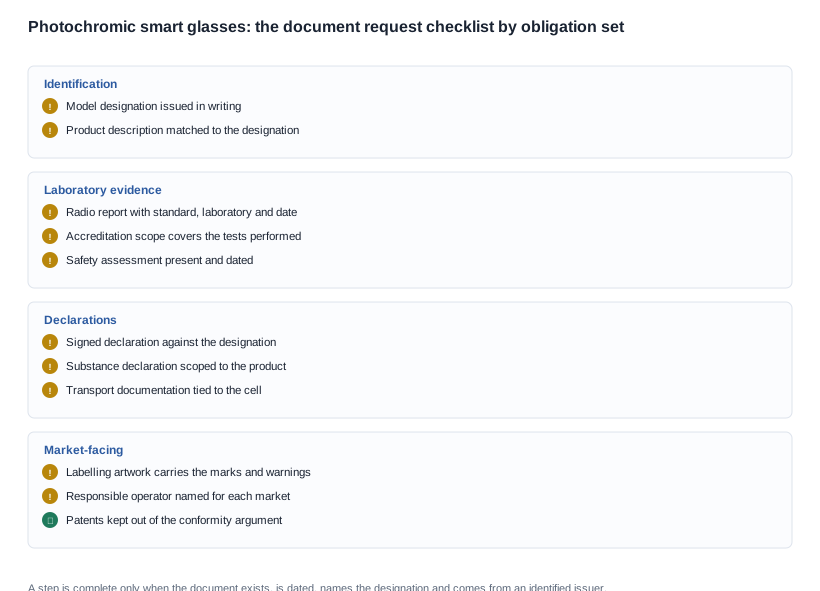
Requesting the file is straightforward; requesting it in the wrong order wastes months and creates a dispute at the worst possible moment. The sequence below is ordered so that the first mismatch surfaces in the first week rather than at the port.
- The model designation, in writing, in the supplier's own document naming convention, together with a statement of what it covers. A step is complete when the designation exists, is dated, and is described precisely enough that a second supplier could not reasonably attach a different product to it.
- The product description that the designation refers to: the electrical rows and the lens configuration, matched line by line to the designation. The catalogue's own record for this entry is a Bluetooth version 5.4 radio, a magnetic charging method, a 100 mAh cell, a rated endurance of roughly seven hours, and a charge time of two hours or less, and that record is what the supplier's description should be reconciled against.
- The radio assessment report, with the standard applied, the issuing laboratory, that laboratory's accreditation and its scope, the sample identification and the date.
- The safety assessment covering the product as radio equipment, again with the sample identification and the date.
- The written declaration of conformity, signed against the designation, listing the standards relied upon and any deviation from them.
- The index of the technical file, so that the buyer knows the full population of documents rather than the subset that has been volunteered.
- The substance and material declarations the supplier is actually able to issue, with a clear statement of which parts of the product they cover.
- The battery transport documentation for the 100 mAh cell, tied to the cell type used in this configuration.
- The labelling and packaging artwork, showing the marks, the warnings, the instructions and the identification of the party answerable for the product in the destination market.
- The economic-operator detail for each destination market, so that whoever signs the documents is also the party the obligation attaches to.
Each of those ten steps is complete on four conditions rather than one: the document exists, it is dated, it names the designation, and the issuing body is accredited or identified. A step that produces a document missing any one of those four is not complete, and the negotiation should say so rather than moving on. What to ask, in what form, and in what sequence is the part of supplier due diligence that is worth doing well, because the trade-off is a slightly longer negotiation against a substantially cheaper recall.
The signs that a supplier is treating the file as a formality are worth naming, because they are consistent and they are visible early. A declaration that is issued for a designation the buyer has not seen in a product document. A test report whose sample identification is a customer or project code rather than a product reference. A laboratory name with no accreditation reference, or an accreditation reference whose scope does not include the tests performed. A file that arrives complete but only after the goods have already been shipped, which reverses the entire order of operations and is the clearest possible indication that the file was assembled to satisfy a delivery rather than a market. In each of those cases the response is to pause the order rather than to accept the document.
The escalation path is simple and it is worth agreeing it in advance, before there is a disagreement. Where a supplier cannot produce a document, the options are to change the product so that the document becomes unnecessary, to change the market so that the requirement disappears, to price the non-compliance and accept it knowingly, or to move. Which of those is right depends on the market and the volume, and a buyer who has done the file request as a structured exercise rather than a series of polite emails is in a position to make that choice on evidence. That is the value of the checklist, and it is the reason the request order matters more than the individual document.
What the company-level page does not settle
The honest position, stated plainly, is the most useful thing we can offer on this subject.
Our catalogue's export-certification page is a company-level page, and its content is images rather than text. Our catalogue text names none of the three marking schemes that buyers ask about most, and no model in the range has a conformity row of its own; the ten certificates on that page are eight appearance-design patents and two utility-model patents, and they are not conformity documents. For the entry this article concerns, the published record is five fields and nothing more: a 100 mAh cell, a magnetic charging method, an endurance of roughly seven hours, a charge ceiling of two hours, and a Bluetooth version 5.4 radio. No lens specification, no weight, no ingress rating, no charging-case capacity, no model designation.
We will not tell you that this product is certified, and we will not quote a certificate number, a test report reference or a laboratory name for it, because we hold none of those for this entry. What we will do is tell you precisely which documents have to come from the supplier, in which order, what each one must contain to be worth filing, and which checks are yours to perform independently — the SIG listing for the product identifier, the accreditation scope of the issuing laboratory, and the match between the designation on the paperwork and the designation on the unit.
The export considerations for this category cover the market and the responsible-party side of the same problem, and the handling note covers the instructions that have to be consistent with whatever the file eventually says. If you are preparing this product for a specific destination, tell us the market and the sales channel, and we will tell you which parts of the photochromic smart glasses certification trail have to be opened with the supplier and which parts we can answer from the catalogue immediately.


