

The certification requirements for a light-responsive lens product are unusual in one specific way: the questions are not primarily about the lens. They are about whether the product is a radio product with a cell in it, and the lens only determines the second-order questions. Photochromic smart glasses certification requirements is a map of which frameworks reach this product, what document each one produces, and what the absence of that document actually costs at the border, at the marketplace and at the second shipment.
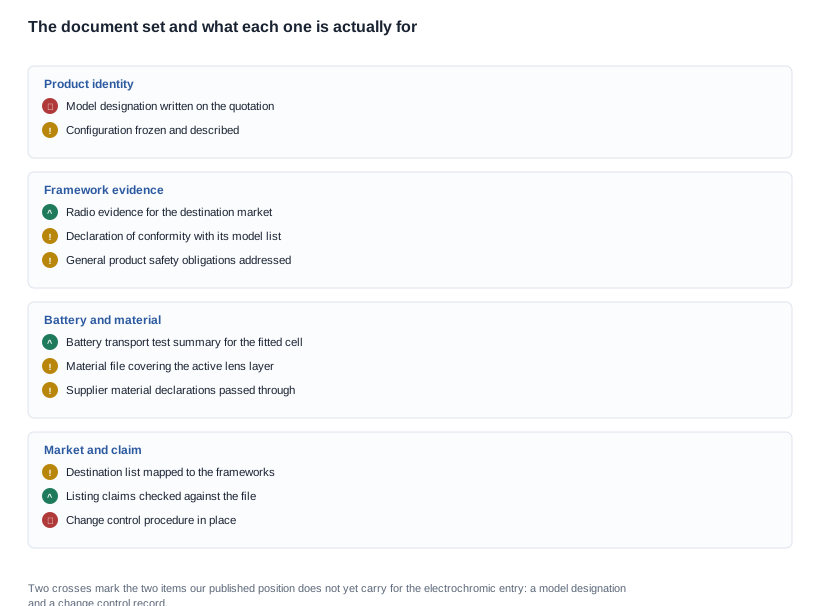
Our published position in this range is the whole of the electrochromic entry: Bluetooth 5.4, a 100 mAh battery, charging in two hours or less, roughly seven hours of runtime, magnetic charging and electrochromic lenses. There is no model designation, no switching time, no transmission range, no temperature behaviour, no uniformity figure and no cycle durability. And the certification status for that entry is not published to us.

Photochromic: four frameworks, one about the lens
A buyer who opens this category expecting a lens certification and finds a radio certification has understood the product correctly. The lens is one line in a file that a radio, a cell and a material declaration each contribute to, and the lens is the line most likely to be missing.
The radio framework and what a connected device triggers
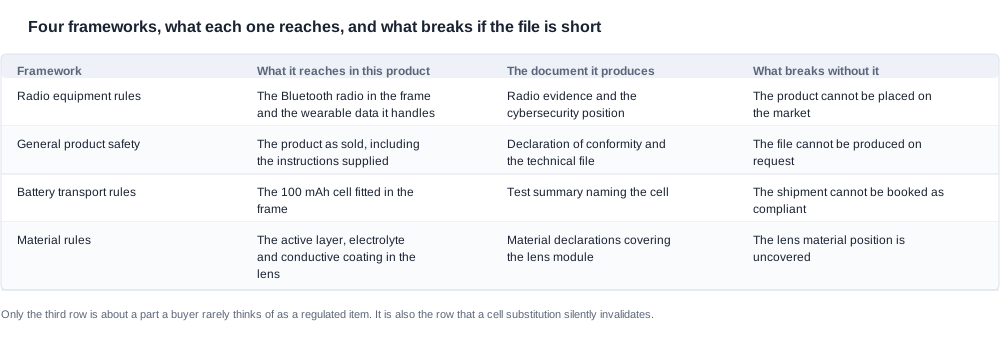
A product with Bluetooth 5.4 is a radio product, and it is subject to the radio equipment rules of every destination it enters. In the European Union the Radio Equipment Directive (EU) 2014/53/EU applies, with the EN 18031 harmonised standards cited into it covering cybersecurity requirements for internet-connected radio equipment, radio equipment processing personal data, and radio equipment enabling money transfer. A device with a microphone and an app sits in the personal-data category, which is the requirement buyers most often underestimate because the product is described as an audio device rather than as something that handles personal data.
The General Product Safety Regulation (EU) 2023/988 applies from 13 December 2024 and layers general safety obligations on top of the framework, bringing a Declaration of Conformity, a technical file, a responsible person in the Union, traceability obligations and the information supplied to the user. In the United Kingdom, UKCA applies with a framework that has diverged from the EU's, which means a buyer selling into both is not covered by one document. In the United States, FCC equipment authorisation covers the radio.
None of this is lens-specific, and all of it is decided before the lens question is asked, because the model designation and the configuration have to be fixed before any document can name them.
The battery transport summary and the single cell it covers
A 100 mAh cell inside the product brings the product into the battery transport regime, and the UN 38.3 test summary covers a specific cell rather than a product. This is the row buyers treat as a formality and it is the one that fails most often, because a cell substitution is invisible from the outside and invalidates the summary regardless of whether the finished product is unchanged.
The control that prevents it is a change-control clause rather than a document. If the purchase order names the fitted cell and requires notice before any change of cell or cell supplier, the summary stays valid. Without that clause, the risk is that the summary and the goods diverge during a period in which nobody was checking, and the divergence is discovered by a carrier rather than by the factory.
There is a related point specific to a lens programme. A powered lens may add a power path and a control function to the product, which means the electrical configuration of the frame is part of what the transport documentation and the technical file have to describe. The buyer who assumes that adding a lens is an optical change has not accounted for the electrical one.
A third point belongs in the same place, and it is the one most buyers have never been told. The cell in a powered lens product is not necessarily the same cell as in the base product. If the lens programme is built on a platform whose cell was selected for a passive configuration, the powered version may draw differently, and a cell that was adequate for the base product may not be the cell that was documented. That does not make the cell wrong; it makes the documentation wrong, because the test summary has to name the cell that is actually fitted. The check is short: name the fitted cell on the order, and require notice before any change.

The lens-specific questions that change the conformity position
Four questions arise only because there is a lens in the assembly, and each one can change the conformity position rather than merely adding to it.
The material file for an active layer, an electrolyte and a coating
An electrically driven lens contains an active layer, an electrolyte and a conductive coating that a passive ultraviolet-reactive lens does not. Each of those is a material inside the scope of the RoHS and REACH position, and the documentation for them belongs to the lens module supplier rather than to the frame factory.
Two consequences follow. The material file has to be obtained, passed through and held, and a lens supplier change voids it unless it is re-obtained — which means the change-control procedure has to name the lens module explicitly, not just the frame. And the buyer has to know who the module supplier is, because a file with no named owner is a file that nobody keeps.
Whether the lens changes the radio, the cyber or the camera position
Three questions, in order. Does the lens change the radio behaviour? A lens that draws power in a connected product changes what the product does, and the cybersecurity position is about the product's behaviour rather than about its radio alone. Does the lens change the camera behaviour? A tinted or light-responsive lens changes the exposure the camera sees, and if the camera compensates as the lens changes state, that compensation is part of the product's described behaviour. Does the lens change the flat-battery behaviour? A powered lens in a product whose cell is empty has a defined state, and that state belongs in the file and in the instructions rather than in a support note.
The point is not that these questions are difficult. The point is that they are nobody's responsibility unless a buyer asks them, because the lens and the frame are frequently specified by different parties and neither assumes the other has covered the interface.

The document set that has to exist before a shipment can be cleared
The four frameworks produce a document set, and a buyer who asks for it as a single list gets a far more useful answer than a buyer who asks framework by framework.
What the model list on a certificate is actually for
The model list on a document is the only part of it that is checkable. A certificate number can be searched in the issuing body's register, and when it is searched, the model list is what the check is actually testing. If your exact configuration is not on that list, the document does not cover it, and no amount of a supplier's assurance changes that.
This is why the absence of a model designation is a schedule problem rather than an administrative one. Our electrochromic entry publishes no designation, and a document has to name a model. Until a designation is issued and written on the quotation, the conformity file for this configuration cannot be closed by anyone, and the artwork cannot be finalised because the model designation determines what goes on the box.
Four documents form the minimum set. The Declaration of Conformity, with its model list, and a check that the exact model and configuration is named on it. The UN 38.3 test summary for the specific cell fitted. The lens module's material documentation, covering the active layer, the electrolyte and the conductive coating. And the technical file behind the declaration, available on request rather than as a summary.
What the technical file has to contain, and why the request is worth making
The technical file is the document that sits behind the Declaration of Conformity, and asking for it is worth more than asking for the declaration itself, because the declaration is a summary written for a regulator while the file is the evidence a regulator would actually examine. In practice a request for the technical file is a test of two things: whether the supplier has one, and whether they are willing to show it to a buyer who has not yet committed.
What a buyer normally finds in it is the general description of the product, the list of the applicable regulations, the standards cited with their versions, the essential requirements and how they are met, the instructions for use, the test reports behind the performance claims, the manufacturer or importer identification, and the technical documentation the declaration refers to. Two of those entries are where the lens programme shows up. The essential requirements are where the powered lens, the radio and the cell have to be argued against each other rather than separately, because the requirements are assessed on the product as shipped. And the instructions for use are where the flat-battery behaviour of a powered lens belongs, because the instructions are a legal document in several frameworks rather than a courtesy insert.
Two things a buyer should establish when the file arrives. Whether the standards cited are the versions in force for the destination market and the date of the shipment, because a file citing a superseded standard is a file that has to be re-reviewed. And whether the file describes the configuration that is actually being ordered, because a file that describes the base product without the lens is a file that does not cover the product.

What happens when a document is missing, market by market
The consequence of a missing document is not uniform, and this is worth understanding before the schedule is fixed. A missing radio document stops the product from being placed on the market in that destination — it is a hard stop, and it is enforced. A missing or unreachable technical file stops the product only when somebody asks for it, which is usually a marketplace review, a customs query or a competitor complaint, and it is discovered at the worst possible moment because it is asynchronous. A missing battery transport summary stops the shipment from being booked as compliant, and it is discovered by the carrier or the freight forwarder. A missing material declaration for the lens leaves a position uncovered rather than a stop, which makes it the quietest of the four and the one most likely to be missed.
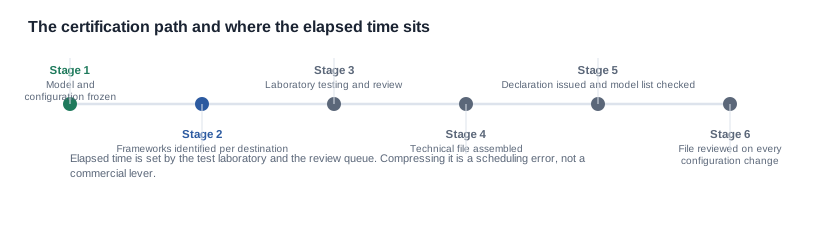
That ordering has a practical consequence for how a buyer sequences the work. The radio and battery items are on the critical path and their elapsed time belongs to the test laboratory and the review queue rather than to the supplier's capacity. The technical file and the material declarations are on the critical path too, because they depend on the model designation and on the lens module being identified. The buyer who compresses the schedule by asking the factory to hurry is compressing the one part that was never theirs to compress.
The change control procedure that keeps the file aligned
A conformity file is a living document in a way that a price list is not, and the procedure that keeps it aligned is usually the cheapest item on the programme and the most commonly missing. Four events trigger a review: a change of the lens module or its supplier, a change of the fitted cell or its supplier, a change of the frame material or the temple construction, and a firmware or control change that alters the described behaviour of the product. Each of those is a configuration change in the sense that matters to the file, whatever it is called in the factory.
The procedure needs four contents, and it needs to be attached to the purchase order rather than held in a supplier's own process. A named trigger list, so that the obligation to notify is specific rather than general. A notice period long enough to act on, because a notification that arrives after the goods have shipped is a notification about a problem rather than an opportunity to prevent one. A re-issue obligation, so that the documentation pack is updated and handed over rather than updated in the supplier's archive. And a right to refuse a lot that ships after an unreported change, because without it the notice obligation has no consequence.
A buyer who puts this clause in place at the quotation stage is protecting a file that will otherwise have to be reconstructed at the third shipment, usually for a reason nobody can name, which is the most expensive form of audit there is.
The three questions to put to a supplier before the schedule is fixed
What is the model designation, and what is the certification status for it, per market? Our published position is that the certification status for this entry is not published to us, which makes this the first question rather than the last.
Which model designations are named on each document, and when was the last one issued? A family-level document does not cover a specific model, and a document issued before a configuration change may no longer reflect the product being shipped.
Who supplies the lens module, and what happens to the material documentation if it changes? This question has two parts and both matter: the supplier has to be named, and the consequence of a change has to be stated, because a substitution that is not controlled is the one that reaches the border without anybody noticing.
Our published certification position, and the limits of it
The certificates we can name for the adult models are none: the catalogue text contains no reference to CE, FCC or RoHS, and it carries no per-model certification row. The specific model and certificate numbers are therefore published for no model at all, and the certification position for the children's models is not published to us. We treat those as separate states rather than one, and the reason is that a claimed certificate, an issued certificate and a certificate that names your exact model are three different things.
Three states that buyers routinely collapse into one
A buyer who collapses the three states ends up holding a file that cannot survive an audit. The first state is a claim — the supplier says the product is certified. The second is an issued document, identifiable by a number, an issuing body and a validity date, which anybody can search for. The third is an issued document whose model list contains the exact configuration being shipped.
Only the third one is evidence, and only the third one protects the shipment. We will not present a claim as a certificate, and we will not tell you a document covers a model we have not seen listed on it. On the lens performance data for our entry, the position is that it is not published, and a lens claim in a listing has to be supported by data you have actually measured, because the framework will not let you claim a performance you cannot evidence.
There is a second limit we name explicitly, and it is the one that surprises buyers: the absence of a published certification position for a specific model does not mean the product cannot be sold. It means that nobody, including the manufacturer, has published a position the buyer can rely on. The distinction matters because the remedy for the first is a document and the remedy for the second is a conversation with your own legal function about whether the evidence you hold is sufficient for the destination you are shipping into. A buyer who waits for the manufacturer to publish a certification statement that does not exist will wait indefinitely, and a buyer who treats the silence as a prohibition will abandon a market that is entirely open.
What we will do, and what we will not do, is consistent across every model in the range. We will name the frameworks that reach a product of this type and tell you which ones are decisive for your destination list. We will tell you which documents each one produces and what its absence costs. We will mark our own certification position as published or as not published, and where a supplier's document is only a claim we will say that it is a claim, and we will not blur those states into a single reassuring sentence.
Four things a buyer should establish independently, regardless of what a supplier says. Whether the product may lawfully be sold in the destination market, which is a legal function's question and not a manufacturer's. What the listing copy may claim, including anything about the lens's behaviour, because a performance claim without a condition is a claim the customer will test. Whether the certification position survives a configuration change, and what the change control procedure covers. And what the flat-battery behaviour is, because a powered lens in a product that is out of power is a product behaviour that belongs in the file and in the instructions.
The fourth of those deserves one more sentence because it is the one that appears in the framework and then disappears from the programme. A powered lens with no power is not a self-evident state — it may clear to its lightest state, it may hold the last state, and it may behave differently depending on whether the product was switched off or simply ran down. Each of those is a product decision with a customer-visible consequence, and each of them has to be written down somewhere the buyer can point to. In most programmes it is written nowhere, and it is discovered by a customer who left the product in a car overnight.
If you tell us the destination markets and whether the lens is powered, we will say which frameworks are decisive. The background is under photochromic lens technology, the wider regulatory picture is in how regulations reach the lens, the document checklist is at certification checklist, and the range is photochromic smart glasses.
Related reading
- Photochromic lens technology
- How regulations reach the lens
- Certification checklist and model coverage
- Photochromic smart glasses range
Send the destination markets and whether the lens is powered, and we will say which frameworks are decisive.


