
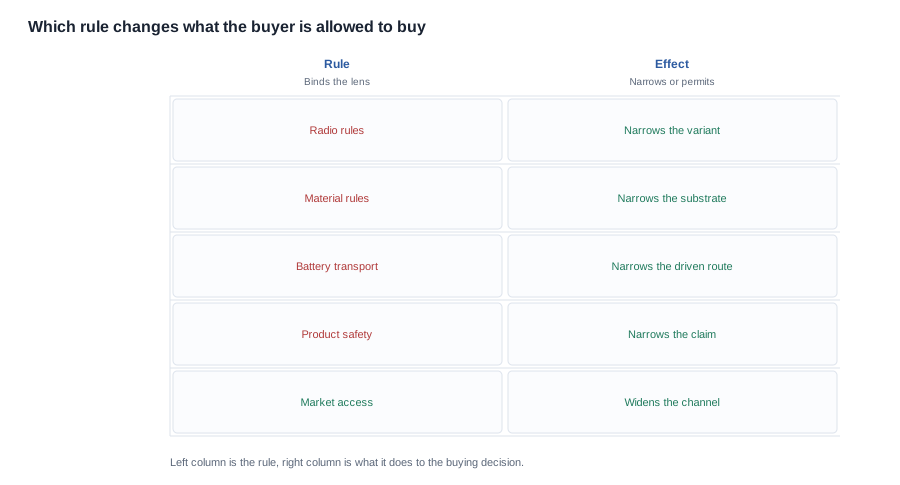
A colour-change lens changes what you are allowed to buy, and it does so in three ways that are easy to miss until a shipment is held. It changes the product's optical description, which means the technical file has to be revisited rather than carried over. It can change the material position, because a reactive chemistry and a coating stack are not the same material list as the rest of the product. And on the driven route it adds a cell, which brings a transport obligation that the passive route does not have at all. None of these is dramatic on its own, and all of them together decide which configurations a buyer can actually ship into which markets. This article sets out the rules that bind the lens, the documents they attach to, the markets that behave differently, and the clauses to write into the purchase order so that a configuration change does not reopen the whole file.
Photochromic: rules for selling a lens configuration
The catalogue's export certification page carries images, not text
The first thing to get right is what our own catalogue does and does not tell you. The front page carries a company-level export certification page whose content is images rather than text, and the catalogue text contains no reference to CE, FCC or RoHS. The catalogue carries no per-model certification row for any model in the range, and no per-model certification line for a lens configuration either.
That distinction matters more than it sounds, because the inference people make from a company-level statement is the wrong one. A company that supports export certification is not the same thing as a model that holds a certificate, and a certificate held by one model does not cover a sibling, a variant or a configuration. In our range the examples that catch this are structural: the IP54 marking appears on two models only, V06 and S7, so it cannot be generalised to the range; eleven models carry a camera, and the catalogue publishes no Bluetooth version for the camera models at all, so no radio position can be read off the catalogue for them.
The operational conclusion is simple and it applies to every rule discussed in this article: no certification position can be inherited from a platform, a company or a sibling model. It has to be requested against the exact model designation of the configuration, with the issuing body and the validity dates, and checked against the certificate model list rather than assumed from a PDF.
Why a lens change is a product change on paper
The second thing to understand is why adding a lens reopens the file at all. A lens changes the product's optical description: what passes through it, how it behaves under different light, and what the camera sees behind it. Where the product also carries a camera — the camera platform in our catalogue publishes an 8 MP sensor, and eleven models across the range carry a camera — the change also touches the imaging description.
Any document that describes the product therefore has to be revisited. That set is wider than people expect, and it is the reason a lens configuration is priced per configuration rather than per unit:
- The technical file, because the design description and the specification have changed.
- The declaration of conformity, because the product described in it has changed.
- The certificate model list, because a new configuration has to appear on the documents that cover it.
- The labelling and the instructions, because the claims and the behaviour have changed.
- The risk assessment held behind the technical file, because a new material and a new optical behaviour sit inside it.
- The battery transport file, on the driven route, because a cell has been added to the bill of materials.
The commercial consequence is that the documentation scope scales with the number of configurations, and a buyer who treats a lens as a variant will be quoted for one of these six items and not the other five.

The document chain a configuration change reopens
The five documents that name the configuration
Five documents in the set carry the model designation, and they are the ones that fail when a configuration is added without a process. The declaration of conformity names the product. The certificate model list names the models the certificate covers. The technical file identifies the product it belongs to. The labelling carries the model and the manufacturer identity. The shipping and customs description carries a classification consistent with the declaration.
If the model designation is not settled before the first order, all five are written against an assumption, and each of them has to be reopened later. The failure is visible and expensive: a unit that cannot be matched to a document is a unit that cannot be cleared, a listed, or claimed, and a warranty claim against it cannot be settled either.
The model list is where it usually fails
The certificate model list is the single point where a lens configuration most often disappears. A certificate is issued for a set of models, and a supplier that added a lens configuration to an existing platform will sometimes have extended the product without extending the document. The result is a unit that is physically and commercially real and that no certificate names.
This is checkable before the order, and the check is short: for each certificate the supplier holds, read the model list, and confirm that the exact model designation of the configuration you are buying appears on it. Where the dedicated colour-change entry in our catalogue is concerned, there is no published model designation at all, so there is nothing to find until one is created. Making the designation a condition of the purchase order is the only way to close it.
The sequence and the dates it waits on
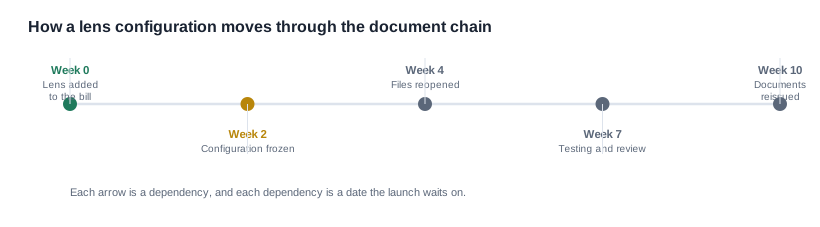
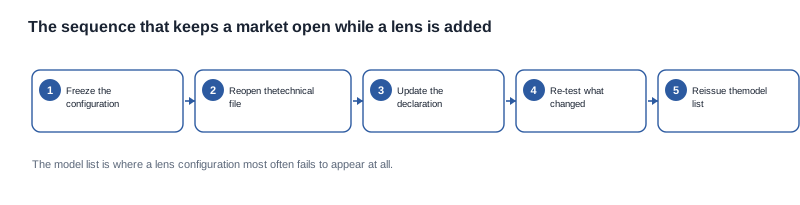
The chain has a natural order, and each step is a dependency rather than a preference. The configuration is frozen first, because a document cannot describe something that is still changing. The technical file is reopened second, and the declaration updated third. The testing and review step follows the declaration, because the review is against the declared description. The model list is reissued last, because it is the last document to be able to change without restarting the review.
The dates in between are not padding. In the illustrative sequence below, the interval between adding the lens to the bill of materials and reissuing the model list is what a launch date has to absorb, and it is why the decision to add a lens is expensive once the specification is frozen. The number of weeks is not published by anyone and should be asked for in your own programme's terms, but the shape of the dependency is the same on every programme.

CE and FCC: two markets, two positions
The European position
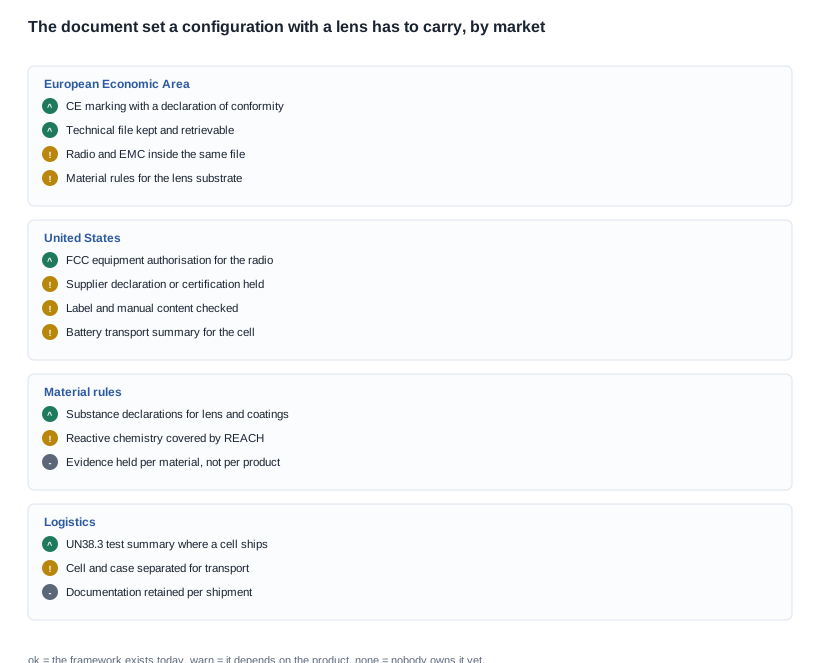
For the European Economic Area, the product's obligations are set by the Radio Equipment Directive for radio functions and by the general product safety and material rules for the product as a whole. The practical shape of the position is a technical file, a declaration of conformity, the marking on the product and the accompanying documentation in the languages the market requires.
A colour-change lens touches three of those. The lens changes the description of the product, so the technical file and the declaration are affected. The reactive chemistry and the coating are materials in the product, so the material position is affected. And where the product carries a radio — and the dedicated colour-change entry publishes Bluetooth V5.4 — the radio position has to be reflected in the same file rather than held separately.
The question a buyer asks a supplier in this market is not "do you have CE". It is: for this exact model designation, which documents cover it, which body issued them, what are their validity dates, and what in the file changed when the lens was added. The four-part answer is what can be filed; the one-part answer is what can be repeated in a listing and not much more.
The related guidance on the radio side is in the RED directive, and the broader battery transport obligations that follow any product with a cell are in battery transport.
The United States position
For the United States, the radio side is governed by the equipment authorisation regime administered by the Federal Communications Commission, and the product side by the general requirements of consumer product safety and the specific rules that apply to a battery and to a lens on a wearable.
The structural difference from the European position is not the number of documents but the way the evidence is held. Where a European declaration is a single document supported by a technical file, the United States position is typically built from an equipment authorisation held by the responsible party, together with supplier declarations, labelling content requirements and the applicable battery documentation. The practical consequence for a buyer is that the file is distributed rather than central, and a configuration change has to be checked against each element of it separately.
What the two markets have in common
Two features are common to both and are worth planning for before a lens configuration is added.
The first is that a model designation is required in both, and a configuration without one cannot be documented in either. The dedicated colour-change entry in our catalogue publishes no model designation, so it cannot currently be documented as a named configuration in either market without that work being done first.
The second is that neither market accepts a claim the evidence does not support. A listing that describes a lens as reacting to light in a way that no measurement in the file supports is a product issue before it is a legal one, and the regulatory position is the reason a supplier's performance evidence has to exist. The instruction to keep the claim inside the evidence is set out in how to choose photochromic smart glasses.

RoHS, REACH and the material questions the lens raises
The reactive chemistry and the substrate
Material rules apply to the substances in the product, and a colour-change lens brings a set of materials that the rest of the platform does not necessarily contain: the reactive chemistry itself, the coating layers, and the adhesive or bonding material used to seat the element.
Each of those has to be assessed on its own terms. The reactive chemistry is the least familiar and the most likely to require a declaration from a supplier further up the chain — an element maker rather than the assembler — which is why a buyer should ask early whether the element is bought as a finished optical good or assembled in-house. The coating stack has its own substances. The substrate has its own. And the bonding material, which is the least visible of the four, is also part of the product.
Per-material evidence rather than per-product evidence
The structural point that catches people is that material evidence is held per material, not per product. A declaration that covers the platform tells you nothing about a new material introduced by the lens configuration, and a supplier may genuinely have the right answer at the material level while having no document at the product level that names it.
The way to handle this is to ask for the evidence at the level it exists and then connect it. Ask which materials the lens configuration adds to the product. Ask for the substance declaration for each of those materials. Then ask whether the product-level declaration has been updated to include them, and by whom. Where the answer is that the declaration is per material and the product file has not been updated, that is a gap with an owner and a date — or a gap without either, which is the more serious version.
The guidance on the material rules, and how the declarations are structured, is in RoHS and REACH.
How the material rules narrow the supplier list
There is a procurement consequence that is easy to overlook: material rules narrow who you can buy from. A lens supplier who cannot supply substance declarations for the reactive chemistry is not a supplier you can use in these markets, regardless of how good their performance data is. That means the due diligence on a lens supplier has a document component that precedes the technical evaluation, and it means the first question to a prospective lens supplier is about declarations rather than about switching times.
The second consequence is about change. A material change in the coating or in the reactive chemistry is a change to the product's material position, not a production adjustment, and it has to be treated as a configuration change with a notice obligation attached. Suppliers who treat it as a routine substitution are the ones who will eventually ship a product whose file does not describe it.
UN38.3 and the battery the driven route adds
When the cell ships with the product
Transport rules for lithium batteries bite whenever a cell is shipped with the product or packed with it. On the driven route that is automatic: the dedicated colour-change entry in our catalogue publishes a 100 mAh cell, charging in two hours or less, a rated runtime of about seven hours and magnetic charging, and the cell is part of the product. On the passive route there is no cell added by the lens at all, which is one of the clearest commercial arguments for it when the requirement allows it.
The camera platform with the colour-change lens configuration is a different case but not a different rule: it publishes a 220 mAh cell and a rated runtime of 5–8 hours, so a cell ships with that product as well, independently of the lens. The lens does not create the transport obligation there; it adds a configuration to a product that already has one, and the transport file has to reflect the configuration.
The test summary and the shipment file
The evidence a transport file needs is a test summary for the cell, produced against the United Nations Manual of Tests and Criteria, plus the packaging arrangements and, where a cell is packed with the product rather than installed in it, the separation and protection requirements.
For the buyer, the questions are specific and belong in the request for quotation rather than in the shipping instructions. Which cell is fitted, and what the test summary for that cell says. Whether the cell is installed in the product or packed with it. Whether the case, where one is supplied, contains its own cell — the catalogue's charging cases are separate items with their own capacities, and a case with a cell inside it is a second transport subject. And whether the test summary is held by the cell maker, the assembler or the shipper, because the party that has to produce it at the border may not be the party that made it.
The full procedure is set out in battery transport.
What to write into the purchase order
Six clauses turn this discussion into something enforceable, and they are worth drafting before the first order rather than during the first shipment delay:
- The exact model designation of the configuration, attached to the order.
- A requirement that the certificate model list and the declaration of conformity name that designation, with the issuing body and the validity dates supplied as identifiers.
- A notice obligation covering any change to the lens, the coating, the reactive chemistry, the substrate, the tint range or the frame material, with the documentation package reissued where the change affects it.
- A statement of the documentation package that will be delivered with the goods, listed item by item, with the language requirements for each market.
- The battery transport evidence for the fitted cell and for any cell in a supplied case, identified by test summary reference rather than by description.
- A requirement that the documentation package for a configuration be reissued on request, so that a distributor or a marketplace asking three years later can be answered.
The last clause is the one that costs nothing to ask for and the one that most often fails to be included. Its absence is invisible until a channel partner asks a question the file cannot answer.
Two habits make this work in practice rather than on paper. The first is to build a shortlist of documents rather than a list of suppliers, and to score each supplier on how many of the six clauses they can already satisfy — a supplier that satisfies four today is usually cheaper to work with than one that satisfies none today but promises six. The second is to treat the change-control clause as the centre of the agreement rather than as an administrative appendix, because it is the clause that governs every future trade-off between a price improvement and a documentation change.
The trade-off to watch is the one between a cheaper lens configuration and a re-validated one. A buyer who lets the unit price decide that trade has made the compliance cost the variable, and the compliance cost is not bounded by anything the supplier has quoted. Before you order, the criteria for that trade belong in the agreement: what a configuration change costs, who pays for the re-validation, and how long the programme waits for it.
Stated plainly: we publish the rows we hold and mark the rest as open. For the camera platform with the colour-change lens configuration we publish the sensor class, the cell capacity, the rated runtime, the charging interface, the charging time, the temple design, the published colour options and the lens configuration itself. For the dedicated colour-change entry we publish the lens technology, the Bluetooth version, the cell capacity, the charging time, the rated runtime, the charging interface, and the absence of a model designation. We do not publish certificate numbers, test report references, declaration contents, material declarations or conformity status for any model, because a catalogue row that names a certificate without the model designation behind it is the mistake this article is about.
The category background sits under photochromic lens technology, and the selection method that sits alongside this compliance work is in how to choose photochromic smart glasses.
If you are working out the regulatory position for a lens configuration, send us the model designations, the markets and whether the driven or the passive route is in scope, and we will tell you which documents have to exist for the configuration and which ones the catalogue cannot answer for you.


