

A procurement team receiving a light-responsive lens product is handling a category where the published specification contains exactly one fact about the lens, and that fact is a technology name rather than a measurement. Our catalogue entry for the electrochromic product publishes Bluetooth 5.4, a 100 mAh battery, charging in two hours or less, roughly seven hours of runtime, magnetic charging, and the fact that the lenses are electrochromic. There is no model designation, no switching time, no transmission range, no temperature behaviour, no uniformity figure, no cycle durability and no coating detail, and no ingress marking is published for it either.
Photochromic smart glasses checklist for procurement teams is therefore a checklist for the execution and acceptance phase of a programme, not for choosing a supplier: what has to be true at the receiving door, how a lot is sampled, what a release depends on, what holds a lot, and what has to be archived so that the next shipment can be judged rather than re-argued.
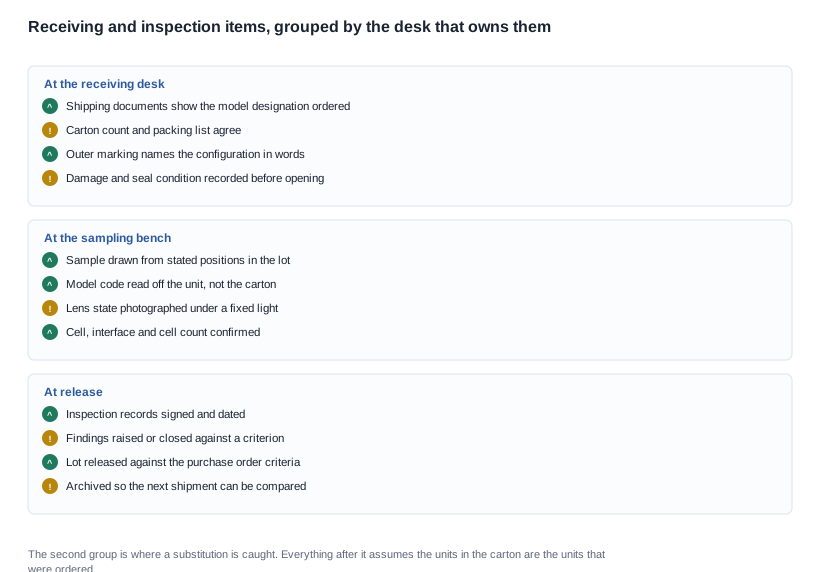
Photochromic: five checks before a carton opens
A receiving desk is the last point at which a configuration mistake is cheap. Everything downstream of it — the inspection, the release, the shelf, the listing — inherits whatever came through the door, and the cost of discovering a mismatch after distribution is a withdrawal rather than a correction. The five checks below take minutes and they assume nothing about the supplier beyond what the purchase order already says.
What the shipping documents must show at the door
The model designation on the shipping documents must match the model designation on the purchase order. This is the first check and it is the one most often skipped, because the paperwork says what the supplier's system says rather than what the buyer's system says. Our electrochromic entry publishes no model designation, which makes this check harder rather than easier for that specific route: until a designation is written on the order, there is nothing on the documents to match against, and the receiving desk can only check the carton count.
The carton count and the packing list must agree with each other, and the count must agree with what the order says. A discrepancy here is either a shipping error or a deliberate substitution, and it is the cheapest possible moment to establish which.
The outer marking must name the configuration in words. A label carrying a model code, a colour and a configuration identifier is what lets a receiving desk separate four colourways of the same platform from each other without opening anything. A label carrying only a product name does not, and four configurations in one delivery then become four identical piles.
The seal condition must be recorded before opening. A broken or replaced seal is not itself a defect, but it removes the evidence that the contents are what the documents describe, and the record of it is what supports a later claim.
The damage state must be recorded in the same pass. Photographic evidence at the door is worth a great deal, because it is the only evidence that exists about the state of the goods before anybody opened them.

The sampling plan: how many units, which positions, which tests
Sampling is where a procurement team's own procedure meets the reality of a product with no published performance data, and the meeting point is uncomfortable: the supplier cannot inspect a lens behaviour that it does not publish, so part of the sampling plan belongs to the buyer.
Drawing the sample and the position codes
The sampling rule has to be written before the sample is drawn, because a rule written afterwards describes what was drawn rather than what should have been. A workable rule has three parts: how many units, taken from positions spread across the lot rather than from the top of the stack; which positions, defined in a way that is reproducible by somebody who was not there when the cartons were opened; and which tests, listed per unit so that no one has to decide what to look at while looking at it.
Two practical points matter more than the numbers. The first is that the position coding has to be written down and kept, because a finding on a specific unit is only actionable if you can find that unit again, and in a lot that has already been distributed the ability to isolate a failing unit is the difference between a targeted action and a full recall. The second is that the sample size has to be consistent between shipments, because a lot that passes on four units and the next lot that passes on one unit tells you nothing about whether the process has changed.
What goes into the sample depends on what is actually checkable. The identity check — the model code read off the unit rather than off the carton — is always included, and it is a stop condition rather than a query. The cell configuration, the charging interface and the count of cells in the box are included because they are published rows that can be compared against the order. The lens state is included, photographed under a fixed light with the condition stated, because no supplier record of that behaviour will exist and a photograph is the only artefact that will survive.
The inspection records that let a lot be released
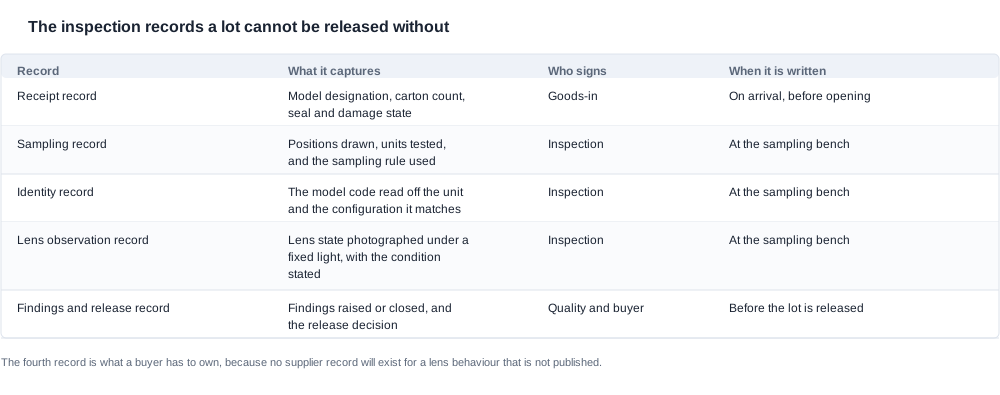
A lot is released against records, not against impressions. Five records are enough to carry the whole decision, and each one has an owner, a moment and a signature.
The five records and who signs each one
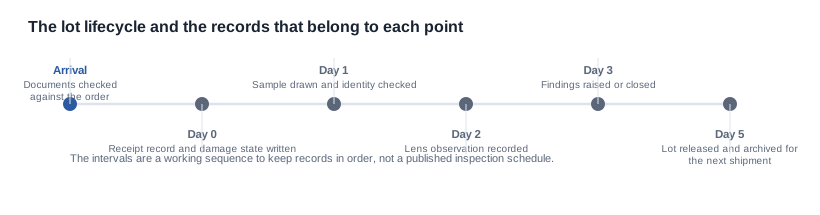
The receipt record is written at the receiving desk on arrival, before anything is opened. It captures the model designation as it appears on the documents, the carton count, the seal condition, the damage state and the date. It is signed by goods-in, and it is the record that every later finding gets referenced back to.
The sampling record is written at the sampling bench. It captures which positions were drawn from, how many units were tested, which units those were, and the rule that was applied. It is signed by inspection, and it is the record that makes a later claim about a lot traceable rather than anecdotal.
The identity record captures the model code read off the unit and the configuration it matches. It is signed by inspection at the bench, on the same visit as the sampling record, because the two belong together: an identity finding without a position code does not isolate a unit, and a position code without an identity finding does not say what was found.
The lens observation record captures the lens state photographed under a fixed light, with the light level, the starting state and the temperature stated, and with the observation written as an observation rather than as a verdict. This is the record that belongs to the buyer, and it is the one that has no supplier counterpart. The wording matters here: a record that says the lens did not darken is a measurement claim, and a record that says the lens did not darken under the stated condition is a finding. Only the second one survives a later argument.
The findings and release record is written before the lot is released. It carries every finding raised, whether it was closed or not, the decision to release or hold, and the signature of both quality and the buyer. A release record with no findings listed is a record of nothing having been looked at, which is worse than no record at all, because it looks like a clearance.

Holding a lot: the triggers, the evidence and the escalation path
A hold is a decision, and a hold made without a written trigger is a hold nobody can defend at the end of it. The three triggers below cover the situations this category actually produces, and each one has a defined evidence requirement.
The three findings that stop a release
The identity does not match. The model code read off the unit is not the code on the order, or the code cannot be read at all. This is a stop condition and not a query, because in a family where several configurations share their electrical rows, an identity mismatch means the configuration that was approved and the configuration that arrived are not demonstrably the same thing. The evidence is the identity record and the photograph of the marking. The escalation is to quarantine the lot, notify the supplier against the purchase order clause that names the configuration, and hold the remaining stock in the warehouse.
The lens behaves outside the criterion in the acceptance criteria. This is the trigger most likely to be handled informally, because the criterion was written by the buyer and is unfamiliar to the supplier. The evidence is the lens observation record with its stated conditions and the photographs taken under them. The escalation is a claim raised against the acceptance criteria in the purchase order, with the number of units affected established from the sampling record rather than estimated.
The documents do not cover the configuration. The certificate numbers on the file do not name the model in the box, or the battery transport summary does not cover the cell that is fitted, or the material file for the lens module is absent. The evidence is the file itself, checked against the model designation on the order. The escalation is a hold on the lot, a written notice to the supplier, and a refusal to release until the documents are extended to cover the configuration — because a lot that ships without coverage becomes a customs query or a marketplace rejection at a point where nobody is on the other end of it.
The cost profile of the three triggers is different and it is worth knowing which is which. An identity mismatch is cheap to fix if the lot is still in the warehouse and expensive if it is not, which is why the check happens at the bench rather than at the shelf. A lens finding is expensive in measurement terms, because re-testing means more units and more time, and it is the trigger where the acceptance criteria have to already exist — a criterion agreed after the finding is a criterion that has already been missed. A documentation finding costs nothing to fix at the desk and everything at the border.
Closing the loop: archiving the lot for the next shipment
Archiving is the part of the checklist that gets skipped, because the lot has already shipped by the time anybody thinks of it, and because archiving does not feel like a procurement activity. It is the difference between a second shipment that is inspected and a second shipment that is checked, and in this category the difference matters more than usual, because there is no published baseline against which the second shipment could be compared by anybody except the team that built the first one.
The comparison that makes the second shipment cheap
Five sets of records have to be retained from each lot, and they are retained for one purpose: to be compared against the next lot. The identity record establishes the configuration rate and whether substitutions occurred. The lens observation records establish whether the lens behaviour moved, and against what stated condition — which is the only way a slow drift across three shipments becomes visible before it becomes a complaint. The findings and release record establishes the defect and nonconformity rate over time, which is the input to a supplier corrective action discussion and to any renewal of the acceptance criteria. The receipt records establish the transit pattern, so that a damage rate that is climbing identifies the carrier rather than the factory. And the shipment documents establish the document coverage, so that a change in which configuration is being shipped against which certificate is caught at the next receipt rather than at the next audit.
Two rules make the archive usable. The records have to be stored against the lot, not against the shipment, because a shipment contains lots and a finding in one lot does not apply to the others. And the retention period has to exceed the warranty period, because the first warranty claim against a lot usually arrives after the lot has been sold through and the only remaining evidence is the archive.
What a supplier corrective action looks like when it is earned
The point of holding a lot is not to punish a supplier; it is to convert a single finding into a change in the process that produced it. A corrective action in this category is worth something only when it names a cause and a verification method, and the verification method is the part buyers most often leave out.
A useful corrective action names the cause — a specific sub-tier component, a specific process step, a specific handling instruction — rather than a category. It names the containment applied to the stock already in the warehouse and to the stock already distributed, because a corrective action that only addresses future production leaves the distributed population exposed. It names the verification, which in this category usually means an additional check at the next shipment's sampling bench rather than a document. And it names a re-inspection point, so that the supplier's process change is tested against incoming goods rather than assumed.
The measure of whether it worked is in the archive, which is the point at which the whole checklist closes: the next lot's records are compared against this lot's, and the comparison is either an improvement or a confirmation that the cause was misidentified. A supplier who receives a corrective action with a defined verification method and produces a measurable improvement across two subsequent lots is doing something rare, and that is worth recording in the supplier file as much as the defect rate is.
The five checks that belong to the buyer's own quality system
Two of the checks at the receiving desk are the buyer's own procedures rather than the supplier's deliverable, and they are the ones most often delegated by accident. The identity check depends on a model designation existing on the order, so it cannot be delegated to a supplier who has not been given one. The lens observation depends on a fixed light and a stated condition, so it cannot be delegated to a supplier who publishes no lens figure to compare against. The archive depends on records being stored against the lot rather than against the shipment, which is a configuration choice in the buyer's own system. The weight check, where one is performed at all, is a measurement the buyer runs, because the catalogue publishes a single figure and it belongs to a different model. And the sample size consistency across shipments is a rule the buyer sets, because a supplier supplying to a rule that changes from shipment to shipment is supplying to no rule.
The consequence of delegating all five is a receiving operation that checks the things a supplier can easily satisfy and misses the three that would have caught the failures this category actually produces.
The final benefit of archiving is commercial rather than operational. A procurement team that can show a defect rate per lot, a lens observation series across shipments and a document coverage record is negotiating from evidence rather than from impressions, and that changes the conversation about the acceptance criteria, the price tier and the warranty terms in a way no amount of specification writing will.
The same archive is what closes the loop between the two checklists a procurement team actually runs. The selection stage decides which configurations enter a programme and on what criteria; the execution stage decides which lots are allowed to leave. When the selection stage wrote its criteria down — the mechanism, the transmission range, the uniformity tolerance, the failure criterion and the model designation — the execution stage inherited them as acceptance criteria, and the records this checklist produces are the evidence that those criteria were applied rather than assumed. A programme that skips either stage does not get a cheaper product; it gets a cheaper purchase with the cost moved somewhere less visible.
We publish the rows we hold — Bluetooth 5.4, the 100 mAh cell, two hours or less to charge, roughly seven hours of runtime, magnetic charging, electrochromic lenses — and we mark the rest as Not published rather than leaving them off the sheet, because a procurement reader who knows a row is missing can act on it. On weight the catalogue's published position is one figure, and it belongs to a different model: the MT6 glasses body at 158 g including its fitted battery and camera and excluding the folding charging case, which holds 1200 mAh and whose own weight is not published. No bare frame weight is published for any model, so a weight check at receiving is a measurement the buyer has to run rather than a figure they can read off.
We will not fill a lens specification with typical values from comparable products, and we will not convert a technology name into a performance claim. Where the lens data is genuinely unavailable, the honest procurement answer is that the programme needs a buyer-run measurement on a fixed protocol, labelled as your measurement of one unit under your conditions.
If you send the models, the destination markets and the number of configurations per shipment, we will tell you which rows we can fill and which ones have to come from a sample or a laboratory. The background is under photochromic lens technology, the ingress and configuration side is in the procurement IP rating checklist, the document side is at certification checklist, and the range is photochromic smart glasses.
Related reading
- Photochromic lens technology
- Procurement IP rating checklist
- Certification checklist and model coverage
- Photochromic smart glasses range
Send the models and the destination markets and we will tell you which rows we can fill and which have to come from a sample.


