

The sample fee is the least consequential number in the whole sampling exercise, and treating it as the number is how buyers end up with a cheap unit and an expensive answer. A sample in this category is a small order with a large footprint: it involves a configuration decision, a document trail, a lithium consignment, a customs declaration and an evaluation window in which the programme is effectively paused. The fee itself is a rounding error against the schedule and against the risk of evaluating the wrong thing.
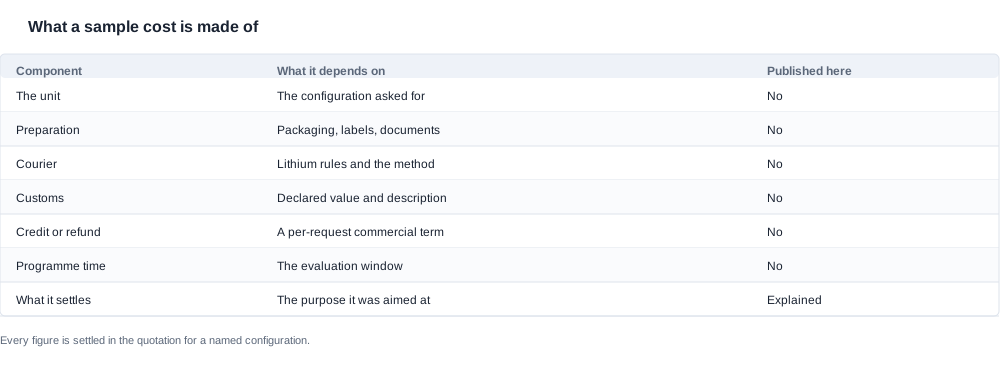
We do not publish a sample fee, and the reason is structural rather than coy. The fee depends on the configuration, on the quantity, on the preparation required and on whether the charge is refundable or creditable against a first order — and each of those is decided per request. A published number would therefore describe a request nobody has made yet. The policy is set out on the sample policy and cost page and the order form is at request a sample.
What this article does instead is explain the structure of the cost, identify the parts of it that are invisible on an invoice, and set out the commercial terms a buyer should settle in the same message as the request so that sampling does not turn into a second round of correspondence.
It is worth saying at the outset that the sample fee is usually the smallest number in a sampling programme and frequently the only one that gets negotiated, which is a poor allocation of attention. The negotiation that matters is over what the sample proves, over whether the configuration is fixed before the unit is built, and over whether the charge is credited against the order that follows. Those three decisions determine whether sampling was worth doing. The fee determines whether it was worth doing in a currency sense, and the two questions are not the same size.
Requesting smart glasses samples: what the cost is made of
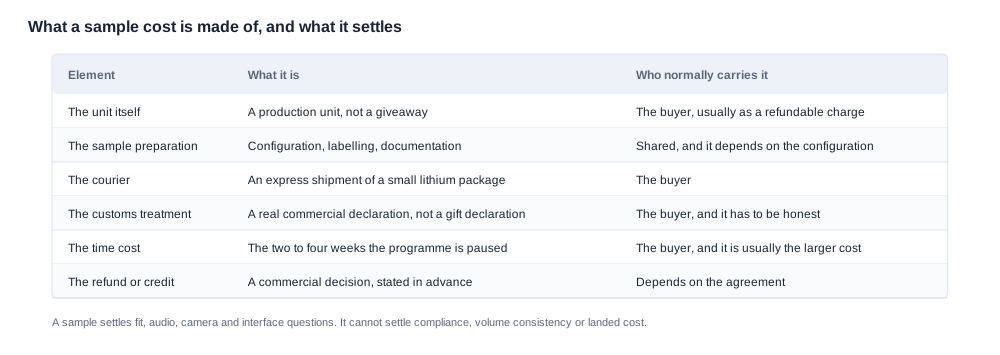
The unit. A sample is normally a production unit rather than a giveaway. A giveaway unit comes off a line somewhere, creates a discrepancy in the accounting and tells the buyer nothing about whether the line can build their configuration. A production unit has a build date and a configuration, which makes it evidence later. Its cost is the production cost of one unit in the configuration requested — and because the configuration drives the cost, the configuration has to be settled before the cost can be. That is the reason a sample quotation follows a specification rather than preceding it.
The preparation. Configuration, labelling, documentation, and any accessory set that travels with the unit. This is the component that scales with what you asked for. A unit in a retail package with a printed manual and a brand insert is a different piece of work from a bare unit in an anti-static bag with a specification sheet, and the difference is not only cost: the packaged unit is what your customer will unbox, so it is the only version of the sample that tests the packaging. For a first evaluation aimed at the hardware, the bare unit is usually the cheaper and more useful choice; for an approval of the product as sold, it is the wrong one.
The courier. A small package containing a lithium cell, moving by express. Lithium shipments are subject to the carrier's own rules, and those rules apply to a single sample in exactly the same way they apply to a production shipment. This is why a sample is not simply a small parcel, and why the method and the window have to be agreed rather than assumed. The transport side of this is covered in battery transport compliance, and the practical questions about tracking and documents are in do you ship samples with tracking.
The customs treatment. A sample is still a commercial good and should be declared as one, with a description and a value that reflect the unit. A gift declaration on a commercial sample is a small fiction that becomes a problem the first time the unit is re-exported, returned or inspected, and it is a bad habit to begin with. The declaration also affects what the courier will do with the paperwork, which is one of the reasons a shipped sample occasionally stalls at the border.
The credit or the refund. Whether the sample charge comes back, and whether it comes back as a refund or as a credit against the first order, is a commercial term rather than a detail. It should be agreed in writing at the point of the request, because it is materially easier to agree before the unit is built than after it has arrived and been evaluated.
What is not published. The fee, the preparation charge, the shipping cost, the expected shipping window, the production lead time for the sample, the refund terms and the total programme cost are all unpublished here, and each of them is established in the sample quotation for a named configuration. That is not a gap in the information; it is the information, because each of those numbers belongs to a specific request.
Two costs sit on top of that list and are easy to miss when a sample is treated as a small parcel. The first is the documentation set. A unit shipped across a border may need to arrive with a specification sheet, a declaration of conformity or its absence, and a commercial invoice in a form the receiving country's customs will accept — and the recipient may need to supply a company registration number or a tax identifier before the shipment moves. A sample that is held for a week waiting on a document has cost a week. The second is the incoterm. Whether the freight is arranged by the supplier to the buyer’s door or by the buyer’s own forwarder changes who bears the risk in transit, who pays the duty and who has to produce the paperwork; a sample shipped on an informal basis can end up with neither side quite clear about who is responsible if it does not arrive. Both questions are ordinary procurement practice, and both are worth settling in the request rather than in the follow-up.
There is also an honest asymmetry worth naming. A sample of one unit carries the freight cost of one unit, and a production order carries the freight cost of the whole shipment with the same documentation burden spread across thousands of units. Sampling is therefore unusually expensive per unit in freight terms, which is one of the few arguments for sampling a broader shortlist in one consignment rather than one unit at a time.
The hidden cost of a requesting decision that stalls
The cost that never appears on an invoice is the time the programme spends waiting, and it is usually the largest line in the sample exercise. There are three distinct waits inside it, and they fail in different ways.
The first is the wait for the unit. A sample that has to be built rather than picked leaves the buyer dependent on a production slot, and the length of that wait is not published on this site because it depends on the configuration and the state of the line. The second is the wait for the evaluation, which is longer than buyers expect: the unit has to be received, the script has to be run, more than one wearer has to try it, the results have to be recorded and a decision has to be taken. The third is the wait for a second sample, which happens when the first one did not answer the question, and which is the most expensive of the three because it repeats the first two in full.
That third wait is the one worth designing against, because it is avoidable and it is expensive. It becomes necessary whenever a sample arrives without a question attached, arrives in the wrong configuration, or arrives in a state that cannot answer the question — a showroom unit, a default configuration, a production unit where an evaluation unit was expected, or a unit whose firmware build does not carry the customisation under review. None of these are exotic failures. They are the ordinary consequence of a request that did not specify the purpose, the configuration and the criteria.
There is a fourth cost in the same category, and it is the one most buyers forget entirely: the cost of the second sample is not only the second sample. It is the second sample plus the revision of everything the first one settled. If the first unit answered the fit and the runtime questions and the second unit arrives with a different colour because the colour was left open, then the fit and runtime data may have to be re-collected as well, because the colour change alters the physical product being measured. This is the practical reason for specifying the configuration completely on the first request rather than iterating, and it is also the reason a colour decision belongs before the sample rather than after it.
The comparison to make is not sample cost against no sample. It is sample cost against the cost of the same question being answered later, in production, at volume, with a customer involved.
That comparison is worth putting in numbers for a hypothetical buyer, because it changes the decision more often than buyers expect. A sample programme that costs a few hundred currency units and takes a month will be judged against a programme that costs the same fraction of the first production run and takes the same month again, plus the tooling, plus the artwork, plus the certification review, plus the marketing that has already been committed around a launch date. The sample is not the expensive part of the discovery; it is the cheap part. What changes the economics is the scenario where the question is never asked, or where it is asked after the first thousand units have shipped.
There is a cost here that does not appear on any invoice either, and it is the one that belongs to the buyer rather than the factory: the internal time of the people who receive the unit, run the script, record the results and write the recommendation. In a small brand that is the founder, and a month of founder attention on a sample is not free. The counter-argument is equally practical: the same month spent reviewing a first production run is a month of the same attention, applied to a decision that cannot be changed.


What a sample settles when requesting it, and what it cannot
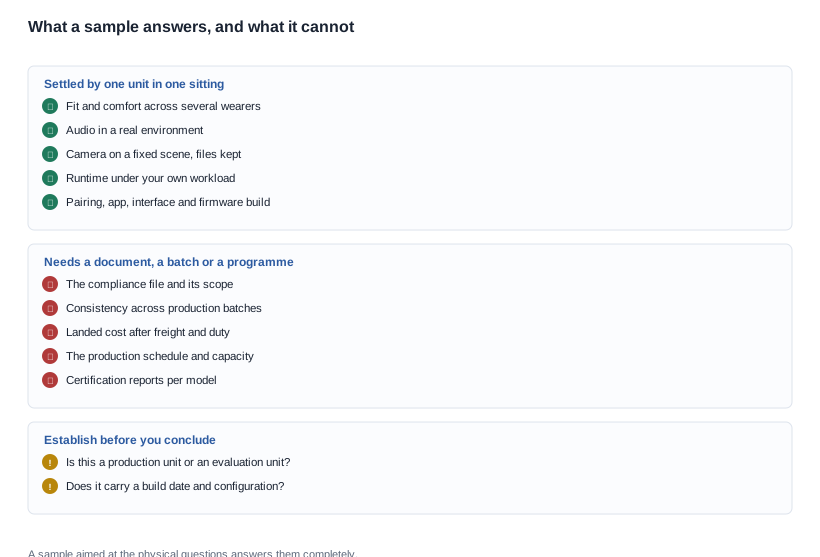
The value of a sample is entirely a function of whether it is aimed. Aim it at the physical and experiential questions and it answers them completely, in a single sitting, for the unit in your hand. Fit and comfort across several wearers. The audio in a real environment rather than in a spec sheet — worth noting that the range publishes surround audio for one model only, so the acoustic comparison between two candidates is one of the few places where a sample is genuinely decisive. The camera in daylight and in low light, against a fixed scene, with the files kept. The runtime under your own workload rather than the published figure, which the catalogue gives as about five to eight hours across the camera entries without a stated test condition. The heat after a long take. The pairing flow, the app, the interface, the firmware build and the defaults. The fit of the packaging, if the sample is packaged.
Aimed at the business questions, a sample answers nothing at all. It cannot settle the compliance file, because the file is a set of documents and no unit carries one — and the published position on this site is that the export certification page is a picture page carrying ten patent certificates, eight design patents and two utility models, with no per-model certification row and no published UN38.3 test summary. It cannot settle consistency, because consistency is a property of a batch and a sample is one unit. It cannot settle the landed cost, because freight and duty are properties of the shipment rather than of the object. It cannot settle the schedule, because a sample says nothing about the state of a line or the capacity behind it.
The middle ground is where the mistake is made. A sample drawn from the production line, with a build date and a configuration, is evidence about the line's output and about the unit's quality. A sample that is a build of one, or an evaluation unit, is not. Before drawing any conclusion from a unit, establish which of the two it is — it takes one question and it changes what the unit can be used for.

How to make a requesting decision worth its cost
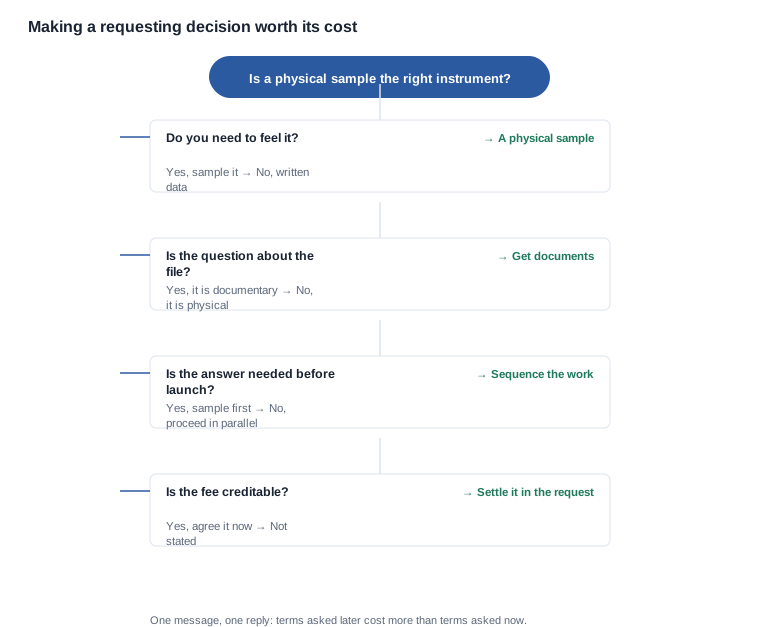
Three things turn a sample order into an answer, and they are all about the request rather than the unit.
Send a specification, not a request for one unit. Name the model, the colour, the case or the absence of a case, the accessory list, the packaging level and the firmware build. Then state the decision the sample feeds and the criteria that will be applied. A request that says "one sample" produces a unit and a wait; a request that names the questions produces a unit, a wait and an answer.
Ask for the commercial terms in the same message. The fee, the preparation, the freight method, the expected window, the refund or credit terms, the production lead time for the sample and the paperwork the recipient will need for the customs declaration. One message, one reply, no round of clarification. It is also the moment to establish whether the sample is credited against a first order, because a credit agreed at the request stage is a discount, while a credit asked for afterwards is a favour.
Plan the programme around the answer. If the sample settles the fit but not the camera, then the camera question needs a second unit or a different instrument, and it is much better to know that before the first one arrives. Where the answer to "can one sample answer everything?" is no, the question becomes which answer is worth the wait — and that is a decision about the launch date rather than about the product.
Decide how many questions one sample is allowed to carry. A sample that is asked to approve the hardware, the fit, the sound, the camera, the packaging and the documentation simultaneously will be evaluated against criteria nobody wrote down, and the most audible opinion will win. A sample with two or three defined criteria and a written record produces a decision; a sample with six produces a meeting. Where the shortlist has more than one candidate, the criteria have to be identical across candidates or the comparison is meaningless, which is another reason to write them before the units are ordered rather than after they arrive.
There is a variant worth considering for buyers who already know the platform and need only the commercial picture. Some programmes can be run without a physical sample, using published configuration data, a written specification and a factory video call for the visual questions. It is a weaker instrument — it settles nothing about fit, feel or sound in your own hands — but it is dramatically cheaper and faster, and for a category decision rather than a product approval it can be the better trade. The decision to sample should be a deliberate one rather than a reflex.
The commercial terms to settle before requesting
Five terms belong in the request, and each one prevents a specific and common failure.
- The sample charge, and whether it is refundable or creditable. Without this, the conversation about the fee happens after the unit is built, which is the worst possible moment for it.
- The freight method and the expected window. Not published here, and required for any plan that has a launch date attached to it.
- The customs declaration and the paperwork required from the recipient. A sample that stalls in transit for a missing document costs more time than it saved.
- Whether the unit is a production unit or an evaluation unit, and whether it carries a build date and a configuration record. This determines what it can later be used as evidence for.
- The consequences of a rejected sample. Whether the unit is rebuilt, whether the preparation charge is repeated, and what happens to the schedule. A supplier who answers this cleanly is telling you how their programme runs.
None of these five is a negotiating trick. They are the terms that determine whether the sample becomes an answer or an expense, and the ones a buyer is entitled to have in writing before committing.
The trade-off worth naming here is between the completeness of the request and the speed of the answer. A request that specifies the configuration, the documentation, the customs treatment, the credit terms and the evaluation criteria will occasionally come back with a question, because the factory may have a constraint you could not have known about. That round trip costs days. A request that asks only for "a sample of the model" will come back quickly and be useless, because the unit that arrives will answer a question nobody posed. The faster route is almost always the more specific one, as long as the specification does not change again once the unit is built.
One last point belongs with the terms rather than with the process. If the sample is credited against a first order, that credit changes the commercial shape of the programme: the sample becomes the first unit of the order rather than a separate transaction, and the programme behaves quite differently. Ask for it in writing at the request stage, and get the answer that applies to your configuration, because a supplier may credit a standard configuration and not a customised one.
The platform behind a sample matters for the same reason: the sample is drawn from a range where the published rows are mostly electrical, and the properties a sample actually tests are the ones the catalogue leaves open. The range is on the OEM ready products page, and the commercial logic of entering with a low-risk configuration first is set out in OEM ready platform low risk entry.
Related reading
- The policy itself — sample policy and cost
- The order form — request a sample
- Shipping a sample — do you ship samples with tracking
- The transport rules — battery transport compliance
Send us the configuration and the questions you need answered, and we will tell you what one sample can settle and what it cannot.


