

A low-risk entry into OEM ready platforms is not a smaller order. It is a narrower commitment with a defined exit. Price, minimum order quantity and lead time are all unpublished on this platform, so the usual ranking of entry points by cost cannot be built here — and any article that ranks them by cost is ranking them by information it does not have. What can be compared is exposure: what each entry point risks, what it resolves, and what it leaves unresolved. OEM ready platforms support several genuine entry structures, and this one compares them by exposure rather than by price.
OEM ready platforms and what a low-risk entry can absorb
The purpose of a low-risk first order is to buy information at an acceptable cost. That reframes the question immediately: the entry point is not judged by how little it costs, but by how much uncertainty it removes per unit of exposure.
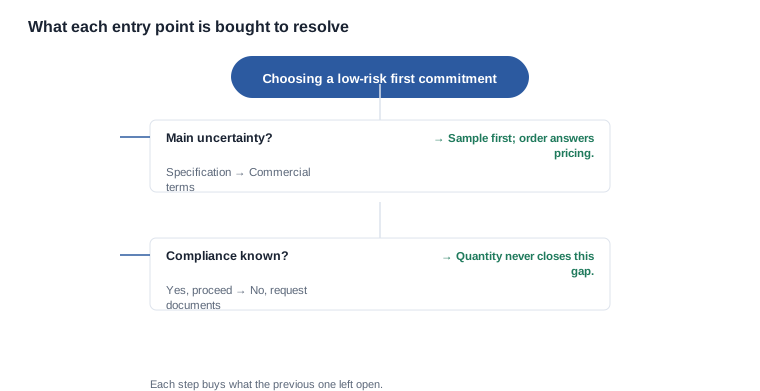
Three kinds of uncertainty dominate a first entry into this platform. Specification uncertainty — whether the product behaves as the published rows suggest. Commercial uncertainty — what the minimum order, the unit price and the lead time actually are for your configuration. Compliance uncertainty — whether the certification and documentation position supports the markets you intend to sell into. No entry point removes all three, and the useful question is which one each point is designed to remove.
Entry point one: the sample order
A sample order is the lowest-exposure point available and the one most often treated as a formality. Its value depends entirely on what you make it settle.
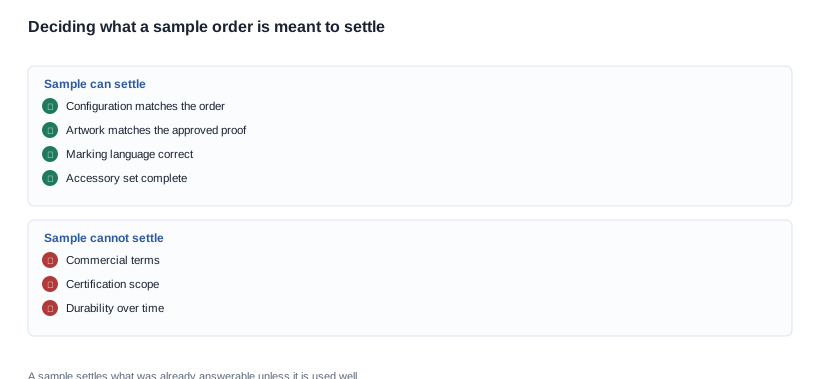
What a sample can genuinely resolve: whether the configuration matches the purchase order; whether the artwork and packaging match the approved proof; whether the accessory set is complete; whether the marking language is correct; and whether the charging method on the unit matches what the specification said. Those are five real classes of risk, and several of them are expensive to discover after a bulk shipment.
What a sample cannot resolve: the commercial terms, the compliance position, and anything about how the product performs across a period of use. A buyer who treats a sample as a low-risk substitute for due diligence will find that it settled the questions that were already answerable and left the ones that mattered.
The sample before bulk note covers the operational discipline, and the trade-off between sample cost, sample lead time and the categories of defect a sample catches is worth evaluating explicitly before the order is placed.
Entry point two: a single-configuration first order
The second structure is a first bulk order restricted to one model in one configuration. This is where commercial uncertainty gets resolved, because a purchase order forces a minimum order quantity, a unit price and a lead time into writing. Its exposure is concentrated in two places: the quantity committed, and the fact that one configuration cannot reveal whether your range structure works.
The configuration-count discipline matters more here than anywhere else, and it is easy to get wrong in the direction of over-launching. A first order of one model across four colourways and two packaging languages is twelve configurations by arithmetic, and each one carries its own minimum. The range overview for the smart eyewear line is useful background on how many sellable configurations a platform of this size can generate.
Entry point three: a documented pilot with a named exit
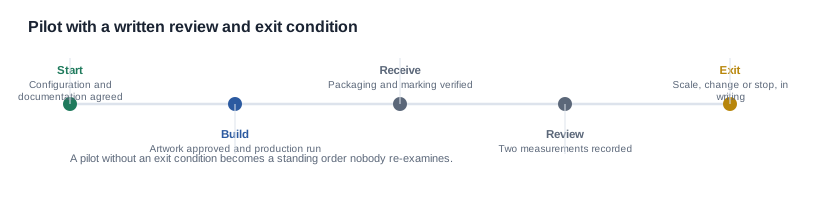
The third structure adds a written pilot agreement: a defined quantity, a defined review date, and a defined exit condition. This is the structure that most reliably protects a buyer, and it is the one most often skipped because it requires negotiating something the supplier has no routine to offer.
What belongs in it is ordinary contract content: the review date, what is measured at the review, what happens at the review in each direction, and what happens to artwork and packaging assets if the programme ends. On this platform the last of these is particularly worth settling, because a private-label configuration has no natural resale outlet, and the inventory exposure at the end of a pilot is one of the most commonly underestimated costs in this category.
The private label options piece sets out the configuration dimension, and the channel strategy note covers what happens when a pilot result has to be read into one channel rather than many.
Entry point four: a prepared range with staged commitments
The fourth structure commits to a range structure but staggers the volume, so that the range decision is made once and the quantities are decided in sequence. This is the highest-exposure entry point and the one that requires the best documentation position, because a range commitment multiplies the number of configurations that must each be documented.

Entry points compared by exposure rather than by price
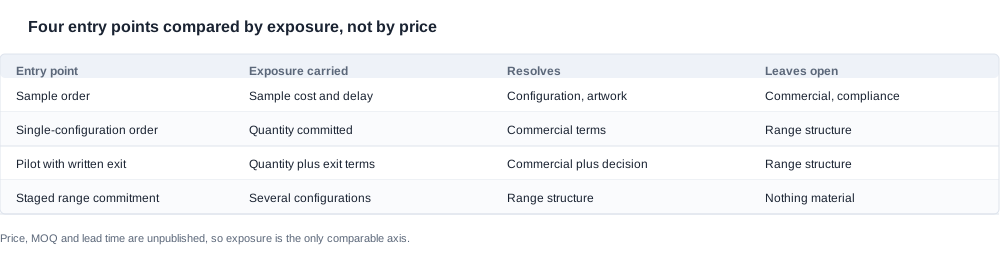
The comparison below is deliberately built on published structure rather than on commercial terms, because the commercial terms are unpublished and a comparison built on them would be a comparison built on assumption.
| Entry point | Exposure carried | Uncertainty removed | Uncertainty left |
|---|---|---|---|
| Sample order | Sample cost and delay | Specification, artwork, configuration | Commercial, compliance, durability |
| Single-configuration order | Quantity committed | Commercial terms for that configuration | Range structure, channel fit |
| Pilot with written exit | Quantity plus exit terms | Commercial terms plus a decision point | Range structure, scale economics |
| Staged range commitment | Multiple configurations at once | Range structure | Nothing material remains |
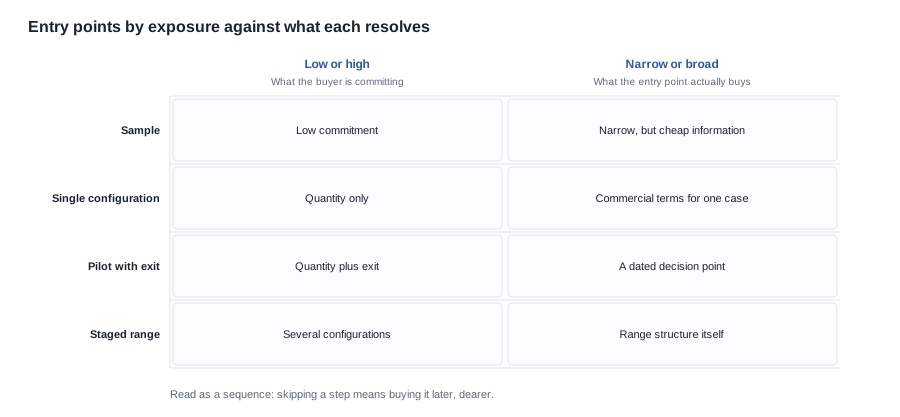
Read this table as a sequence rather than a menu. Each structure buys what the previous one left open, and the cost of skipping a step is that you buy it later at a worse price and with less information.
Matching the entry point to the documentation gap
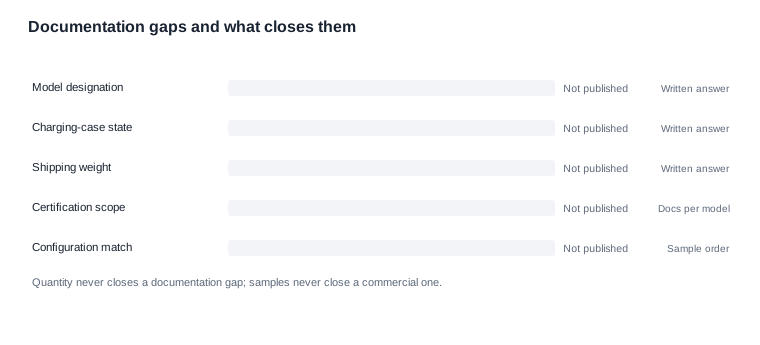
The four documentation gaps that matter on this platform have a specific logic to them, and the entry point should be chosen against the gap rather than against a budget.
The model designation gap. Where a page carries more than one name — the L2 Utral prints Utral and Pro Max side by side, with a case row reading 900/1400mAh and no stated relationship between the names and the capacities — the gap is resolved by a written answer, not by a sample. A sample cannot tell you which name the paperwork will use.
The charging-case gap. Five camera models publish a case capacity, two publish a case without a capacity, and four publish no case row — the V03 and the V03 Pro, and the S7 and the V06. A buyer whose programme spans more than one of those states needs the case state confirmed per model in writing, and the charging case options note is the place to work through the implications.
The weight gap. The range publishes exactly one weight: the MT6 at 158 grams for the glasses body, excluding its folding case. Every other model's weight is unknown, which means a shipping calculation built for anything except that one model is an estimate. The shipping weight note covers how to handle a single published figure across a range of unpublished ones.
The certification gap. The range documentation contains no per-model certification row and no reference to CE, FCC or RoHS in its text; the company-level page it does carry is images rather than text. This gap cannot be closed by a sample and cannot be closed by a first order. It is closed by requesting the documents for the specific model. The certification coverage notes set out why this is a negotiation point rather than an administrative one.
A sequencing rule that holds up
The rule is simple and it follows directly from the table: close the documentation gaps with written answers, use the sample to close the specification gaps, and use the first bulk order to close the commercial gaps. Doing them in a different order means paying a specification question twice.
The failure pattern to avoid is starting with a bulk order because it looks efficient, and then discovering during production that the case configuration was ambiguous or the marking language was wrong. At that point the buyer has committed quantity against a configuration that was never fully defined, which is the one state of affairs the sequencing rule exists to prevent.
A cost of exposure checklist you can apply to any entry point
Because the commercial terms are unpublished, "low risk" has to be assessed structurally rather than financially. Five questions do it, and each one can be answered from published information plus the written answers a supplier has already given you.
How many configurations does this commitment create? Count colourways times packaging languages times destination markets. If the product is three, the commitment is a small order; if it is twelve, it is a programme, and the entry point has quietly changed category.
Which documentation gaps remain open at the moment of commitment? A commitment made with the case configuration unconfirmed, or the model designation ambiguous, is not low risk regardless of its size.
What is the cost of being wrong at the end of this commitment? For a private-label configuration the answer is usually high, because the inventory has no natural resale outlet on your own channel and a secondary outlet requires separate branding work.
Which questions does this commitment leave permanently unanswered? Any question it cannot address later at a reasonable cost is a question it should address now.
What does the exit require? If the exit involves artwork, packaging assets and inventory with no defined position, the exposure is not bounded and the commitment is not low risk.
Run these five before choosing the entry point rather than after, and record the answers. The record matters because the assessment changes as the programme develops, and an entry point that was genuinely low risk in month two can stop being one by month six if the configuration count has grown.
The trade-off nobody prices into a first order
There is a trade-off in every entry point between the information gained and the options retained. A very small commitment gains information and retains almost no option: if the answer is good, you still have to place a real order, and you will have done the diligence twice. A very large commitment retains options and gains information slowly, because it ties up cash in configurations whose demand you have not yet observed.
The middle position — a single-configuration order at a stated volume, with the documentation closed first — is usually the right one, because it resolves the commercial terms in a single step while keeping the configuration count low enough that a bad result is survivable. The judgement it requires is not about the size of the order; it is about whether you have closed the documentation gaps that would make the order meaningless.

The limits of a small first order
A small first order reduces financial exposure and increases information. It does not reduce two specific risks, and buyers frequently assume it does.
It does not reduce the compliance gap. The documentation position is the same on a small order as on a large one. If the certification scope for a model is unstated, a small order leaves it unstated, and a marketplace listing that depends on it inherits the same problem.
It does not establish channel viability. A small order can demonstrate that the product is as specified and can demonstrate nothing about whether it sells. Treating a modest sell-through as a market signal is one of the more expensive analytical errors available at this stage, because the sample size does not support the conclusion being drawn.
There is also a structural limit worth naming. A small order spread across several configurations is not a small order — it is several small orders, each with its own minimum, its own artwork and its own documentation. The bulk ordering note covers the mechanics of how quantity commitments behave on this platform.
When a small order is the wrong instrument
Some objectives cannot be met by reducing quantity. Reducing quantity does not tell you whether the supplier can hold a production slot at volume, because capacity behaviour at low volume is different. It does not tell you whether the unit price at a stated volume is the price you will get. It does not tell you whether the packaging line can run your artwork at scale, or whether the documentation can be produced for several markets rather than one.
If the objective is to test any of those, the right instrument is a written commitment at a stated volume with a stated term, not a reduced order. That is the scaling up consideration in its simplest form: the questions about scale are answered by a contract, and cannot be answered by a smaller purchase.
Which models are ready for which entry point
Not every model suits every entry point, and the reason is published structure rather than commercial terms. A model whose page publishes a complete set of rows — a cell, a runtime, a charge ceiling and a charging method — is straightforward to evaluate at the sample stage, because there is little left to discover. A model that publishes fewer rows is better approached with written questions first, because the sample will confirm the configuration but not the documentation.
The which models are ready note works through this at the model level, and it is the piece to consult before choosing a first model rather than after.
Building the exit terms before you need them
The exit terms are the part of a pilot agreement that most often gets drafted after a pilot has already produced an uncomfortable result, at which point the drafting party has no leverage. Drafting them first is what makes the structure protective rather than decorative.
Four clauses carry most of the value. The review date and what is measured at it. The two decisions available at the review, with what triggers each. What happens to artwork, packaging files and any tooling if the programme ends. And what happens to remaining inventory, including whether it can be reworked, re-marked or has to be written down.
The fourth is the one that determines whether a pilot is genuinely bounded. Inventory built for a private label can sometimes be re-marked for another channel and sometimes cannot, depending on the artwork position and the model designation printed on the carton. Because the model designation is part of the identity rather than part of the decoration, a carton printed with your model name is generally not a carton you can re-purpose. That is worth settling with a written answer at the start rather than discovering at the end.
What the range's published structure tells you about entry order
One last piece of published information is worth using before you choose. The camera group varies far more than the audio group in how much it publishes, which means entry points land differently depending on which group you start with. Audio models publish a Bluetooth version, a cell configuration, a charging method and a runtime; camera models publish a resolution class, a cell, a runtime and a charge ceiling, but no Bluetooth version at all, and their charging-case position splits into three states rather than two.
The practical consequence is that an audio configuration is a cleaner candidate for a sample-led entry, because there is less left to discover and fewer state variables to confirm. A camera configuration is better approached with written questions first, because the case state and the charging method may both be unpublished and both materially affect what the product physically is. This is a structural observation about the range, not a recommendation of one group over the other.

Deciding when the pilot has done its job
A pilot that has no exit condition does not finish; it becomes a standing order that nobody has re-examined. Defining the exit in advance is what makes the pilot useful, and the definition is straightforward: a date, a measurement, and two decisions — continue at what volume, or stop and release the commitment.
The measurement should be one the buyer can actually produce. Sell-through is the obvious candidate and it is frequently the wrong one, because it conflates demand with execution and it is slow. Two measurements are more diagnostic: whether the configuration sold as specified once the documentation questions were answered, and whether the supply chain held its quoted lead time and produced the packaging as approved. Those two test the things the pilot was actually bought to test.
When the review arrives, the decision is one of three: scale the configuration that performed, change the configuration that did not and repeat the measurement, or stop. The third option should be written into the agreement at the start, with the terms of what happens to artwork and inventory. It is the option least likely to be reached in practice and the one most expensive to leave undefined.
We will not quote a minimum order quantity, a unit price or a lead time for an entry-point structure, because none of them is published. What we will do is tell you which models carry the most published structure, which carry the least, and which documentation gaps have to be closed with written answers before any entry point is worth taking.
Send us the models you are considering, the markets you intend to serve and the entry point you are weighing, and we will mark which gaps that entry point actually closes.
Related reading
- What a sample is for — sample before bulk
- Configuration states — charging case options
- Weight and shipping — shipping weight
- The documentation gap — certification coverage notes
- Volume behaviour — bulk ordering
- Channel decisions — channel strategy
- When to scale — scaling up
- Range structure — smart eyewear range overview


