

Requesting smart glasses samples is a decision about evidence, not a decision about models. A buyer who names twenty-eight samples in the first request collects a folder of impressions and settles nothing. A buyer who names six collects six answers they can put in front of a customer. The rule we apply to our own catalogue is narrow and worth stating before anything else: sample only where a published row leaves a question open, and name one model per distinct published row. Everything below is that single rule, applied group by group to the twenty-eight entries in our catalogue, followed by the paperwork that has to travel with the units, the checks to run when they arrive, and the commercial terms a quotation has to settle before the first bulk order is placed.
Requesting samples: start from the decision the unit has to settle
The first question in any sample request is not "which models do we like". It is "what decision will this unit inform". A sample is evidence, and evidence has to be aimed at something. If the decision is which configuration we put on the shelf for a specific channel, then the sample has to answer a configuration question. If the decision is whether we open a category at all, then one unit per distinct hardware row is enough and everything else is spending.
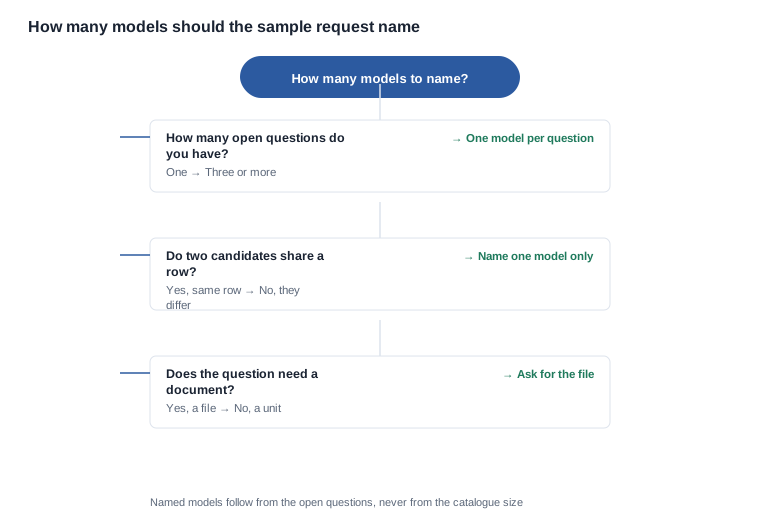
That framing changes the number immediately. Twenty-eight catalogue entries do not imply twenty-eight samples. What matters is how many distinct published rows exist in the subset you are actually evaluating, because a sample can only tell you something the specification row has left open. Where the catalogue already publishes a fact — a cell capacity, a runtime figure, a charge time, a charging method, a Bluetooth version, a resolution class — a sample adds little beyond confirming that the published row matches the physical unit. Where the catalogue publishes nothing, a sample is often the only route available.
So the ordering of work is fixed. First, write down the decisions. Second, find the published rows that bear on each decision. Third, count the points where the row is silent. Fourth, name one model for each silent point. Fifth, and only then, decide how many units per model you need — which is a separate question, and one that belongs to the quality-control plan rather than to the evidence plan.
There is a second framing question that buyers routinely skip: are the samples for you, or for a customer you are supplying? The two produce different requests. Your own evaluation sample needs one unit per model, checked against a written criteria list. A customer demonstration sample needs units that survive being handled by somebody else, that arrive with documentation a buyer can read, and that you can explain without a sample in your hand. A request that mixes the two produces a package that is simultaneously too small to evaluate and too small to demonstrate. If both are needed, ask for them separately and price them separately — which is also the point where the quotation becomes meaningful.
Requesting the right models: what each catalogue group can prove
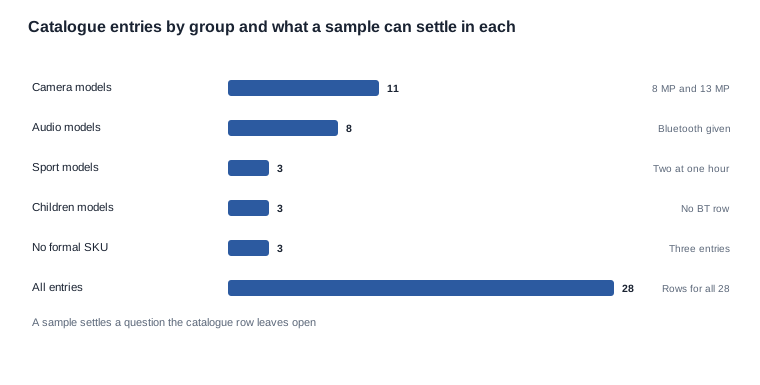
Our catalogue publishes twenty-eight entries: eleven camera models, eight audio models, three sport models, three children's models, and three entries that carry no formal SKU (the augmented-reality glasses, the electrochromic glasses and the bone-conduction model). Every entry carries a battery row, a runtime row and a charge-time row; twenty-six of them publish a charging ceiling of two hours or less, while the two sport models with the shortest cycle publish about one hour. That published skeleton is what a sample request should be built against, because the silence sits inside it.
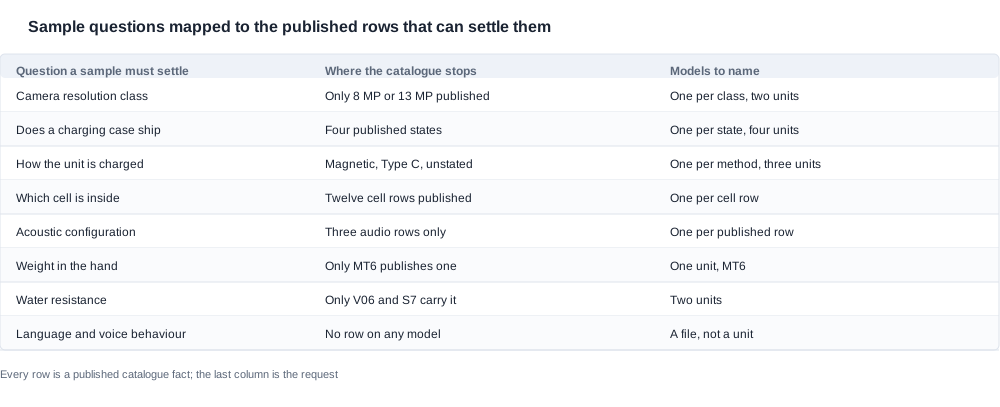
The camera group is where the sample earns its cost. Eleven models, two resolution classes: eight MP on V03 Pro and the V03, MT5 and CY05, and CY03 and MT6, and KY06 and V06, and 13 MP on the S7 and the L1 Pro, and the L2 Utral. That is a structural split, not a price split, and two units settle the resolution question for the whole group. What the catalogue does not publish for any of the eleven is the sensor model, the field of view, the frame rate, the video format, the stabilisation behaviour, the low-light result, or the storage capacity and file format. The eleven are also the only group with no Bluetooth version published at all, so a unit in hand is the first and only way to observe radio behaviour on them.
The charging-case picture on those eleven models is genuinely three-state, and a buyer who reads it as two will mis-specify a delivery. Five publish a case capacity: the CY03 and L1 Pro, and CY05 — each at 1400 mAh, the MT6 at 1200 mAh in a folding case, and the L2 Utral at two published values, 900 and 1400 mAh, in a single row with no published mapping between the two variant names and the two capacities. Two more, the KY06 and the MT5, publish a case but no capacity. Three — the V03 and the S7, and the V06 — have no charging-case row in the catalogue at all, which is an unpublished state rather than an absent feature. One, the V03 Pro, has no charging-case row. Four of the eleven — L1 Pro and CY05, and the CY03 and MT6 — publish a case capacity but no charging method, so the method is a question for the supplier rather than something to read off the page.
The audio group splits on fewer rows than buyers expect. Eight models: D11 and the K02, G07 and YK12, LC-105-1 and LC-105-2, and K01 and D12. Bluetooth version is published for all eight — V5.3 on the K02 and K01, V5.4 on the other six. Cell capacity falls into three published rows: 90mAh2 on the K02 and K01, 100 mAh on the D11 and D12, and 55mAh2 on the LC-105 pair, the G07 and the YK12. Runtime splits once: about eight hours for the K02, K01, LC-105-1 and LC-105-2, about seven hours for the D11 and D12, and about six hours for the G07 and YK12. The G07 and the YK12 are the only two models that publish both 55mAh*2 and about six hours, and their feature rows are what separate them: the G07 publishes an ultra-thin removable temple, the YK12 publishes a surround-sound slim temple. The D11 publishes a surround-sound row and a long-runtime row; the D12 publishes neither.
The sport group has the only sub-two-hour charge times in the catalogue. Three models: the YKC02 on 70mAh*2 with about eight hours and magnetic charging, the D17 on 115 mAh with about seven hours and a Type-C charge in about one hour, and the ZH12 on 100 mAh with about eight hours and a Type-C charge in about one hour. The D17 and the ZH12 also publish the only remote shutter feature rows in the catalogue — remote control photo on the D17, remote shutter on the ZH12. Note that the YKC02 is a sport model, not an audio model; it sits alongside the D11 and the YK12 in the surround-sound rows but belongs in the sport group.
The three children's models are separate rows and separate questions. The A05 and the A06 both publish 40 mAh, about twenty hours, a charge time of two hours or less and magnetic charging, and their catalogue pages list the same feature rows; our product detail sheet records that their parameters are identical and that the difference between them is unconfirmed. The A07 publishes 70 mAh, about twenty hours, magnetic charging and a Bluetooth version of V5.4. Whatever the A05 and A06 distinction turns out to be, a sample cannot be the way to answer it, because the difference is recorded as unresolved on the product side rather than hidden on the unit.
Three entries have no formal SKU. The augmented-reality entry publishes 100 mAh, about eight hours, magnetic charging and V5.4, with indicator-light and button-control feature rows. The electrochromic entry publishes 100 mAh, about seven hours and magnetic charging. The bone-conduction entry publishes 200 mAh, about seven hours and a Type-C charge, with an amplification-gain row of 35 dB. Naming these in a sample request is possible; converting them into a purchase order line is a different matter, because there is no SKU to convert them into.
Requesting a mixed set: four rules that keep the result readable
A mixed sample request — several models at once — is efficient, but it becomes unreadable unless four rules hold. These are not stylistic preferences; each one prevents a specific and common failure in procurement.
Rule one: one model per distinct published row, never two. If two candidate models publish the same cell row, the same runtime row, the same charge method and the same resolution class, sampling both buys you the same information twice. The two models that share 55mAh*2 and about six hours in the audio group — the G07 and the YK12 — are separated by a feature row, not by a specification row, so the sample question is about the temple and the audio configuration rather than about power. Sample one of them and ask the supplier for the difference in writing; sample both only if the temple difference is the thing your customer actually reacts to.
Rule two: the sample request names the row each unit is being asked about. A request that lists models without listing the question attached to each one produces a return package you cannot evaluate, because you will not know which unit answered which question. Put the row next to the model in the request: which capacity, which charge method, which runtime, whether a case ships, and which single behaviour the unit is meant to settle.
Rule three: separate the demonstration units from the evaluation units. They have different acceptance criteria, different documentation needs and different shelf lives. Mixing them in one request is how a buyer ends up with units that were opened for evaluation and then sent to a customer.
Rule four: every unit in the request carries a written acceptance checklist before it leaves the supplier. Not a verbal assurance and not a promise in a message — a short list, agreed in advance, that names what will be checked on arrival and what happens if a check fails. Without it, the arrival is a formality.

A worked walkthrough: six units and what each one settles
The following is an illustrative exercise built only from our published catalogue rows. It is not a client project, and no customer has ordered this configuration.
A distributor is deciding whether to open a smart glasses category with an audio-first range and a single camera model, and it has two months before a trade event. The decisions are: what cell configuration to lead with, whether the camera offering can carry a case, and whether the charge method is a source of customer friction.
Step one, the decisions: three, and they are unrelated to each other, which means three evidence points rather than one bundle.
Step two, the rows: cell configuration on the audio side splits into three published rows — 90mAh2, 100 mAh and 55mAh2 — so one unit per row, three units. The camera question, whether a case ships with the unit, has four published states across the eleven camera models, so one camera unit per state would be four units. The charge-method question has three published answers — magnetic, Type-C, and unpublished — so the camera unit already covering an unpublished case row can carry this question as well.
Step three, the silence: the audio units answer the cell question, the camera units answer the case and charge-method questions, and the acoustic configuration is left open because the catalogue publishes no row for it — which means that question goes to the supplier in writing rather than to a sample.
Step four, the result: six units, each with one question attached, plus a written request for three answers that no unit can settle. If the budget had covered twenty-eight units, the extra twenty-two would have repeated eight rows and answered nothing new.

Requesting samples: paperwork, acceptance checks and the failures they catch
The request itself is a document, and it should be treated like one. Six elements belong in it. Who and where: a named contact, a delivery address and the entity that will receive the goods, because the entity on the paperwork is not always the entity that will eventually sell the product. What: the model names as they appear in the catalogue, the quantity per model, and the question attached to each. Which paperwork: what should travel with the units, and what you need back with them. When: the date you need the units, and what happens to the request if that date is missed. Who pays: the freight and the sample cost, and whether either is credited against a subsequent bulk order. What happens if a unit fails: the replacement rule, the evidence you need to claim it, and who decides that a unit has failed.
Two items in that list need particular care. The first is battery transport. Samples with cells travel under the same dangerous-goods regime as commercial shipments, so the transport test summary and the state-of-charge limit apply to a package of two units as much as to a container — and the rules are the same in every market, which means the packaging and the declared state of charge have to be right before the courier is called. Our battery transport position is set out in the battery transport note, and it is worth reading before the request is written rather than after the first unit is refused.
The second is the paperwork itself, and here the honest position is uncomfortable. Our catalogue's export certification page carries ten patent certificates — eight appearance-design patents and two utility-model patents — as images, and its text layer carries no mention of CE, FCC or RoHS and no per-model certification row anywhere. Our internal working record adds the part a unit in your hand cannot supply either: no certificate number exists for us to quote, and no real product photographs, video or test reports have been supplied for any of the twenty-eight models. The consequence for a sample request is direct: a unit in your hand is evidence about hardware, and it is never evidence about certification. Certificates are documents. Ask for them as documents, with the model named on them.
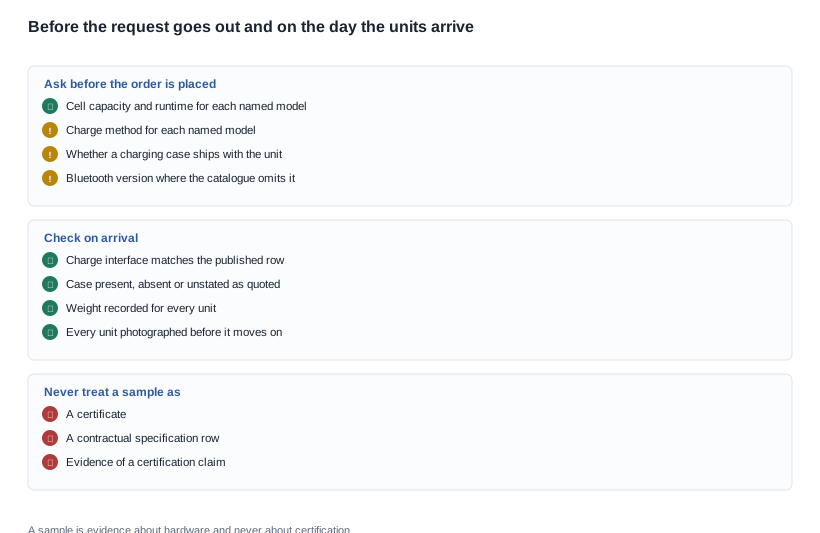
When the units arrive, run the acceptance checks against the row each one was sent for. For the audio group, the physical check that matters most is the charge interface — magnetic contacts or a Type-C port — since the catalogue distinguishes them and because a supplier answer about method is only as good as the unit in front of you. Check Bluetooth version from the device's own reported information, because the catalogue publishes a version for all eight audio models and none for the eleven camera models. Check whether a case is present, and record it as present, absent or unstated exactly as the row said. Record the weight of every unit even where no weight is published, because a weight series across a range is the cheapest internal consistency check you can run. Photograph each unit before it goes anywhere else.
Now the failure modes these checks exist to catch. The most common is treating a sample as a specification: the unit demonstrates that a feature works on one unit, on one day, in one room, which is not the same as a published row and not the same as a contractual specification. The second is configuration drift — the unit that arrives is not the unit the catalogue describes, because a component was substituted between the catalogue page being written and the production run. The third is reading an unpublished row as an absent feature. The catalogue publishes no charging-case row for the V03, the V06 or the S7; that is silence, not an exclusion, and only the V03 Pro has no charging-case row. A buyer who treats the silence as an absence will either skip models that do ship with a case or promise a case that does not exist. The fourth is assuming a sample carries any certification standing at all. The fifth is sampling to satisfy curiosity rather than to settle a decision, which is the failure that turns a six-unit request into a twenty-eight-unit one.

Requesting samples: the commercial terms the quotation has to settle
A sample request is a small commercial transaction with most of the same fields as a large one, and the fields that are missing from the request are the fields that cause disputes later. We publish no sample pricing, no freight terms, no sample credit, no evaluation window and no warranty period, and none of these should be inferred from anything written here. They belong in the quotation, and the quotation is where a procurement team should be asking for them explicitly.
The list worth having open when the quotation arrives is short but complete:
- Sample cost and unit price tier — what a single evaluation unit costs against what a bulk order costs, since the gap between them is usually larger than a buyer expects.
- Sample credit — whether the sample cost is deducted from the first bulk order, and against which line.
- Freight and duties — who arranges them, who pays them, and what the landed cost of one unit actually is.
- Lead time — the production and dispatch time for samples, and separately for the bulk order, because they are rarely the same number.
- Minimum order quantity — what it is per model, what it is for the mixed range, and whether it is a per-model floor or a range total.
- Tooling and NRE — whether any model in the sample set carries a tooling or NRE charge, and what that charge covers.
- Packaging customisation minimum — whether logo, colour or packaging customisation carries its own minimum, and whether that minimum sits above the product MOQ.
- Certification handling — whether the supplier files on your behalf, whether that service is charged, and whether the charge is per model or per market.
- Warranty and defect handling — how a defective sample is replaced, and how a defect found in the sample is treated when the same defect appears in a bulk delivery.
Two negotiation points are worth raising while the request is still open rather than after the quotation arrives. The first is quantity per model. One unit is enough to answer a configuration question, but it is not enough to catch a defect rate, and a buyer who wants a defect read has to ask for a sample quantity that supports it. The second is the relationship between the sample and the specification: ask for the sample to ship against the same configuration, the same packaging revision and the same accessory set as the bulk order will use, and get that written into the purchase conditions. A sample that differs from the production configuration is a sample of a different product, and it is one of the most expensive forms of false economy in a sourcing programme, because it produces a confident answer to the wrong question.
The broader market and paperwork context for this kind of request sits in our select by market overview, and the range we would actually be sampling is on the oem ready products page.
Requesting samples: what our own record does and does not settle
We publish specification rows, and only specification rows. We do not publish prices, minimum order quantities, lead times, warranty periods, capacity, per-model certification numbers, test reports or production photographs, and our own product detail sheet records the absence of test reports and real images across the whole range. What we can do is narrow the request to the questions a sample can actually answer, state which published row each named model carries, and tell you plainly which of your questions need a document rather than a unit.
That is why the sample request starts with the decisions and ends with the units, and why the units are fewer than the catalogue. If you want help building the request against a specific destination market, the certification mapping note covers which rows have to produce which file, and the samples channel is where a request reaches us.
Next step: write down the decisions first, then send the request through the quotation channel with the questions attached to each model. Tell us the models and the questions, and we will come back with what the published rows already answer, what a sample can add, and what has to be a written confirmation instead.


