

Selecting smart glasses by market overview is usually treated as a chapter of compliance material. It is not. It is a sequencing problem, and the answer is short enough to state in one paragraph: a market decision runs on five dimensions, those five dimensions have to be settled in a fixed order because each one constrains the next, and the model list is the second thing you choose rather than the first. Everything else in this article is that argument worked through against the published rows of our own catalogue.
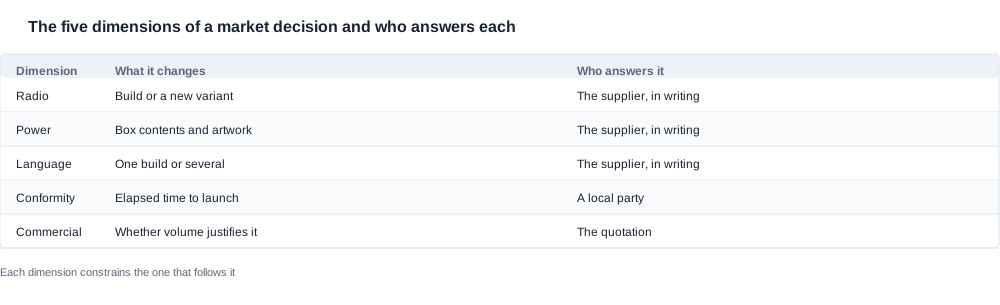
The reason the ordering matters is that the five dimensions are not independent. The radio configuration determines whether the product is a variant or a new build. The power arrangement determines whether there is an adapter in the box, and the adapter determines part of the electrical file and part of the artwork. The language decision determines whether you are managing one build or several. The conformity work determines how long the launch takes. And the commercial terms determine whether the volume justifies any of it. A buyer who opens all five at once ends up with a long request list and no sequence, and a request list without a sequence produces answers that do not fit together.
Selecting by market: the five dimensions and the order they have to be settled
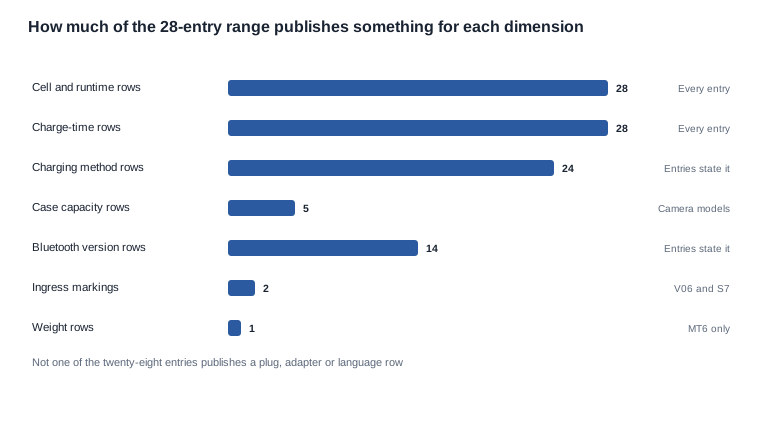
The first dimension is the radio. Every unit in the range carries a transmitter, so no destination is a paperwork-only decision. What our catalogue contributes here is a protocol version on fourteen of the twenty-eight entries and nothing on the other fourteen, with the silence concentrated on all eleven camera models. That tells a buyer where the radio question is documentation and where it has to be asked from scratch.
The second is the power arrangement, and it has two parts that are routinely confused. The device end is well documented: every entry states a cell figure, a charge ceiling and a runtime, and twenty-four of them state how they are charged, with four camera models leaving the method unstated. The box end is not documented at all. There is no adapter row and no plug row anywhere in the specification set, so whether an adapter ships is a question with commercial, electrical and artwork consequences and it has to be answered before any of those three things can be planned.
The third is language and artwork, which is the dimension that decides whether you are running one programme or several. Nothing in the set records a language, a prompt set, a translation entry or an application support list, so the language decision is a question to a supplier and a decision to make before the print cycle rather than after it.
The fourth is conformity and documentation, which is where most of the elapsed time goes and which is the dimension our own records contribute least to. There is no per-model certificate row in the published text, no test report number and no reference to any conformity mark, and the model-level identifiers remain unresolved in our product record. What the catalogue can do is tell you which attributes trigger which frameworks — the radio row, the cell row, the category, the ingress marking — and leave the documents to a written request.
The fifth is commercial, and it is the dimension that converts the other four into a decision. A per-market build, a per-market artwork, a per-market conformity step and a per-market agent appointment all have a price and a lead time, and our published set carries none of them.
The order that follows from those five is straightforward. Fix the destination set, then settle the power arrangement, then the radio configuration, then the language, then the conformity scope, then price what the whole thing costs. Move any two of these and the work repeats. Move the language after the artwork and you pay for a second print cycle; move the radio after the conformity file and you pay for a second file.

Selecting the destination set: how many markets a range can carry
The second decision is which destinations to serve, and the useful way to frame it is as a cost structure rather than a list.
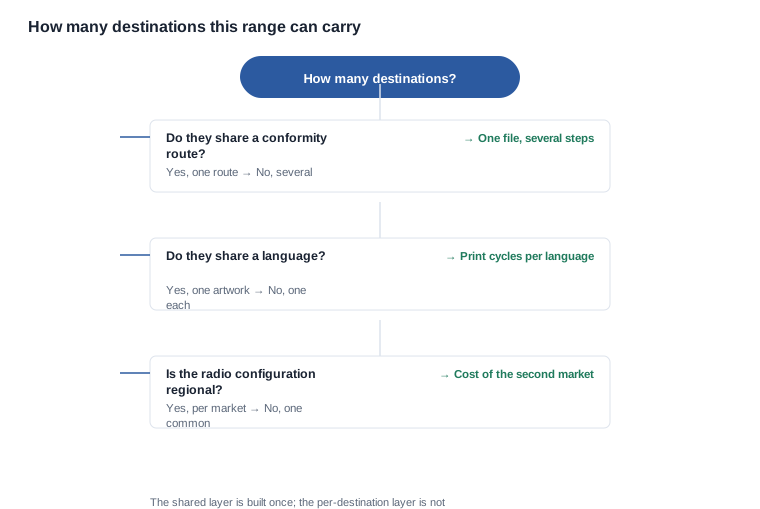
Two kinds of work appear in every market programme. The shared layer is the technical evidence: the radio test work, the cell and transport documentation, the performance measurements behind any published claim, the specification annex of the technical file. This work is destination-independent for a given configuration, and building it once for the whole range is the single largest economy available to a multi-market programme. The per-destination layer is everything that a destination adds: the conformity mark and its national variants, the importer or agent arrangement, the language and the artwork, the plug and the adapter, the registration of the product where one is required, and the retailer's own specification. This layer multiplies by the number of destinations and cannot be shared.
A portfolio therefore has a shape, and it is worth drawing it before deciding anything. A short list of destinations that share a conformity route, a language and a plug can be served from one artwork cycle and one route, and the marginal cost of each additional destination within that group is small. A destination outside that group costs a new conformity step and a new artwork cycle, and the second cost is usually the larger of the two because it recurs with every new account and every new print run.
There is a third category that is easy to overlook and expensive to discover late: the destinations you have deliberately not chosen. Each excluded market has a cost that is not zero. It is the cost of an enquiry that arrives and cannot be answered, of a distributor who asks whether the product is cleared for their country, and of a listing that has to carry a qualification in every market where the qualification is not needed. A programme that has decided what it is not doing can state that in writing to a buyer; a programme that has not will be asked the question at the least convenient moment.
Selecting the models: how the published rows narrow a range
This is the part of the work the catalogue is genuinely good at, and it is worth being concrete about what the rows can and cannot do for a market decision.
They can do four things well. They can separate candidates that a buyer would otherwise treat as interchangeable: two models in the same group with different cell figures are different products to a sourcing team. They can establish the configuration axes — runtime groupings, charging interface groupings, resolution class groupings, case states — so that a request to a supplier is written in terms of the published rows rather than in terms of a marketing description. They can identify the models that carry a documented attribute worth selecting for, such as the two models that carry an ingress marking or the single model that publishes a weight. And they can expose, before any sample is ordered, that a group contains models with materially different documentation, which is exactly the information a sample programme should be built around.
They cannot do three things, and the plan has to account for each. They cannot tell you which models are cleared for a destination, because the catalogue carries no conformity row at all. They cannot tell you the radio configuration, the language, the connectivity position, the adapter, the plug or the carton, because none of those is published for any entry. And they cannot tell you the price, the minimum order quantity, the lead time or the capacity, because those are commercial facts that no specification page can carry.
That last point is worth restating because it is the one buyers most often want to ignore. The published rows make a shortlist defensible and they make a supplier request precise. They do not make an order, and the distance between a defensible shortlist and a signed order is exactly the length of the written request that closes the open items.
Turning the rows into a request that can be answered
A request written in product language gets a product answer, and a product answer is not what closes an open item. A request written in the catalogue's own row language gets an answer that can be filed against a model. The difference is small in wording and large in what it produces.
Six blocks belong in the request, and the order between them matters less than the fact that none of them is missing.
- The model list, written with the designations as the catalogue writes them, including both variant names where an entry publishes two and a note of which entry has no formal SKU.
- The configuration, taken straight from the published rows: the cell figure and the cell count, the charging interface where one is stated, the charge ceiling, the runtime, the case state, and the resolution class on a camera model.
- The destination question, naming the market rather than the region, because a region-level question gets a region-level answer.
- The attribute question, for the things the catalogue does not hold: the radio module and its configuration, the adapter and the plug, the language and where it is loaded, the connectivity position, the ingress report behind any marking.
- The evidence request, asking for the test report behind a claim, the certificate number behind a conformity statement, and the issuing body, rather than for a summary.
- The commercial request, listing the quotation lines that the programme needs and leaving the values to be filled in.
Two exclusions are worth enforcing. The request should not ask the supplier to confirm that a model is compliant with a framework, because that returns a claim; it should ask for the document that covers the model. And it should not include a question whose answer would be a marketing preference, because it will come back as an opinion and it will sit on the register indefinitely.
How to judge the answers that come back
Suppliers answer under commercial pressure, and the answers arrive with a spread of quality. Three criteria sort them. Does the answer name the model? Does it name the configuration the model will ship in? Does it carry a date or a version that it applies to?
An answer that fails the first criterion is not about your product, however confident it sounds. An answer that fails the second is about a different build, which is a common and expensive confusion in a market programme where the configuration itself is still being negotiated. An answer that fails the third cannot be checked against the goods on arrival, and the acceptance step at goods-in then has nothing to test against.
Applying those three criteria produces the same three states as the register itself. Closed, and writable into the purchase conditions. Open with an owner and a date, which is a workable state. Open without an owner, which is a blocker. The useful discipline is to insist that a supplier answer moves an item from the third state to the second without help, and to treat a long delay as an unanswered question rather than as progress.


Selecting the open items: a programme that survives an audit
Once the destinations and the models are set, the remaining work is a register, and the register is the deliverable that determines whether the programme is auditable.
The register has one row per open item and no more. Each row carries the model designation as the catalogue writes it, the destination, the question in one sentence, who is obtaining the answer, the date by which it is needed, and what happens to the launch if it does not arrive. That last column is the one that makes a register useful rather than decorative, because it converts a silent risk into a decision somebody has already taken.
The rule that keeps the register honest is that an item cannot be closed by an answer that does not name the model. A statement about the range, or about a category, or about "the camera products" leaves the individual models open, and the register should show it that way.
Two states are worth distinguishing. An item that has an answer is closed and can be written into the purchase conditions. An item that has no answer is either open with an owner and a date, which is a working state, or open without an owner, which is a blocker for the affected model and destination. Buyers often collapse the third state into the second and then discover it at the point of shipping.
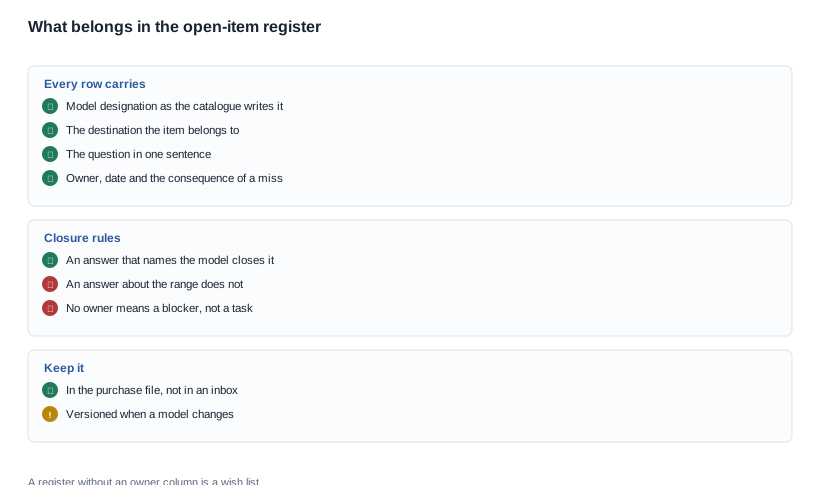
The register also has to be handed over rather than kept. A register that lives in one buyer's inbox is lost the first time that buyer leaves, and the second buyer inherits a range with no record of what was assumed and what was confirmed. A register that travels with the purchase file survives a change of supplier, a change of distributor and an audit, and it is the cheapest insurance in the whole programme.
There is a fourth discipline that gets skipped more often than the other three, and it is the one that determines whether the register is worth keeping. Every row needs a consequence attached to it: what happens to the launch if the answer does not arrive, and who takes that decision. Without a consequence, a delayed answer is indistinguishable from a late one, and the register drifts. With one, the delay becomes a decision somebody has already made under pressure rather than a decision nobody has made at all. The consequence does not have to be severe. A destination can simply be held back from the first shipment while the rest of the range launches, and the register records that the hold was chosen rather than accidental.

Selecting the next market: how to extend a range without restarting
The last question in this series is the one that gets asked after everything else is finished, and the answer determines whether a range is a one-market product or a multi-market one.
Adding a destination to a range that was already built for another one should cost the shared layer again — ideally nothing — and should cost the per-destination layer once. If adding a market means re-testing the radio from scratch, or re-printing every carton, or re-opening every technical file, then the range was not built as a range. The three things that determine which of those happens are known in advance: whether the radio configuration is regional or common, whether the language is loaded on the device or in an application, and whether the destination shares a conformity route with the ones already served.
There is also a version of this question that is asked earlier and answered better. A buyer who expects to add a second destination in the following year is making a different first order than a buyer who will serve one market only, and the differences are small: one build instead of two, an artwork format that can carry a second language, and a supplier agreement that does not forbid the second destination. None of these costs anything at the start and all of them are expensive to retrofit.
What a wrong sequence costs
The commercial argument for sequencing is easy to make and hard to quantify, so it is worth describing in the terms a finance team recognises.
A re-test is a charge per model per destination, and it repeats in full whenever the radio module changes. A re-print is a charge per artwork version per language, and it repeats in full whenever the artwork is revised after the print run has started — which is why artwork is the item most often paid for twice. A second build is a per-unit charge that lasts as long as the variant exists, which is the most expensive of the three because it does not go away. A re-opened technical file is mostly a delay, and delay is the cheapest of the four until it pushes a launch past a season, at which point it is the most expensive.
The total cost of a market programme is therefore not the sum of its line items. It is the sum of the line items plus the cost of the work that had to be repeated. Sequencing is the discipline that keeps the second term small, and it is why the order given earlier in this article is worth arguing for inside a buying team rather than being assumed.
Selecting by market: what this series covers and what it does not
This article is the map for the series, and the destination-specific pieces sit underneath it. The certification mapping guide sets out how a map is built from catalogue attributes; the frequency and language guide treats the two variables that change the product itself rather than the paperwork; and the destination guides work through the European Union, the United Kingdom, Japan and Korea, the Middle East and the South East Asian region individually. The full destination logic is on the select by market page, and the OEM and ODM route behind a range that is being built for more than one market is covered in the OEM and ODM note.
What we publish is the specification: cell capacity and count, a charge ceiling, a charging interface where one is stated, a runtime figure, a case capacity on the models that carry one, a camera resolution class, a Bluetooth version on the entries that have one, the two ingress markings, and one weight. Nothing in that list describes a market, and we do not pretend otherwise by publishing framework names we cannot evidence. What a buyer can take from us is a shortlist that narrows properly and a request that names the right question against the right model. The rest is work that has to be done in writing, by the supplier and by the party placing the product on the market.
Next step: write down the destinations and the models in one table, mark each cell with what the catalogue publishes and what it does not, and treat every blank as an item on the register rather than as a decision already taken.


