
The published record for the S7 is short and specific: a 13 MP camera, a 260 mAh cell, a runtime written as five to eight hours, magnetic charging, a charge time of two hours or less, an IP54 marking, an ergonomic frame and a detachable inner frame. Almost everything a buyer normally uses to plan a day's power is absent from the page — no test conditions, no unit count, no charging-case row, no weight, no dimensions.
This page is written for the buyer who has to turn that record into something defensible: a specification line, an incoming-inspection rule, and a listing claim that a channel partner will take apart. The argument is narrow and it is about one number.
The published runtime for the S7 is a bracket, not a specification. A bracket tells you a range was measured. It does not tell you which workload produced either end of it, and until that is answered the figure cannot be written as a pass line — only as a range you quote with its limits attached.
Why the S7 runtime is a bracket and not a specification
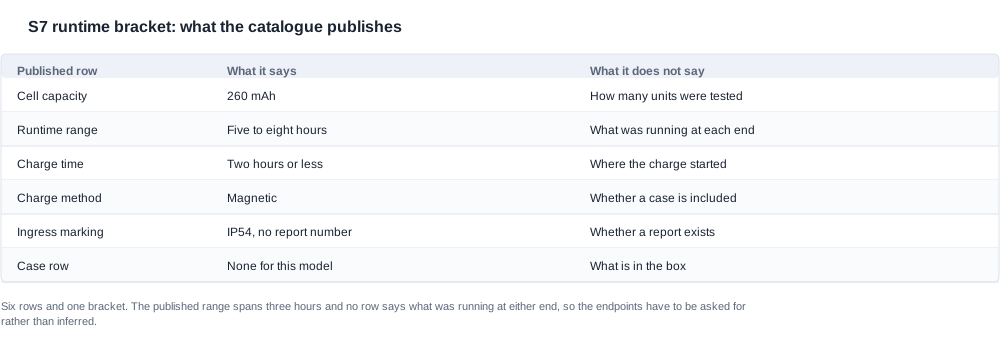
A five-to-eight-hour range spans three hours. That is wide enough for two quite different products to sit inside it, and the catalogue does not say which two. Read the page as a table of published rows and one of them is a bracket with its ends left open:
| Published row | What it says | What it does not settle |
|---|---|---|
| Cell capacity | 260 mAh | How many units were tested |
| Runtime range | Five to eight hours | What was running at each end |
| Charge time | Two hours or less | Where the charge started |
| Charge method | Magnetic | Whether a case is included |
| Ingress marking | IP54, no report number | Whether a report exists |
| Charging case row | None for this model | What is in the box |
Three of those gaps are the same gap in different clothes: a number without a condition. Capacity without a unit count, runtime without a workload, charge time without a starting state. Each is publishable on its own — that is how catalogue rows work — and each stops exactly where a buyer needs it to continue.
No test condition is published for any model in the catalogue. Not for this one, not for the sibling model in the same family, not for the rest of the range. There is no laboratory, no ambient condition, no duty cycle, no video mode and no unit count anywhere in the record. So the bracket cannot be attributed to a method, because no method was published.
There is no charging-case row for this model. That is a different situation from a case row whose capacity is withheld, and the two are routinely confused. Five camera models elsewhere in the catalogue do carry a case-capacity row; the S7 page carries none. The absence of the row is a fact about the record. Whether a charging case exists for the model, whether it ships with the product, and what it would carry are three separate questions that the record does not answer in either direction.
The ingress marking needs the digits read the right way round. IP54 is a catalogue marking on this model, and the product record states plainly that no third-party test report number stands behind it and that an IP rating needs a report before it can be claimed externally. The reading is this: the first digit covers solid foreign objects, and 5 permits a limited amount of dust ingress rather than being dust-tight; the second digit covers water, and 4 means splashing water from any direction — not immersion, not a shower, not a water jet. A buyer intending to use the marking in a listing should treat it as a catalogue statement until a report exists, and the IP rating guidance page covers the standard in detail.
The detachable inner frame is a feature, not a function. The feature line lists it. The catalogue does not publish what it consists of, what sizing it supports, or what it is intended to achieve. It therefore cannot be used to extend a runtime argument, a durability argument, or a serviceability argument. Ask for the specification; do not supply the inference.
Notice the shape of all of this. Three separate published rows — runtime, ingress, inner frame — stop at the point where the buyer's own argument would need them to continue. That is not a defect in the page. It is the shape of a catalogue, and the buyer's task is to supply the missing half in writing before anything reaches a customer.

What the catalogue publishes around the bracket
Before a buyer asks a supplier anything, it is worth knowing exactly what the record contains for this model, because the list of what is settled and the list of what is open differ greatly in length.
| Row | Published value | What to ask the supplier |
|---|---|---|
| Camera resolution | 13 MP | Which video mode and frame rate the runtime was measured at |
| Cell capacity | 260 mAh | Whether the figure is for the shipped configuration |
| Runtime | Five to eight hours | The workload at each end of the range |
| Charge time | Two hours or less | The starting state and the ambient condition |
| Charge method | Magnetic | Whether a case or a pad is in the box |
| Ingress marking | IP54 | Whether a test report exists for this model |
| Frame | Ergonomic design, detachable inner frame | The inner frame specification and the supported sizing |
| Colour | No row published | Which colourways ship |
| Weight and dimensions | Not published | Measured figures taken from a sample |
| Certification | CE, FCC and RoHS stated by the company; no report numbers | Report numbers and the documents behind them |
| Customisation | The record notes five customisation axes | Which axes are open and what each one covers |
| Marketing files | One product image per model page; no demonstration video | Real product photography and demonstration material |
| Independent product page | None | Where the current specification is maintained |
Two rows in that list behave differently from the rest, and both are worth pulling out.
The resolution row is a camera fact, not a power fact. The catalogue publishes 13 MP and publishes no video specification at all — no sensor model, no field of view, no video resolution, no frame rate. A runtime figure for a camera product only has meaning against a recording configuration, and the configuration cannot be derived from a still-image resolution row. So nothing can be computed from 13 MP; the number can only be obtained as a stated measurement.
The charge-time row is a ceiling with an unstated origin. "Two hours or less" is a ceiling, not a figure, and the ceiling has no starting point. From empty? From a partially charged state? At what ambient condition? The catalogue does not say, which means two suppliers can both comply with the same ceiling and mean different things by it. The same applies to the runtime bracket: a ceiling promises the best case, and a bracket promises the worst and best case, with the conditions for both unstated.
Six questions close most of that list, and they travel well together in one message to a supplier:
- At what video resolution and frame rate was the runtime measured, and how many units were in the sample?
- What was running at the short end of the range, and what was running at the long end?
- Is the five-to-eight-hour figure measured from a full charge, and is the charge time measured from empty?
- Is a charging case or a charging pad supplied with this model, and if a case is supplied, what capacity does it carry?
- Does a third-party ingress test report exist for this model, and what is its number?
- What are the measured weight and the temple dimensions of a production unit?
Those six are the difference between a runtime you can write into a specification sheet and a runtime you can only repeat. Three answers to them are red flags: a runtime with no workload, a charge time with no starting state, and a certification claim with no report number behind it. Each of those looks like a specification on a listing and behaves like a promise without a condition.
The battery life and power page sets out why the condition and the number are two different things, and the sample evaluation page covers what a physical sample can settle and what it cannot. When a written answer and a physical unit disagree, the supplier's written position is the one that belongs in the agreement, and the sample is what tells you whether the written position is honest.
What the sibling sport camera model shows
The S7 is not the only sport camera model in this family, and the other one is the most useful comparison available, because the catalogue publishes both models and they overlap on almost every row.
| Published row | S7 | The sibling model | What the pair shows |
|---|---|---|---|
| Resolution | 13 MP | 8 MP | The camera load differs |
| Cell capacity | 260 mAh | 260 mAh | Identical |
| Runtime range | Five to eight hours | Five to eight hours | Identical |
| Charge method | Magnetic | Magnetic | Identical |
| Charge time | Two hours or less | Two hours or less | Identical |
Four comparable rows are identical and the fifth differs. The sibling model is published with a lower camera resolution and the same cell, the same runtime bracket, the same charging method and the same charge ceiling.
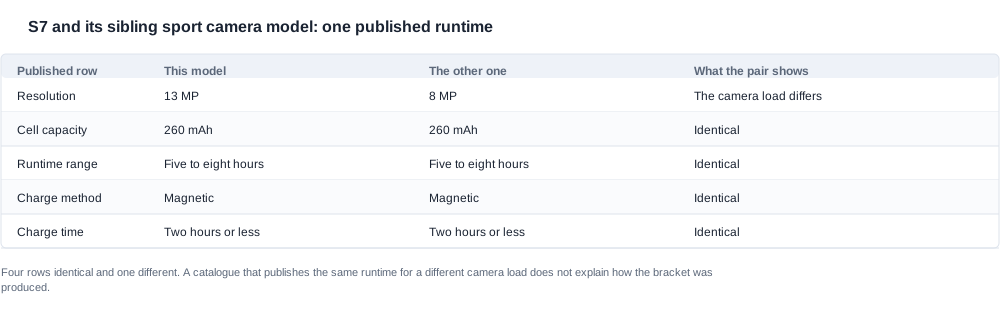
Two readings of that overlap are consistent with the published page, and the catalogue does not choose between them. Either the runtime does not depend on the camera configuration — which would be a notable claim in its own right and is not published — or the figure is a family-level statement attached to both models without a per-model measurement behind it. Neither reading can be confirmed from the record, and this page does not pick one. What is worth carrying into a supplier conversation is not "which of these is true" but "is there a single measured workload behind both models, and if there is, which one?"
The sibling model also carries a marketing phrase that the S7 does not. Its feature line includes a short phrase claiming long endurance, while its published runtime row is the same five-to-eight-hour bracket the S7 carries. A phrase and a bracket describing one number is worth resolving before either appears in a listing: ask what the phrase is measured against, and whether the phrase and the bracket are two descriptions of a single measurement or two independent statements.
The sibling model publishes a colour row and the S7 does not. Four colourways are listed for the sibling; the S7 page has no colour row at all. This is the same pattern as the charging-case row: where the catalogue holds the information it prints it, and where the row is missing the record is silent rather than negative. The practical consequence for a buyer is the same in both cases — the missing row becomes a question to the supplier, and it becomes a question before a shortlist is scored, not after a purchase order is placed.
What the pair means for a specification. If a figure is derived from this bracket, the specification has to state which model it describes and which row it was read from. A single runtime number presented as a model-level specification, taken from a bracket the catalogue attaches identically to two different camera loads, is a claim about the family rather than about the model. That is a difficult position to defend in front of a channel partner who has the catalogue open beside your listing. The S7 and sibling model battery and charging comparison page works through the same pair from the charging side.
The five lines that turn a bracket into a publishable figure
A bracket becomes publishable when it acquires two labelled ends and a stated condition. The work is five steps long, and each step has a gate that a number either passes or fails.
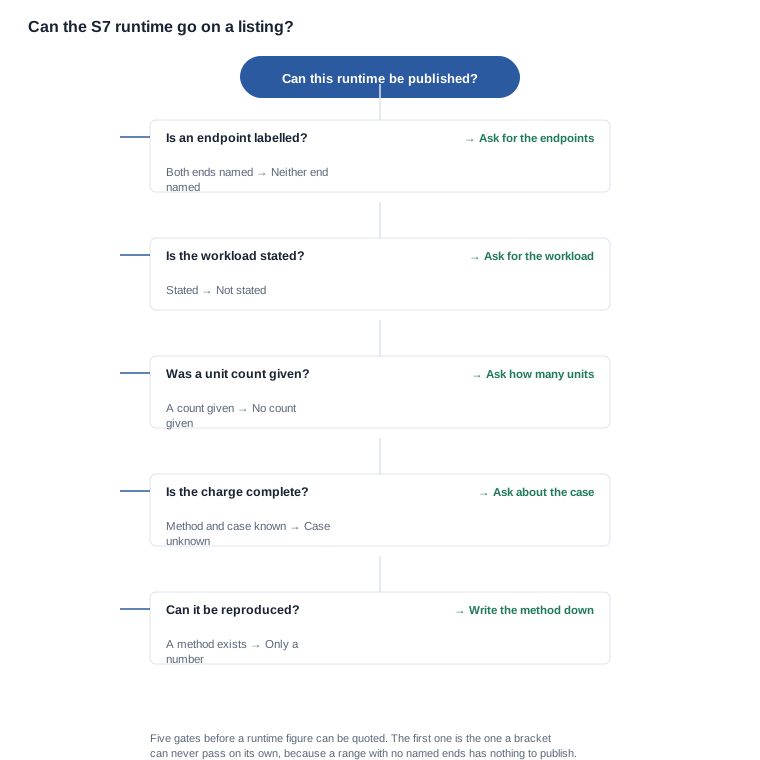
- Name the two ends. A bracket with two unlabelled ends has nothing to publish. The supplier has to state, in words, what was running at the short end and what was running at the long end. Until then, the bracket describes a product that has not been specified.
- State the workload. The workload is the condition that makes the number mean something: a recording mode, a capture frequency, screen time, or the mix that sits between them. This is the answer that turns one range into two scenarios you can defend separately.
- Give the unit count. Capacity and runtime are both per-unit quantities, and a single-unit measurement is a sample rather than a specification. The number of units tested belongs with the figure, and so does the spread across them if there is one.
- Complete the charge picture. Magnetic charging tells you the interface. It does not tell you whether a case is supplied, whether the product also charges from a pad, or what the starting state was for the charge-time ceiling. A charge cycle that is not closed leaves a question about endurance open.
- Make it reproducible. A figure that cannot be reproduced cannot be inspected. The method — not only the outcome — has to exist somewhere the supplier and the buyer both hold it, and that is what converts a catalogue number into an inspection rule.
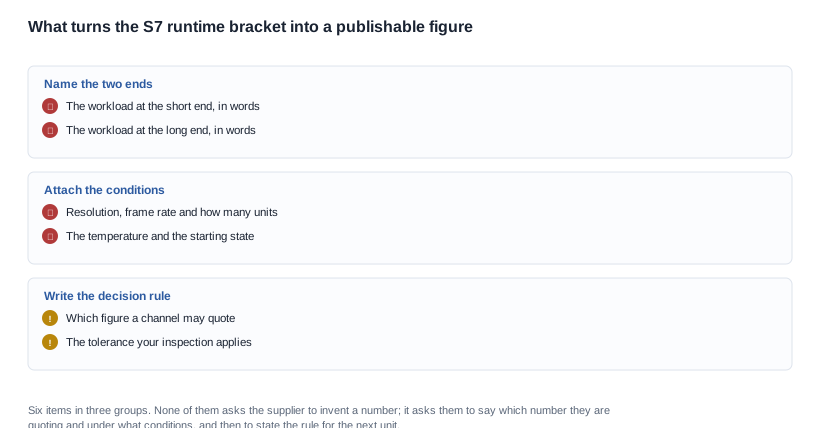
The same five steps organise into three groups once they are written into a file, and this is the form to copy into a supplier request:
- Name the two ends — the workload at the short end of the range, in words, and the workload at the long end, in words.
- Attach the conditions — the resolution and frame rate and how many units, plus the temperature and the starting state.
- Write the decision rule — which figure a channel is permitted to quote, and the tolerance the inspection applies on receipt.
None of these asks a supplier to invent a number. Each asks them to say which number they are quoting and under what conditions, and then to state the rule the next unit will be judged against. That last one is what most catalogues are missing, and it is the one that converts a published row into something a quality agreement can carry.
Before you commit to a figure, decide which of two routes you are taking, because each one costs something different.
The conservative route is to publish the short end of the bracket with its condition attached. It is defensible on the day it is written, and it needs only the workload at one end. What it costs is the ceiling: a listing that leads with the lower number understates the product beside a competitor's bracket, and the unused half of the range becomes a source of internal argument rather than a selling point.
The labelled route is to publish both ends as two scenarios, each with its workload. It gives a listing two defensible numbers and a channel partner two ways to match the product to a use. What it costs is a supplier commitment to two scenarios, and the maintenance that comes with them, because the figure has to be restated whenever the configuration changes.
How to choose between the two depends on your channel, what your customer actually does, and how much of the specification you are willing to own. That is a commercial decision, and it belongs with the buyer rather than with the catalogue. The trade-offs are worth writing down before the request goes out, because the answer shapes which six questions get asked first.
Two checks close this section. The charging options page covers the charge-cycle questions that sit alongside the runtime question, and the IP rating guidance page covers the ingress standard, including what a marking means before a report exists behind it. A related read on the runtime-versus-condition distinction is battery life and power.
What the S7 record supports on runtime
Every published row has to land in a document that someone else will read without you in the room. Four documents do that work, and they are not independent of each other.
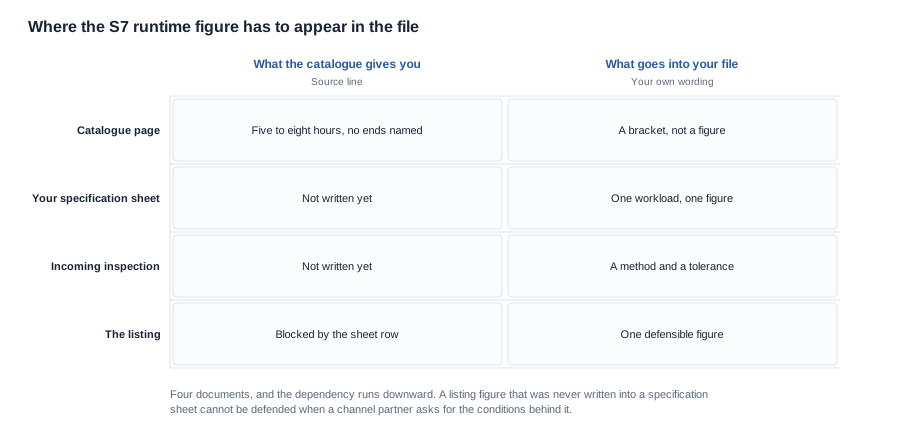
The catalogue page is where the figure comes from, and for this model it carries a bracket with no ends named. The specification sheet is where a single workload and a single figure get written down, and for most buyers it does not exist yet — the bracket gets copied forward instead. Incoming inspection is where the method and the tolerance get written, and it usually does not exist either, because there is no published method to copy. The listing is the last document in the chain and the only one a customer ever sees.
The dependency runs downward, and that has a practical consequence: a listing figure that was never written into a specification sheet cannot be defended when a channel partner asks for the conditions behind it. The listing is not the place where the runtime is decided; it is the place where a decision made earlier is disclosed. Buyers who find themselves deciding at the listing stage have skipped the step that makes the claim answerable, and the signs that this has happened are simple — the listing carries a number that appears nowhere else, and no document in the set can produce it.
The record itself sets the outer limit of what can be claimed. The certification position for this model is stated by the company as CE, FCC and RoHS, without report numbers, and the record adds that the IP rating needs a test report before it can be claimed externally. The customisation position is recorded as five axes on the model page, without the contents of those axes being published — ask which of them are open, what each one covers, and how they apply to an order, rather than inferring a capability from a count. The marketing material available for this model is one product image on the model page and no demonstration video, and there is no independent product page for it, which means your due diligence starts with the supplier's written answers and a sample rather than with published material. The record also flags that the printed page numbering for this section is inconsistent, so confirm which page your supplier is quoting from and cite that page in the agreement.
Our position on this model. We will give you the published rows for the S7 and we will tell you plainly that the runtime figure is a bracket with no labelled endpoints. We will not tell you which end of the bracket corresponds to your customer's use, because no one has published it. We will not describe the IP54 marking as a tested result, we will not quote a weight, a dimension or a charging-case capacity that we have not been given, and we will not present the detachable inner frame as an endurance feature. What we will do is set out what is on the page, what is missing from it, and the six questions that close the gap.
Send us the channel, the target configuration, the quantity, and a description of what your customer actually does with the camera in a typical session, and we will tell you which published rows of this model cover that case and which ones do not. The sport platforms this model sits among are in sport smart glasses, the runtime-versus-condition question is covered in battery life and power, the charge-side questions sit in charging options, and the ingress reading is in IP rating guidance.
A short list of related reading
- The sport platforms this model sits among — sport smart glasses
- Runtime, test condition and why the two are different things — battery life and power
- The charge cycle questions that sit next to the runtime question — charging options
- What a physical sample can settle and what it cannot — sample evaluation
- How the same pair compares from the charging side — S7 and sibling model battery and charging
Send the channel, the quantity and the customer's typical session, and we will tell you which published rows of the S7 cover it.


