

The battery and charging rows published for the S7 and the V06 carry the same four values, and that sameness is the most useful thing on this page rather than a disappointment. Both catalogue entries print a 260 mAh cell, a rated runtime of five to eight hours, a charge time of two hours or less and magnetic charging. No fifth row in the power block separates them, so the s7 smart glasses vs v06 battery and charging question is not answered by the power rows at all. It is answered by the rows each page prints elsewhere, by the rows each page leaves out, and by what a procurement team has to obtain in writing before a specification sheet can be built.
Identical published numbers are a statement about the catalogue rather than about the hardware. They tell you that two pages print the same four values. They say nothing about whether those values were measured on the same duty cycle, whether the charge ceiling was reached from the same starting state, or whether either figure describes the workload an active camera creates in the field.
What follows takes the four shared power rows one at a time, moves outward to the rows where the two pages genuinely differ, then sets out the questions a buyer should put against the shared rows in writing before a specification is committed. Nothing here turns a published rating into a tested result, and no figure appears on this page that the catalogue does not print against these two models.
What both pages publish for power
Four rows carry the power information on each of these two catalogue entries, and on every one of them the two models agree in value, in shape and in what they leave unsaid.
- Cell capacity. 260 mAh on the S7 page and 260 mAh on the V06 page.
- Runtime band. Five to eight hours on both.
- Charge time. Two hours or less on both.
- Charging method. Magnetic on both.
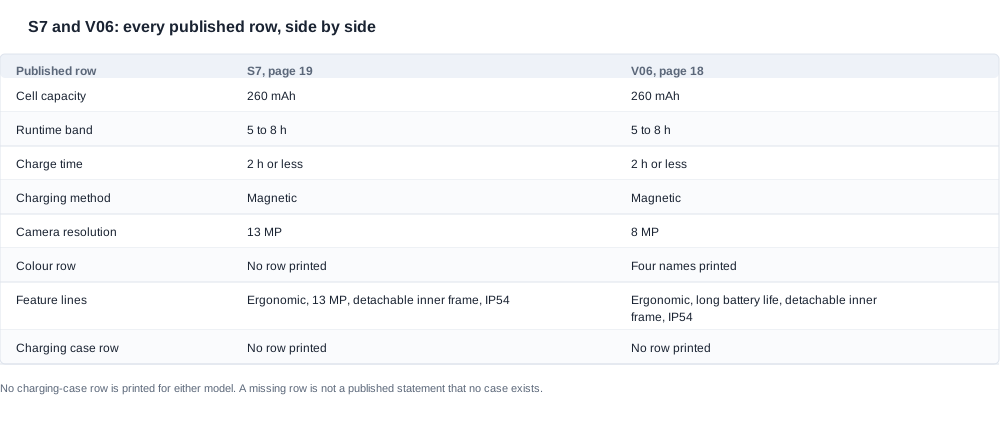
The table below is the working inventory of what the two pages print, with the question each row is capable of answering attached to it.
| Published row | S7, page 19 | V06, page 18 | What the row settles |
|---|---|---|---|
| Cell capacity | 260 mAh | 260 mAh | Shared; separates neither model |
| Runtime band | 5 to 8 h | 5 to 8 h | Shared, and published without a condition |
| Charge time | 2 h or less | 2 h or less | Shared ceiling, not a measurement |
| Charging method | Magnetic | Magnetic | One accessory decision for both |
| Camera resolution | 13 MP | 8 MP | The largest published difference |
| Colour row | No row printed | Four names printed | A range-structure difference |
| Feature lines | Ergonomic, 13 MP pixels, detachable inner frame, IP54 | Ergonomic, long battery life, detachable inner frame, IP54 | Three lines shared, the fourth differs in kind |
| Charging case row | No row printed | No row printed | An open request, not an answer |
| Radio version row | No row printed | No row printed | An assessment to be requested |
Three details inside the shared block deserve attention before anything else, because each of them changes how the values may be used downstream.
The charge time is a ceiling, not a duration. Two hours or less permits a charge that takes exactly two hours and says nothing at all about a charge that completes sooner. Twenty-six of the twenty-eight models in the catalogue publish this same ceiling, and the two entries that publish a figure of about an hour are the only ones stating anything tighter. A two-hour-or-less line is therefore the outer bound of the category rather than a property of these two products, and it cannot be used to plan how long a shift interruption lasts.
The runtime is a band with no stated condition. Five to eight hours is three hours of uncertainty expressed as a range, and every one of the eleven camera models in the catalogue publishes a runtime figure without publishing the condition that produced it. A band is better disclosure than a single number, because it signals that more than one condition was measured, and it remains a rating rather than a specification until the condition behind each end is known.
Two identical values are not two measurements. When two separate catalogue pages print the same capacity, the same band and the same ceiling, the most economical explanation is a shared figure rather than two independent measurement programmes. That has a direct consequence for a buyer: a condition obtained for one of these models is likely to describe the other, so it is worth asking once and applying the answer to both, or, if the answer never arrives, using neither. Rows that agree are a reason to ask one well-targeted question, not a reason to treat a value as confirmed twice.
The charging method reaches beyond the product in one respect. Magnetic charging means a proprietary contact rather than a cable the customer is likely to own, so the accessory programme for a range carrying both models becomes one decision rather than two, provided a single charger actually serves both units. Nothing published states that it does, and it is the first question in the request list below. A cell of 260 mAh also produces a battery transport document when the units travel, and that document is prepared against a cell record rather than against a product name, so it has to be requested early rather than assembled at the shipping stage.

Where the two rows actually differ
Three published rows separate the two pages, and not one of them is a power row. That is the finding, and it is worth stating before the detail, because a comparison built only on the four shared values produces a table with two identical columns and no decision inside it.
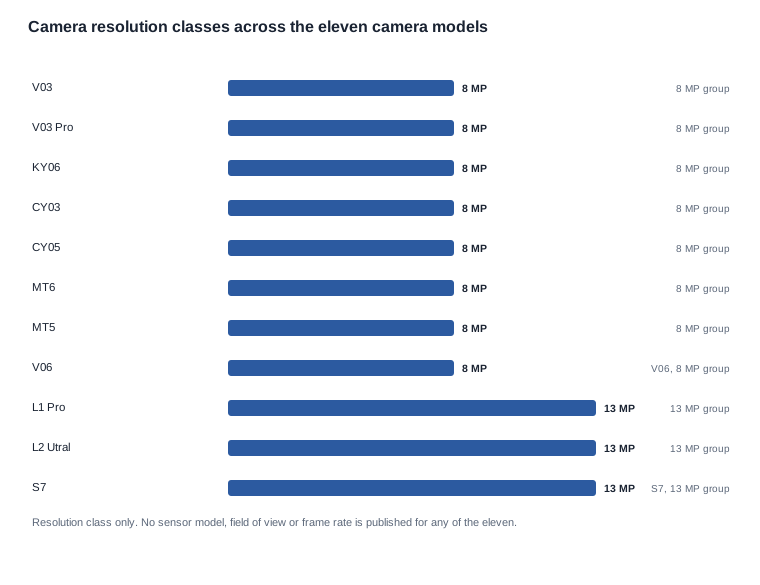
The camera resolution class. The S7 is published in the thirteen-megapixel class and the V06 in the eight-megapixel class. The eleven camera models split into two classes: eight of them print the eight-megapixel figure — the CY05 and the KY06, the V03 and the CY03, and the MT5 and the V06, and the V03 Pro and the MT6 — while the remaining three print thirteen megapixels, the L2 Utral and the L1 Pro, and the S7. A choice between these two models is therefore a choice between the smaller group, not between two individual alternatives, and no row in the catalogue ranks the three thirteen-megapixel entries against one another.
The colour row. The V06 publishes four names: orange, white ice blue, black and black ice blue. The S7 publishes no colour row at all. That is an absent row rather than a short list, and the difference is structural: a colour programme on the V06 is four configurations to plan against, while a colour programme on the S7 is an open request to the factory. Only two models in the whole catalogue publish a colour row, the V06 with four names and the V03 Pro with three. Nothing published states which of the four finishes require separate tooling, what each one adds to the packaging artwork, or whether each finish is separately assessed for conformity.
The fourth feature line. The S7 prints four feature lines: an ergonomic design statement, a numeric line carrying the thirteen-megapixel pixel count, a detachable inner frame, and an IP54 ingress marking. The V06 prints four as well: an ergonomic design statement, a general endurance descriptor, a detachable inner frame and an IP54 ingress marking. Three lines are common to both pages, and the fourth differs in kind rather than in value — a number on one entry, a descriptor on the other. A buyer who assumes a uniform feature-list structure across a range will read that fourth line as a difference in value, and will then quote a pixel count and an endurance descriptor as though the two were comparable quantities.
Two further rows are shared by absence rather than by value, and the distinction has to be handled carefully. The catalogue prints no charging-case row for either the S7 or the V06, and it prints no radio version for either. The first of these is a missing line, not a published statement that no case exists. Across the eleven camera pages the case row takes three shapes: a printed capacity on five of them, a case named but not quantified on two, and nothing on the remaining four, which is where the S7 and the V06 both sit. A sheet that reads a blank as a negative answer will be contradicted by the first carton that is opened. The wider row-by-row reading of the V06 entry sits in the V06 page against the S7, and it separates the same published rows from a different starting point.

What a shared cell figure cannot settle
The four power rows are identical, and the temptation is to treat that identity as evidence that the two models behave alike in the field. It is not evidence about either product, and the reasons are specific enough to be worth listing one at a time.
A capacity is not a runtime, and the load decides the conversion. The same 260 mAh cell produces a different number of hours behind a camera that captures continuously than behind one that sits idle, and a different number again in bright outdoor light than in a dim interior. What the catalogue publishes is the capacity; what a buyer needs is the duty cycle behind the band. The general treatment of a rated figure with no stated test condition is set out in the battery life guidance, and the method for comparing two bands side by side is worked through in the battery comparison method.
A band without a condition cannot be reduced to a single number. The commercially safe handling of five to eight hours is to publish the band as a rated band and to hold any customer-facing claim at the lower end until the condition behind each end is on file. A listing that converts the band into a working day has quietly converted a rating into a promise, and that is the most common way a published figure of this shape turns into a return.
Two pages agreeing closes no gap. The band has no published condition on the S7 page and none on the V06 page, and the agreement between the two pages does not supply one. It narrows the number of questions to ask; it does not answer any of them.
Nothing about mass is published for either model. One catalogue page carries a unit weight, and it belongs to a third product: the MT6 eyewear body, measured at 158 g without the folding case printed alongside it. Setting that figure beside the S7 or the V06 on a comparison sheet would move a specification between models rather than transfer one. Neither of these two pages gives a weight, a dimension or a temple length, and a sport product without a mass figure leaves the packaging and freight arithmetic unstarted.
Nothing about the charging accessory is published for either model. Because no case row appears on either page, the carton contents, the part reference for the magnetic lead and the behaviour of the contact surface over repeated use are all unresolved for both entries. A range carrying both models inherits that unresolved accessory at the same moment it inherits the shared charging method, which is exactly why the accessory question is worth asking before the range is designed rather than after.
Sorting the material into four layers is the quickest way to see which items can be acted on and which ones simply have to be scheduled.
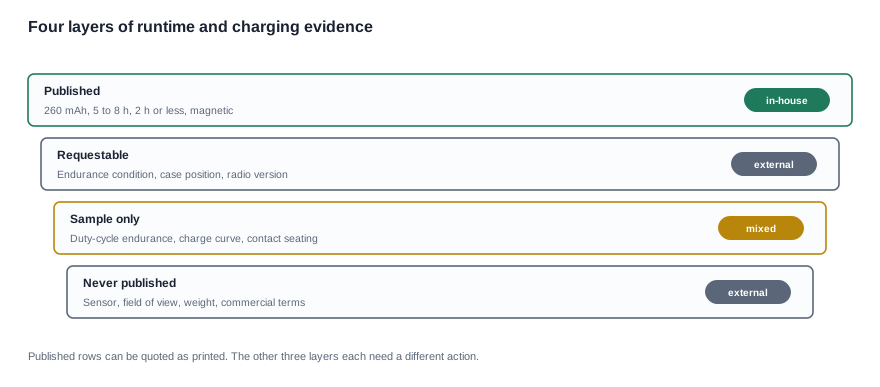
The first layer is published, and it holds the four power rows plus the feature lines and the resolution class. The second layer is requestable in writing. It holds the endurance condition behind each end of the band, the charging-case position put in words instead of left blank, the radio version, the unit weight as shipped, the inner-frame size range, the ingress test report, and the documentary evidence that a finished unit meets both the emissions-side and the radio-side conformity requirements. Nothing on that list is a refusal; it is simply unprinted, and a written request is the only thing that moves a line up a layer. No catalogue page carries a certification row against an individual model, and the three familiar marks never appear in the text, so a compliance file has to be assembled by request.
The third layer can only be closed at a bench: the endurance of the assembled unit under a stated duty cycle, the charge time from a stated starting state, the seating of the magnetic contact under a hurried placement, and the state of the product after the inner frame has been removed and refitted. The fourth layer will not be published by anybody — the sensor model, the field of view, the frame rate, the video format, the low-light behaviour, the storage arrangement, the unit price, the minimum order quantity, the lead time, the warranty period and every certificate number — and a programme built on any of those has to change the requirement rather than chase the number.

The questions a buyer should put against the shared rows
The shared block resolves into three separate things, and the sequence in which they have to be closed is not negotiable. Begin with the row a customer's own requirement is written against: if that line appears in the published set, the two pages either answer it or they do not. Only then ask which side is capable of answering — the catalogue for a published row, a supplier document for anything that has to be measured or filed. The last question is the one that ends a comparison: when no answer exists anywhere for the requirement, the way forward is to change the model on the line or to change the requirement on the order, and those two carry different costs.
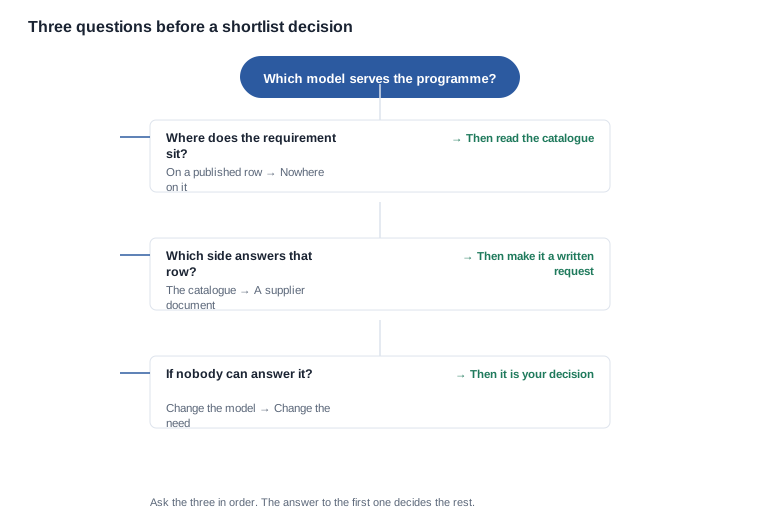
Applied to this pair, the answer to the first question decides the shape of everything else. A requirement for a resolution class is answered by the catalogue, at the limit of a class filter rather than a ranking. An ingress marking request is answered by the catalogue, at the same limit. A requirement for a case in the carton is not answered for either model, because neither page prints that line. A requirement for a colour list is answered for the V06 and not for the S7, which sends that requirement back to the factory as a written request rather than resolving it on a product page.
The request list below is the version that can be sent as it stands, grouped by the answer each reply closes.
- What duty cycle produced each end of the five-to-eight-hour band, on each model, and were the camera and the radio active during the measurement?
- From what starting state was the two-hour ceiling measured, and what counts as a completed charge?
- What cell is fitted to each model, and what battery transport document covers it?
- Does one magnetic charger serve both models, or does each require its own contact, and what is the part reference?
- What does the carton contain for each model, and is a charging case supplied, listed, or simply not mentioned?
- What is the unit weight as shipped, including the battery and the camera, for each model?
- How many inner frames ship with each model, in which sizes, and do the frames interchange between the two?
- Which sensor and lens are fitted, and what are the field of view, the frame rate and the video format?
- Which ingress test report covers the marking, and which assembly and which configuration were tested?
- Which wireless radio version is fitted to each model, and which conformity documents apply to the finished product?
The criteria that decide whether the answers are usable apply identically to the S7 and to the V06, which is precisely why the shared rows cannot decide between them. A figure that arrives with its condition attached can go straight onto a specification sheet; a figure without one cannot. A comparison that sits on a single axis is a comparison, whereas two models measured in different ways are two separate observations. And a number that can be reproduced on a unit from a sample order is worth more than a number that appears only in a specification file. Run those three criteria against the answers, and a shortlist can be built without ranking two entries the catalogue does not rank.
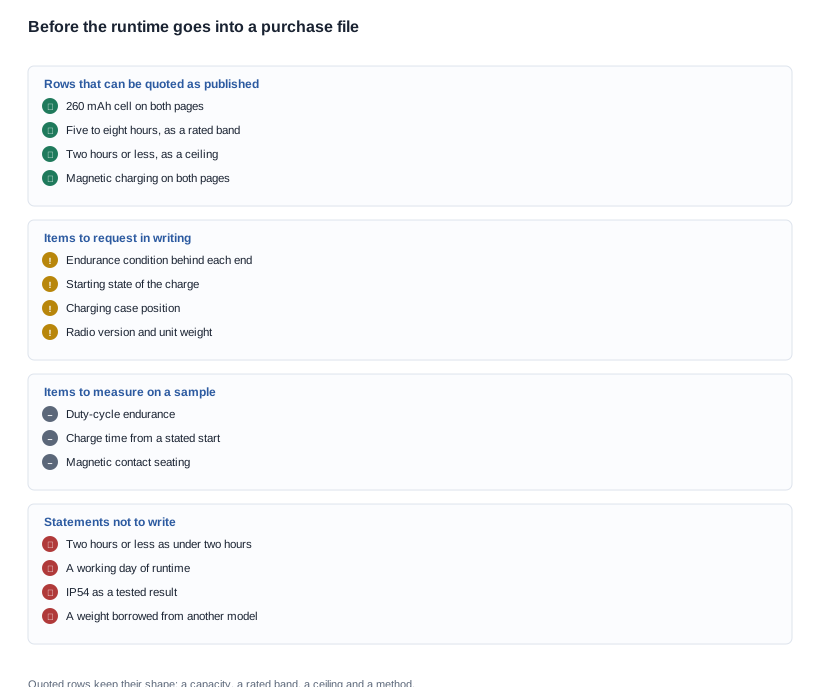
The checklist above sorts the rows into four groups, and the sort matters because a customer-facing sheet and a supplier-facing request treat each group differently. Rows that can be quoted as published are the cell capacity, the runtime band, the charge ceiling and the charging method, with the band quoted as a rating and the ceiling quoted as a bound rather than as a typical figure or a duration. Items to request are the endurance conditions, the starting state of the charge, the case position, the radio version, the weight, the inner-frame interchangeability, the ingress report and the conformity documents, which are collected through the certification checks material rather than from the product pages. Items to measure on a sample are the duty-cycle endurance, the charge curve and the contact seating. And the statements not to write include the two-hour ceiling restated as under two hours, the band restated as a working day, the ingress marking restated as a tested result, a resolution class restated as an imaging specification, and a unit weight borrowed from a different model.
One commercial point sits underneath all of it. No price list, order floor, production timetable, warranty term or certificate number appears against any catalogue entry, and neither of these two pages carries one either. A buyer who needs those terms has to put them into the request list and then into the agreement, because acceptance criteria written into the contract are worth more than the numbers themselves: they determine whether a shipment that arrives is a shipment that is accepted. The same discipline applies to the parts programme, since a spare inner frame that is sold on its own needs its own minimum order quantity and its own packaging artwork, and neither is published for either model.
For this pair our position is narrow, and we would rather state it than have it assumed: the four power rows are published rows, so we will publish them as printed; we do not present an identical band as evidence that two units behave alike, we do not convert a ceiling into a duration, and we do not quote a weight, a case capacity or a certificate number the record does not carry. What a sourcing team needs back from this comparison is not a verdict but a closed request list, and the cheapest way to get one is to send it with the sample order rather than after it.
The s7 smart glasses vs v06 battery and charging
The power comparison between the S7 and the V06 is the shortest one in the camera section, and the reason it is short is that the four rows a power comparison normally rests on carry the same value on both pages. A 260 mAh cell, a band of five to eight hours, a charge time of two hours or less and magnetic charging: that is the published position, and it is published identically for the two models.
What the pair actually offers a procurement team is a narrower question with a much longer answer. The two entries separate on the camera resolution class, with the S7 in the thirteen-megapixel group and the V06 in the eight-megapixel group, and they separate on the colour row, with four names published for the V06 and no colour line at all for the S7. Everything else either matches or is blank on both sides, and the blanks are where the work sits: the charging-case line, the radio version, the unit weight, the endurance condition, the starting state of the charge and the conformity documents.
So the s7 smart glasses vs v06 battery and charging comparison resolves into one line that can be copied and a list of items that have to be requested. The four shared rows can go onto a specification sheet as published values, quoted with their proper shape — a capacity, a rated band, a ceiling and a method. The rest of the sheet is a request, and that request should travel with the sample order so that the sample is measured against the answers rather than against an assumption.
The shared rows go in front of a buyer here exactly as the catalogue records them, and no ranking is offered on numbers the catalogue does not rank. Send the market, the channel and the quantity, and the outstanding rows come back in writing against them.
Related reading
- The range both models belong to — sport smart glasses
- Every published row, read one by one — S7 versus V06 spec comparison
- The gaps on the parallel model — V06 limitations
- Where the S7 sits against the other camera models — S7 how it compares
- The endurance rows on their own — S7 battery life
For the S7 and the V06, the power rows are one line to copy and one page of questions to answer.


