

The question arrives in every category review, usually in the first ten minutes: of the families in this catalogue, which ones actually move? It is a reasonable question and it deserves a precise answer, which is that the catalogue cannot answer it. There is no unit-shipped figure, no revenue split, no channel sell-through, no margin, no return rate and no ranking of any kind in the published material, and a best-seller list produced from it would be our invention presented as a fact.
That answer is only useful if it comes with something better. What a buyer can do instead is separate the demand question from the catalogue question, generate demand evidence from their own channel, and read the published specification in a way that shows where the factory has already done work. The category structure itself is set out in the smart eyewear range category comparison, and this page is about the part of the picture that structure cannot answer.
Smart eyewear range best selling categories: the question the catalogue cannot answer
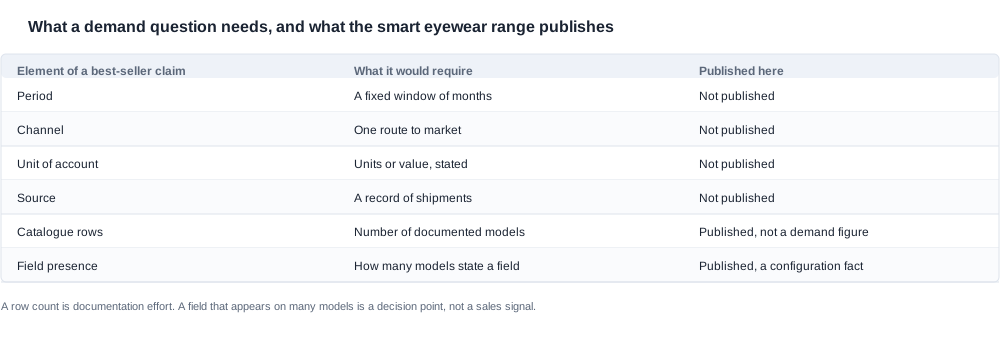
A best-seller claim is not a feeling, it is a measurement with a definition attached, and a defensible one has four parts: a period, a channel, a unit of account and a source. Which families shipped the most units in Europe through distributors last year. Which families generated the most revenue in a marketplace channel this quarter. Which family had the highest return rate in a pilot batch. Each of those is a legitimate question with a legitimate answer, and each answer would be worth a page in a range review.
None of them can be produced from a specification catalogue, and the reason is worth stating plainly: the catalogue describes products, it does not record transactions. A published row tells you what a cell holds, how long a charge takes, whether a feature row exists. It cannot tell you what a customer bought, and no amount of reading between the lines of a specification sheet produces a demand curve.
The specific trap in this range is a counting error that is easy to make and hard to unmake. The camera family carries more catalogue rows than any other family, and it is tempting to read that as a signal about demand — the logic being that a factory with the deepest family presumably sells the most of it. The logic does not hold, and the reason is a property of how a catalogue is assembled: the number of rows reflects how many product variants a manufacturer has written documentation for, and documentation effort is driven by product complexity, by how many configurations exist, and by how long the family has been in the catalogue. A family with many similar models needs more rows. It does not follow that it sells more.
There is a second version of the same error, and it is subtler. The family with the most published specification detail may look like the safest bet, on the reasoning that a well-documented product is a proven one. That is a reasonable heuristic about documentation, and it says nothing about what sells. What it actually tells you is that the factory was willing to write the details down, which is a fact about a documentation department rather than about a shelf.
A third version is the one that costs the most money, because it is the one a range review is most likely to produce. When the demand data is missing, the family that gets picked is the one that generates the most confidence in the room, and the most persuasive family is usually the one with the most rows and the most photographs. A channel then commits its first year of budget to that family, discovers in the second quarter that the demand it was reading off the brochure was a photographic illusion, and has to rebuild the line from the bottom. The honest way to avoid that is to refuse the question in its unanswerable form and replace it with a question that can be answered, which is where the rest of this page goes.

What the smart eyewear range does publish that looks like a ranking
There is one published signal in a specification catalogue that correlates with commercial attention, and it is not a count. It is the presence or absence of a field in a row, and specifically the question of how many models in a family publish it.
When a field appears on many models, it is a field the market has treated as important enough to write down repeatedly: a cell configuration, a rated use figure, a charging method, a radio version. A buyer does not learn demand from that, but they do learn something useful — the field is a decision point, and a model in that family will be compared on it. A listing that omits the charging method on a model whose siblings all publish it looks like an omission, and a buyer who knows that will chase it.
When a field appears on only one or two models in a whole family, the picture inverts, and this is where the genuinely useful signal sits. A remote photo control row appears on two models in the sport family and on no audio model, which tells you the shutter is a differentiator rather than a standard. A photochromic lens row appears on one camera model and on no other, which tells you the lens story belongs to that model alone. A colour line is published for two camera models and for no audio or sport model, which tells you that colour is part of the product story in that family and nowhere else. Those are narrow signals, and narrow signals are useful in a different way: they identify a model that can carry a claim on its own, which is exactly what a channel needs when it is building a listing rather than a price comparison.
Case capacity is a third kind of signal, and it is the one most often overlooked. A charging case with a published capacity appears on only some camera models, one model publishes two capacities, two models ship with a case whose capacity is not published, and four camera models have no case row at all — the V03 Pro and the V03, and the V06 and the S7. A family in which case capacity varies this much is a family where the case is a live commercial decision rather than a constant, and where a buyer who assumes every model arrives with a case will get the box contents wrong somewhere in the range.
The caution to hold onto is that all of these signals describe the factory's configuration and documentation decisions. They are excellent for finding which models can carry a distinct claim, and useless for predicting which models a customer will buy. A model with a photochromic lens is not a popular model; it is a model with a story that a listing can be built around, and whether that story sells is a question about your channel rather than about the catalogue.

The four demand signals a buyer can build without sales data
Everything in this section is method rather than result, because the results belong to the buyer and not to the catalogue. Each signal below has a collection method, a period and a stated limit, and each one should be run over a fixed window so that it can be compared with the next one.
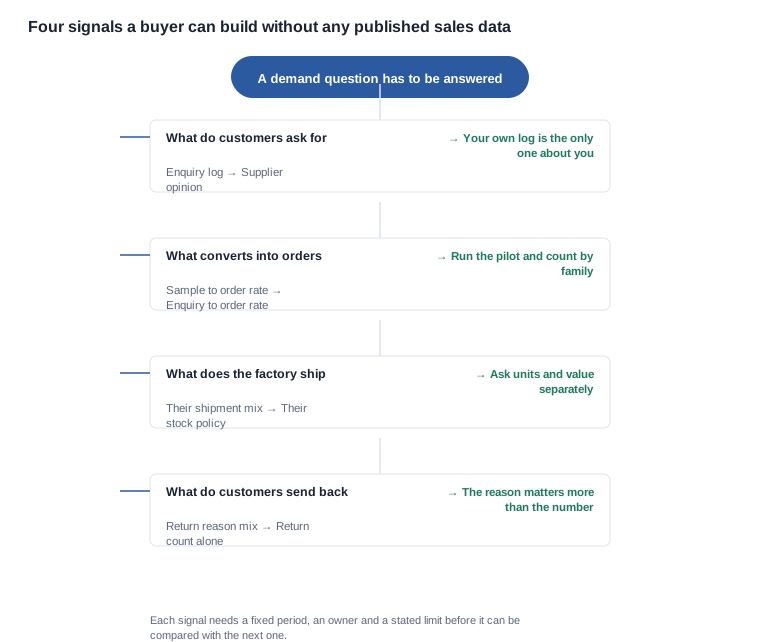
The enquiry log, classified by requirement. The cheapest signal and the most direct. Take every enquiry your sales or channel team received in a fixed period — a quarter is usually enough to get a usable sample — and sort them by the requirement the customer described rather than by the model they asked about. A customer who says they need something to wear on a run and a customer who says they need something to record a site visit are two different requirements, and the second one is a camera-family requirement even if the customer never used the word camera. Sorted this way, the families that appear most often are the families your own market is asking for, and this is the only demand data in the whole exercise that is genuinely about your business rather than about the industry. Its limit is obvious: it measures stated interest, not completed orders, and interest is cheap to generate.
Sample-to-order conversion, tracked by family. Run a sample programme the way you would run it anyway, and record what happens next for each family separately: how many samples went out, how many quotations followed, how many orders followed, and how long each step took. This measures commercial attractiveness under your own conditions, which is the only kind that matters, and it separates the family that generates interest from the family that converts. A family can lead on samples and trail on conversion for a reason worth knowing — packaging, documentation, expectation-setting, or simply that the requirement it serves is rarer than the enquiry suggests. Its limit is sample size: a family with three samples against it produces a rate that swings wildly on a single order.
The supplier's own shipment mix, asked for plainly. Most suppliers will tell you roughly which families they ship most of, and they will usually say so in units rather than in value, and they will usually qualify it by period, by region or by their own customer type. Treat the answer as indicative rather than as data, because it is self-reported, unverified, and often covers the supplier's whole customer base rather than the channel you are in. Its value is comparative: if one family accounts for most of what a supplier ships, that is a signal about their production planning and their stock, and it tells you which family they can turn around fastest. Ask the same question of two suppliers and treat the agreement between their answers as more meaningful than either answer on its own.
The return-reason mix after a pilot batch. The slowest to arrive and the most honest, because it is based on what customers actually did with the product rather than on what they said they wanted. Classify every return by the reason the customer gives — an expectation that did not match the published figure, a pairing problem, a fit problem, a missing accessory, a damaged box, a change of mind — and then group the reasons by family. A family that returns for a reason the catalogue already warned about is a listing problem, and it is fixable. A family that returns because the requirement was misunderstood is a targeting problem, and it is more expensive. Its limit is volume: a pilot batch produces a handful of returns, and the first season of a launch is exactly when the reasons are most concentrated and most fixable.
The four signals do not add up to a market forecast, and no claim in this page should be read as one. They add up to something more modest and more useful: a defensible shortlist, a set of numbers you actually hold, and a set of questions you can put to a supplier with a specific reason behind each one.
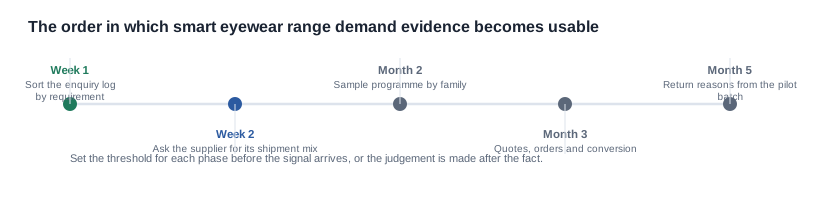
The order in which those signals arrive matters, and it is worth planning the sequence rather than collecting everything at once. The enquiry log is available immediately and costs nothing, so it should be sorted first — it is the only signal that can change a shortlist before any money is spent, and it is also the one most likely to be skipped, because a spreadsheet of enquiries feels less rigorous than a supplier quotation. The supplier's shipment mix arrives within a single meeting and costs nothing, so it belongs in the same phase, even though it is the weakest of the four, because it is a good filter for which families to sample at all. The sample programme takes a month or two, and it should start as soon as the first two signals have narrowed the field, because the conversion rate is the first figure that is genuinely about your channel rather than about your inbox. The return-reason mix comes last because it needs a batch in the field, and it is worth the wait because it is the only signal that tells you whether the first batch will hold.
There is a practical consequence to that sequence. The criteria for going to the next phase should be written down before the signal arrives, not after. A buyer who decides what counts as a good conversion rate once the number is on the table has already decided, and a buyer who writes the criteria in advance gets a decision that can survive a difficult quarter. The same is true of the threshold for reading a family's returns: decide in advance what number of returns of one reason constitutes a targeting problem rather than a listing problem, because that is the judgement that is hardest to make in the moment and the easiest to make in advance.

Turning a supplier questionnaire into a demand signal
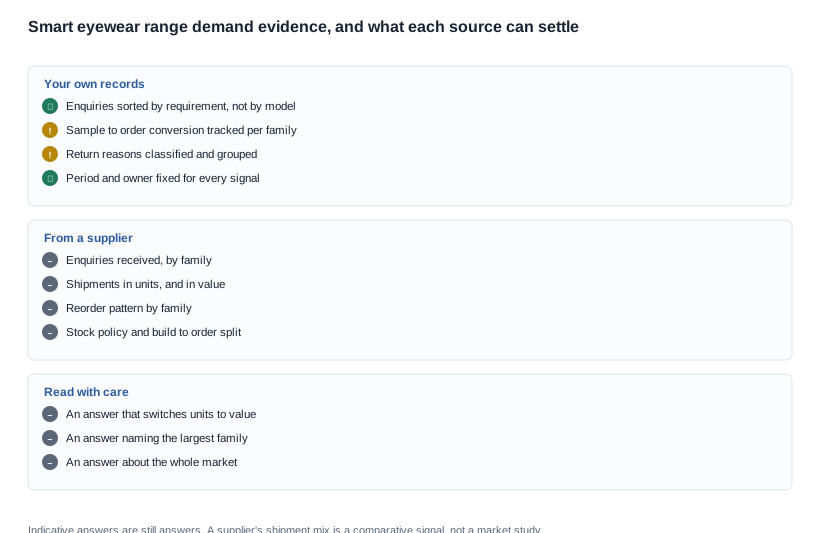
The questionnaire is the mechanism, and the discipline is in how the answers are read. A supplier asked an open question will usually answer with whatever is most convenient to say, which is generally wherever the family with the most models sits. The fix is to ask three versions of the same question, because they have three different answers, and only one of them is about shipped product.
- Which family receives most of the enquiries you receive, and over what period does that reflect?
- Which family accounts for most of what you ship, measured in units rather than in value, and which accounts for most of it by value?
- Which family do your customers reorder most, and which family do you hold as stock rather than build to order?
Enquiries are interest, shipments are realised demand, and reorders are the only one of the three that a buyer should treat as a signal about how durable a market is. The reorder question is the most valuable and the most likely to be deflected, and the deflection itself is informative — a supplier that will discuss its shipments but not its reorder pattern is telling you that reorder behaviour is where its uncertainty sits.
Two more questions earn their place. Ask which family they would build a stock order for, and against what minimum, because the answer reveals which family their factory is set up to deliver quickly and which is a build-to-order commitment. And ask which family they consider mature, which they consider new, and what changed in each during the last production cycle, because the reply is a rare direct view of what the factory believes is moving and what is being refreshed.
There are three answers to distrust. An answer that moves from units to value in the middle of a conversation, because the two tell different stories and the switch is usually made deliberately. An answer that names the family with the most models, which usually means the family they know best rather than the one they sell most. And an answer that is about the whole market rather than about their own shipments, which is a subject no supplier has direct evidence on and which is best answered by nobody in the room.
What we will not say about best sellers, and why
Here the position is narrow, and it is worth stating in plain words rather than as a disclaimer. We will not name a best-selling family, we will not rank the families against each other, and we will not repeat a number from a supplier, a distributor or a market report as though it described this range, because the range publishes no such number and any we gave you would be inherited rather than sourced.
What we will do is more useful. We will tell you which fields each family publishes, so you can see where the specification is comparable and where it is not. We will tell you where a family carries a differentiator that belongs to a single model, because that is where a listing can be built. We will tell you which published rows a buyer has to go and ask for, and for the larger families we will tell you how much qualification work sits between a shortlist and a factory quotation. And we will give you the questions above in a form you can send as they are.
The commercial reality underneath all of this is simple. A category bet is a bet on your channel, your market and your season, and a specification catalogue is not a demand study for any of those three. The most valuable demand data in a range review is the one nobody else has: your own enquiry log, your own sample programme, your own return reasons. A range chosen against evidence you generated yourself will survive contact with the first quarter; a range chosen against a brochure will not, and the most expensive part of the correction is the stock you already bought.
One caution is worth adding about how a wide family reads. Breadth inside a family gives a channel more listings, more angles and more room to test which one works, and that is a real commercial advantage even when the family is not the strongest seller. It is a different advantage from volume, and it should be counted separately, because a buyer who treats "more models" as "more demand" will over-invest in a family that offers them forty listings and no reason to choose between them.
Give us the requirement mix from your own enquiry log, and we will return the published rows of the models inside the families those requirements fall into, so that your shortlist is built on evidence you already hold.


