

The word entry level normally means the bottom of a price ladder, and this catalogue has no price ladder. It publishes no unit price, no price band, no entry point and no discount structure, so a buyer looking for the cheapest model is looking for something the material does not contain. What the material does contain is a variable that serves the same commercial purpose better: how completely a model's page is documented. A model whose page answers the questions a buyer has to ask can be ordered, quoted and listed; a model whose page leaves them open needs a document to be obtained first, and that document is the thing that decides whether a first order is a quick transaction or a project.
This page is about that method — how to find the models in the range whose published rows are most complete, and what to do with the ones that are not.
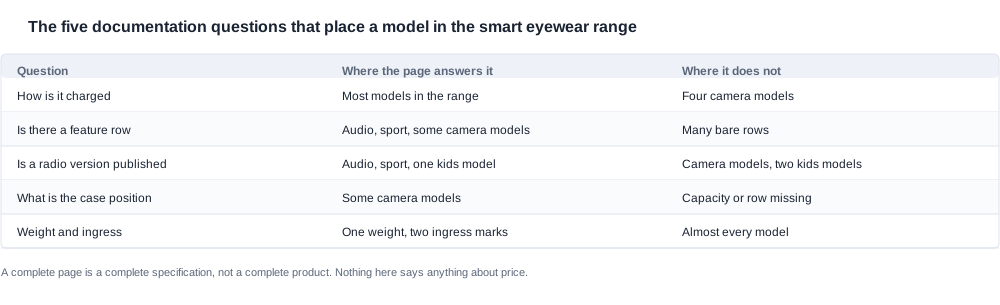
Smart eyewear range entry level options: the tier is defined by what is published
Two things follow from the absence of prices, and they point in opposite directions. The first is that a buyer cannot rank models by cost from the catalogue, and any list headed "the most affordable models" would be a list with no criterion behind it. The second is that the buyer has something better available, because the published rows differ enormously in completeness, and completeness is a real, checkable property of each model's page.
The logic behind using it runs like this. An order needs three things before it can be placed with confidence: a specification, an estimate of what will arrive in the box, and a set of documents that describe the product for the destination market. Each of those three has a corresponding question that the catalogue either answers or leaves open. A model whose page answers all three can be ordered from the catalogue alone. A model whose page leaves all three open cannot, and the gap has to be closed with a document and a conversation before anything is quoted. The models at the bottom of the documentation ranking are therefore not cheap models or poor models; they are the models with the longest lead time for a first order, and that is a different kind of line on a range plan.
This is a more useful definition than a price tier for a specific reason. A price tier tells a buyer what they will pay. A documentation tier tells a buyer how long the order will take to become a shipped order, how much of the specification is already settled, and how much of the work falls on their own side before the first unit can be judged. For a channel testing a market, for a buyer running a first pilot, or for anyone who has to justify a lead time to a customer, that is the more valuable of the two numbers.
It is also the definition that survives a supplier change. A price tier is a relationship; a documentation tier is a property of a product page, and a product page does not change when the supplier does. A shortlist built on documentation completeness is still a usable shortlist in a year, with a different factory, because the question it asks of every model is the same.

The five documentation questions that place a model
These are the questions. A model is fully documented against them when its page answers all five, partially documented when it answers some, and a special project when it answers none. The questions are deliberately about the documentation rather than about the product, because documentation is the thing that is scarce and the thing that can be asked for.
- Does the page say how the product is charged? A charging method is published for most models in the range, and it is absent for four camera models. Where it is present, the box contents, the accessory and the customer's replacement habit are all determined. Where it is absent, the accessory question is open and the specification is incomplete in a way that touches the customer directly.
- Is there a feature row to write a listing from? Some models publish a descriptor and some publish nothing beyond the standard rows. A model with no feature row can still be sold, but its page has to be built from numbers, and every sentence on it has to be defensible on its own.
- Is a radio version published? Bluetooth versions are published across the audio and sport models and on one of the children's models, and they are not published for the camera models or for the other two children's models. Where a version is published, the pairing claim on a listing is supported. Where it is not, the claim has to wait for a written answer.
- Is the charging case position published? The position differs in four distinct ways across the camera models: a published capacity, two published capacities on one model, a case with no published capacity, and no case row at all. A buyer who has not checked this will get the box contents wrong on a specific model.
- Is anything published about weight, or about ingress? One model in the range publishes a weight, and two models publish an ingress marking. For every other model both are absent, which means both questions have to be asked, and a listing that mentions either has to be silent until an answer arrives in writing.
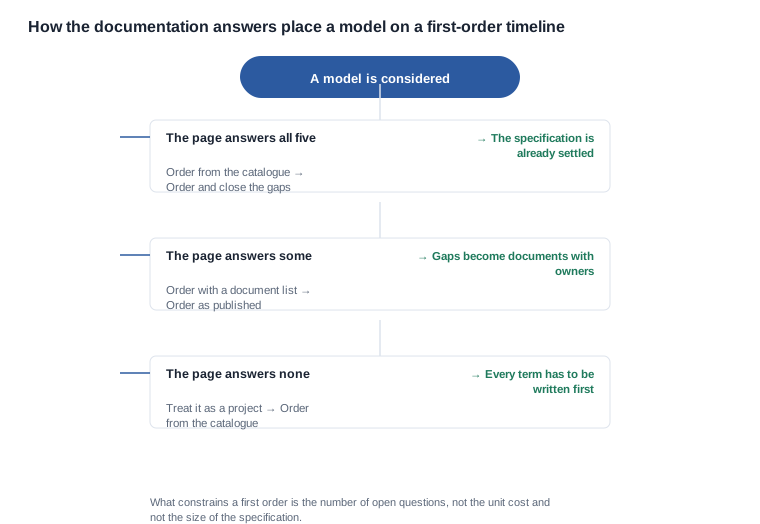
The five questions are also a cheap way to audit a supplier's catalogue page for a buyer, and the audit is worth doing before a sample order rather than after one. A page that answers all five for a model is a page somebody wrote with a buyer in mind. A page that answers one of them is a page that was written for a reader who is not a buyer, and the gaps are in exactly the places a buyer needs them answered.
What each answer buys the buyer
It is worth spelling out what each of the five answers actually enables, because "more documentation" is an abstract idea until it is attached to a deliverable.
A published charging method determines the accessory, and the accessory determines three things a buyer has to plan for: what goes in the box, what the warehouse counts, and what a customer replaces when it is lost. It also determines the customer expectation, because a product that arrives with a dock and a product that arrives with a cable produce different first impressions from the same hardware.
A published feature row determines what a listing may say. A model with a descriptor can carry a claim that the factory has already described; a model without one can only be described by its numbers, which is a legitimate approach but a more demanding one to execute well, because every sentence has to be both true and interesting.
A published radio version determines whether the pairing line on a listing is supported or whether it has to wait for an answer. It also determines the compatibility question — which devices the product works with — and compatibility is the first thing a channel customer asks and the last thing a sparse page answers.
A published case position determines the box contents, and the box contents determine the unboxing, the returns and the shelf. In this range the position varies in four different ways, which means it cannot be assumed from a neighbouring model in the same group, and it means the question has to be asked per model rather than per group.
A published weight or ingress marking determines whether anything at all can be said about how the product feels to wear or how it behaves in conditions. One weight and two ingress markings in the whole range means that in almost every case both subjects are closed, and a listing that mentions either is making a statement the catalogue does not carry.
The point of the method is that these are not small administrative details. Each one of the five answers removes a category of question, and a model that answers all five removes the majority of the questions a first order would otherwise generate.

What a low-commitment order still has to answer
There is a temptation to read "most fully documented" as "fewest questions", and the two are not the same. A model with a complete page still has questions that no page answers, and for a first order those are the questions that decide whether the order goes smoothly.
A weight and a frame balance matter for anything worn. A charging cycle matters for anything that leaves a warehouse, because a unit that is charged to a level nobody can define is a unit that comes back. A pairing or connection routine matters for anything with a radio, because the support script is written from it. A capture behaviour matters for anything that records, and a recording that silently fails is a failure that is discovered by the customer rather than by you. A detection behaviour matters for anything that senses, and the published rows in this range describe the categories of detection rather than the conditions that trigger them.
None of these are published for any model, so the method has a built-in limit: a complete page is a complete specification, not a complete product. What the documentation ranking does is tell you how much of the specification is already settled, which determines how much of the first order is spent on paperwork rather than on product.
The other limit is worth stating because it is the one that catches new buyers. A model with a sparse page may be a newer model, a less carefully documented one, or simply one whose configuration is unusual — and the catalogue does not tell you which. So the documentation ranking is not a quality ranking and should never be presented to a customer as one. It is an internal tool for planning an order, and the most valuable output of running it is usually the list of models whose pages are thin, because that list is the list of documentation to request before anything else is ordered.

Smart eyewear range entry level options: how to run the first order on a model with gaps
When a buyer does choose a model with gaps, the order still works, and the way it works is by turning each gap into a named document with an owner and a date. The sequence below is the one that keeps a first order small.
- List the gaps against the five questions, and against the operational questions the page cannot answer either. Write them as questions, not as concerns.
- Send them as one list, with the sample request attached, so the answers and the sample arrive in the same round trip rather than in two.
- Record the answers against the configuration, so that a repeat order starts from an answer instead of a question.
- Write the acceptance criteria for the first batch from the answers, and make sure each criterion is something the batch can be judged against rather than something the batch can be argued about.
- Keep the documentation set with the order, so the second order carries the first order's answers with it.
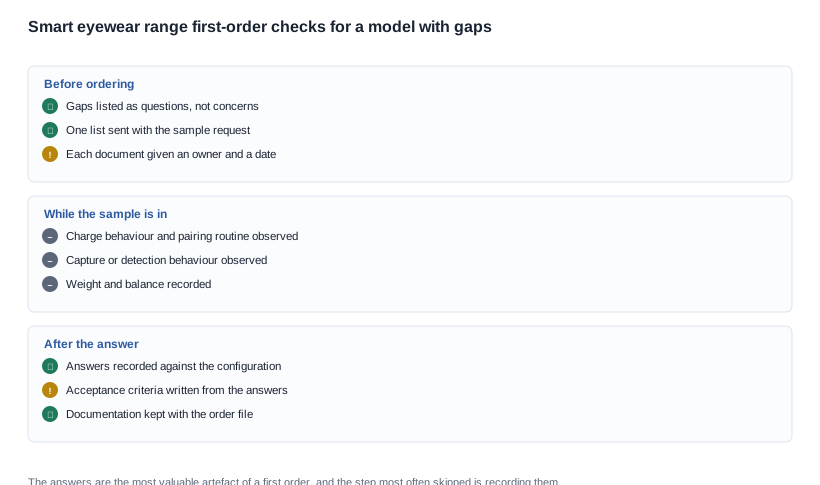
The step that is usually skipped is the third. A first order produces a set of answers, and those answers are the most valuable artefact the order creates — more valuable than the units, in the sense that the units are consumed and the answers are not. An order whose answers are not recorded is an order that has to be re-investigated, and the second investigation costs more than the first because it happens against a deadline.
There is a version of this method that applies to a supplier rather than a model. A supplier whose pages are consistently complete has demonstrated a documentation discipline, and that discipline is a better predictor of how your own customised build will be documented than any statement about their process will be. A supplier whose pages are consistently thin may still be excellent at engineering and simply not set up for buyers, and that is a workable relationship as long as the expectation is written into the order rather than assumed.
The way to run that version is simple and it is worth doing before a sample rather than after one. Take a model the supplier considers ordinary, ask for its full specification as it would be given to a customer in another market, and read what comes back. The question is not whether the answer is good — it is whether the answer exists, and whether the gaps in it are the same gaps the catalogue shows or different ones. A supplier whose specification is fuller than its catalogue page is a supplier who writes specifications and is willing to do it again for you. A supplier whose specification has the same gaps as the page is telling you that the page is the specification, and the buyer has to supply the rest.
That distinction also tells you where to put your own effort. Where the supplier writes specifications, your work is selection and judgement. Where the supplier publishes a summary, your work includes writing the specification the order is placed against — and that work has to be budgeted, scheduled and owned, because it does not go away when the sample arrives.
Why the cheapest model is the wrong thing to optimise
A buyer who has been told to find the entry point in a range and finds no prices will look for a substitute, and there are three tempting ones. The first is the model with the smallest cell, which is a proxy for cost and tells you nothing about the order. The second is the model with the longest rated endurance, which is a proxy for what a customer will value and is equally unhelpful for choosing where to start. The third is the model with the fewest published rows, on the reasoning that less is simpler — and this one is actively misleading, because fewer published rows means more unanswered questions and a longer path to a shipped order.
The documentation method is better than all three for a specific reason: it optimises the thing that actually constrains a first order. What constrains a first order is the number of open questions, not the cost of the unit and not the size of the specification. A model whose page is complete and whose specification is modest will get a buyer to a shipped, judged, repeatable order faster than a model with a richer specification and four unanswered questions, and for a first order that is the right trade.

The one thing the method will not do is tell you which model your customers will want, and it is worth being clear about that boundary before it is used. It tells you which models can be ordered with the least friction, which questions have to be closed first, and how long the documentation is going to take. Demand is a different question, it needs different evidence, and the fastest route to that evidence is the enquiry log rather than the catalogue — the approach is set out in what can and cannot be known about demand in this range.
It is also worth saying what the method does with a supplier rather than a model, because the two readings overlap more than buyers expect. A supplier whose pages are complete has a documentation habit, and a documentation habit is what determines how a customised build will be documented, whether or not anybody promises it will be. A supplier whose pages are thin may be a fine engineering shop that has never been asked to write for a buyer, which is a workable relationship and one that becomes much easier once the expectation is written into the order rather than assumed at the sample stage. The audit is therefore worth running across the whole range of models a buyer might use, and the pattern that comes out is more useful than any single model's score.
What we will do with this method is run it against the range with you, model by model, and show which pages answer the five questions and which do not. What we will not do is publish a list headed "entry level" that implies a price ranking the material does not contain, and we will not describe the models with the sparsest pages as the cheapest ones, because they are the ones a buyer has to do the most work with.
One last thing to say about how this method should be used with a customer. A buyer asking for the entry point in a range is often asking for a product that is easy to explain, easy to ship and easy to support, and the documentation answer is usually the right one for all three of those reasons — a model with a settled specification is easier to explain to a customer than one with five open questions, and it is easier to support because the support script can be written from the page. It is worth resisting the temptation to present a documentation ranking to a customer as a quality ranking, though, because the next question is always "so which one is the best one", and the honest answer to that question is a different one that the catalogue cannot give.
Tell us which requirement the first order has to serve, and we will return the models whose pages answer the most of the five documentation questions, with the gaps that remain and the questions we would put against them.


