

There is no premium tier in this catalogue, and it is worth understanding why before deciding which models could support one. No model in the range publishes a material, a build quality, an optical figure, an acoustic figure or a performance measurement of any kind, and there is no price, no margin and no grade to point at. A premium position that rests on "this one is better made" is therefore a claim with nothing behind it, and a channel that writes it will be asked for the evidence by the first customer who takes it apart or the first competitor who reads the listing.
What the range does publish is a set of capabilities, and several of them are rare enough within the range to carry a claim of their own. The work is not finding a premium model. It is finding which published fields can support a claim, what each claim is allowed to say, and what a buyer has to be able to answer when the customer asks why it costs more.
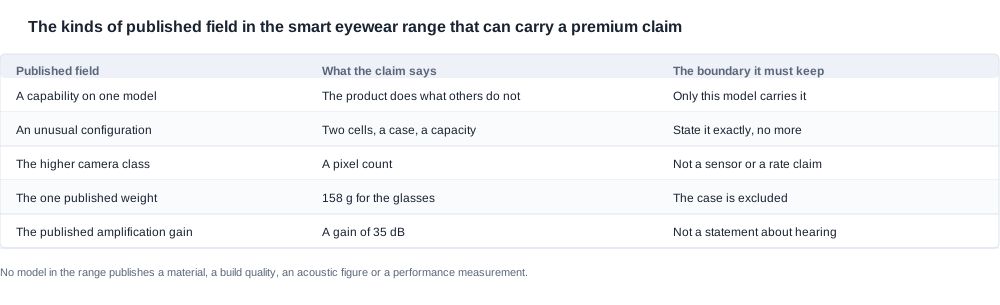
Smart eyewear range premium categories: no model publishes a quality figure
The temptation in a range like this is to treat the word premium as a synonym for the more expensive end of a ladder, and to look for the models with the biggest numbers. That approach fails immediately, because the numbers in this range are not a scale. Two models publish a cell configuration of two 55 mAh cells, and one of them publishes about six hours of rated use while the other publishes about eight; two models publish a single cell of 100 mAh and both publish about seven hours; the camera models publish one of two resolution classes and the classes are not a ranking of quality. A larger number in one field is a different configuration, not a better one, and a listing that implies otherwise is making a comparison the material does not support.
The same applies to the fields that are absent. The range publishes no acoustic figure for any model, so no model can claim better sound. It publishes no material, so no model can claim better build. It publishes one weight figure in the whole catalogue, and one ingress marking on two models, and these are the only two published fields in the entire range that could be read as quality statements at all — and both come with their own boundaries, which a premium claim has to respect.
So the honest definition of a premium-capable model in this range is a specific one: a model that publishes a capability which the rest of the range does not, and where the factory can produce a document that supports a claim about that capability. Everything else — the price, the packaging, the story, the photograph — is the channel's work rather than the catalogue's, and it can be as good or as bad as the channel is.
That definition is narrow, and it is the reason a premium position in this range is built on a small number of models rather than on a tier. It also means the decision is checkable before a sample arrives, which is worth a great deal to a channel that is planning a season rather than a quarter.

The five kinds of published field that can carry a premium claim
A capability published on one model only. These are the strongest material available, because the claim is comparative without needing a comparison figure: the product does something the rest of the range does not. In this range the examples are a remote photo control, a photochromic lens configuration, a removable inner frame, a slim temple, a removable temple, an ingress marking, a published case capacity, and a bone-conduction entry that states an amplification gain. Each of these is a claim that stands on the fact of its own existence.
An unusual published configuration. A two-cell configuration where a sibling publishes one, or a case with a published capacity where a sibling publishes none, is a difference a listing can describe without exaggerating it. The word to use in the copy is exact — two cells, a folding case, a published capacity — because a buyer who can check the page will check it, and a buyer who cannot check it is not the buyer the claim is for.
The higher camera resolution class. This is the one place where the range publishes a specification that is objectively higher rather than merely different. Eight models sit in the eight megapixel class and three sit in the thirteen megapixel class, and a claim built on the class is defensible in a way that a claim built on a photograph is not. It is also the claim most often overstated: a resolution class counts pixels and says nothing about the sensor, the view or the rate, none of which are published for either class.
The published weight figure. One camera model in the range publishes a weight — 158 g for the glasses themselves, with the folding case weighed separately — and it is the only weight in the catalogue. A weight can carry a claim, and this one carries an unusually precise claim: a specific figure, for a specific configuration, excluding a component that a customer will handle. A premium listing that quotes it has to say the same thing the catalogue says, including what it excludes.
The published amplification gain. The bone-conduction entry publishes a gain of 35 dB, and that figure can be quoted as a published specification. What it cannot carry is any statement that touches a person's hearing, a treatment of a loss, or the product's status as an assistive or a medical device. A premium position built on that figure has to be built on the figure itself, and a listing that reaches past it is not a premium listing, it is a problem waiting for a customer to ask.
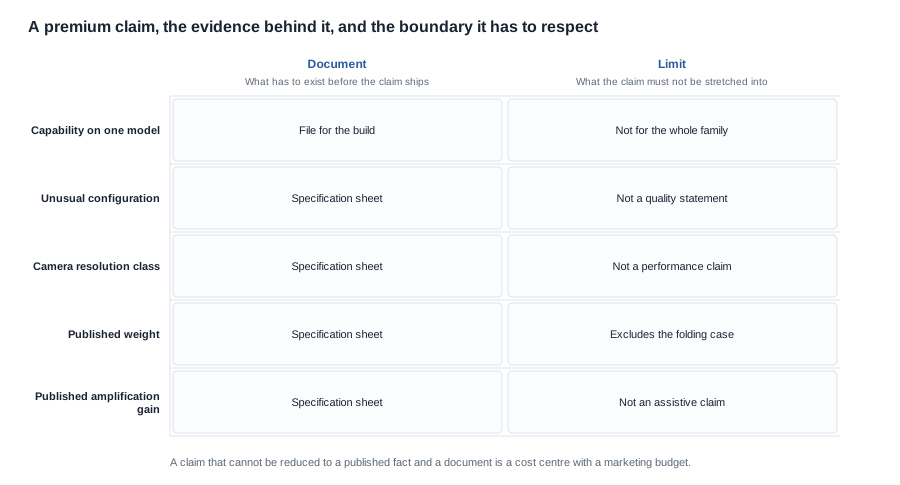
The five are not equally strong, and it is worth ranking them before the copy is written. A capability that appears on one model is the strongest, because the comparison is free and the claim is about existence. An unusual configuration is next, because the claim is exact and the page supports it exactly. The camera class is third, because it is a genuine difference in a published number but the surrounding language is where the overstatement happens. The weight figure is fourth, because it is precise and the exclusion has to travel with it. The amplification gain is last, because the figure is published and the temptation to build more on it is strongest, and because the one thing it must not be turned into is a statement about a person.
What each premium claim has to be able to answer
A claim that cannot be answered is a cost centre with a marketing budget. Before any of these five is written into a listing, it has to survive four questions, and the fourth is the one that is usually skipped.
What exactly is being claimed? Not the marketing sentence — the underlying fact. The presence of a capability, the existence of a configuration, the membership of a class, the value of a figure, or the fact of a weight that excludes a named component. A claim that cannot be reduced to one of those is a feeling, and a feeling does not survive a customer who has read the page.
Which document supports it? This is where the absence of published certification information bites, and it is not a reason to avoid the claim — it is a reason to attach the claim to a specific document. The file that covers the build, in the market the product will ship to, signed by the party responsible, is what turns a catalogue row into something a procurement file can carry. The pattern of the file set follows the product category, and the requirements for a product intended for children are set by the destination market and the age band, which the catalogue does not state and the buyer's own compliance function determines.
What does the claim not say? Every premium claim needs a boundary, and the boundaries here are specific. The published weight is for the glasses and not the case. The published gain is a figure and not a statement about hearing. The ingress marking appears on two models and cannot be extended to a family. The resolution class is a pixel count and not a statement about how the camera performs. Writing the boundary into the copy is not a concession; it is what makes the claim credible to a reader who is checking.
Who answers the follow-up question? This is the one that decides whether a premium position survives its first year. A premium buyer asks a follow-up question — about the material, about the warranty, about whether a spare is available, about how long the battery lasts under a specific condition. Some of those are published, some are not, and the ones that are not have to be answered by somebody in the supplier's organisation with a current answer. A premium listing with no owner for the follow-up is a support queue with a better margin.
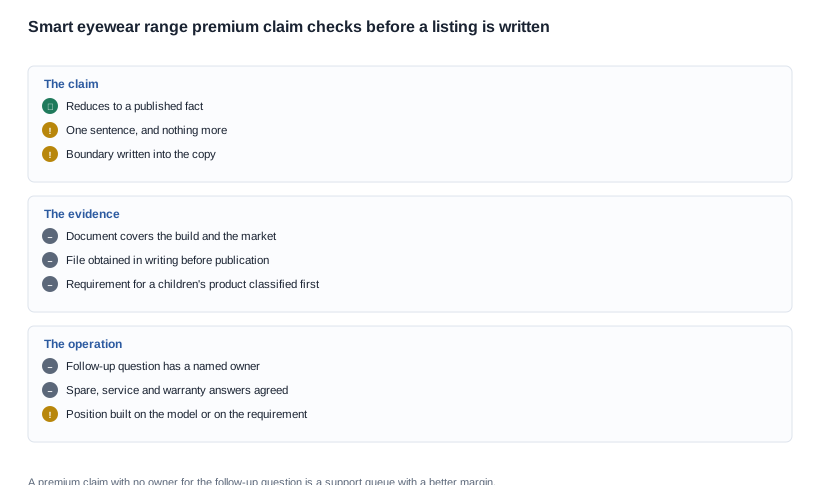

Six questions before a premium claim goes on a page
The checks above are the substance; these are the sequence, and the order matters because each answer changes the question that comes after it.
- Which published capability is the claim built on, and is it published on this model alone? A claim that rests on a field every model publishes is not a claim, and the first job is to find the one that is.
- What is the one-sentence version, and can it be read by somebody who has the page in front of them? If the sentence needs a second sentence to be fair, the claim is not ready.
- What does it exclude, and where is that exclusion written? The weight figure excludes a case, the class says nothing about a sensor, the gain is a figure and not a statement about a person. Each of these is a question the customer will ask, and each of them has to be answered in the copy rather than in a reply.
- Which document covers it, in which market, for which build? Without that document the claim is a statement the channel is making on the factory's behalf, which is the one arrangement that a distributor's compliance team will not accept.
- Who answers the follow-up, and from what record? A premium claim that generates questions needs a named owner and a source the owner can answer from — a specification, a file, a dated answer from the factory.
- Is the position built on this model or on the requirement behind it? This is the question with the longest reach, because a position built on a model ends when the model changes and a position built on a requirement can be supplied by whatever configuration answers it.
The red flags in this sequence are recognisable. A claim that cannot be stated in one sentence without a qualifier. A boundary that exists in the buyer's notes but not in the copy. A document request that has been made twice without a date attached to the answer. A follow-up question with no owner because the channel expects the customer not to ask. And a premium position with exactly one model behind it and no plan for what happens if that model is withdrawn or replaced.
The trade-off in the last question is the one buyers argue about longest, and it is worth separating the two positions clearly before either is chosen. A position built on a model is easier to explain, easier to photograph and easier to keep consistent, because there is one page, one specification and one set of expectations. A position built on a requirement is harder to run and much harder to copy, because it promises a capability rather than a product, and it survives whatever the factory does to the model that happens to satisfy it this season. Which one a channel should take depends on how long it expects to be selling the category and on how much of its own identity it wants bound to somebody else's product plan.

Smart eyewear range premium categories: the operational cost of a premium position
A premium position has operating consequences that a standard position does not, and they are worth pricing into the decision even though the range publishes no price to price them against.
The first is the expectation of service. A customer who has paid more expects faster answers, spares, and a smoother returns process, and none of those are published in this range — there is no warranty term, no spare-parts policy and no service commitment on any page. A channel taking a premium position therefore has to obtain those answers as part of the product decision rather than as a service afterthought, and the cost of obtaining them is a cost of the position.
The second is the evidence burden. The higher the claim, the more likely a customer, a distributor or a reviewer is to check it. A standard listing that says little has little to be wrong about. A premium listing that says something specific is a claim that can be tested, and a claim that can be tested has to have been tested.
The third is the concentration risk. In this range the number of models that can carry a premium claim at all is small, because the capabilities that are rare are rare by definition. A channel that builds its premium position on one model is making a bet on that model, on that factory and on that documentation, and it has no second option inside the range if something goes wrong. The alternative is to build the position on a category rather than a model — the requirement the customer buys into — and that is a more durable structure, because a category can be supplied by more than one configuration over time.
That last point is the one that connects this page to the rest of the range, and it is where the other end of the tier question sits. A premium position that names a product is a bet on a product; a premium position that names a requirement is a bet on your ability to supply it. The trade-off between them is a commercial one that the catalogue cannot settle, and the budget question — what a requirement-driven order looks like when the aim is to exclude everything that is not necessary — is treated separately in the cost side of the tier question.
There is a fourth operational cost that only shows up in the second year, and it is the cost of being visibly premium in a market where nothing else is. A channel that has made a claim the rest of the range does not make is now the channel whose claim gets checked. The first customer who asks whether the figure includes the case, the first reviewer who asks whether the class says anything about the sensor, the first distributor who asks for the document behind the claim — each of those questions is a small cost that a standard position does not incur, and they are cumulative. A channel that has decided to hold a premium position should decide at the same time how many claims it intends to make, because a channel making six claims a year will be examined six times, and one making one claim a year will be examined once.
That is a budgeting decision rather than a product decision, and it is worth making before the listing rather than after the first examination, because the cost of removing a claim later — rewriting a page, correcting a shipment, answering a customer who bought on the strength of it — is several times the cost of never making it.
How a premium position is decided without price data
Without prices, the decision has to be made on structure, and the structure is a set of checks rather than a ranking. The sequence below is the one that works, and it is deliberately short because the material that supports it is short.

- List the models in the range that publish a capability no other model publishes. That list is short, and it is the only list a premium position can be built from.
- For each model on that list, write the one-sentence claim the published rows support, and nothing more. If the sentence cannot be written from the page, the model is not premium-capable.
- Write the boundary of each claim next to it — what the figure excludes, what the class does not say, what the marking does not cover.
- Identify the document that would have to support the claim in the destination market, and get it in writing before the listing is written.
- Identify who answers the follow-up question, and put that in the agreement rather than in a support script.
- Decide whether the position is built on the model or on the requirement behind it, because that decision determines what happens when the model changes.
The criteria for accepting a premium claim are correspondingly tight, and they are worth writing down before the copy is written rather than after. The claim reduces to a published fact. The fact has a document behind it. The document covers the build and the market. The boundary is written into the copy. And somebody owns the follow-up question.
What we will not do is tell you which models are the premium ones, or which category holds a premium position, because that would be a commercial judgement dressed as a catalogue fact, and the catalogue does not carry the information to make it. What we will do is read the range with you, list the models that publish a capability of their own, and put the claims and their boundaries side by side so that the decision is made on what can be evidenced rather than on what can be asserted.
Tell us the requirement your premium buyer is paying for, and we will return the published rows of the models that carry a capability of their own, together with the claim each one supports and the boundary that claim has to keep.


