

A budget conversation in this catalogue has to start somewhere other than price, because no price is published for any model and no price tier, discount band or entry point is stated anywhere in the material. That is not a gap in the writing; it is the position, and it means the tier has to be defined by something else. What a cost-sensitive buyer can do instead is draw a capability boundary — the point past which a specification stops being necessary for the use — and then work out which published fields that boundary excludes, because those exclusions are the only lever visible from the buyer's side of the table.
This page is about that boundary and about the questions a cost-driven purchase has to ask. The other end of the same question, where a specification earns a premium by doing something the rest of the range does not, is a separate argument and is kept separate.
Smart eyewear range budget categories: a tier with no price has to be a boundary
The first thing to understand is that "budget" in a product line without prices is not a statement about money. It is a statement about specification sufficiency. A model is enough for the requirement, and everything beyond that requirement is cost the buyer chose to carry — whether it shows up in the invoice depends on the price, and the price is a conversation with the factory rather than a line in the catalogue.
That reframing has a practical consequence. Instead of asking which model is cheapest, the buyer asks which specification features are required by the use, and then treats every published field that is not required as a candidate for removal. The fields that survive are the ones worth paying for; the ones that do not survive are where a saving is being left on the table, and the buyer has to ask the factory what each one costs before deciding.
The second consequence is about comparability. Two models can be compared directly on published fields only where those fields are the same kind of field. A model that publishes two cells and another that publishes one can be compared on the basis of what those configurations deliver, but a model with a published feature row and a model without one are not the same product, and a cost argument that treats them as interchangeable is an argument about the wrong object. Where the fields differ in kind, the comparison has to happen at the level of the requirement rather than the level of the row.
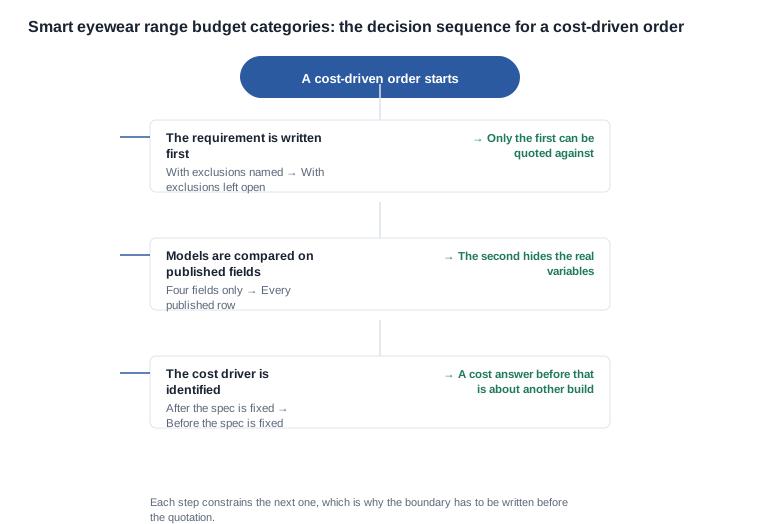
There is a third point, and it is the one that most often turns into a dispute later. The boundary has to be written down before the quotation, because the boundary decides the quote. If the requirement is written as "a Bluetooth audio product for general use", a supplier is free to propose a model with a feature row and a two-cell configuration, and the resulting price will be defended as meeting the requirement. If the requirement is written as "a Bluetooth audio product for general use with a magnetic dock, one published cell, and no published feature row beyond the radio version", the quotation has been constrained before it was produced, and any deviation from it is visible on the page. The specification sentence is the budget control; the negotiation is downstream of it.

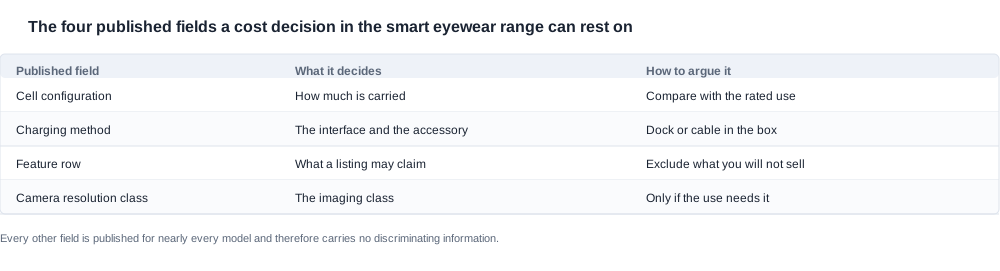
The four published fields a cost decision can rest on
Most of the fields in a range are published for every model and therefore carry no discriminating information. Four kinds of field are the ones a cost decision can actually be argued on, because they are the ones where a model differs from another model in a way a buyer can see and a supplier can price.
Cell configuration. This is the field that most often separates a cost build from a specification build, and it is published in a form that makes the difference visible: a single cell of 100 mAh, two cells of 55 mAh, two cells of 70 mAh, two cells of 90 mAh, a single cell of 40 mAh, a single cell of 70 mAh, and larger single cells in the camera families. The rated use moves independently of the cell, which means the two fields have to be read together — two models with the same cell figure and different endurance figures are two different products, and the endurance figure is where the cost argument usually turns.
Charging method. Magnetic charging, Type-C charging, and — for four camera models — no published charging method at all. This is a cost decision with a real tail: the interface determines what is in the box, what a customer replaces when it is lost, what a warehouse counts, and what a return arrives with. It also determines the accessory, and an accessory is a component with a cost and a lifecycle. A buyer who treats the charging method as a cosmetic preference has left a real variable outside the cost model.
Feature row. The presence or absence of a published descriptor is the clearest published separator in the range, because it changes what can be written on a listing. A model with a feature row can carry a claim; a model without one can only carry its numbers. The cost consequence is indirect but real: it is the difference between a product page the factory's own copy supports and one the buyer has to write and evidence.
Camera resolution class, where a camera is in scope. For camera models the class is the published separator, and it is binary — an eight megapixel class and a thirteen megapixel class. The cost question is whether the requirement needs the higher class, and it cannot be answered from the class alone, because the catalogue publishes no field of view, no frame rate and no sensor detail for either class. A buyer who assumes the higher class is better for a given use will be making a decision the specification does not support, and a cost-saving argument built on that assumption is the kind that collapses at the sample stage.
What a cost-sensitive requirement should leave out on purpose
The savings in a cost-driven order do not come from negotiating the price of a model that does too much. They come from naming, in the requirement, the things the product does not need to do — and then checking that the model you have been quoted against still has them.
Four exclusions are worth making explicitly, because each of them is the kind of thing that gets included by default. The first is a feature row the channel will not use. If the listing will not mention a surround-sound descriptor or a removable-temple descriptor or a remote photo control, then a model that publishes one is carrying a specification the channel has decided not to sell, and that is a cost with no return attached to it. The second is a charging method that fights the rest of the operation: a Type-C product in a fleet organised around magnetic docks, or the reverse, produces a second accessory line and a second set of spares for no commercial gain.
The third exclusion is the charging case, where one is published and the requirement does not need it. That decision is not free, because a case in the box changes the unit economics, the returns process and the shelf footprint, and because the models where case capacity is published are not the same models where it is not. The fourth exclusion is a resolution class, on the same caution as above: the higher class is only worth carrying if the requirement uses the difference, and the catalogue cannot tell you whether it does.
The discipline is the same in all four cases. Write the exclusion into the requirement line, not into a conversation afterwards. A requirement that says what the product must not have is a document a supplier can quote against; a requirement that says only what it must have leaves every one of these four variables to the supplier's discretion, and discretion is where the cost goes.

The order of that conversation is worth fixing in advance as well, because each step constrains the one after it. Write the requirement boundary first, including the exclusions, and a supplier cannot answer it with a model that does more than the requirement. Compare the models that satisfy the boundary against the published fields, and note which of the four variables each one carries, because those are the variables the cost discussion will run on. Only then ask what the cost driver is, because until the specification is fixed, a cost answer is an answer about somebody else's build. And record the answers, because the second order is a negotiation with a different supplier representative at the table and only the record carries the first one forward.

What the boundary costs you in the other direction
A boundary is not free, and the price of drawing it is paid in the direction the buyer is not looking at. Excluding a feature row means the listing has one fewer thing to say, and a listing built only from numbers is a harder page to write and a weaker one to sell. Excluding the charging case changes what a customer finds in the box, and a customer who expected a case and finds a cable treats the product as incomplete even when every published figure is correct. Excluding the higher resolution class is the cheapest of the three exclusions to justify and the most expensive to defend later, because a customer whose use does not need the difference and a customer who assumes the product is the higher class look identical from the outside.
None of that argues for a wider boundary. It argues for a recorded one. The practical form of this is a short exclusions note that travels with the order: what was excluded, why, and what the customer-facing consequence was accepted to be. A buyer who has written that note can answer a question about the missing case in one sentence, and a buyer who has not will spend a support conversation rediscovering a decision that was made deliberately.
There is a second-order effect worth putting in the same place. Once a specification is fixed, a later request to change it is a change against a fixed build rather than a preference expressed at the right moment, and the difference in cost between those two situations is usually larger than the cost of the change itself. The configuration record, the artwork set and the build identifier all have to be re-established, and the schedule that was already agreed with the customer does not move by itself. Recording the exclusions is therefore not paperwork for its own sake; it is the thing that makes a later change visible while it is still cheap to make.
One model, several listings, and the cost of carrying a second model
A cost-driven buyer often arrives at a question that is not about a model at all: how many models can this operation carry? A channel that lists one product has one artwork set, one packing list, one support script, one spare line and one set of customer expectations. A channel that lists two has two of each, and the second listing is rarely half the work of the first, because the comparison between the two is where the effort goes.
The published fields make this visible in a way that is easy to miss. Two models that differ only in charging method look like a simple pair from a distance, and they are not: they produce two accessory lines, two packing lists, two sets of expectations about what arrives with the product, and two support scripts whose only difference is a word. Two models that differ in cell configuration and in the presence of a feature row are two products, not two listings, and they are better sold as a deliberate pair than as a range. The useful discipline is to count the operating objects rather than the listings, and to notice that the models whose published rows are identical are the cheapest to carry together and the hardest to sell apart.
That counting is also what makes the boundary conversation productive. A buyer who has established that the operation can carry two models can spend the specification budget on making the two genuinely different, rather than on making one of them slightly better than the other and then discovering that the channel has nothing to choose between them.

Smart eyewear range budget categories: the questions that decide the unit cost
A cost-driven purchase needs a different question list from a specification-driven one. The specification purchase asks what a model does; the cost purchase asks what changes the number on the invoice and what has to be paid for that is not on it. These are the questions that decide the unit cost, and they are worth sending as a list.
- What is the cost driver on this build, and which single change would move it most?
- What is the minimum order quantity per configuration, and does a colour split create a separate minimum per colourway?
- What is included in the box, and what is available as a separately ordered accessory?
- What does the packing list look like, and how many components does a warehouse count per unit?
- What does a repeat order cost to reproduce, and is there a configuration record that makes it repeatable?
- What documentation is required for this build and this market, and who is responsible for producing it?
- Which of the published fields on this model can be changed without changing the model designation, and which changes the designation?
- If we remove a feature row, what changes in the specification, the packaging and the documentation?
- What is the cost of a change made after the first order rather than before it?
- Which accessory or spare does your own operation expect to replace most often, and at what cost?
- Which published field is a customer most likely to compare this build on, and does the build state it clearly?
- What does a colour split do to the packing list and to the packaging artwork?
- What is the expected number of units per order line once the minimum is applied to it?
- If this order had to be cheaper again, what would you change first, and what would that change cost elsewhere?
The last question is the one that tests whether a supplier is pricing a build or pricing a relationship with you, and the answer is more informative than the one on the first question. A supplier who can name the single change that would move the cost most, and who can say what that change does to the other parts of the build, is describing a specification they understand. A supplier who answers with a general statement about efficiency is describing their sales process. And question thirteen is the quiet one that matters for a small order: the minimum is applied to a line, so an order that is split across two configurations has two lines, and the arithmetic of a small order is decided by how many lines it has rather than by how many units it contains.
The list is deliberately about cost structure rather than about features, and the two hardest questions on it are the second and the last. A minimum order quantity that applies per configuration rather than per order changes the shape of a small order completely, and it is the single most common reason a cost-driven order costs more than the buyer expected. The accessory question is the one that gets forgotten, because the accessory is not the product and therefore does not appear on the product specification — and the cost of the cables, docks and cases that a channel replaces over a year is a real line in a cost model, even though no catalogue publishes it.
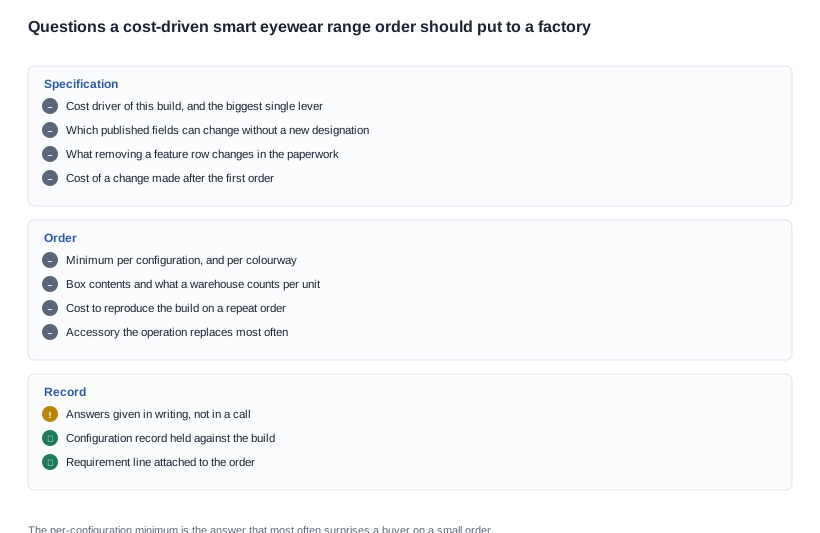
Two of these answers are worth demanding in writing rather than in a call. The answer to the first question tells you whether the supplier's own cost model is stable enough to quote against, and the answer to the configuration-record question tells you whether the second order will cost what the first one did. A supplier who cannot name the cost driver of a build is a supplier whose price is an opinion, and a supplier who cannot name the record that reproduces a build is a supplier whose repeat order is a fresh negotiation.
The other end of the tier question
Everything above assumes the buyer is working downwards — defining what is sufficient and excluding the rest. The opposite movement deserves its own treatment, because the two are easy to confuse and because the premium question is not simply the budget question with a bigger number attached.
A specification earns a position at the top of a range when it does something the rest of the range does not, in a way a customer can be told about and a supplier can be held to. That is a different test from being expensive, and it is a different test from being well documented. The published material in this range is unusually good at showing which models could pass that test, because the fields that appear on only one or two models are exactly the ones that describe a capability the family otherwise does not have — and the analysis of which models those are, and what each of them would need before the claim could be made, is in the premium position in this smart eyewear range. Reading the two arguments together is the point: a boundary defines what the requirement makes necessary, and a premium position defines what the buyer is willing to pay for beyond it, and a range review that produces only one of the two has answered half the question.
The practical point is that a range review should end with two separate answers rather than one: what the requirement makes necessary, and what the buyer is willing to pay for beyond it. A range that mixes the two into a single "good, better, best" ladder without published prices behind it is a presentation, and the first time a buyer has to defend the middle tier to a customer, the ladder collapses.
Tell us the requirement you need met and the specification you can do without, and we will send back the models inside that boundary with the fields each one publishes, so the order can be quoted against a written requirement rather than a model name.


