

A lifecycle question and a product question look similar and are answered by completely different evidence. The product question — what does this model do, what does it cost, does it meet the requirement — is answered by the published rows and by a supplier conversation. The lifecycle question — is this model still being built, will it still be here next season, what happens to the spare parts and the artwork when it changes — is answered by almost none of what our catalogue publishes, and a buyer who treats the two as one question will end up with a confident answer to the wrong thing. What the catalogue does publish, read carefully, gives a buyer the beginnings of a lifecycle view. It gives the shape of a register rather than the register itself, and the difference between those two is the whole of this page.
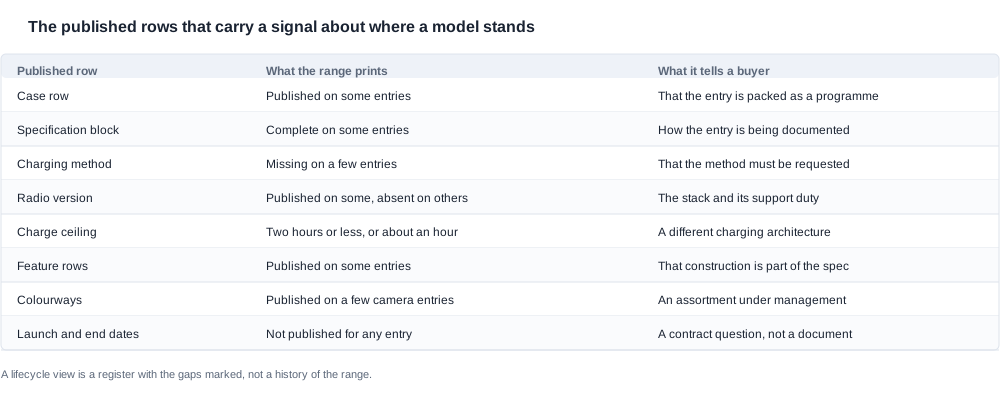
Smart eyewear range product lifecycle: what the published rows say about standing
The most important thing to understand about a lifecycle view of this range is that our catalogue is a snapshot of configurations, not a record of history. It prints what each entry looks like now, in terms of the cells, the charge ceilings, the charging methods, the radio versions and the feature rows. It does not print when an entry entered the range, whether it is still open for new orders, whether a revision has superseded the configuration a buyer quoted last season, or when anything will be withdrawn. A buyer looking for a lifecycle signal in the catalogue is therefore looking in the right place and asking the wrong question of it, and the useful move is to change the question: not "how old is this model" but "what does this model's published row set tell me about how it is being treated".
That reframing produces a surprisingly serviceable set of signals, because the range does not treat every entry the same way and the differences are legible.
The first signal is the presence of a charging-case row. A published case capacity, in any of its forms, indicates that the entry is packed as a programme rather than as a bare device, and that the pack is being specified. An entry with no case row at all is in a different position, and a buyer should read that difference as a question rather than as a fact about the product.
The second signal is the completeness of the specification block. Some entries print a cell, an endurance figure, a charge limit, a charging method, a radio version and a set of feature notes; others print fewer of these, and the most conspicuous case in the range is the group that prints a cell, a charge ceiling, an endurance figure and a case capacity while leaving the way the product charges unstated. An entry whose published rows are incomplete is not necessarily a lesser product, but it is an entry where the buyer cannot currently describe how the product is charged, and that is a fact about the documentation programme rather than about the product.
The third signal is the radio version, and it works in both directions. A published version ties an entry to a particular radio stack, and a radio stack carries an obligation that outlives a single production run. An entry with no published version is an entry where the radio position is undocumented, which means either that there is no radio or that the radio is not described — and the catalogue does not distinguish between those two, so the buyer has to ask.
The fourth signal is the charge ceiling, and here the range contains a genuine architectural difference rather than a documentation difference: two entries publish a charge time of about an hour while the rest of the range publishes two hours or less. That is not a small copy variation. A charging architecture that fills a cell in about an hour is a different design decision, and a buyer who has qualified one of those entries and then assumes the other behaves the same will have made an assumption that the published rows do not support.
The fifth signal is the feature rows, because an entry that publishes a set of fitted elements is an entry whose construction is part of its specification, and a change to that set is a change a buyer needs to be told about. The entries that publish no feature rows at all are entries where the construction is entirely undocumented from the outside.

The model register a buyer can build from the catalogue alone
It is worth setting out the criteria a buyer should apply when comparing two suppliers' answers to these questions, because the answers are administrative and easy to make look complete without being comparable. The first criterion is whether an answer names a model and a build, since an answer that names a range is an answer about nothing in particular. The second is whether it is dated, because an undated answer is a memory rather than a position. The third is whether it can be checked later, which in practice means whether the supplier would be willing to confirm the same answer in writing if the entry changed. A fourth criterion, and the one that most often separates a good answer from a merely polished one, is whether the supplier distinguishes between what it can commit to and what it merely intends. How to choose between two suppliers on this is not a matter of preference: a buyer should put the same eight questions to both, score the answers against the same four criteria, and see where the difference actually is. A shortlist built that way is defensible; a shortlist built on who answered first is not. The trade-offs are worth stating because the answers are rarely in conflict on the facts — they differ on commitment, and a buyer who cannot tell the difference between a commitment and an intention will end up planning on the wrong one.
There is a fifth criterion that applies to the whole exercise rather than to a single answer, and it is the one that decides whether the register earns its maintenance: whether the supplier will answer the same questions again in the same form when the register is rebuilt. A supplier who welcomes that is one whose answers are a position rather than a performance. A supplier who treats the second round as a new enquiry has told the buyer something useful for nothing, and the buyer has saved the effort of asking.
The practical output of the previous section is a document, and building it is a few hours of work that any procurement team can do without a supplier. The register has one row per published entry, and the columns are the published rows themselves, with one column for what the catalogue does not print. It is worth being precise about what this document is, because it is easy to mistake it for something it is not.
The register is not a lifecycle record, because a lifecycle record contains dates and a register does not. It is not a recommendation, because it ranks nothing. It is not a commercial document, because no term appears on it. What it is is a current-state map of the range with the gaps marked, and its value is that it makes the gaps countable. A buyer who walks a supplier through the register can say "these entries have a published case and these do not, these two publish a short charge ceiling and the rest do not, and these entries publish no charging method", and the supplier can then answer the specific questions rather than the general one.

The sequence in the diagram is deliberately mechanical, because the value of the register is that it is reproducible. A buyer who builds it today and rebuilds it in six months can see, from the diff, which entries have changed their published row set — and a change in a published row set is the earliest externally visible signal that something in the range has moved. That signal does not tell the buyer what moved or why, but it tells them to ask, and it tells them which entry to ask about, which is the difference between a productive enquiry and a general one.
There is a second column set that the register should carry, and it is the one that turns the document from a catalogue extract into a working tool: the open questions, per entry, in a fixed order, so that the same set of questions is asked of every supplier and the answers can be compared side by side.
- Is this entry open for new orders, and is what is being produced today the same build as the one that was published?
- What is the revision history of the published row set, and what changed in the most recent revision?
- Is the entry expected to remain in the range, and over what horizon?
- What happens to the spare-part and artwork position if the entry is revised or withdrawn?
- Is the entry published under a model code that a buyer can order, and if the configuration changes, does the code change?
- Which entries published without a model name are orderable, and under what codes?
- What is the delivery position for a repeat order of a configuration already in the field?
- What notice does a buyer receive ahead of any change to a configuration already quoted?
The eighth question is the one that decides whether a register is worth maintaining. A buyer who has asked it once and has a written answer has a mechanism; a buyer who has not has a document that goes stale without warning.

Signals that a model is being changed, and what the catalogue cannot show
Change in this range is invisible from the outside in most cases, and the few places where it is visible are worth knowing about in advance. A change of colourway, a change of feature rows, a change of the published radio version, a change of the charge ceiling, and a change of the case position are all things a buyer can see by diffing two registers. A change of charging method, a change of the endurance rating, a change of the cell arrangement, and the addition or withdrawal of a case are equally visible and equally significant, because each of them changes either the accessory programme or the customer's box contents.
What is not visible is the change that matters most commercially, which is a withdrawal. There is no published end-of-life notice for any entry in this range, no published last-time-buy position, no published notice period and no published service horizon. A buyer who has qualified an entry and then finds that it has been withdrawn has no published document to point at, and the only protection available is a contractual one: a notice period, a last-time-buy right, or a stated service horizon written into the order.
The second invisible change is the configuration change under a stable model code. Nothing in our published material requires a model code to change when the product beneath it changes, and the rows would still print the same way after a revision that altered a lens, a temple, an accessory or a pack. This is the single most common way a buyer is surprised in this category, and it is the reason the register carries a revision column that has to be confirmed by the supplier rather than inferred from the catalogue.
The third invisible change is the supply change, which shows up in the delivery position rather than in the specification. A configuration can be unchanged and still be unavailable, and a buyer who has only ever read the published rows will not see the change until it is a lead-time conversation. That is why the register has a question about the delivery position for a repeat order of a configuration already in the field, and why that question should be asked at the point the configuration is qualified rather than when the first shortfall appears.
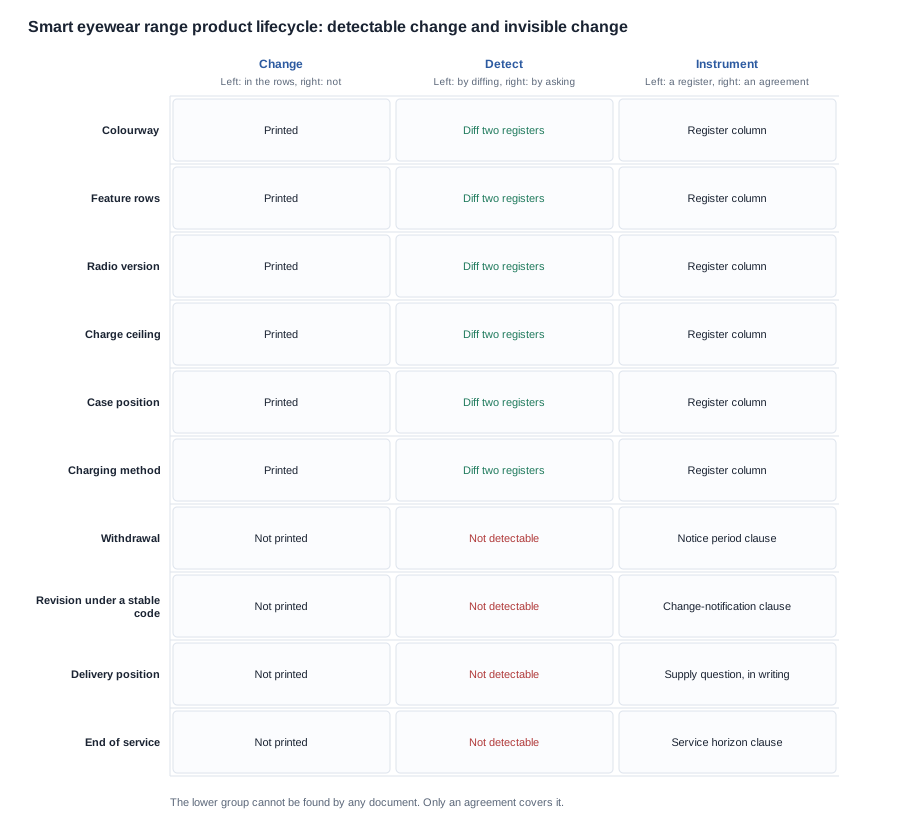
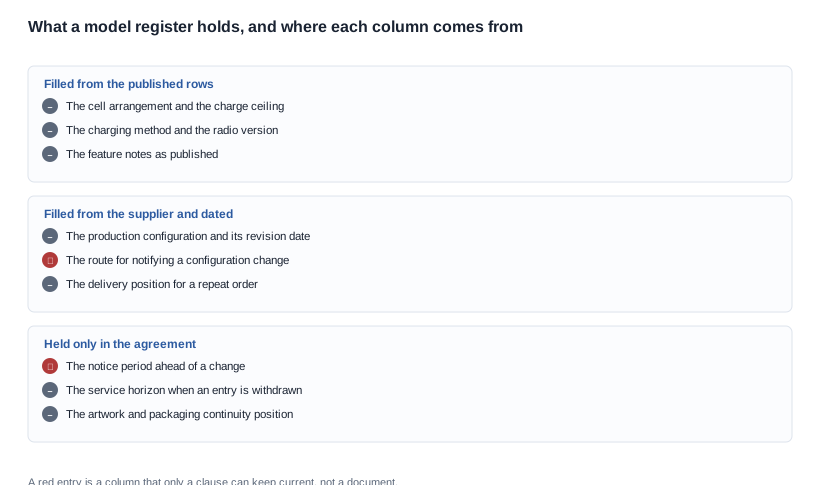
The matrix is the point of the section in one view. The upper group of changes is detectable, and the detection is mechanical — diff two registers, look for the changed cell. The lower group is not detectable by any means except a supplier conversation, and each of those items needs a contractual answer rather than an enquiry. A buyer who has worked out which of their questions are answerable by asking and which require an agreement has already done the useful part of the analysis.
It is also worth being clear that none of this is a criticism of the catalogue's design. A catalogue that printed a price, a lead time and an end-of-life date for every entry would be a document with a different purpose, and it would be wrong in a different way: it would freeze decisions that are properly made per order, per market and per volume. The split is not a defect. It is a question of which document a buyer is holding, and a range evaluation that mixes the two is a range evaluation with no reliable part in it.

The questions a supplier has to answer for every model on a register
The request that turns a register into a lifecycle view is a request for a set of answers per entry rather than a set of documents per range, and the reason a supplier can answer it is that the answers are administrative rather than technical. The questions below are the ones that decide whether a buyer can keep a model in a range for more than one season, and they are the same set for every entry, which is what makes the register comparable.
- Is the entry open for new orders, and does what is being produced match the build that was published?
- What has changed in the published row set since the previous revision, and when was it revised?
- How long is the entry expected to remain in the range, and is that a plan or an intention?
- What notice period would a buyer receive before a configuration is withdrawn or changed?
- Is a last-time-buy position available for a configuration a buyer has already qualified?
- Which entries published without a model name are orderable, and under which codes?
- What is the delivery position for a repeat order of a configuration already in the field?
- Does a model code survive a change of configuration, and how would a buyer be notified?
- What is the service and spare-part position for an entry that is withdrawn?
- What is the artwork and packaging continuity position for a repeated order?
The third and fourth questions are the ones that a buyer is most likely to get a vague answer to, and they need to be pushed to a specific one. "The entry is expected to remain in the range" is not an answer that a buyer can put in a plan. A stated horizon, a stated notice period, or an explicit statement that neither can be committed to are all usable answers, and the third one is the most honest of the three.
The tenth question is the one with the most practical bite, because a re-order that arrives with different artwork is a re-order that creates a new SKU in the channel's own system, and a buyer who has not asked about continuity will find that cost arriving with the container rather than with the quotation.
There is a seventh category of question that is not a lifecycle question at all but that a lifecycle exercise usually uncovers, and it is worth separating out: the question of what happens to the model names themselves. Our catalogue prints a designation for each entry, and in the children's line that designation names a use rather than a model. A buyer who has quoted a designation into a listing, a tender document or a warranty form is quoting a description, and a change in what sits behind that description is a change a buyer will only discover through the register diff. This is the same point as the configuration-revision point above, applied to the name rather than to the product, and it is the reason the register should carry the designation as a separate column from the model code.
Maintaining a range view across a purchasing year
A register that is built once and filed is a document about a moment, and a moment is not very useful to a buyer who is planning across four quarters. The version of this exercise that earns its place is the one that is rebuilt on a fixed cycle, and the cycle should be short enough to catch a change and long enough to be worth doing. The practical interval is once per quarter, aligned to the buying calendar rather than to the month, and the rebuild should be a diff rather than a fresh read: the value of the second register is entirely in the comparison with the first.
What the diff gives a buyer is a short list of entries whose published row set has moved, and a short list of entries where the supplier's answers have moved even though the rows have not. The second list is the more valuable of the two, and it is only visible if the register carries the answers as well as the rows, with a date against each. A buyer who records the answers and re-asks the same questions in the same order can see a supplier's position change, and that is the earliest warning a buyer can get of a change that has not yet reached the catalogue.
The working rule for the exercise is that a register is a buyer-side document and never becomes a catalogue claim. Nothing in it is ours to quote to a customer, and nothing in it is a statement about whether a product is good. Its only function is to tell a buyer which conversations to have and which questions to have them with, and its second function is to tell a buyer whether the supplier's own answers have moved since the last time. A buyer who keeps it that way — as a working instrument rather than as a claim — gets a range view that is accurate about its own limits, and that is the only kind of range view worth having.
The platform side of the same work, and how a range view is turned into an assortment that can actually be produced and reordered, is set out in the material on which models are ready to build a range from. For a buyer assembling a line rather than a single product, that is the natural next page; for a buyer who only needs one model, the register plus the open-questions list is the whole job, and it is a job that can be finished in a week with a supplier that answers questions.
The offer we can make is narrow and we will keep it narrow. Send us the register you have built, the line you are trying to assemble and the markets you intend to serve, and we will work through the entries on it: which of them the published rows support for the use you have described, which entries have open questions that decide the programme rather than the polish, which of the changes you have detected are documented and which are not, and what to put in the agreement so that the next revision does not arrive unannounced. We will also tell you plainly where the catalogue is silent and where the only honest answer is a question for the supplier.


