

Readiness is not the same as customisability, and the difference matters more than the length of any supplier's option list. A model is ready to brand when the configuration axes a programme needs already exist for that specific model, the documentation behind it is complete enough to sign off, and the files that let a buyer verify the product are available. Set against the product record for this catalogue, the answer is that readiness is uneven in a way that is visible without asking anyone, and that the unevenness follows the category rather than the individual model. Seven categories appear in the record, they carry between zero and seven recorded configuration axes each, and their certification positions are not the same either. Three models have no stable code at all, two models publish identical specifications with no stated difference between them, and not one of the twenty-eight entries comes with the product photographs or detection reports that would let a buyer check a claim independently.
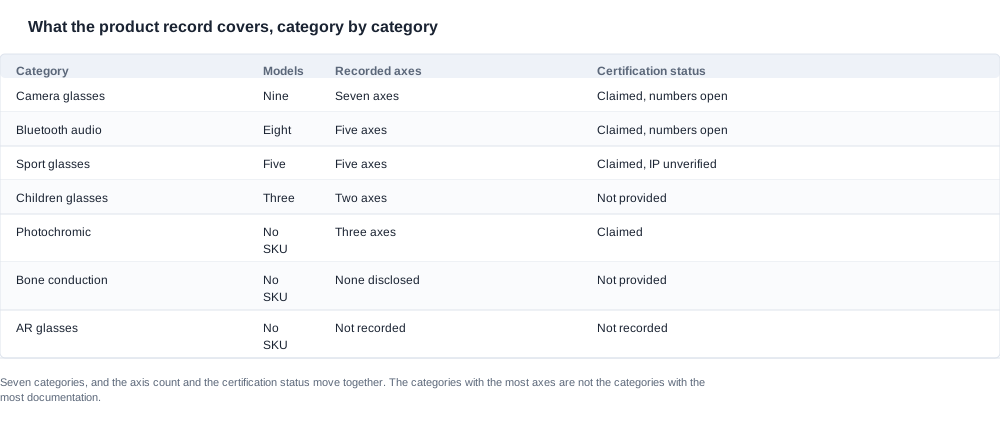
What the product record covers, category by category
The table below summarises the record. The recorded axes column counts the configuration axes the record lists for that category, the certification column states the position as the record states it, and neither column is a claim that any of it has been verified.
| Category | Models | Recorded axes | Certification status |
|---|---|---|---|
| Camera glasses | Nine | Seven axes | Claimed, numbers open |
| Bluetooth audio | Eight | Five axes | Claimed, numbers open |
| Sport glasses | Five | Five axes | Claimed, IP unverified |
| Children glasses | Three | Two axes | Not provided |
| Photochromic | No SKU | Three axes | Claimed |
| Bone conduction | No SKU | None disclosed | Not provided |
| AR glasses | No SKU | Not recorded | Not recorded |
Two things in that table deserve a closer look, because both are easy to get wrong by reading the rows individually rather than across them.
The first is that the axis count varies by category and that the categories with the most axes are not the categories with the most documentation. The camera glasses category records seven axes and the audio category records five, the sport category records five, the children category records two, and the bone conduction entry records none. A reader who looks only at the camera category sees a deep configuration surface and a broad certification claim, and concludes that this is where the most supportable programme sits. A reader who compares across categories sees something different: the categories with the fewest recorded axes are the ones where the record itself carries explicit gaps. The children entries record two axes and no certification position at all, the bone conduction entry records no axes and no certification position, and the AR entry records nothing on either count. Depth of configuration and completeness of documentation are two separate things, and the record keeps them in separate columns.
The second is that the certification column has three distinct states rather than two, and conflating them is the most common way a readiness claim goes wrong. The camera and audio entries publish no CE, FCC or RoHS text and no per-model certification row, and no certificate number exists for us to quote. The sport entries publish the same absence and add that the IP marking is a catalogue annotation with no third-party test report number behind it. The children entries publish no certification information at all, and children's products usually carry additional requirements in most markets. The bone conduction entry publishes no certification information either, and the gain figure it carries may bring it into medical device regulation. So there are frameworks with no document attached, markings with no report behind them, and positions that are simply blank, and the three of them need three different responses from a buyer.
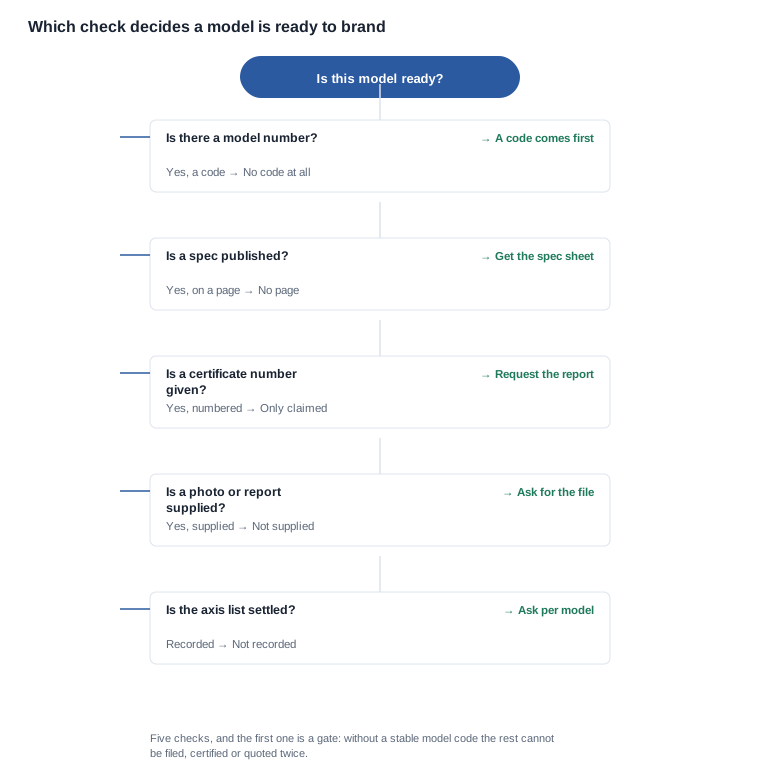
The five checks that decide a model, in order
Readiness is usually discussed as a single judgement, and it is easier to handle as five checks applied in a fixed order, because the order is what makes the work efficient. The criteria for deciding whether a model is ready to brand are these five.
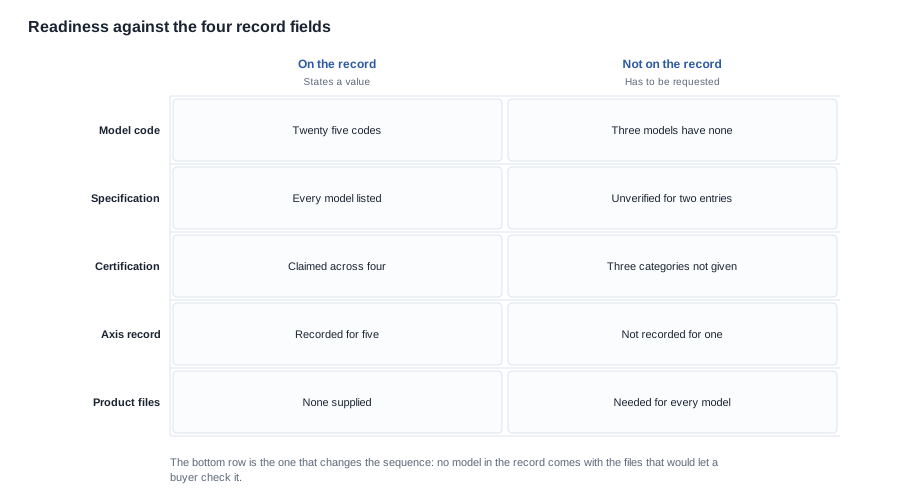
- Is there a stable model code? This is a gate rather than a question. Three entries in the record do not have one: the photochromic entry, the bone conduction entry and the AR entry all carry parameters with no model number, and the record flags each of them as needing a formal code added.
- Is a catalogue page published for it? Twenty-five of the twenty-eight entries have one, and the three without a code are the same three without a page. This is nearly always passed, which is why it is worth separating from the first: a specification on a page is a statement of what the catalogue says, and it is a different thing from a technical file.
- Is there a certificate number, or only a claim? Across the four categories where certification is claimed, the record carries the claim and explicitly states that the specific model and certificate numbers await confirmation.
- Which configuration axes are already defined for this exact model, as opposed to for its category? The record answers this at category level, which means it answers it less precisely than a programme needs.
- Are the product files available? The record states for every one of the twenty-eight entries that photographs, video and detection reports have not been provided.
A product without a code cannot be certified against, filed for warranty, or written consistently on two separate purchase orders, and no amount of configuration depth fixes that. On the third check, a claim is a starting point for a document request, and it is not something to print on a listing or a carton. The certification coverage notes piece sets out how to work through that request category by category.
The fourth check needs more explanation, because it is the one where a buyer can most easily over-read the record. The record lists seven axes for the camera category as a whole and five for the audio category as a whole, and the axis lists differ between those two categories rather than being a subset of one master list. The audio category has no logo axis and no firmware axis, and it does have a lens material and colour axis that the camera category does not. The sport category has neither a lens material axis nor a firmware axis, and it has a remote control axis that the other two do not. So the record tells a buyer which axes exist in a category, and the question of which of them are already defined for one model is still open and is worth asking in writing, per model, before a programme is designed around them.
The fifth check has a practical consequence that is easy to miss. A buyer cannot independently verify anything the catalogue asserts, because there is no file to check it against. The practical sequence is that a sample and a test report have to fill that gap, and they have to be requested explicitly because nothing arrives with the documentation. The checklist to ask the supplier before that conversation starts is short, and it is worth reading once before writing the first request: what to ask about the model code, the specification, the certification numbers, the axis definition and the product files, in that order.

Where the record flags models as unresolved
Three groups of entries need a separate conversation, and in each case the record itself marks the issue rather than leaving it to be discovered later.
The first group is the three entries with no model code. The photochromic entry publishes a Bluetooth version, a cell capacity, a charge limit, an endurance figure and a magnetic charge mode, and it is the only entry whose recorded configuration axes include a lens response range and speed, so it is not a thin record on axes. It is thin on identity. The bone conduction entry publishes a gain figure, a cell capacity, a charge limit, an endurance figure and a Type C charge, and it records no configuration capability at all. The AR entry publishes parameters identical to an ordinary Bluetooth model, and the record itself notes that this is either an unfilled template or a product that is not in production, and that its readiness cannot be assessed. Three entries, three different reasons, and the first question for each of them is the same one: what is the code.
The second group is the two models that publish identical specifications. The two children entries with the electronic atomiser and the posture and distance detection both publish a forty milliamp hour cell, a charge limit of two hours or less, an endurance figure of about twenty hours and a magnetic charge mode, and the record flags that the parameters are entirely the same and the difference is to be confirmed. Two lines of stock that are indistinguishable on paper need a written reason to exist separately, and until that reason arrives, carrying both is a way to end up with two slow lines. The CY05 and CY03 price positioning piece works through what an identical-specification pair means for range planning on a different pair of models.
The third group is the entries with unresolved naming or classification. The L2 Utral page carries two variant names, and the record notes that one of them may be a transcription of a different word and that the meaning of the second is not established. The MT5 entry is flagged for an irregular page reference in the catalogue and for a product classification that is open to question, sitting between the camera and sport categories. The sport entries for the two camera-capable models are flagged for irregular page references. None of these is fatal, and all of them are the kind of thing that has to be closed before a purchase order repeats a model name in three places.
There is also a category-level point that the record makes about claims rather than specifications. The product differentiation notes in the record carry explicit limits on what may be stated externally: performance comparisons require a physical comparison against competing units first, the ingress marking needs a test report before it can be asserted, acoustic performance has no third-party measurement behind it, the photochromic entry has no lens performance parameters at all so there is no basis for a differentiation claim in that category, and the bone conduction gain figure is both the most aggressive parameter in the whole record and the highest compliance risk. The children category carries a similar caution about safety and health claims. These limits are not editorial preferences, they are the conditions attached to the data.

The OEM ready platforms order of work that a branded range needs
The five checks above are the filters. This is the sequence that follows from them, and it is ordered so that the free checks come before the expensive ones.
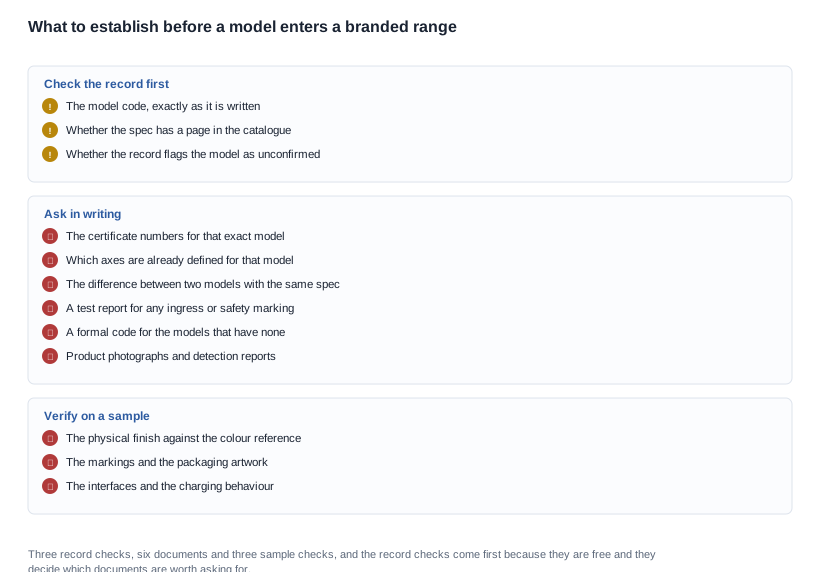
Start with the model code, exactly as it is written, and settle the three entries that have none. A brand cannot certify a product it cannot name, so this conversation has to come before any document request, because the certificate number and the warranty file both hang off the code. Confirm the naming questions on the entries where the record flags them, so the code that gets certified is the code that appears on the artwork and the purchase order.
Then check the specification against the catalogue page for each model on the list, and note which models in the list are on the list of models the programme prepared to sell rather than the list of models it would like to sell. A range decision built on the first list is one that can be executed. The OEM ready platforms sample before bulk piece covers what a sample has to settle before a bulk order follows, and the partnering with a factory that ships piece covers the commercial path once a model is chosen.
Then ask, in writing, and ask for the model by code. The certificate numbers for that exact model. Which configuration axes are already defined for that model rather than for its category, and whether the ones that are defined are defined in the file or only in a description. The difference between any two models that publish the same specification. A test report for any ingress or safety marking that will appear on the packaging. A formal code for the three entries that lack one. And product photographs and detection reports, because the record states that none of the twenty-eight entries has them, and without them nothing on the catalogue can be independently checked.
Then verify on a sample, because three things cannot be settled by a document. The physical finish against the colour reference, since a colour is a finish and finishes vary between production lots. The markings and the packaging artwork, since that is the part of the programme the buyer controls. And the interfaces and the charging behaviour, since the catalogue publishes the charge method for most models but not for four of the camera models, and the behaviour in the hand is what a customer will judge.
Two commercial parameters sit outside all of this and need their own conversation, because a configuration and a market are needed before either number means anything: minimum order quantity and lead time. The minimum order quantity discussion piece covers why that conversation starts with a configuration rather than a number, and the OEM ready platforms inventory planning piece covers holding stock across a range once the models are fixed.
There is one more decision that sits above the five checks, and it is the one a brand makes before any of them: whether the programme needs a camera model, an audio model, a sport model or something outside the four main categories. That decision determines which axis list applies and therefore which questions are worth asking, and it is worth making explicitly rather than letting the shortlist decide it. A programme that needs a camera model and a programme that needs a sport model are asking about the same supplier with different documents, and the records show why: the camera category carries a seven-axis list and a certification claim awaiting numbers, the sport category carries a five-axis list with a different set of names and an ingress marking that needs a test report, and the audio category carries a five-axis list with no logo axis and a lens material axis that the other two do not have. Whichever category the programme lands in, the trade-offs are the same shape. The category with the deepest recorded configuration surface is not automatically the most supportable one, and the shortest axis list is not automatically the least capable one. What decides it is how much of the documentation behind that category is complete, and the answer for the childrens and bone conduction categories, and the AR entry, is very little.
So the criteria for the first decision are simple to state. A camera programme buys a thirteen or eight megapixel tier and a case configuration, and it inherits a certification claim with numbers outstanding. An audio programme buys a Bluetooth version and a battery configuration, and it inherits a claim with numbers outstanding and a different set of configuration axes. A sport programme buys an ingress marking and a remote control, and it inherits a marking that needs a test report. And a programme that reaches outside those three inherits either no code at all, or a code that has to be created first. Which of those is right depends on the programme, not on the catalogue, and the catalogue's contribution is to show which one it is before the samples are ordered.
How to read the OEM readiness record
Readiness is a documentation question, and the documentation is uneven. Readiness should be judged on documentation, not on ambition, and the documentation in this record is uneven in a way that the record itself is honest about. We will not present a model as brand-ready because a list of configuration options exists in a category, and we will not treat a category-level axis list as a model-level commitment. We will not print a certification mark next to a model name, because the claims in the record are claims and the certificate numbers are not yet supplied. We will not claim a physical comparison against a competing product, because no such comparison has been performed, and we will not state an ingress or safety marking without a test report behind it. And where the record flags a model as unconfirmed, a naming question or a missing code, we will say that plainly rather than filling the gap.
What the record does support is a defensible shortlist. Twenty-five models carry a code and a catalogue page. Four categories carry a certification claim awaiting numbers, one carries an ingress marking awaiting a report, and two carry no certification position at all. Five categories have a recorded axis count between two and seven, with the axis lists differing between categories rather than forming a nested set, so the right question for any one model is which of that category's axes are already defined for it. And every one of the twenty-eight entries lacks the photographs and detection reports that would let a buyer check a claim, which makes a sample and a document request the two things a programme cannot skip.
A brand that works through the five checks in order, and treats the record's own flags as part of the brief rather than as obstacles, ends up with a shortlist it can defend to a customer, a compliance file it can hand to a test house, and a set of claims it can actually make. The OEM ready platforms sample before bulk piece and the OEM ready platforms which models are ready record are the two documents that sit behind this one.
Tell us the models you have shortlisted, the brand elements you need and the markets you are shipping to, and we will confirm which configuration axes are already defined for each model and which are still open.


